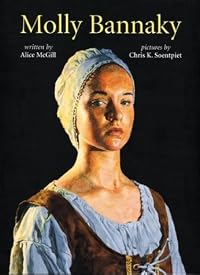
Molly Bannaky
by Alice McGill
On This Page
Description
Relates how Benjamin Banneker's grandmother journeyed from England to Maryland in the late seventeenth century, worked as an indentured servant, began a farm of her own, and married a freed slave.Tags
Recommendations
Member Reviews
This story of an early British immigrant coming to America as an indentured slave was a wonderful find. This story lends itself to so much discussion about slavery and servitude, and wonderful opportunities for discussion about inclusion, racism, and community. The watercolor paintings are also beautiful, so glad this was printed in a large picture book format, to truly be able to enjoy the art. While this doesn't really qualify as fiction-- the writer had to take creative license to flesh out the story which only really existed in marriage, indentured servant, slave and death records. The characters are real, the story settings are real, but the conversations and thoughts are imagined by the writer. There is a wonderful author's note show more at the back that explains all this, and then talks about Benjamin Bannacker, a world famous black astronomer who was the grandson of this couple. show less
Despite the fact that it's oversize, which doesn't suit library shelves or intended audience, despite the fact that the author's note doesn't give sources, further reading, any details like that, despite the fact that the progression of the story is oversimplified and the writing methodical, I do recommend this. It gives a portrait of a time in history that is not well-known, and aspects of some of the laws, customs, and characters of the ppl that are often not explained.
For example, how many children know that slaves were not just cotton-pickers in the deep south? How many know anything about indentured servants? How many know that some owners did free their slaves? Etc.
For example, how many children know that slaves were not just cotton-pickers in the deep south? How many know anything about indentured servants? How many know that some owners did free their slaves? Etc.
The book I'm reading is actually quite big and since the illustrations take up the whole page, I feel more engaged and invested. It starts of with Molly milking a cow. She doesn't seem very happy with her life but I don't think she has much choice. Because the cow she was milking tipped over the bucket of milk (twice) she was sent to court and they sentenced her to seven year of bondage. That's insane to me but this book seems to be based of the life of a girl who lived during the 1400/1500s. She was sent to the New World and worked for a planter. Then after seven years, she was free. She found herself a piece of land and worked hard on the field. So hard she had to buy an enslaved man to help her but she promised to free him when her show more land was done. Eventually they fell in love and had four daughters. Molly's neighbors eventually accepted their love and treated the two with respect. I really like how this book is portrayed and how the pictures speak louder than the words. show less
I have long admired Benjamin Banneker, the highly regarded scientist and mathematician who helped survey the planned city of Washington, D.C., so I was delighted to find this story about his grandmother.
[Benjamin Banneker was the first black man to publish an almanac, which he did from the years 1792 to 1802. He also wrote to Secretary of State Thomas Jefferson objecting to the injustice of slavery, and enclosed one of his almanacs. At first Jefferson regarded Banneker’s intelligence as an exception among African-Americans, rather than evidence that Jefferson’s perceptions about race might be fundamentally flawed. But three years after Banneker’s death, Jefferson wrote a letter disparaging Banneker and arguing that he could not show more have made the calculations contained in the almanac without assistance. Bannaker, according to Jefferson, “had a mind of very common stature indeed.”]
Alice McGill takes us back to Molly Walsh’s girlhood in 1673 in England. She was a 17-year-old dairymaid who dropped a pail of milk for the second time, and so was taken to court for “stealing” her lordship’s milk.
The usual punishment for stealing was death on the gallows, except if you could show you could read the Bible, which Molly could. Thus her life was spared but the judge sentenced her to seven years of bondage, to be served in the American colonies.
After seven years, Molly, now 24, was free, and she went out into the “wilderness” and bought a farm ten miles from Baltimore. Her new neighbors helped her build a cabin, but she couldn’t manage a tobacco farm on her own.
In 1692 she bought two slaves from a newly arrived ship. [The author only tells you about one of them, an African slave named Bannaky (also called Banneka) whom she eventually married.]
Bannaky, the son of an African chieftain, had by all accounts impressive stores of intelligence and dignity. He and Molly worked together and grew to love one another. Within three years Molly freed him. The author writes:
“Though Molly had broken colonial law by marrying a black man, her neighbors came to accept this marriage and to respect Bannaky.”
This was important because, as one learns elsewhere, at least 256 white women were prosecuted in Maryland for marrying black men during the colonial period. [The state of Maryland passed its first law against interracial marriage in 1664. The Maryland legislature claimed such marriages were a “disgrace” to the nation. See for example, Kevin Mumford, “After Hugh: Statutory Race Segregation in Colonial America, 1630-1725,” The American Journal of Legal History, Vol. 43, No. 3 (Jul., 1999), pp. 280-305.]
In addition, the law stipulated that mixed-race children of these marriages would be slaves for life. The white mothers could be sold as servants for seven years.
Somehow Molly and her children avoided these repercussions, although the book doesn’t provide details.
The two had four daughters, but while they were still young, Bannaky died. Molly taught her daughters how to work the land.
In time, the author writes, Molly had a grandson:
“In her Bible, Molly wrote her new grandson’s name: Benjamin Banneker. She taught this young boy to read and write. She told him about his grandfather, a prince who was the son of a king in Africa, and about her days as a dairymaid across the ocean in England.”
The story ends there, but the author appends a “Historical Note” that fills in more background not only on Mary but on Benjamin as well. In the story itself, there is no indication why Benjamin is more notable than anyone else.
The award-winning illustrator, Chris K. Soentpiet, employs bold, colorful watercolors to create some of the dramatic scenes imagined from Molly’s life. They look a bit like tableaus, however, rather than dynamic artwork.
Discussion: The story is actually a bit sketchy, and is more like a movie trailer in that way, with tantalizing highlights that should pique the interest of readers for further exploration. Issues kids might want to know more about include the punishments for stealing - even a pail of milk! - in 17th Century England; the laws involving indentured servants and interracial marriage in the early colonies; and what life was like for a young woman alone back then. And of course the big issue left unexplored in the main story: who was Benjamin Banneker?
Evaluation: This book is interesting, but mostly in the subjects it leaves unanswered. If a parent is willing to help fill in the blanks, it would constitute a valuable lesson on colonial times in America. show less
[Benjamin Banneker was the first black man to publish an almanac, which he did from the years 1792 to 1802. He also wrote to Secretary of State Thomas Jefferson objecting to the injustice of slavery, and enclosed one of his almanacs. At first Jefferson regarded Banneker’s intelligence as an exception among African-Americans, rather than evidence that Jefferson’s perceptions about race might be fundamentally flawed. But three years after Banneker’s death, Jefferson wrote a letter disparaging Banneker and arguing that he could not show more have made the calculations contained in the almanac without assistance. Bannaker, according to Jefferson, “had a mind of very common stature indeed.”]
Alice McGill takes us back to Molly Walsh’s girlhood in 1673 in England. She was a 17-year-old dairymaid who dropped a pail of milk for the second time, and so was taken to court for “stealing” her lordship’s milk.
The usual punishment for stealing was death on the gallows, except if you could show you could read the Bible, which Molly could. Thus her life was spared but the judge sentenced her to seven years of bondage, to be served in the American colonies.
After seven years, Molly, now 24, was free, and she went out into the “wilderness” and bought a farm ten miles from Baltimore. Her new neighbors helped her build a cabin, but she couldn’t manage a tobacco farm on her own.
In 1692 she bought two slaves from a newly arrived ship. [The author only tells you about one of them, an African slave named Bannaky (also called Banneka) whom she eventually married.]
Bannaky, the son of an African chieftain, had by all accounts impressive stores of intelligence and dignity. He and Molly worked together and grew to love one another. Within three years Molly freed him. The author writes:
“Though Molly had broken colonial law by marrying a black man, her neighbors came to accept this marriage and to respect Bannaky.”
This was important because, as one learns elsewhere, at least 256 white women were prosecuted in Maryland for marrying black men during the colonial period. [The state of Maryland passed its first law against interracial marriage in 1664. The Maryland legislature claimed such marriages were a “disgrace” to the nation. See for example, Kevin Mumford, “After Hugh: Statutory Race Segregation in Colonial America, 1630-1725,” The American Journal of Legal History, Vol. 43, No. 3 (Jul., 1999), pp. 280-305.]
In addition, the law stipulated that mixed-race children of these marriages would be slaves for life. The white mothers could be sold as servants for seven years.
Somehow Molly and her children avoided these repercussions, although the book doesn’t provide details.
The two had four daughters, but while they were still young, Bannaky died. Molly taught her daughters how to work the land.
In time, the author writes, Molly had a grandson:
“In her Bible, Molly wrote her new grandson’s name: Benjamin Banneker. She taught this young boy to read and write. She told him about his grandfather, a prince who was the son of a king in Africa, and about her days as a dairymaid across the ocean in England.”
The story ends there, but the author appends a “Historical Note” that fills in more background not only on Mary but on Benjamin as well. In the story itself, there is no indication why Benjamin is more notable than anyone else.
The award-winning illustrator, Chris K. Soentpiet, employs bold, colorful watercolors to create some of the dramatic scenes imagined from Molly’s life. They look a bit like tableaus, however, rather than dynamic artwork.
Discussion: The story is actually a bit sketchy, and is more like a movie trailer in that way, with tantalizing highlights that should pique the interest of readers for further exploration. Issues kids might want to know more about include the punishments for stealing - even a pail of milk! - in 17th Century England; the laws involving indentured servants and interracial marriage in the early colonies; and what life was like for a young woman alone back then. And of course the big issue left unexplored in the main story: who was Benjamin Banneker?
Evaluation: This book is interesting, but mostly in the subjects it leaves unanswered. If a parent is willing to help fill in the blanks, it would constitute a valuable lesson on colonial times in America. show less
This book displays love and kindness to people who were enslaved in the 1600's-1800's. Interracial marriage is also displayed with a beautiful story of a white woman who marries an enslaved African man. This story also shows that a woman can be as successful as a man when it comes to farming, etc. I think that this book could teach children many different, important lessons. Molly was born in England and lived there as a dairymaid until she was exiled to the New World. In Maryland, she worked as a servant for seven years until she was set free. When she was free, she started a new life on her own and purchased an enslaved, African man named Bannaky. She treated him kindly and fell in love with him. She set him free, and they were show more privately married. They taught each other different things regarding farming and had four children together. The story ends with Molly teaching her grandson how to read, about her life in England, and about his grandfather, Bannaky. show less
Molly Bannaky retells the true story of Molly Walsh, an English woman banished to the American colonies as an indentured servant. After many years of hard work, she is able to stake a claim to nearby land, but she discovers her own labor is not sufficient. She visits a slave auction, where she purchases an African slave, Bannaky, with the intention of freeing him as soon as the season’s crop is reaped. Instead, she falls in love with Bannaky and the two marry, continuing to work the land they now own. The tale concludes with a sneak peak at Molly and Bannaky’s grandson, Benjamin Banneker. A historical note at the end of the book explains with more detail the story of Molly’s life and remarks that Benjamin Banneker was a well-known show more and respected scientist and mathematician in his time.
While this book is more serious than the average picture book, it is a wonderful introduction into a past era full of customs and laws that will seem foreign and strange to today’s children. The story of hard work, however, is timeless. Children reading this story will see how Molly and her husband were able to provide for themselves and their family from their physical labor on their land and the knowledge they had gained from past experiences of work.
I reviewed this for EconKids. See full review here: http://econkids.rutgers.edu/index.php?option=com_content&task=view&id=10... show less
While this book is more serious than the average picture book, it is a wonderful introduction into a past era full of customs and laws that will seem foreign and strange to today’s children. The story of hard work, however, is timeless. Children reading this story will see how Molly and her husband were able to provide for themselves and their family from their physical labor on their land and the knowledge they had gained from past experiences of work.
I reviewed this for EconKids. See full review here: http://econkids.rutgers.edu/index.php?option=com_content&task=view&id=10... show less
What an amazing story!! This is the story of an English "criminal" sentenced to be an indentured servant in the "New World" just for spilling milk!! Strange!! Molly went on to do more things considered illegal, she staked land, bought a slave but treated him well, went on to marry him. She also taught her children and grandchildren to read and to read the Bible. Molly must have been a one of kind gem to have the character to be and do all the things she did in the face of adversity.Her grandson went on to be a city planner in D.C. and wrote an almanac and some other cool stuff. You'll have to read the book Benjamin Bannaker to find out about all the cool stuff he did. This book is terrific!! I recommend it for grades 4+
Members
- Recently Added By
Author Information
10+ Works 799 Members
All Editions
Awards and Honors
Awards
Distinctions
Common Knowledge
- People/Characters
- Molly Welsh; Benjamin Banneker
- Important places
- Maryland, USA
Classifications
Statistics
- Members
- 398
- Popularity
- 77,906
- Reviews
- 18
- Rating
- (4.52)
- Languages
- English
- Media
- Paper
- ISBNs
- 4
- UPCs
- 1