The Object Stares Back: On the Nature of Seeing
by James Elkins 
On This Page
Description
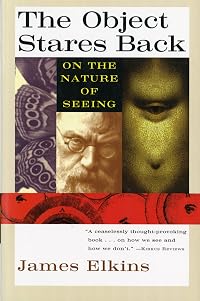
At first it appears that nothing could be easier than seeing. We just focus our eyes and take in whatever is before us. This ability seems detached, efficient, and rational - as if the eyes are competent machines telling us everything about the world without distorting it in any way. But those ideas are just illusions, Elkins argues, and he suggests that seeing is undependable, inconsistent, and caught up in the threads of the unconscious. Blindness is not the opposite of vision, but its show more constant companion, and even the foundation of seeing itself. Elkins asks about objects that are too violent, too sexually charged, or too beautiful to look at directly. When we see a naked body, we either stare lasciviously or look away in embarrassment: in those moments our eyes are not ours to command. Bodies, Elkins says, are among the fundamental things that the eye seeks in every scene: when we are presented with something new, we first try to find a body, or the echoes of a body, and if we fail, our seeing becomes restless and nomadic. The same is true of things that are dead or inert. The world is full of objects that catch our eye, and that seem to have eyes of their own. The sun is an eye, perhaps the most powerful of all. It sees us as much as we see it, and when we stare at it, the sun stares back. Using drawings, paintings, diagrams, and photographs to illustrate his points, Elkins raises intriguing questions and offers astonishing perceptions about the nature of vision. Ultimately, he concludes, "Seeing alters the thing that is seen and transforms the seer"--As this remarkable book will transform the viewpoints of all who read it. show lessTags
Recommendations



















Member Reviews
From the Introduction:
"Ultimately, seeing alters the thing that is seen and transforms the seer. Seeing is metamorphosis, not mechanism."
This is an axiom of how I see and think.
(john)
"Ultimately, seeing alters the thing that is seen and transforms the seer. Seeing is metamorphosis, not mechanism."
This is an axiom of how I see and think.
(john)
Ratings
Members
- Recently Added By
Published Reviews
ThingScore 75
In a remarkable tour de force, this art historian uses scores of intriguing photos and illustrations (of a mermaid, ice halos in Alaska, the surface of atoms, a eunuch, a medieval Russian icon painting, etc.) to buttress his thesis that seeing depends on context, desire and expectation.
added by private library
Lists

The Great Courses: Visual Literacy Skills
53 works; 1 member
Author Information

52+ Works 2,139 Members
James Elkins is E.C. Chadbourne Chair in the Department of Art History, Theory, and Criticism at the School of the Art Institute of Chicago. He is the author of Pictures and Tears, How to Use Your Eyes, Stories of Art, Visual Studies, Why Are Our Pictures Puzzles?, Our Beautiful, Dry, and Distant Texts, On the Strange Place of Religion in show more Contemporary Art, and Master Narratives and Their Discontents, all published by Routledge. He is editor of Art History Versus Aesthetics, Photography Theory, Landscape Theory, The State of Art Criticism, and Visual Literacy, all published by Routledge. show less
James Elkins is a LibraryThing Author, an author who lists their personal library on LibraryThing.
Common Knowledge
- Original publication date
- 1996-01-01
Classifications
- Genres
- Nonfiction, Art & Design, General Nonfiction, Science & Nature, Philosophy
- DDC/MDS
- 152.14 — Philosophy & psychology Psychology Sensory perception, movement, emotions, physiological drives Senses Vision
- LCC
- BF241 .E45 — Philosophy, Psychology and Religion Psychology Psychology Sensation. Aesthesiology
- BISAC
Statistics
- Members
- 299
- Popularity
- 108,005
- Reviews
- 2
- Rating
- (3.70)
- Languages
- English
- Media
- Paper
- ISBNs
- 2
- ASINs
- 2