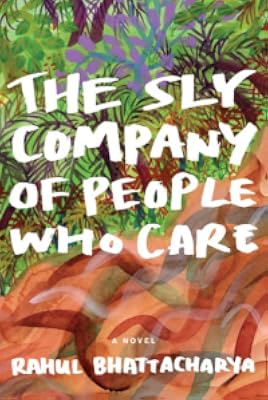
The Sly Company of People Who Care
by Rahul Bhattacharya
On This Page
Description
In flight from the tame familiarity of home in Bombay, a twenty-six-year-old cricket journalist chucks his job and arrives in Guyana, a forgotten colonial society of raw, mesmerizing beauty. Amid beautiful, decaying wooden houses in Georgetown, on coastal sugarcane plantations, and in the dark rainforest interior scavenged by diamond hunters, he grows absorbed with the fantastic possibilities of this new place where descendants of the enslaved and indentured have made a new world. show more Ultimately, to fulfill his purpose, he prepares to mount an adventure of his own. His journey takes him beyond Guyanese borders, and his companion will be the feisty, wild-haired Jan.In this dazzling novel, propelled by a singularly forceful voice, Rahul Bhattacharya captures the heady adventures of travel, the overheated restlessness of youth, and the paradoxes of searching for life's meaning in the escape from home.The Sly Company of People Who Care is the winner of the 2012 Royal Society of Literature Ondaatje Prize. show lessTags
Recommendations








































Member Reviews
Guyana had the feel of an accidental place. Partly it was the epic indolence. Partly it was the ethnic composition. In the slang of the street there were chinee, putagee, buck, coolie, blackman, and the combinations emanating from these, a separate and large lexicon. On the ramble in such a land you could encounter a story every day.
The twenty-something Indian narrator returns to Guyana, where he once spent a week, seeking relief from his restlessness. He plans to spend a year there and then return to India. He doesn't have a goal other than to observe the culture and see as much of the country as possible. Over the course of the year he forms loose partnerships with a string of individuals who become short-term traveling show more companions.
Parts of the book are very good, and the rest is either over my head or ineffective. Most of the conversations are written in Guyanese street slang and it makes very difficult reading. There are frequent references to alternative music genres that are completely unfamiliar to me. The book has won some literary prizes and been shortlisted for others, so maybe it's just me. I know I'm not the right audience for the book. However, I'm having trouble deciding who would be in the target audience. I'm not certain that even readers who read mostly from among the short- or long-lists for literary prizes will have the patience for this one. I stuck it out because of its descriptions of Guyana, which is why I wanted to read it in the first place. I couldn't help wondering why the author chose to write this as a novel when it would have made a very good literary travel book. Guyana is a very small nation, with a population of less than 1 million. Perhaps the author thought it would be safer to distance himself from his Guyanese acquaintances through fiction. show less
The twenty-something Indian narrator returns to Guyana, where he once spent a week, seeking relief from his restlessness. He plans to spend a year there and then return to India. He doesn't have a goal other than to observe the culture and see as much of the country as possible. Over the course of the year he forms loose partnerships with a string of individuals who become short-term traveling show more companions.
Parts of the book are very good, and the rest is either over my head or ineffective. Most of the conversations are written in Guyanese street slang and it makes very difficult reading. There are frequent references to alternative music genres that are completely unfamiliar to me. The book has won some literary prizes and been shortlisted for others, so maybe it's just me. I know I'm not the right audience for the book. However, I'm having trouble deciding who would be in the target audience. I'm not certain that even readers who read mostly from among the short- or long-lists for literary prizes will have the patience for this one. I stuck it out because of its descriptions of Guyana, which is why I wanted to read it in the first place. I couldn't help wondering why the author chose to write this as a novel when it would have made a very good literary travel book. Guyana is a very small nation, with a population of less than 1 million. Perhaps the author thought it would be safer to distance himself from his Guyanese acquaintances through fiction. show less
Like many other readers, I read this book hoping to learn more about Guyana. I am particularly interested in the fascinating mix of nationalities that thrive in the Caribbean world, including Guyana. If this book is read as an ethnographic study, it provides some information but not enough. If this book is read as a novel, it fails.
Rahul Bhattacharya is an Indian national. His narrator seems to stand in for himself, making this novel seem autobiographical. The book is divided into three parts. In the first part, the author pals about Georgetown. He lives in something like a hostel and befriends a few people, and visits a mining settlement. In the second part, he travels to the border and enters Brazil. He contrasts Brazil's development show more with Guyana's lack thereof. In the third part, he travels to Venezuela with his lover. There is not much of a traditional plot. The only real conflict comes toward the end when he has trouble getting back to Guyana.
Throughout the book, Bhattacharya expounds on his love of music. He seems to truly love reggae genres. He also mentions several authors, like Naipaul and Mittelholzer. It is clear that Bhattacharya is a person of arts and letters. There are frequent scenes in bars with alcohol and drugs.
Perhaps of most interest to me was the ten-page tangent about Guyanese history. Although he glossed over the Amerindians, Bhattacharya had an easy-to-understand chronicle of slavery through the indentured servitude area. Here there was some discussion of the rift between Asian Indian descendants and African descendants that touched on some current political trends. I wish that throughout the book, the author identified who was a descendant of which group, although he may have avoided this on purpose in order to show either his interest in multiculturalism or that such classifications of people are pointless.
There is quite a bit of fun in the book when the author breaks into dialect or explains Guyanese idioms.
In the end, I had no particular attachment to the narrator who simply floated through all three sections without a purpose. It was never explained why he traveled to Guyana, why he lived in the Kitty neighborhood of Georgetown, why he went to Brazil, or why he went to Venezuela. He seemed to be just a rich person enjoying purposeless travels. show less
Rahul Bhattacharya is an Indian national. His narrator seems to stand in for himself, making this novel seem autobiographical. The book is divided into three parts. In the first part, the author pals about Georgetown. He lives in something like a hostel and befriends a few people, and visits a mining settlement. In the second part, he travels to the border and enters Brazil. He contrasts Brazil's development show more with Guyana's lack thereof. In the third part, he travels to Venezuela with his lover. There is not much of a traditional plot. The only real conflict comes toward the end when he has trouble getting back to Guyana.
Throughout the book, Bhattacharya expounds on his love of music. He seems to truly love reggae genres. He also mentions several authors, like Naipaul and Mittelholzer. It is clear that Bhattacharya is a person of arts and letters. There are frequent scenes in bars with alcohol and drugs.
Perhaps of most interest to me was the ten-page tangent about Guyanese history. Although he glossed over the Amerindians, Bhattacharya had an easy-to-understand chronicle of slavery through the indentured servitude area. Here there was some discussion of the rift between Asian Indian descendants and African descendants that touched on some current political trends. I wish that throughout the book, the author identified who was a descendant of which group, although he may have avoided this on purpose in order to show either his interest in multiculturalism or that such classifications of people are pointless.
There is quite a bit of fun in the book when the author breaks into dialect or explains Guyanese idioms.
In the end, I had no particular attachment to the narrator who simply floated through all three sections without a purpose. It was never explained why he traveled to Guyana, why he lived in the Kitty neighborhood of Georgetown, why he went to Brazil, or why he went to Venezuela. He seemed to be just a rich person enjoying purposeless travels. show less
Ratings
Members
- Recently Added By
Lists

SantaThing 2014 Gifts
299 works; 17 members

Dishonourable Mentions of 2014
80 works; 23 members

A Novel Cure
742 works; 23 members
Author Information

4 Works 217 Members
Awards and Honors
Awards
Distinctions
Notable Lists
Common Knowledge
- Canonical title
- The Sly Company of People Who Care
- Important places
- Guyana
- Epigraph
- All this was Dutch. Then, like so much else, it was English. - James Salter, Light Years.
- First words
- Life, as we know, is a living, shrinking affair, and somewhere down the line I became taken with the idea that man and his world should be renewed on a daiy basis.
Classifications
Statistics
- Members
- 143
- Popularity
- 226,729
- Reviews
- 4
- Rating
- (3.44)
- Languages
- English
- Media
- Paper, Ebook
- ISBNs
- 9
- ASINs
- 3