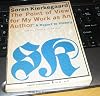
The Point of View for My Work as an Author: A Report to History, and Related Writings (Harper torchbooks. The Cloister library)
by Søren Kierkegaard
On This Page
Description
As a spiritual autobiography, Kierkegaard's The Point of View for My Work as an Author stands among such great works as Augustine's Confessions and Newman's Apologia pro Vita Sua. Yet Point of View is neither a confession nor a defense; it is an author's story of a lifetime of writing, his understanding of the maze of greatly varied works that make up his oeuvre. Upon the imminent publication of the second edition of Either/Or, Kierkegaard again intended to cease writing. Now was the time show more for a direct ""report to history"" on the authorship as a whole. In addition to Point of View, show lessTags
Recommendations




















Member Reviews
KIERKEGAARD, Soren, Synspunktet for in Forfatter-Virksomhed. (The Point of View for my Work as an Author), C. A. Reitzels, Kjøbenhavn, 1859. TP [i]-[ii] = Indhold [1]-114 [115] = Kettelser, small Octavo. First Edition (Himmelstrup 292). "The first complete publication of this work, part of which appeared in 1851 as On My Work as an Author. Published posthumously by Kierkegaard's brother." (Wronoski, p. 30) CONDITION: Very good in contemporary softcover marbled boards. Light edgewear. Minor brownspotting to pages. [Import notes: Purchase price: $145; My value: $250; Purchase date: 2025-06-22; Source sheet: Bibliotek; Source row: 12]
«Mi punto de vista» expone la intención última de Kierkegaard como autor: su proyecto de comunicación indirecta, la centralidad de la verdad subjetiva, la relación entre fe y responsabilidad, y la función del escritor frente al lector. El texto funciona como clave hermenéutica para entender el conjunto de su obra filosófica y religiosa.
La obra combina reflexión filosófica con tono confesional. Kierkegaard articula una defensa de la subjetividad como núcleo de la verdad y explica su método de comunicación indirecta. La traducción de José Miguel Velloso mantiene la precisión conceptual del original danés. La edición de Aguilar, en formato de 16 cm, presenta maquetación sobria y aparato editorial mínimo, propio de la show more serie «El Libro Aguilar». Es un volumen de alto valor para investigadores y lectores interesados en la arquitectura interna del pensamiento kierkegaardiano.
---
VALORACIÓN (1–5)
Puntuación: 5/5
Razón.- Obra clave para comprender la autointerpretación filosófica de Kierkegaard y su concepción de la comunicación indirecta, la subjetividad y la responsabilidad del autor. La edición de Aguilar (1987) es sólida, con traducción cuidada y perteneciente a una serie de prestigio. El ejemplar está completo, bien conservado y con marcas de propiedad que no afectan negativamente al valor. show less
La obra combina reflexión filosófica con tono confesional. Kierkegaard articula una defensa de la subjetividad como núcleo de la verdad y explica su método de comunicación indirecta. La traducción de José Miguel Velloso mantiene la precisión conceptual del original danés. La edición de Aguilar, en formato de 16 cm, presenta maquetación sobria y aparato editorial mínimo, propio de la show more serie «El Libro Aguilar». Es un volumen de alto valor para investigadores y lectores interesados en la arquitectura interna del pensamiento kierkegaardiano.
---
VALORACIÓN (1–5)
Puntuación: 5/5
Razón.- Obra clave para comprender la autointerpretación filosófica de Kierkegaard y su concepción de la comunicación indirecta, la subjetividad y la responsabilidad del autor. La edición de Aguilar (1987) es sólida, con traducción cuidada y perteneciente a una serie de prestigio. El ejemplar está completo, bien conservado y con marcas de propiedad que no afectan negativamente al valor. show less
Jun 30, 2026Spanish
ZBB-4
Feb 21, 2024Catalan
Ratings
Members
- Recently Added By
Author Information

635+ Works 33,263 Members
Born in Copenhagen, Denmark, Søren Kierkegaard was the son of a wealthy middle-class merchant. He lived all his life on his inheritance, using it to finance his literary career. He studied theology at the University of Copenhagen, completing a master's thesis in 1841 on the topic of irony in Socrates. At about this time, he became engaged to a show more woman he loved, but he broke the engagement when he decided that God had destined him not to marry. The years 1841 to 1846 were a period of intense literary activity for Kierkegaard, in which he produced his "authorship," a series of writings of varying forms published under a series of fantastic pseudonyms. Parallel to these, he wrote a series of shorter Edifying Discourses, quasi-sermons published under his own name. As he later interpreted it in the posthumously published Point of View for My Work as an Author, the authorship was a systematic attempt to raise the question of what it means to be a Christian. Kierkegaard was persuaded that in his time people took the meaning of the Christian life for granted, allowing all kinds of worldly and pagan ways of thinking and living to pass for Christian. He applied this analysis especially to the speculative philosophy of German idealism. After 1846, Kierkegaard continued to write, publishing most works under his own name. Within Denmark he was isolated and often despised, a man whose writings had little impact in his own day or for a long time afterward. They were translated into German early in the twentieth century and have had an enormous influence since then, on both Christian theology and the existentialist tradition in philosophy. (Bowker Author Biography) show less
Series
Belongs to Publisher Series
Classifications
- Genres
- Philosophy, Nonfiction, Religion & Spirituality, Biography & Memoir
- DDC/MDS
- 198.9 — Philosophy & psychology Modern western philosophy Philosophy of Scandinavia and Finland Denmark
- LCC
- BX4827 .K5 .A5 — Philosophy, Psychology and Religion Christian Denominations Christian Denominations Protestantism General
- BISAC
Statistics
- Members
- 278
- Popularity
- 116,525
- Reviews
- 4
- Rating
- (4.57)
- Languages
- Danish, English, Italian, Spanish
- Media
- Paper, Ebook
- ISBNs
- 12
- ASINs
- 14