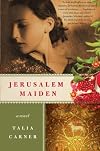
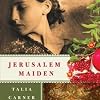
Jerusalem Maiden
by Talia Carner 
On This Page
Description
"Talia Carner is a skillful and heartfelt storyteller who takes the reader on journey of the senses, into a world long forgotten." -Jennifer Lauck, author of Blackbird "Exquisitely told, with details so vivid you can almost taste the food and hear the voices….A moving and utterly captivating novel that I will be thinking about for a long, long time." -Tess Gerritsen, author of The Silent Girl "Talia Carner's story captivates at every level, heart and mind." -Jacquelyn Mitchard, author of show more The Deep End of the Ocean The poignant, colorful, and unforgettable story of a young woman in early 20th-century Jerusalem who must choose between her faith and her passion, Jerusalem Maiden heralds the arrival of a magnificent new literary voice, Talia Carner. In the bestselling vein of The Red Tent, The Kite Runner, and A Thousand Splendid Suns, Jerusalem Maiden brilliantly evokes the sights and sounds of the Middle East during the final days of the Ottoman Empire. Historical fiction and Bible lovers will be captivated by this thrilling tale of a young Jewish woman during a fascinating era, her inner struggle with breaking the Second Commandment, and her ultimate transcendence through self-discovery. show lessTags
Recommendations

























Member Reviews
Let me begin by saying that when I finished reading the engrossing Jerusalem Maiden by Talia Carner (Harper Collins, $14.99), two thoughts flashed through my mind. First, that the inevitable ending was quite satisfying! And, second, that a number of the ancient cultural and religious rituals and practices among the ultra Orthodox Charedi Jews in Jerusalem at the onset of the twentieth century are still being followed, and not just by Charedim. I remember my own grandmother cracking one egg after another to search "its clear part for a red vein of fertilization that would render it impure." A practice I continue to follow. I remember my father reciting "Woman of Valor" from the Book of Proverbs to my mother on Erev Shabbat, as does Aba show more in "Jerusalem Maiden." I also remember that despite my own joy at giving birth to two beautiful daughters, to say that my mother-in-law was less than pleased would be an understatement. Not until I read the richly detailed Jerusalem Maiden did I realize that the Talmud, Kiddushin decrees: "Happy the man whose children are boys and woe to him if they are girls."
Jerusalem of 1911, at the end of the rule of the Ottoman Empire, was a mixture of isolated individuals -- Arabs, Charedim, Zionists, Chassidim and even a few Parisians -- with such conflicting religious and cultural beliefs you might think they lived on different planets. The animosity between Jews and Arabs is well documented, perhaps not so the resentment of Orthodox Jews toward the "brash" Zionists for fighting, for drying swamplands and for planning vineyards, instead of "waiting for the Messiah to bring salvation." Zionist women were disliked for their slack ways, their lack of respect to men, for speaking up in mixed company. Jerusalem was a miserable place for conservative Charedi women, yet, accustomed to familial and financial struggles, to the laws of the book and of the land, most of these women did not consider their lives that miserable. Working hard and bearing sons was a small price to hasten the arrival of the Messiah.
But the talented Esther Kaminsky, who has the courage and insolence to paint, a forbidden act, refuses to accept this life. Nor will Esther's Parisian teacher, Mlle Thibaux, who recognizes Esther's exceptional talent and does everything in her power to nurture it. But despite Esther's love and respect for her liberal teacher, "None of Mlle Thibaux's arguments carried weight with God." When Esther's God strikes her family with one misfortune after another, certain she is punished for the grave sin of "drawing Hashem's image," she sacrifices her dream, steps on her overwhelming desire to paint and swears to stop creating art.
After a short reprieve from misfortune, Esther allows herself to believe again, believe that her sins might not have brought "Sodom-and-Gomorrah-like wrath" after all, and it would be safe to leave her three children with her sister and join her husband in Europe. But once in the city of lights, the lure of Paris proves irresistible. Esther ignores her husband's letters to return home. Relishing her newfound sense of freedom among a community of Avant-garde artists, she allows her passions free rein, cuts her hair short, wears fashionable clothes, picks up her brushes and paints again. Perhaps Hashem intended her to be an artist, after all, she reasons. This is why He facilitated her journey to Paris and guided Mlle Thibaux and her son, Pierre, back into her life -- the goy sculptor Pierre, who is unfortunate enough to fall in love with a "woman who would be forever claimed and reclaimed from me by her God." The story gathers speed when Esther experiences a short period of happiness as a vibrant woman and an artist. But her wrathful God strikes again. This time more forcefully. The devastated Esther is certain that her sinful conduct in Paris instigated this last tragedy. But why would God punish an "innocent bystander for her sins!"
The main thread running through the story is Esther's continued struggle with her deep-rooted guilt and with God -- the story's main protagonist -- and the ongoing clash between her sense of responsibility to her religious mores on one hand and to her passions and desires on the other. Esther's tumultuous journey leads the reader to 1968 and back to Paris and to the gripping epilogue. We care for Esther. We pray that the older woman has learned to make peace with her God. show less
Jerusalem of 1911, at the end of the rule of the Ottoman Empire, was a mixture of isolated individuals -- Arabs, Charedim, Zionists, Chassidim and even a few Parisians -- with such conflicting religious and cultural beliefs you might think they lived on different planets. The animosity between Jews and Arabs is well documented, perhaps not so the resentment of Orthodox Jews toward the "brash" Zionists for fighting, for drying swamplands and for planning vineyards, instead of "waiting for the Messiah to bring salvation." Zionist women were disliked for their slack ways, their lack of respect to men, for speaking up in mixed company. Jerusalem was a miserable place for conservative Charedi women, yet, accustomed to familial and financial struggles, to the laws of the book and of the land, most of these women did not consider their lives that miserable. Working hard and bearing sons was a small price to hasten the arrival of the Messiah.
But the talented Esther Kaminsky, who has the courage and insolence to paint, a forbidden act, refuses to accept this life. Nor will Esther's Parisian teacher, Mlle Thibaux, who recognizes Esther's exceptional talent and does everything in her power to nurture it. But despite Esther's love and respect for her liberal teacher, "None of Mlle Thibaux's arguments carried weight with God." When Esther's God strikes her family with one misfortune after another, certain she is punished for the grave sin of "drawing Hashem's image," she sacrifices her dream, steps on her overwhelming desire to paint and swears to stop creating art.
After a short reprieve from misfortune, Esther allows herself to believe again, believe that her sins might not have brought "Sodom-and-Gomorrah-like wrath" after all, and it would be safe to leave her three children with her sister and join her husband in Europe. But once in the city of lights, the lure of Paris proves irresistible. Esther ignores her husband's letters to return home. Relishing her newfound sense of freedom among a community of Avant-garde artists, she allows her passions free rein, cuts her hair short, wears fashionable clothes, picks up her brushes and paints again. Perhaps Hashem intended her to be an artist, after all, she reasons. This is why He facilitated her journey to Paris and guided Mlle Thibaux and her son, Pierre, back into her life -- the goy sculptor Pierre, who is unfortunate enough to fall in love with a "woman who would be forever claimed and reclaimed from me by her God." The story gathers speed when Esther experiences a short period of happiness as a vibrant woman and an artist. But her wrathful God strikes again. This time more forcefully. The devastated Esther is certain that her sinful conduct in Paris instigated this last tragedy. But why would God punish an "innocent bystander for her sins!"
The main thread running through the story is Esther's continued struggle with her deep-rooted guilt and with God -- the story's main protagonist -- and the ongoing clash between her sense of responsibility to her religious mores on one hand and to her passions and desires on the other. Esther's tumultuous journey leads the reader to 1968 and back to Paris and to the gripping epilogue. We care for Esther. We pray that the older woman has learned to make peace with her God. show less
This book is the story of a woman's life, and her relationships with god, her community, her family, and her art. it was a fascinating look at a time and place that I didn't know much about, but beyond that it was just an excellent book. The writing was wonderful, and the characters fascinating. I would have loved to have learned more about any of them. I would highly recommend this book to anyone who has ever struggled with competing obligations to family, faith, and self.
 This review was written for LibraryThing Early Reviewers.
Jerusalem Maiden was a book chosen by a friend for a book club reading.
The book is the coming of age story of Esther Kaminsky. She is a young Haredi girl, a Jerusalem Maiden; who's life is pre-ordained, because she is one of the Chosen by Hashem to help in the bringing of the Messiah and the help of the entire Jewish nation. The laws governing the Haredi are extremely strict: no images can be reproduced, no music, no dancing... There are laws to govern all. Her primary "job" as a Jewess is to get married, produce children and work to support her husbands yeshiva study. This is non-negotiable.
The book begins with Esther in her French teacher's home, where she's learning Art. Her struggle to be the self she wants to be and the self that show more society (or her klal) wants her to be are the very first paragraphs of this book. We first see her as a young girl with a gift of art. She is learning of color and the combination of different colors to make new, different and more rich colors. She is drawing a gecko, but knows that there are laws that forbid the drawing of Hashem's creatures. She is committing a sin by drawing this gecko. This is the set up of Esther's life. The fight between what is in her heart and the religion is she is born under.
Her life is extremely difficult and the choices she makes, make life that much more difficult. Very early on she recognizes her "calling" to be an artist, but this conflicts with what she understands her role in life to be. Esther, to me, was extremely difficult to like. She is by turns, convinced of this calling to be an artist (and she is an extremely gifted artist); and will switch in a heartbeat to the laws governing what a Haredi girl should be. She never makes a decision for herself. She is constantly waiting for Hashem to speak to her through "signs". Except that she is capricious in what she thinks these "signs" are, or what they mean.
She stands in her own way all the time. There are those that are willing to help her, but she is contrary to everyone. If the person is asking to help her be an artist, she wants only to be a Haredi girl. If they want her to be a Haredi girl, she wants to be an artist. She makes a decision to escape, a "sign" will appear and she must stay. She makes decision to stay, a "sign" will appear and she must go. She was extremely frustrating to me to sympathize for her. There were moments that were difficult, and being a parent and a woman, I can understand. There were more moments, however, that I simply did not like her.
I can never speak to the religious pressure she was under. There are, however, expectations that we all are born into. There are expectations that all parents have for their children; that society has for it's people and for their women. I also can't speak to having this gift of a calling (this Primordial Light) that Esther had. But there are things about myself that are true no matter what. I found her to be so different to me, that I felt no common bond with her. As women we all struggle with choices about what is best for us and how will we fit into society. I feel, however, that we must make the decision. We must choose the path we want to take. As hard as it may be, waiting for someone to guide you, or make decisions for you seems self defeating. I could not respect the choices made by Esther.
I felt most touched by Ruthi (and most saddened by her ending).
This was a frustrating read for me. I felt bad for everyone, and helpless about the life the Haredi women have to lead, but then this is their religion. How can you feel bad for that? Faith is difficult and I shouldn't judge someone else's faith; however, I found it foreign and sad. It is a thought provoking book. I just wish I had connected more to Esther. show less
The book is the coming of age story of Esther Kaminsky. She is a young Haredi girl, a Jerusalem Maiden; who's life is pre-ordained, because she is one of the Chosen by Hashem to help in the bringing of the Messiah and the help of the entire Jewish nation. The laws governing the Haredi are extremely strict: no images can be reproduced, no music, no dancing... There are laws to govern all. Her primary "job" as a Jewess is to get married, produce children and work to support her husbands yeshiva study. This is non-negotiable.
The book begins with Esther in her French teacher's home, where she's learning Art. Her struggle to be the self she wants to be and the self that show more society (or her klal) wants her to be are the very first paragraphs of this book. We first see her as a young girl with a gift of art. She is learning of color and the combination of different colors to make new, different and more rich colors. She is drawing a gecko, but knows that there are laws that forbid the drawing of Hashem's creatures. She is committing a sin by drawing this gecko. This is the set up of Esther's life. The fight between what is in her heart and the religion is she is born under.
Her life is extremely difficult and the choices she makes, make life that much more difficult. Very early on she recognizes her "calling" to be an artist, but this conflicts with what she understands her role in life to be. Esther, to me, was extremely difficult to like. She is by turns, convinced of this calling to be an artist (and she is an extremely gifted artist); and will switch in a heartbeat to the laws governing what a Haredi girl should be. She never makes a decision for herself. She is constantly waiting for Hashem to speak to her through "signs". Except that she is capricious in what she thinks these "signs" are, or what they mean.
She stands in her own way all the time. There are those that are willing to help her, but she is contrary to everyone. If the person is asking to help her be an artist, she wants only to be a Haredi girl. If they want her to be a Haredi girl, she wants to be an artist. She makes a decision to escape, a "sign" will appear and she must stay. She makes decision to stay, a "sign" will appear and she must go. She was extremely frustrating to me to sympathize for her. There were moments that were difficult, and being a parent and a woman, I can understand. There were more moments, however, that I simply did not like her.
I can never speak to the religious pressure she was under. There are, however, expectations that we all are born into. There are expectations that all parents have for their children; that society has for it's people and for their women. I also can't speak to having this gift of a calling (this Primordial Light) that Esther had. But there are things about myself that are true no matter what. I found her to be so different to me, that I felt no common bond with her. As women we all struggle with choices about what is best for us and how will we fit into society. I feel, however, that we must make the decision. We must choose the path we want to take. As hard as it may be, waiting for someone to guide you, or make decisions for you seems self defeating. I could not respect the choices made by Esther.
I felt most touched by Ruthi (and most saddened by her ending).
This was a frustrating read for me. I felt bad for everyone, and helpless about the life the Haredi women have to lead, but then this is their religion. How can you feel bad for that? Faith is difficult and I shouldn't judge someone else's faith; however, I found it foreign and sad. It is a thought provoking book. I just wish I had connected more to Esther. show less
Having just finished this book, I'm still flailing (internally) and sort of waving my arms because I'm so caught up in the bittersweet ending and the story of the characters. This was a beautiful, moving novel.
The setting of this book was wholly alien to me and yet Carner's writing and brilliantly conceived characters plunged me into the story and Esther's world. Esther might be one of the most moving and compelling heroines I've read in a long time: her complicated relationship with her faith, her God, her family, and her community was gripping.
The early 20th century was a tumultuous time in the world: the Ottoman Empire was crumbling, leaving residents of Jerusalem with famine, outbreaks of disease, conflict among the various show more communities, a loss of infrastructure; and later, World War I would cause further hardship. For the Esther's Haredi community, waiting for the coming of the Messiah, things are especially difficult, and she chafes at the life her family and her God has envisioned for her, one that, most tragically, requires her to give up her passion and talent in painting.
While this is such a sad story, I found it beautifully written and easy to read. Despite Esther's life being so unlike mine, her emotions and responses were so authentic, I could appreciate and relate to her and I cared so very, very much about how things would turn out for her. I think this would a fantastic book for discussion groups and book clubs, and anyone interested in novels about unusual faith communities. Or, frankly, any reader who wants to be caught up in a beautifully told story. show less
The setting of this book was wholly alien to me and yet Carner's writing and brilliantly conceived characters plunged me into the story and Esther's world. Esther might be one of the most moving and compelling heroines I've read in a long time: her complicated relationship with her faith, her God, her family, and her community was gripping.
The early 20th century was a tumultuous time in the world: the Ottoman Empire was crumbling, leaving residents of Jerusalem with famine, outbreaks of disease, conflict among the various show more communities, a loss of infrastructure; and later, World War I would cause further hardship. For the Esther's Haredi community, waiting for the coming of the Messiah, things are especially difficult, and she chafes at the life her family and her God has envisioned for her, one that, most tragically, requires her to give up her passion and talent in painting.
While this is such a sad story, I found it beautifully written and easy to read. Despite Esther's life being so unlike mine, her emotions and responses were so authentic, I could appreciate and relate to her and I cared so very, very much about how things would turn out for her. I think this would a fantastic book for discussion groups and book clubs, and anyone interested in novels about unusual faith communities. Or, frankly, any reader who wants to be caught up in a beautifully told story. show less
Jerusalem Maiden was not at all what I expected. I think after reading some fairly heavy Jewish stories in the last year I was expecting another similar to those, but instead got a very approachable, easy to read story about a young Jewish girl pre-WWI.
This isn't a bad thing though. I'm familiar with some Jewish traditions and rituals, but this book took them all to a new level with the strictness Esther and her family lived by those rules. Just being kosher wasn't even - but being raised, as a female, to be the "salvation" of the Jewish race and having all that weight put on you - I can't even imagine.
I did struggle with the book a bit, and I can't really recommend this book to those who are looking for a more religious themed novel show more due to some rather graphic sexual scenes and choices made by Esther. In a way, the story reminded me of another of my favorites, A Long, Long Time Ago & Essentially True by Brigid Pasulka, except this story lacked the charm and fairy-tale like quality that book had, which made it seem more heavy.
I found Esther's story to be a tragic one and, while I wasn't sorry to see the story come to an end (it was just really depressing), I am glad I read this book just for the information I received about a time I really haven't read that much about and a sect of the Jewish people I knew very little about. show less
This isn't a bad thing though. I'm familiar with some Jewish traditions and rituals, but this book took them all to a new level with the strictness Esther and her family lived by those rules. Just being kosher wasn't even - but being raised, as a female, to be the "salvation" of the Jewish race and having all that weight put on you - I can't even imagine.
I did struggle with the book a bit, and I can't really recommend this book to those who are looking for a more religious themed novel show more due to some rather graphic sexual scenes and choices made by Esther. In a way, the story reminded me of another of my favorites, A Long, Long Time Ago & Essentially True by Brigid Pasulka, except this story lacked the charm and fairy-tale like quality that book had, which made it seem more heavy.
I found Esther's story to be a tragic one and, while I wasn't sorry to see the story come to an end (it was just really depressing), I am glad I read this book just for the information I received about a time I really haven't read that much about and a sect of the Jewish people I knew very little about. show less
This is a very beautifully written book about the little known sect of Jews who lived in Israel during the Ottoman Empire. They are almost cult like in the orthodoxy. Quite frankly I usually avoid books like this because reading about ultra-orthodox religions of any kind annoy and infuriate me. Inevitably woman are subjugated, people are encouraged never to think for themselves, and irrational "laws" govern behaviour, often to horrible results.
In this case the writing was so good that I was somewhat able to shelve my personal emotions about religion from the equation and just delve into the characters and their lives.This is a novel that came from the author's family history as well as a great deal of research. Having read Carner's show more blog further enhanced my enjoyment of the novel. show less
In this case the writing was so good that I was somewhat able to shelve my personal emotions about religion from the equation and just delve into the characters and their lives.This is a novel that came from the author's family history as well as a great deal of research. Having read Carner's show more blog further enhanced my enjoyment of the novel. show less
Jerusalem Maiden is the “what if” story of author Talia Carner’s grandmother Esther. Carner’s creation of the life she envisioned for her grandmother had she not been limited by the time, place, and religion of her birth is interwoven with harsh but realistic descriptions of the lives of the Haredi Jews. Esther, the Jerusalem maiden of the tale, was born around 1900 in a neighborhood created outside of Jerusalem to alleviate the crowding in the city. Esther’s people are ultra Orthodox Jews that do not allow a woman to speak to men, forbid the creation of art or music that doesn’t directly honor Hashem, and demand hard physical labor from the women. Esther’s father, unlike most of the men in his neighborhood, believes that show more women should be educated so that they can be better wives and mothers and it is during this education that Esther’s French teacher discovers and nurtures her artistic talents. The onset of womanhood will be the end of Esther’s freedom, education, and art so she secretly takes herbs that will delay the onset of her menstruation. In childhood Esther was encouraged to challenge the scriptures and to argue her points. Her father favored her because of her strong spirit and intellect but her transformation into womanhood ends all of that and Esther is betrayed and rejected by her father and forced to become a wife and mother and to abandon her dreams of being a free spirited unmarried female artist—free to travel and do as she pleases. The story doesn’t end there because Esther is able to reclaim part of herself and to pursue her dream for a short while but at a great price. This is a beautifully written novel full of historically accurate details and with writing that is so realistic that you are living with Esther and her family in their home, eating their sparse meals, and living their tragedies. I will definitely read other books and/or stories by this author. Any lover of historical fiction will not want to put this novel down. show less
This review was written for LibraryThing Early Reviewers.Members
- Recently Added By
Author Information

6+ Works 500 Members
Talia Carner is a LibraryThing Author, an author who lists their personal library on LibraryThing.
Common Knowledge
- Canonical title
- Jerusalem Maiden
- Original publication date
- 2011
- People/Characters
- Esther Kaminsky; Chaim Soutine
- Important places
- Jerusalem; Jaffa, Palestine; Paris, France
- Epigraph
- Evil urge rules only over what the eyes behold.
- Talmud Sanhedrin - Dedication
- To my grandmother,
Esther (Yanovsky) Lederberg, 1900 - 1980, For your untapped genius
And unfulfilled destiny. - First words
- Esther's hand raced over the paper as if the colored pencils might be snatched from her, the quivering inside her wild, foreign, thrilling.
- Last words
- (Click to show. Warning: May contain spoilers.)She limped out, her ankle inside her boot throbbing as it swelled, like another scream stuck in her throat.
(Click to show. Warning: May contain spoilers.)Epilogue: "Book me on a flight to Israel," I say.
Classifications
Statistics
- Members
- 202
- Popularity
- 161,341
- Reviews
- 22
- Rating
- (3.86)
- Languages
- English
- Media
- Paper, Audiobook, Ebook
- ISBNs
- 5
- ASINs
- 3