On This Page
Description
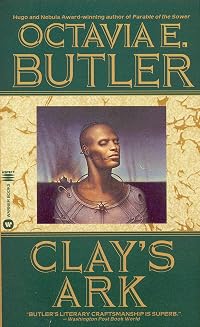
In a "haunting, apocalyptic, compelling" near future, one man and his daughters must stop an alien virus from becoming a deadly global epidemic (Essence).Blake Maslin and his two daughters are driving to Flagstaff when bandits swarm their car. At gunpoint, the marauders kidnap one of Blake's children, promising to keep her safe in return for medical care. Warily, the doctor goes with them, not realizing that he has just taken the first step down a terrifying path that will consume his show more life.
The gunmen take him deep into the desert, to a colony of people infected with a gruesome alien disease. It causes weakness, sallow skin, and birth defects so horrible that the children who suffer them cannot rightly be called human. The victims have quarantined themselves in the desert lest their illness spread and doom mankind. But as their willingness to accept isolation falters, Blake becomes the last hope for the survival of an uncontaminated Earth.
Octavia E. Butler's groundbreaking and award-winning science fiction and dystopian novels have inspired generations of readers all over the world.
This ebook features an illustrated biography of Octavia E. Butler including rare images from the author's estate.
. show less
Tags
Recommendations










Member Reviews
Reading this book was uncomfortable both in its 1980s sci-fi ethos and in reading it during a pandemic. That said, Butler's exploration of a tension between parasitism and symbiosis is really intriguing. I did find the character arcs to be on the weaker side, although the jumping between past and present is artfully done (and not gratuitous). The final showdown takes too long and seems sensationalist in its rampant violence, although I supposed there is a point to be made there. The humanity question is explored fairly well through some of the main protagonists, but one of the better aspects of the novel is that it redefines the protagonist role altogether. A worthwhile read, but I could have used more interrogation of the larger show more themes, and a little less sexual and bodily violence. show less
Powerful, intense, riveting, a really good read. As in a couple of her other sci-fi novels, Octavia Butler begins her story in the near future, when the social fabric is pretty frayed. People live in enclaves, and the gangs and outlaws own the roads. Into this violent world comes a parasitic alien life-form. It kills but it also strengthens, and it creates a completely new kind of society.
The novel is about the point of transition, when the humans are beginning to change into something different. How does it feel to let go of your humanity, to be driven by compulsions that you don't recognize? Butler does a good job of staying at that tight edge between will and inevitability.
The novel is about the point of transition, when the humans are beginning to change into something different. How does it feel to let go of your humanity, to be driven by compulsions that you don't recognize? Butler does a good job of staying at that tight edge between will and inevitability.
Butler’s main theme in this book is material determinism: the body determining behavior. It’s a theme that recurs in some of her other stories as well. It isn’t a question of nature, nurture or genes in Clay’s Ark however, and that adds to the novel’s strength. The microscopic aliens serve as the perfect metaphor for molecules influencing human behavior, and Butler doesn’t get stuck in the quagmire of trying to categorize causal chains and drawing moral conclusions from that.
Instead, we get a handful of characters who try to retain parts of their humanity – another bodily drive. Butler shows the emotional struggles that we all experience if we try to decide between conflicting desires – yes or no to that extra glass of show more wine, yes or no to lacing up and going for a run, yes or no to forgiving a loved one – but she ups the ante as the aliens install some bodily desires most humans consider immoral, leading to some interesting ethical conundrums, all anchored to emotions of the characters. Butler shows that context matters, and absolutes seem myopic. “You think you can choose your realities. You can’t.” To prevent worse, sometimes harm needs to be done – yet another iteration of the trolley problem.
(...)
Full review on Weighing A Pig show less
Instead, we get a handful of characters who try to retain parts of their humanity – another bodily drive. Butler shows the emotional struggles that we all experience if we try to decide between conflicting desires – yes or no to that extra glass of show more wine, yes or no to lacing up and going for a run, yes or no to forgiving a loved one – but she ups the ante as the aliens install some bodily desires most humans consider immoral, leading to some interesting ethical conundrums, all anchored to emotions of the characters. Butler shows that context matters, and absolutes seem myopic. “You think you can choose your realities. You can’t.” To prevent worse, sometimes harm needs to be done – yet another iteration of the trolley problem.
(...)
Full review on Weighing A Pig show less
Not bad, but I think it's the weakest of the Patternist series. The clayark mutants from Patternmaster get their origin story here: the lone survivor of an interstellar exploration returns to a dystopian Earth carrying an extraterrestrial pathogen that gives him enhanced physical abilities and an overwhelming need to spread the contagion through bites/scratches and sexual contact. Sounds great, but a good chunk of the book is the infected explaining to the people they're about to infect why they're not evil rapists when they really kind of are.
This is part of the Patternist series, but works as a standalone; I presume it is setting up for more intriguing clashes further on in the series. Clay's Ark doesn't seem related to the first book of the series at all (I'm out of order, haven't read book 2).
This tells the story of a doctor and his two daughters driving along a road in the near future US, where society seems to have somewhat but not completely broken down. The family is kidnapped and brought back to the isolated ranch of a strange group of people, who appear emaciated but are super-strong and super-fast. We learn soon that they have become infected with a virus from space, through the lone survivor of the mission that was out exploring. The virus is easily passed, and show more the community is attempting to remain isolated so as not to pass it to the population as a whole, while still increasing their numbers a bit so as to remain viable.
This book is a bit similar to Fledgeling, Butler's final novel, and suffers some of the same weaknesses. It's long on explication, violating that classic writing rule: "show don't tell". Her other books I've read (Wild Seed, Kindred) don't have this problem.
But what I found most troubling is that the theme seems to be that this community is doing what it can to avoid destroying the world, which is clearly a hopeless endeavor in the long term if they continue to live on the same planet. They have some ethical boundaries they won't cross, but apparently kidnapping innocent passersby and forcibly infecting them is not quite over the line! Maybe future books will reveal Butler has a similar point of view, but it doesn't seem like it. show less
This tells the story of a doctor and his two daughters driving along a road in the near future US, where society seems to have somewhat but not completely broken down. The family is kidnapped and brought back to the isolated ranch of a strange group of people, who appear emaciated but are super-strong and super-fast. We learn soon that they have become infected with a virus from space, through the lone survivor of the mission that was out exploring. The virus is easily passed, and show more the community is attempting to remain isolated so as not to pass it to the population as a whole, while still increasing their numbers a bit so as to remain viable.
This book is a bit similar to Fledgeling, Butler's final novel, and suffers some of the same weaknesses. It's long on explication, violating that classic writing rule: "show don't tell". Her other books I've read (Wild Seed, Kindred) don't have this problem.
But what I found most troubling is that the theme seems to be that this community is doing what it can to avoid destroying the world, which is clearly a hopeless endeavor in the long term if they continue to live on the same planet. They have some ethical boundaries they won't cross, but apparently kidnapping innocent passersby and forcibly infecting them is not quite over the line! Maybe future books will reveal Butler has a similar point of view, but it doesn't seem like it. show less
Butler's characters are among the most complex and fascinating in contemporary science fiction, and this book is a short but gripping example. A father and his two daughters, one dying of leukemia, are abducted in a roadside attack by an off-the-grid village infected with an alien disease it takes all their self-control not to spread. Its side-effects give them strange powers: immunity to terrestrial illness, heightened speed and senses; but the children they raise in their hidden mountain enclave are not human, and their enhanced physical drives make avoiding murder and rape a daily struggle. The story is awash in complex, difficult-to-unravel moral situations, where you're unsure which side to be rooting for: do you side with the show more family struggling to escape, even if that escape might lead to a global epidemic? Does the society they live in *deserve* one? If the disease could cure his daughter's leukemia and let her live, is the father right to try to prevent her from contracting it? Are the half-alien children frightening merely because they are strange, or is there something more sinister in them? How much of your humanity can you sacrifice and still remain human? A strikingly thought-provoking, disturbing, and masterfully written novel. show less
intensely violent and often disturbing, Butler stays true to creating "aliens" that are truly alien (not just humans in frightening or idealized costumes). I am now down to one novel yet to read by Butler, and that is her first, [b:Patternmaster|116256|Patternmaster (Patternmaster, #4)|Octavia E. Butler|https://i.gr-assets.com/images/S/compressed.photo.goodreads.com/books/1389456750l/116256._SY75_.jpg|1119636]. Feel like I maybe need a break after this one, because of the intensity of her work, and because I will regret not having any new Butler to read.
Members
- Recently Added By
Lists

Favorite Science Fiction by Women Authors
737 works; 202 members

2023
32 works; 1 member

Post-Apocalyptic Fiction
57 works; 3 members
Books Read in 2018
4,360 works; 110 members

Books Read in 2023
5,547 works; 145 members

hypatian_kat to-read
429 works; 3 members
Author Information

58+ Works 56,064 Members
Science-fiction writer and novelist Octavia Estelle Butler was born in Pasadena, California, on June 22, 1947. She earned as Associate of Arts degree from Pasadena City College in 1968 and later attended California State University and the University of California. Her first novel, Patternmaster, was the first in a series about a society run by a show more group of telepaths who are mentally linked to one another. She explored the topics of race, poverty, politics, religion, and human nature in her works. She won a Hugo Award in 1984 for her short story Speech Sounds and a Hugo Award and Nebula Award in 1985 for her novella Bloodchild. She received a MacArthur Grant from the John D. and Catherine T. MacArthur Foundation. The award pays $295,000 over a five-year period to creative people who push the boundaries of their fields. She died in Lake Forest Park, Washington on February 24, 2006 at the age of 58. (Bowker Author Biography) show less
Some Editions
Series


Work Relationships
Is contained in
Common Knowledge
- Canonical title*
- Incidente nel deserto
- Original title
- Clay's Ark
- Original publication date
- 1984-03
- People/Characters
- Asa Elias "Eli" Doyle; Blake Maslin; Keira Maslin; Rane Maslin; Orel Ingraham; Meda Boyd (show all 9); Stephen Kaneshiro; Jacob Boyd Doyle; Badger [Clay's Ark]
- Important events
- The return of the Clay's Ark starship
- Dedication
- In memory of Phyllis White
- First words
- The ship had been destroyed five days before. He did not remember how.
- Last words
- (Click to show. Warning: May contain spoilers.)They held each other until they could no longer tell which of them was trembling.
- Original language
- English
*Some information comes from Common Knowledge in other languages. Click "Edit" for more information.
Classifications
Statistics
- Members
- 1,443
- Popularity
- 16,279
- Reviews
- 29
- Rating
- (3.72)
- Languages
- English, French, Italian, Portuguese
- Media
- Paper, Audiobook, Ebook
- ISBNs
- 17
- UPCs
- 1
- ASINs
- 20