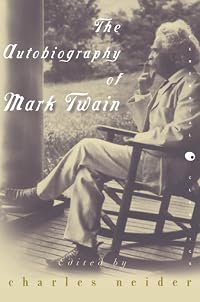
The Autobiography of Mark Twain
by Mark Twain 
On This Page
Description
"A book filled with richness of humor and tragedy of disappointment and triumph, of sweetness and bitterness, and all in that unsurpassed American prose."-New York Herald Tribune Book Review Mark Twain was a figure larger than life: massive in talent, eruptive in temperament, unpredictable in his actions. He crafted stories of heroism, adventure, tragedy, and comedy that reflected the changing America of the time, and he tells his own story with the same flair he brought to his fiction. show more Writing this autobiography on his deathbed, Twain vowed to be "free and frank and unembarrassed" in the recounting of his life and his experiences. With an introduction by noted scholar Charles Neider, and featuring sixteen pages of photographs, this edition was the first to arrange Twain's autobiographical writings in chronological order, and it presents a man who was more than a match for the expanding America of riverboats, gold rushes, and the vast westward movement that provided the material for his beloved novels. show lessTags
Recommendations





















Member Reviews
This is a great time travel book, and by the end it is also one of the most heartfelt intimate memoirs I've read. It has an open direct intimate feel to it all through, like reading letters from an unselfconscious old friend. He seems to have written a few pages at a time as stories occurred to him, which makes it a good book for dipping into. I read it as a bedside book, and it always kept me awake a little too long. Stories about his youthful adventures with crazy friends and business partners;his fairly barbaric Tom Sawyer childhood with reflection on his character development as he aged; stories about his absolutely adored wife and 3 daughters; his intense guilt over the death of his baby son; transcribed comments on his personality show more from his young daughter who clearly took after him; Why I Loved Minstrel Shows (well, it's some insight); his adventures in publishing; his investments; and his final losses. The last piece was written four months before his death. show less
I'd give this 4.5 stars if I could.
Incredibly humorous and charming, as is natural of Twain. Very many interesting anecdotes about his life and encounters with the figures of his time. Many timeless observations throughout. Also a refreshing format for a biography, he just talks about whatever pleases him at the time. The only problem is for such an enormous book, I was expecting a lot more which was devoted to the actual autobiography. The scraps and notes are still worth looking at, though.
Incredibly humorous and charming, as is natural of Twain. Very many interesting anecdotes about his life and encounters with the figures of his time. Many timeless observations throughout. Also a refreshing format for a biography, he just talks about whatever pleases him at the time. The only problem is for such an enormous book, I was expecting a lot more which was devoted to the actual autobiography. The scraps and notes are still worth looking at, though.
Ok, I have decided to mete out the 5 stars sparingly. The rating wouldn't mean much if it was given to just any old book that I happened to like.
This book though, is without a doubt, one of those few that actually deserves more than 5 stars and it is therefore one of my favorite books of all time.
Why?
Well, I think there are some books that you read and you think, upon closing the last page, "Hmmm, that was a pretty good book", but then if asked about it a few days later you might be hard pressed to remember much if anything about it. Other books you read, they affect you, they touch your life, your heart, your soul, and you are changed, a different person afterwards. I have not read too many of those books.
When people are asked to show more name the books that have changed their lives, I'm always amused at those whose lists are long. My list is short and this one is on the short list.
I absolutely fell in love with Mark Twain and his autobiography. It is even more interesting when you realize that Mark Twain never actually wrote an autobiography. What he did write were a grab bag assortment of small books and personal anecdotes, with the intention of someone else compiling it after his death into an autobiography. That is why each version will be slightly different. This is not the version that I read, but Amazon did not have a photo of it, so I chose this one.
I was just so taken in by the humanity of Mark Twain, his was an American life to be sure, but it was more than that. He was a living human being,much more than just one of America's, the world's, most beloved authors. He was also a son, a brother, a husband, a father, a friend. He was all of those and more. He lived the ups and downs of life. He lived through more than his fair share of tragedy and yet in the end, he was never beaten by life's circumstances. He stayed true to who he was. He stayed forever and inimitably, Mark Twain. He laughed, he cried, he was happy, and he was sad. In the end he was supremely human, not a perfect human being, and his flaws are readily apparent.
This was one of the few books that I have read where I actually had tears streaming down my face when I closed the last page.
From his early boyhood, to the many tragedies in his life, all the way up to the end when he lost his daughter and his wife, this book was incredibly poignant. You couldn't help loving this man even more and being sad that we have no equivalent of Mark Twain today. He died himself the following year after his daughter Jean died and the world has been the worse off ever since. show less
This book though, is without a doubt, one of those few that actually deserves more than 5 stars and it is therefore one of my favorite books of all time.
Why?
Well, I think there are some books that you read and you think, upon closing the last page, "Hmmm, that was a pretty good book", but then if asked about it a few days later you might be hard pressed to remember much if anything about it. Other books you read, they affect you, they touch your life, your heart, your soul, and you are changed, a different person afterwards. I have not read too many of those books.
When people are asked to show more name the books that have changed their lives, I'm always amused at those whose lists are long. My list is short and this one is on the short list.
I absolutely fell in love with Mark Twain and his autobiography. It is even more interesting when you realize that Mark Twain never actually wrote an autobiography. What he did write were a grab bag assortment of small books and personal anecdotes, with the intention of someone else compiling it after his death into an autobiography. That is why each version will be slightly different. This is not the version that I read, but Amazon did not have a photo of it, so I chose this one.
I was just so taken in by the humanity of Mark Twain, his was an American life to be sure, but it was more than that. He was a living human being,much more than just one of America's, the world's, most beloved authors. He was also a son, a brother, a husband, a father, a friend. He was all of those and more. He lived the ups and downs of life. He lived through more than his fair share of tragedy and yet in the end, he was never beaten by life's circumstances. He stayed true to who he was. He stayed forever and inimitably, Mark Twain. He laughed, he cried, he was happy, and he was sad. In the end he was supremely human, not a perfect human being, and his flaws are readily apparent.
This was one of the few books that I have read where I actually had tears streaming down my face when I closed the last page.
From his early boyhood, to the many tragedies in his life, all the way up to the end when he lost his daughter and his wife, this book was incredibly poignant. You couldn't help loving this man even more and being sad that we have no equivalent of Mark Twain today. He died himself the following year after his daughter Jean died and the world has been the worse off ever since. show less
This is the great American humorist in his own words; and also in the words of Albert B. Paine. The text includes a biography written by the latter. Twain's contribution consists of a series of stories from his life, without a clear direction, but just sort of roaming around in his life choosing at random. The portraits of himself and others he draws are entertaining, his characteristic wit shining through clearly, but it's a little hard to put together a picture of his life from the format. As a freethinker, I find it interesting the very toned down way in which he addresses his lack of belief, simply through a short vignette about a goose, which never really says anything, but hints at his non-belief in a deity. The biography which show more follows it is interesting, and fleshes out his life nicely, so you can put his stories into context better, and delivers a very intriguing picture of an adventurous life well suited to Tom Sawyer. The book lost in my opinion by including a long, rambling, and excessively dull essay at the tail end, an essay that is philosophical, and with which I agreed in large part, but which was not compelling and was marred by constant repetitiveness and the excessive use of capital letters. This should have been excised by the editor, but I suspect few people in the modern world are willing to cut the great masters (unless they should use "the n word", as Twain did in Huckleberry Finn. Political correctness wins out over literary history every time). This book also suffered from formatting problems which I suspect are the direct result of being converted to electronic format, and which can be very distracting and at times hard to read. show less
While the Autobiography is certainly not Clemens's best or most humorous effort, it is the one work that I consistently return to, year after year. His writing here at the end of his life can be tangential and fractured, yes, but there is a maturity and wisdom that shines through in this book.
This is primarily a collection of anecdotes: some hilarious, some heartbreaking, some brilliant, and some dull. But the nonlinear style in which it has been organized allows the reader to skim or skip the not-so-inspired narration. (Although I would recommend that the Autobiography be read in its entirety upon first being taken up.)
It is in this book, spanning from the late 19th century to his death, that Samuel Clemens the man is most fully and show more nakedly revealed. show less
This is primarily a collection of anecdotes: some hilarious, some heartbreaking, some brilliant, and some dull. But the nonlinear style in which it has been organized allows the reader to skim or skip the not-so-inspired narration. (Although I would recommend that the Autobiography be read in its entirety upon first being taken up.)
It is in this book, spanning from the late 19th century to his death, that Samuel Clemens the man is most fully and show more nakedly revealed. show less
Twain arranged for his autobiography to appear after his death – he wanted it to be “fresh and free and unembarrassed as a love letter.” The resulting account is unblinkingly candid, heartbreaking and funny. By the end, I loved Twain. Maybe you will too.
Sono partito molto carico, e Twain non mi ha deluso.
Poi, nell'ordine (a) le digressioni economiche (b) la villa di Quarto e le sue funeste nostalgie (c) il fatto che e' uscita in questi giorni l'autobiografia *completa* con alcune parti qui non comprese (d) il fatto che anche l'ultima discendente di Twain sia scomparsa da questa terra 50 anni fa circa, con un cocktail di pillole ed alcool (e) alcuni passaggi sentimentali.
Tutto cio', dicevo, ha appesantito la lettura, e me ne dispiaccio, perche' ho apprezzato la traduzione, gli argomenti, il narratore. Quest'ultimo, seppur prolisso, mi induce sempre un lieto e costante sorriso, indimenticabile.
***
Aggiornamento 28/09/14
E poi oggi mi accorgo che in casa ho un'altra copia del libro, letto show more nell'aprile del 2000. show less
Poi, nell'ordine (a) le digressioni economiche (b) la villa di Quarto e le sue funeste nostalgie (c) il fatto che e' uscita in questi giorni l'autobiografia *completa* con alcune parti qui non comprese (d) il fatto che anche l'ultima discendente di Twain sia scomparsa da questa terra 50 anni fa circa, con un cocktail di pillole ed alcool (e) alcuni passaggi sentimentali.
Tutto cio', dicevo, ha appesantito la lettura, e me ne dispiaccio, perche' ho apprezzato la traduzione, gli argomenti, il narratore. Quest'ultimo, seppur prolisso, mi induce sempre un lieto e costante sorriso, indimenticabile.
***
Aggiornamento 28/09/14
E poi oggi mi accorgo che in casa ho un'altra copia del libro, letto show more nell'aprile del 2000. show less
Members
- Recently Added By
Published Reviews
ThingScore 75
"Wry and cranky, droll and cantankerous — that’s the Mark Twain we think we know, thanks to reading “Huck Finn” and “Tom Sawyer” in high school. But in his unexpurgated autobiography, whose first volume is about to be published a century after his death, a very different Twain emerges, more pointedly political and willing to play the role of the angry prophet. "
added by lorax
Lists

Modern Library 100 Best Nonfiction Books
100 works; 8 members
Author Information

2,766+ Works 209,362 Members
Mark Twain was born Samuel L. Clemens in Florida, Missouri on November 30, 1835. He worked as a printer, and then became a steamboat pilot. He traveled throughout the West, writing humorous sketches for newspapers. In 1865, he wrote the short story, The Celebrated Jumping Frog of Calaveras County, which was very well received. He then began a show more career as a humorous travel writer and lecturer, publishing The Innocents Abroad in 1869, Roughing It in 1872, and, Gilded Age in 1873, which was co-authored with Charles Dudley Warner. His best-known works are The Adventures of Tom Sawyer, Mississippi Writing: Life on the Mississippi, and The Adventures of Huckleberry Finn. He died of a heart attack on April 21, 1910. (Bowker Author Biography) show less
Mark Twain has a Legacy Library. Legacy libraries are the personal libraries of famous readers, entered by LibraryThing members from the Legacy Libraries group.
Some Editions
Awards and Honors
Distinctions
Notable Lists
Series
Belongs to Publisher Series
Work Relationships
Is abridged in
Has as a student's study guide
Common Knowledge
- Canonical title
- The Autobiography of Mark Twain
- Original title
- Autobiography of Mark Twain
- Original publication date
- 1959
- People/Characters
- Samuel Langhorne Clemens (Mark Twain)
- Dedication
- To my wife, Joan Merrick
- First words
- [The Tennessee Land] | The monster tract of land which our family own in Tennessee, was purchased by my father a little over forty years ago. [p. 61]
===
An Early Attempt | The chapters which immediately follow constitu... (show all)te a fragment of one of my many attempts (after I was in my forties) to put my life on paper. [Autobiography proper: p. 203] - Quotations
- We have no respectworthy evidence that the human being has morals. He is himself the only witness. (page 186)
When I was younger I could remember anything, whether it had happened or not; but my faculties are decaying, now, and soon I shall be so I cannot remember any but the latter. (page 210)
I can call back the solemn twilight and mystery of the deep woods, the earthy smells, the faint odors of the wild flowers, the sheen of rain-washed foliage, the rattling clatter of drops when the wind shook the trees, the far... (show all)-off hammering of wood-peckers and the muffled drumming of wood-pheasants in the remotenesses of the forest, the snap-shot glimpses of disturbed wild creatures skurrying through the grass,—I can call it all back and make it as real as it ever was, and as blessed. I can call back the prairie, and its loneliness and peace, and a vast hawk hanging motionless in the sky, with his wings spread wide and the blue of the vault showing through the fringe of their end-feathers. I can see the woods in their autumn dress, the oaks purple, the hickories washed with gold, the maples and the sumachs luminous with crimson fires, and I can hear the rustle made by the fallen leaves as we plowed through them. I can see the blue clusters of wild grapes hanging amongst the foliage of the saplings, and I remember the taste of them and the smell. I know how the wild blackberries looked, and how they tasted; and the same with the pawpaws, the hazelnuts and the persimmons; and I can feel the thumping rain, upon my head, of hickory nuts and walnuts when we were out in the frosty dawns to scramble for them with the pigs, and the gusts of wind loosed them and sent them down. ... (page 216)
I have made it a rule never to smoke more than one cigar at a time. (page 659) - Last words
- (Click to show. Warning: May contain spoilers.)Yours sincerely, | Helen Keller [p. 467]
- Original language
- English
- Disambiguation notice
- The 1959 Charles Neider edition. Please do not combine with the Mark Twain Project's 2010 edition.
The texts of Charles Neider's 1959 edition and the Mark Twain Project's 2010- edition differ sufficiently that the first/l... (show all)ast words for the one cannot be used for the other.
Classifications
Statistics
- Members
- 1,004
- Popularity
- 26,097
- Reviews
- 9
- Rating
- (4.12)
- Languages
- 9 — English, Finnish, French, German, Italian, Polish, Portuguese, Croatian, Spanish
- Media
- Paper, Audiobook, Ebook
- ISBNs
- 22
- ASINs
- 20