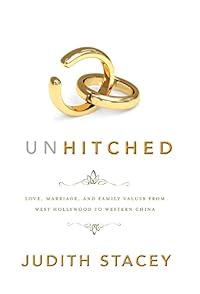
Unhitched: Love, Marriage, and Family Values from West Hollywood to Western China
by Judith Stacey
On This Page
Description
Judith Stacey, 2012 winner of the Simon and Gagnon Lifetime Achievement Award presented by the American Sociological Association.A leading expert on the family, Judith Stacey is known for her provocative research on mainstream issues. Finding herself impatient with increasingly calcified positions taken in the interminable wars over same-sex marriage, divorce, fatherlessness, marital fidelity, and the like, she struck out to profile unfamiliar cultures of contemporary love, marriage, and show more family values from around the world.Built on bracing original research that spans gay men ?s intimacies and parenting in this country to plural and non-marital forms of family in South Africa and China, Unhitched decouples the taken for granted relationships between love, marriage, and parenthood. Countering the one-size-fits-all vision of family values, Stacey offers readers a lively, in-person introduction to these less familiar varieties of intimacy and family and to the social, political, and economic conditions that buttress and batter them.Through compelling stories of real families navigating inescapable personal and political trade-offs between desire and domesticity, the book undermines popular convictions about family, gender, and sexuality held on the left, right, and center. Taking on prejudices of both conservatives and feminists, Unhitched poses a powerful empirical challenge to the belief that the nuclear family ?whether straight or gay ?is the single, best way to meet our needs for intimacy and care. Stacey calls on citizens and policy-makers to make their peace with the fact that family diversity is here to stay.Judith Stacey, 2012 winner of the Simon and Gagnon Lifetime Achievement Award presented by the American Sociological Association.A leading expert on the family, Judith Stacey is known for her provocative research on mainstream issues. Finding herself impatient with increasingly calcified positions taken in the interminable wars over same-sex marriage, divorce, fatherlessness, marital fidelity, and the like, she struck out to profile unfamiliar cultures of contemporary love, marriage, and family values from around the world.Built on bracing original research that spans gay men ?s intimacies and parenting in this country to plural and non-marital forms of family in South Africa and China, Unhitched decouples the taken for granted relationships between love, marriage, and parenthood. Countering the one-size-fits-all vision of family values, Stacey offers readers a lively, in-person introduction to these less familiar varieties of intimacy and family and to the social, political, and economic conditions that buttress and batter them.Through compelling stories of real families navigating inescapable personal and political trade-offs between desire and domesticity, the book undermines popular convictions about family, gender, and sexuality held on the left, right, and center. Taking on prejudices of both conservatives and feminists, Unhitched poses a powerful empirical challenge to the belief that the nuclear family ?whether straight or gay ?is the single, best way to meet our needs for intimacy and care. Stacey calls on citizens and policy-makers to make their peace with the fact that family diversity is here to stay. show lessTags
Recommendations








Member Reviews
The fundamental premise of Stacey's book is that monogamous, heterosexual marriage is:
a) Not the only viable form of pair-bonding,
b) Not the overwhelmingly dominate form in human history,
c) Not necessarily the "best" form
In pursuit of this thesis, she presents data and opinion based upon her researches, looking at permutations of gay marriages and unions (somewhat less so at lesbian relationships), non-exclusive relationships, polygamous/polyamorous relationships, and some unique matriarchal, non-marital practices in a part of China. If there is a central tenet of her arguments, it is that love and marriage don't always go together like a horse and carriage.
Since I'm going to list a few problems I had with this book, let me start by show more saying that it is a book well worth reading. If your religious beliefs do not permit flexibility about human relationships, it is still full of fascinating sociological study. If that is not true, then there is the added benefit of the thought-provoking questions it raises.
The ideas and questions she raises are quite fascinating and, in my view, quite relevant in Western society of today. Her research is intriguing to read about. I do, however, think that her conclusions are somewhat suspect. Though she refrains from stating a recipe for successful relationships, I felt she implied that if we just "take a little of A from here, and a drop of B from there, mix in some C and stir with a lot of tolerance" that all would be well. It's a facile approach that assumes that transplanted behaviors and beliefs would function identically in a different context. Perhaps I mis-read between the lines; other readers can form their own judgments.
There are also some overt statements that caused me to raise an eyebrow. For example: "Musuo children have no fathers"—hogwash. (Traditional Musuo relationships are matrilineal, matrilocal and matriarchal; and biological fatherhood was not important.) Of course they do. The social role of father is simply played by maternal uncles rather than biological fathers. Biology is not essential, as adoption shows.
In a way, these deficiencies (as I perceive them) don't really hurt because they become little speed bumps that joggle you out of the flow and cause you to challenge what you are reading.
It's a well-written book that avoids academic fustiness. It's full of topical questions ranging from LGBT issues, to child rearing, to the rash of high-profile cheating scandals that seem to occur disproportionately on the conservative side of our country's leadership. show less
a) Not the only viable form of pair-bonding,
b) Not the overwhelmingly dominate form in human history,
c) Not necessarily the "best" form
In pursuit of this thesis, she presents data and opinion based upon her researches, looking at permutations of gay marriages and unions (somewhat less so at lesbian relationships), non-exclusive relationships, polygamous/polyamorous relationships, and some unique matriarchal, non-marital practices in a part of China. If there is a central tenet of her arguments, it is that love and marriage don't always go together like a horse and carriage.
Since I'm going to list a few problems I had with this book, let me start by show more saying that it is a book well worth reading. If your religious beliefs do not permit flexibility about human relationships, it is still full of fascinating sociological study. If that is not true, then there is the added benefit of the thought-provoking questions it raises.
The ideas and questions she raises are quite fascinating and, in my view, quite relevant in Western society of today. Her research is intriguing to read about. I do, however, think that her conclusions are somewhat suspect. Though she refrains from stating a recipe for successful relationships, I felt she implied that if we just "take a little of A from here, and a drop of B from there, mix in some C and stir with a lot of tolerance" that all would be well. It's a facile approach that assumes that transplanted behaviors and beliefs would function identically in a different context. Perhaps I mis-read between the lines; other readers can form their own judgments.
There are also some overt statements that caused me to raise an eyebrow. For example: "Musuo children have no fathers"—hogwash. (Traditional Musuo relationships are matrilineal, matrilocal and matriarchal; and biological fatherhood was not important.) Of course they do. The social role of father is simply played by maternal uncles rather than biological fathers. Biology is not essential, as adoption shows.
In a way, these deficiencies (as I perceive them) don't really hurt because they become little speed bumps that joggle you out of the flow and cause you to challenge what you are reading.
It's a well-written book that avoids academic fustiness. It's full of topical questions ranging from LGBT issues, to child rearing, to the rash of high-profile cheating scandals that seem to occur disproportionately on the conservative side of our country's leadership. show less
It's been a couple years since I read this through, but it's definitely a favorite. It's a very interesting history of relationship structures throughout history and the world, and highlights that "non-standard" relationships occur regularly in the United States, as well. It does a great job of normalizing various ways people relate to each other, taking into account different cultures and time periods as well.
Members
- Recently Added By
Author Information
5+ Works 179 Members
Judith Stacey is Professor of Social and Cultural Analysis and Sociology at NYU. She is the author of numerous books and articles, including In the Name of the Family: Rethinking Family Values in the Postmodern Age (1996), Brave New Families: Stories of Domestic Upheaval in Late Twentieth-Century America (1990) and Patriarchy and Socialist show more Revolution in China (1983). show less
Series
Belongs to Publisher Series
Common Knowledge
- Original publication date
- 2011
- Important places
- USA; South Africa; Yunnan, China
- Epigraph
- Do you [Adam] take [Eve] to be your wife--to live together after God's ordinance--in the holy estate of matrimony? Will you love her, comfort her, honor and keep her, in sickness and health, for richer, for poorer, for bette... (show all)r, for worse, in sadness and in joy, to cherish and continually bestow upon her your heart's deepest devotion, forsaking all others, keep yourself only unto her as long as you both shall live?
--traditional Western wedding vows. - First words
- When "Frankie," a New Jersey hero, recorded the song "Love and Marriage" in 1955, he was crooning for me and my gals, and we sure did soak it up. (Introduction)
Not so long ago, the notion of a gay or lesbian wedding or family seemed oxymoronic to most people, including many lesbians and gay men themselves. (Chapter 1) - Last words
- (Click to show. Warning: May contain spoilers.)But we can, and we should, prevent our society from forsaking all of our other families.
- Publisher's editor
- Zinner, Eric; McLaughlin, Clara
- Blurbers
- Weeks, Jeffrey; Coontz, Stephanie; Stein, Arlene; Connell, Raewyn
- Original language
- English
Classifications
- Genres
- Nonfiction, Sociology, General Nonfiction, Anthropology, Sexuality and Gender Studies
- DDC/MDS
- 306.8109 — Society, Government, and Culture Social sciences, sociology & anthropology Social Behavior - Dating, Marriage, Divorce Marriage, partnerships, unions; family Marriage and marital status Biography And History
- LCC
- HQ75.27 .S73 — Social sciences The family. Marriage, Women and Sexuality The Family. Marriage. Women Sexual life
- BISAC
Statistics
- Members
- 36
- Popularity
- 796,371
- Reviews
- 2
- Rating
- (3.83)
- Languages
- English
- Media
- Paper, Ebook
- ISBNs
- 4
- ASINs
- 1