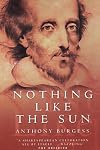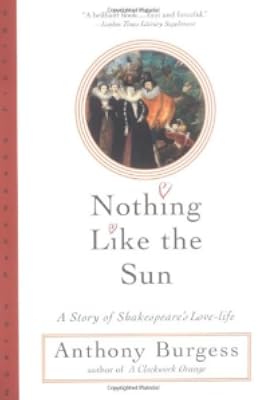
Nothing Like the Sun
by Anthony Burgess 
On This Page
Description
Before Shakespeare in Love, there was Anthony Burgess's Nothing Like the Sun: a magnificent, bawdy telling of Shakespeare's love life.Tags
Recommendations



















Member Reviews
Nothing Like the Sun has made me a Burgess fan, since I was never going to finish reading A Clockwork Orange beyond the fist two pages which I tried doing back in my late teens and got thoroughly turned off. This book purports to be a biography of Shakespeare and introduces him to us from his late teens, when he was presumably occupied chasing women and bedding every one of those who accepted his advances. Until he got caught into marriage by the brothers of one Anne Hathaway, one of the women which he managed to impregnate, though not at all his first or last choice as a wife. The story follows his career path from his first scratchings until his demise from syphilis, with his first sonnets devoted to what was reportedly one of the show more greatest loves of his life, a young teenage lord of great beauty, here presented as being Henry Wriothesley, 3rd Earl of Southampton. His second great love is a Dark Lady, also mentioned in his sonnets, who was probably from Indian descent from the details we glean in this highly fictionalized story. Burgess present to us a lusty William Shakespeare who seems entirely convincing considering the countless bawdy references in his plays, but also a very realistic portrait of a man of genius who is unsure of himself and his position in the world, blending the sublime and the ordinariness of life. Among my favourite books this year.
I should mention I listened to an excellent very recently release audio version narrated by Sean Barrett, and also that I'm very glad I didn't let the utterly confusing beginning of the novel discourage me from continuing on. I can be very slow on the uptake sometimes, so among other things, it took me some time to catch on to the fact that "WS" was our main man. I've got two more Burgesses waiting in the wings, one being the Booker shortlisted Earthly Powers, which comes highly recommended by some of my favourite LT members. I just may have to make room for more Burgess this year. show less
I should mention I listened to an excellent very recently release audio version narrated by Sean Barrett, and also that I'm very glad I didn't let the utterly confusing beginning of the novel discourage me from continuing on. I can be very slow on the uptake sometimes, so among other things, it took me some time to catch on to the fact that "WS" was our main man. I've got two more Burgesses waiting in the wings, one being the Booker shortlisted Earthly Powers, which comes highly recommended by some of my favourite LT members. I just may have to make room for more Burgess this year. show less
Summary:
Anthony Burgess’s Nothing Like the Sun is a highly fascinating, albeit fictional, re-telling of Shakespeare’s love life. In 234 pages, Burgess manages to introduce his reader to a young Shakespeare, developing into manhood and clumsily fumbling his way through his first sexual escapade with a woman, through Shakespeare’s long, famed (and contested) romance with Henry Wriothesley, 3rd Earl of Southampton and, ultimately, to Shakespeare’s final days, the establishment of The Globe theater, and Shakespeare’s romance with “The Dark Lady.”
The Good:
Burgess has a command for language. This is my third experience with a work by Anthony Burgess and, once again, I am impressed and awed by his skill as a story-teller and an show more imagist. While, in typical fashion, he does tend to break-off at points of leisurely prose into something more Gertrude Steine-esque (stream of consciousness, for example), for the most part he keeps this novel in finely tuned form. There is also an exceptional arc to this story, which carries the reader from Shakespeare’s boyhood, to his death, with common characters interacting regularly and to an end result. Even the minor characters, such as Wriothesley’s secretary, are well-established and easily identified, once they have been described. I also very much appreciated the references to other historical figures of the time, and how they impacted Shakespeare’s life and works. Marlowe, Lord Burghley, Sir Walter Raleigh, Queen Elizabeth I, The University Wits (Greene, Lyly, Nashe) all make an appearance, or are at least referred to, throughout the novel – their works (as well as works of the Classicists – Ovid, Virgil; and the early dramatists – Seneca, etc) are clearly defined in relation to their impact on Shakespeare’s own designs and interpretations. I found this highly informative and a nice refresher to/reinforcement of my studies of Shakespeare at the Undergraduate and Graduate levels – I enjoyed being reminded of how the playwrights competed and worked together, how Shakespeare was inspired, and by whom, and how politics and the time period played an important role in the successes and failures of the players (Greene, for instance, died sickly and shamed; Marlowe hunted down as an atheist; Jonson’s imprisonment for treasonous writing, and Nashe’s escape from England for the same). Incredibly fascinating and surprisingly sound story, which also appropriately references, with subtlety, many of Shakespeare’s works, at their time of development, so that a reader familiar with the works may catch them without their names actually having been written. Lovely little way for Burgess to reward his learned readers (as Shakespeare oft amused himself by doing).
The Bad:
Burgess takes much creative, though well-researched, license with Shakespeare’s life and the details of his relationship with various people. For instance, while many scholars believe “The Rival Poet” of “The Fair Youth” sonnets to be either Chapman or Marlowe due to circumstances of fame, stature, and wealth (ego, essentially), Burgess breaks from the traditional interpretation of “The Rival Poet” to explore the possibility that Chapman was, in fact, a rival for Henry Wriothesley’s attention and affection and, for this reason, Shakespeare became jealous and critical of Chapman. Similarly, the ultimately un-established relationship between Shakespeare and Wriothesley, Shakespeare and “The Dark Lady” (or Lucy, in this novel), as well as, even Shakespeare and his wife – are all quite largely fictional. That being said, while the novel’s general details – including historical happenings, political and religious tensions, and rivalries between the poets and the players are all well envisioned – the novel is dangerous in that the story of Shakespeare’s life comes across so logical here that it almost appears factual (and, who knows, a large portion of Burgess’s interpretations may have been true). Thus, the writing is fantastic, but the liberties taken are troublesome.
Final Verdict (4.0 out of 5.0)
The story was well written and enjoyable. It was also, I thought, a fascinating glimpse at history and this particularly time period. Burgess reminds the reader of many of the fears and prejudices of the time, and seems to be more critical of Elizabeth I than Shakespeare himself (most scholars believe) was. I appreciated Burgess’s cleverness and subtlety, but also his openness and candor in terms of sexuality and taboo relationships. Burgess clearly wants to open the reader’s eyes to what very well could have happened, yet is never acknowledged. Still, some of the author’s creative license, I think, goes beyond an artistic historian’s realm. When I compare Nothing Like the Sun to, say, Stone’s Lust for Life I find the latter to be much more honest to the facts as we know them, whereas the former is a bit more adventurous in scope. Overall, though, it was a highly educational, enjoyable read of an interesting and valid perspective look on Shakespeare. show less
Anthony Burgess’s Nothing Like the Sun is a highly fascinating, albeit fictional, re-telling of Shakespeare’s love life. In 234 pages, Burgess manages to introduce his reader to a young Shakespeare, developing into manhood and clumsily fumbling his way through his first sexual escapade with a woman, through Shakespeare’s long, famed (and contested) romance with Henry Wriothesley, 3rd Earl of Southampton and, ultimately, to Shakespeare’s final days, the establishment of The Globe theater, and Shakespeare’s romance with “The Dark Lady.”
The Good:
Burgess has a command for language. This is my third experience with a work by Anthony Burgess and, once again, I am impressed and awed by his skill as a story-teller and an show more imagist. While, in typical fashion, he does tend to break-off at points of leisurely prose into something more Gertrude Steine-esque (stream of consciousness, for example), for the most part he keeps this novel in finely tuned form. There is also an exceptional arc to this story, which carries the reader from Shakespeare’s boyhood, to his death, with common characters interacting regularly and to an end result. Even the minor characters, such as Wriothesley’s secretary, are well-established and easily identified, once they have been described. I also very much appreciated the references to other historical figures of the time, and how they impacted Shakespeare’s life and works. Marlowe, Lord Burghley, Sir Walter Raleigh, Queen Elizabeth I, The University Wits (Greene, Lyly, Nashe) all make an appearance, or are at least referred to, throughout the novel – their works (as well as works of the Classicists – Ovid, Virgil; and the early dramatists – Seneca, etc) are clearly defined in relation to their impact on Shakespeare’s own designs and interpretations. I found this highly informative and a nice refresher to/reinforcement of my studies of Shakespeare at the Undergraduate and Graduate levels – I enjoyed being reminded of how the playwrights competed and worked together, how Shakespeare was inspired, and by whom, and how politics and the time period played an important role in the successes and failures of the players (Greene, for instance, died sickly and shamed; Marlowe hunted down as an atheist; Jonson’s imprisonment for treasonous writing, and Nashe’s escape from England for the same). Incredibly fascinating and surprisingly sound story, which also appropriately references, with subtlety, many of Shakespeare’s works, at their time of development, so that a reader familiar with the works may catch them without their names actually having been written. Lovely little way for Burgess to reward his learned readers (as Shakespeare oft amused himself by doing).
The Bad:
Burgess takes much creative, though well-researched, license with Shakespeare’s life and the details of his relationship with various people. For instance, while many scholars believe “The Rival Poet” of “The Fair Youth” sonnets to be either Chapman or Marlowe due to circumstances of fame, stature, and wealth (ego, essentially), Burgess breaks from the traditional interpretation of “The Rival Poet” to explore the possibility that Chapman was, in fact, a rival for Henry Wriothesley’s attention and affection and, for this reason, Shakespeare became jealous and critical of Chapman. Similarly, the ultimately un-established relationship between Shakespeare and Wriothesley, Shakespeare and “The Dark Lady” (or Lucy, in this novel), as well as, even Shakespeare and his wife – are all quite largely fictional. That being said, while the novel’s general details – including historical happenings, political and religious tensions, and rivalries between the poets and the players are all well envisioned – the novel is dangerous in that the story of Shakespeare’s life comes across so logical here that it almost appears factual (and, who knows, a large portion of Burgess’s interpretations may have been true). Thus, the writing is fantastic, but the liberties taken are troublesome.
Final Verdict (4.0 out of 5.0)
The story was well written and enjoyable. It was also, I thought, a fascinating glimpse at history and this particularly time period. Burgess reminds the reader of many of the fears and prejudices of the time, and seems to be more critical of Elizabeth I than Shakespeare himself (most scholars believe) was. I appreciated Burgess’s cleverness and subtlety, but also his openness and candor in terms of sexuality and taboo relationships. Burgess clearly wants to open the reader’s eyes to what very well could have happened, yet is never acknowledged. Still, some of the author’s creative license, I think, goes beyond an artistic historian’s realm. When I compare Nothing Like the Sun to, say, Stone’s Lust for Life I find the latter to be much more honest to the facts as we know them, whereas the former is a bit more adventurous in scope. Overall, though, it was a highly educational, enjoyable read of an interesting and valid perspective look on Shakespeare. show less
Needed to acclimate here and stick it out awhile. Recounts in dense, paragraph-free style the life of the rambunctious, versifying, bisexual, "swelling in flesh-fed lustihead" WS, "the swift-tongued, spaniel-eyed poet-glover." Bold ambition to enter the mind of genius. Replete with quotations and allusions. Its primary concern is the fleshing out (so to speak) of the sonnet triangle: "I would, in some manner, wish to share her with him, him with her, but perhaps only a poet may think in these high terms."
Hmmm, I love the man, but Burgess was kind of a chancer, wasn't he? He never follows an idea through - take Clockwork Orange for an example, a shallow dip into a hugely fruitful universe - and when he does it ends up a bunch of nonsense about massive cumshots, as in the unfortunate scene in Earthly Powers. He's a dilettante, per his wide interests in music and linguistics as well as teh stories. The language affinity serves him well here - the beginning of the story is in this fragmented pseudo-Elizabethan which half represents his (legitimate) take on Shakespeare as foggy-brained and yearnsome, but half sort of hurts your head and doesn't really hold up under pressure - anachornistic and probably too literary as well to be the real way show more they spake. The story, which is or may as well be basically the original of Shakespeare in Love with his dark love and his sexy dude instead of that Gwyneth Paltrow rigmarole, gets more engaging as the patois gets closer to Standard Modern, but it's still disappointing since he started with such ambitions to take us into their language and mindset, even if it didn't bear fruit. But you learn a lot of words, no doubt there, and I do not get tired of that thing back then where it was "this fellow Merlin or Marlin or Marley" and "yer man Shogspaw or Choxper." And if you insisted on spelling your name a certain way they'd be like "Ugh! Pedant." It makes you think. show less
Not Burgess' best, and Dead Man in Deptford is the superior English playwright fictionalization. Burgess doesn't shy away from the unhygienic grit of 16th century life, but this is perfected in the latter novel, and tends to be overdone in this one. Burgess interprets the literary artist well, however, and makes some interesting assumptions about the obscure life of W. Shakespeare.
Not the best book I've read by this author; I really felt that it bordered on bad fan-fiction at times. (Did fan-fiction really even exist when Burgess wrote this? I thought it was an internet phenomenon, but whatever.) At least the language used for anything "sexual" was entertaining and different, and I did like that this book was unafraid to show Shakespeare as blatantly bisexual.
What makes it even more entertaining is if you keep in mind some of Shakespeare's writing while reading this. Take sonnet 130, for example (which the title of this book comes from, and which is also my favorite Shakespeare sonnet by far, although this book makes me think about it in more of a truthful and less of a exaggerated comedic light):
My mistress' show more eyes are nothing like the sun;
Coral is far more red than her lips' red;
If snow be white, why then her breasts are dun;
If hairs be wires, black wires grow on her head.
I have seen roses damasked, red and white,
But no such roses see I in her cheeks;
And in some perfumes is there more delight
Than in the breath that from my mistress reeks.
I love to hear her speak, yet well I know
That music hath a far more pleasing sound;
I grant I never saw a goddess go;
My mistress when she walks treads on the ground.
And yet, by heaven, I think my love as rare
As any she belied with false compare.
And the opening to sonnet 18:
Shall I compare thee to a summer's day?
Thou art more lovely and more temperate.
Rough winds do shake the darling buds of May,
And summer's lease hath all too short a date.
I don't know much about Shakespeare himself, though, and I understand because of how long ago he lived, a lot of his life is up to speculation, but I was always under the impression the image of the "dark lady" was the one that was oppressing him or keeping him from what he sought--someone like the figure in sonnet 18. In this book, we have is his wife, his "dark lady", who is Indian (at least, I think), and his "fair haired beauty", who is actually a lord he wrote for. He loves them all, but is really only sexually attracted to the latter two, whom he goes back and forth between. He ends up deceived by them all, and dies after becoming ill from one of them.
Overall, the book didn't really move me that much, although it was funny. I think his death (and a few other points) could have been made more poignant, but somehow they didn't seem so--if they were, I believe I would have liked this book much more. As it is, it won't get placed on my list of favorites, unfortunately. show less
What makes it even more entertaining is if you keep in mind some of Shakespeare's writing while reading this. Take sonnet 130, for example (which the title of this book comes from, and which is also my favorite Shakespeare sonnet by far, although this book makes me think about it in more of a truthful and less of a exaggerated comedic light):
My mistress' show more eyes are nothing like the sun;
Coral is far more red than her lips' red;
If snow be white, why then her breasts are dun;
If hairs be wires, black wires grow on her head.
I have seen roses damasked, red and white,
But no such roses see I in her cheeks;
And in some perfumes is there more delight
Than in the breath that from my mistress reeks.
I love to hear her speak, yet well I know
That music hath a far more pleasing sound;
I grant I never saw a goddess go;
My mistress when she walks treads on the ground.
And yet, by heaven, I think my love as rare
As any she belied with false compare.
And the opening to sonnet 18:
Shall I compare thee to a summer's day?
Thou art more lovely and more temperate.
Rough winds do shake the darling buds of May,
And summer's lease hath all too short a date.
I don't know much about Shakespeare himself, though, and I understand because of how long ago he lived, a lot of his life is up to speculation, but I was always under the impression the image of the "dark lady" was the one that was oppressing him or keeping him from what he sought--someone like the figure in sonnet 18. In this book, we have is his wife, his "dark lady", who is Indian (at least, I think), and his "fair haired beauty", who is actually a lord he wrote for. He loves them all, but is really only sexually attracted to the latter two, whom he goes back and forth between. He ends up deceived by them all, and dies after becoming ill from one of them.
Overall, the book didn't really move me that much, although it was funny. I think his death (and a few other points) could have been made more poignant, but somehow they didn't seem so--if they were, I believe I would have liked this book much more. As it is, it won't get placed on my list of favorites, unfortunately. show less
When I read Shakespeare's sonnets on my local community radio station, as I do from time to time, I always suggest that listeners enchanted by the music and passion of those poems read this novel. It is a shimmering, surprising, enlightening book.
Members
- Recently Added By
Lists

1001 Books You Must Read Before You Die
1,448 works; 1,132 members

Lives of the Poets (and Philosophers)
110 works; 5 members

Shakespeare Quote Titles
112 works; 12 members

Harold Bloom - The Western Canon: D. The Chaotic Age
833 works; 24 members
Author Information

120+ Works 48,185 Members
Anthony Burgess was born in 1917 in Manchester, England. He studied language at Xaverian College and Manchester University. He had originally applied for a degree in music, but was unable to pass the entrance exams. Burgess considered himself a composer first, one who later turned to literature. Burgess' first novel, A Vision of Battlements show more (1964), was based on his experiences serving in the British Army. He is perhaps best known for his novel A Clockwork Orange, which was later made into a movie by Stanley Kubrick. In addition to publishing several works of fiction, Burgess also published literary criticism and a linguistics primer. Some of his other titles include The Pianoplayers, This Man and Music, Enderby, The Kingdom of the Wicked, and Little Wilson and Big God. Burgess was living in Monaco when he died in 1993. (Bowker Author Biography) show less
Anthony Burgess has a Legacy Library. Legacy libraries are the personal libraries of famous readers, entered by LibraryThing members from the Legacy Libraries group.
Some Editions
Awards and Honors
Notable Lists
Common Knowledge
- Canonical title
- Nothing Like the Sun
- Original publication date
- 1964
- People/Characters
- William Shakespeare; Anne Hathaway
- Important places
- London, England, UK; England, UK
- Epigraph
- My mistress' eyes are nothing like the sun/Coral is far more red than her lips' red/If snow be white, why then her breasts are dun,/If hairs be wires, black wires grow on her head.
- Dedication
- MR BURGESS'S farewell lecture to his special students(Misses Alabaster, Ang Poh Gaik, Bacchus, Brochocki, Ishak, Kinipple, Shackles, Spottiswoode and Messrs Ahmad bin Harun, Anguish, Balwant Singh, Lillington, Lympe, Raja Mok... (show all)htar, Prindable, Rosario, Spittal, Whitelegge etc) who complained that Shakespeare had nothing to give to the East. (Thanks for the farewell gift of three bottles of samsu. I will take a swig now. Delicious.) The text being the acrostical significance of the following lines: "...My love is as a fever -Feeding on that which doth preserve the ill,/The uncertain sickly appetite to please./My reason, the physician to my love/Angry that his prescriptions are not kept/Hath left me ..."
- First words
- It was all a matter of a goddess - dark, hidden, deadly, horribly desirable.
- Quotations
- And then he grew calmer and thought: It is not good, but it is as good as many. I cannot waste my whole life in longing for this man’s art and that man’s scope. If I am not made, why then I am not made; I return to my cra... (show all)ft of glove-puppetry humbled. And then he walked the streets composing his epistle to the noble lord. It was far harder than any poem.
‘I know not how I shall offend . . .’ Spring waking in London, crude crosses still on the doors, but the wind blowing in the smell of grass and the ram-bell’s tinkle. Piemen and flower-seller’s cried. ‘. . . in dedicating my lines, no, my unpolished lines, to your lordship . . .’ From a barber-shop came the tuning of a lute and then the aching sweetness of treble song. ‘. . . nor how the world will rebuke, no, censure me for choosing so strong a prop . . .’ A kite overhead dropped a gobbet of human flesh. ‘. . . only, if your honour seem but pleased, I account myself highly praised . . .’ In a smoky tavern a bawdy catch was flung at the foul air. ‘. . . and vow to take advantage of all idle hours . . .’ Pickpurses strolled among the gawping country cousins. ‘. . . till I have honoured you with some grave labour . . .’ A limping child with a pig’s head leered out from an alleyway. ‘. . . But if the first heir of my invention prove deformed . . .’ A couple of Paul’s men swaggered by, going haw haw haw. ‘. . . I shall be sorry it had so noble a godfather . . .’ Stale herrings smelled to heaven in a fishman’s basket. ‘. . . and never after ear so barren a land . . .’ A cart lurched, rounding a corner; wood splintered against stone. ‘. . . for fear it yield me still so bad a harvest . . .’ The sun, in sudden great glory, illumined white towers. ‘. . . I leave it to your honourable survey . . .’ A thin girl in rags begged, whining. ‘. . . and your honour to your heart’s content . . .’ An old soldier with one eye munched bread in a dark passage. ‘. . . which I wish may always answer your own wish . . .’ Skulls on Temple Bar. ‘. . . and the world’s hopeful expectation.’ A distant consort of brass -- cornets and sackbutts. ‘Your honour’s in all duty . . .’ A drayhorse farted. ‘. . . WILLIAM SHAKESPEARE.’
(Norton ed., 1975), pp. 97-8 - Last words
- (Click to show. Warning: May contain spoilers.)One last word. One last last last last word. My Lord.
Classifications
- Genres
- Fiction and Literature, General Fiction, Poetry, Historical Fiction
- DDC/MDS
- 823.914 — Literature & rhetoric English & Old English literatures English fiction 1900- 1901-1999 1945-1999
- LCC
- PZ4 .B953 — Language and Literature Fiction and juvenile belles lettres Fiction and juvenile belles lettres Fiction in English
- BISAC
Statistics
- Members
- 741
- Popularity
- 37,897
- Reviews
- 13
- Rating
- (3.79)
- Languages
- 5 — Czech, English, Portuguese (Portugal), Romanian, Swedish
- Media
- Paper, Audiobook, Ebook
- ISBNs
- 17
- ASINs
- 14