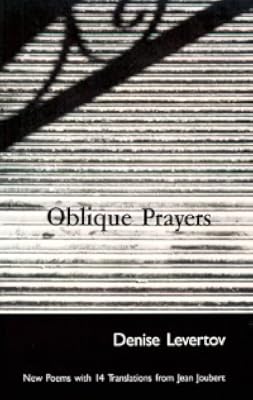
Oblique Prayers
by Denise Levertov
On This Page
Description
Oblique Prayers is arranged in four thematic sections that, taken together, work toward a mature philosophy in equal harmony with public activism and private reflection. A personal mood links the poems of Decipherings." In "Prisoners," the poet addresses the continuing horrors of our dark time: genocide, imperialism, impending nuclear holocaust - human degradation in brutal political guise. Levertov is an accomplished translator. With "Fourteen Poems by Jean Joubert," she introduces show more English-speaking readers to a contemporary French poet whose work is remarkably akin to her own. "Of God and of the Gods," the final section of the book, is informed by a transcendent lyricism that can equate in a breath "a day of spring, a needle's eye." " show lessTags
Recommendations















Member Reviews
I got this collection because I was really floored by a poem from it, however upon rereading I couldn't place which poem it was. Levertov vacillates between metaphysical musing and relaying more concrete social realities and concerns. The space where these overlap captured my interest most, however there were not as many of these moments as I would've hoped for.
So there I was, standing in the poetry section of the library, with no more idea what I was doing there or looking for other than the resolution to "read more poetry" running through my mind. I'd done no research, I'd put no poetry on my hold list, I was just standing there, hoping for inspiration to jump out at me. A few books were picked up and placed back, on the grounds that they were giant anthologies, and my stack for checking out was already towering to a ridiculous height. Finally, I saw this book, and recognizing Levertov from my Panhala poetry email list, I grabbed it and moved on.
When I first started reading, it was clear that I'd forgotten how to read poetry. I kept finishing poems and thinking, "Okay, that was nice, but show more what was the point?" But soon I was drawn in by the steel hooks in the section "Prisoners," about the horrors of brutal regimes in South America, massacres in the name of religions in the Middle East, the proliferation of nuclear weapons... but before we lose hope, Levertov reassures us with her translations of Jean Joubert's poetry from the French, and a final, more lyrical section, "Of God and of the Gods."
While this probably is not a book I'll feel compelled to own, it did reaffirm my resolution to read more poetry. show less
When I first started reading, it was clear that I'd forgotten how to read poetry. I kept finishing poems and thinking, "Okay, that was nice, but show more what was the point?" But soon I was drawn in by the steel hooks in the section "Prisoners," about the horrors of brutal regimes in South America, massacres in the name of religions in the Middle East, the proliferation of nuclear weapons... but before we lose hope, Levertov reassures us with her translations of Jean Joubert's poetry from the French, and a final, more lyrical section, "Of God and of the Gods."
While this probably is not a book I'll feel compelled to own, it did reaffirm my resolution to read more poetry. show less
Smart and graceful, Levertov's poems are meditations on what is possible in a world of compassion, and what comprises darkness in the same. As ever, her language is drenched in lyrical grace, and seemingly effortless. Some of the poems here are spiritual, some concrete. Some of them are difficult and striking, others straightforward. All together, though, the collections rings with soulful engagement with the world, and any poetry reader will find something to love here.
Well worth the read.
Well worth the read.
Yale - notes in Poetry file Bay _
Ratings
Members
- Recently Added By
Author Information

81+ Works 3,126 Members
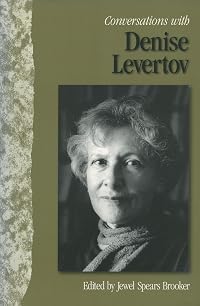
Born in Essex, England, Denise Levertov became a U.S. citizen after her marriage to Mitchell Goodman, the writer who was indicted, with Benjamin Spock and the Rev. William Sloane Coffin, for his antiwar activities. She came to New York to live in 1948. Levertov acknowledges that her writing was influenced by William Carlos Williams, Charles Olson, show more and Robert Duncan. After her first book, The Double Image (1946), was published in England in 1946, she did not produce another volume until 1957, when City Lights brought out Here and Now. In 1961 she was poetry editor for the Nation, and in 1965 she received the grant in literature from the National Institute of Arts and Letters. Her essays collected in The Poet in the World (1973) and Light Up the Cave are written with a penetrating intelligence. Winner of numerous awards and prizes, she is a poet of reverence and fierce moral drive. Denise Levertov died December 20, 1997. (Bowker Author Biography) show less
Classifications
Statistics
- Members
- 68
- Popularity
- 461,457
- Reviews
- 4
- Rating
- (4.20)
- Languages
- English
- Media
- Paper, Ebook
- ISBNs
- 3
- ASINs
- 1