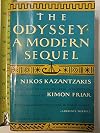
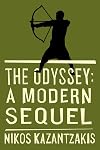
The Odyssey: A Modern Sequel
by Níkos Kazantzákis
On This Page
Description
A continuation of Homer's epic poem, Kazantzakis's own Odyssey finds Odysseus once again leaving Ithaca on finding that the satisfactions of home and hearth are not as he remembered them. Following an encounter with the former Helen of Troy (now returned to her husband, the king of Sparta, after the ignominious defeat of the Trojans), Odysseus gradually wends his way to Egypt and southward, grappling all the while with questions about the nature of God. Considered by Kazantzakis himself to show more be one of his most important works, The Odyssey takes readers on a richly imagined quest for adventure and understanding with one of literature's most timeless characters. show lessTags
Recommendations



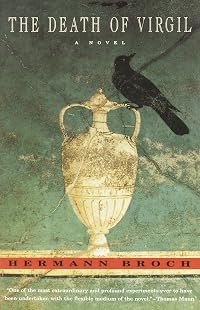


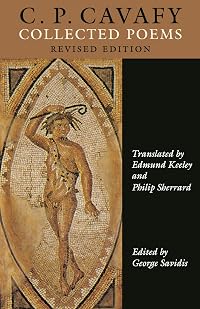
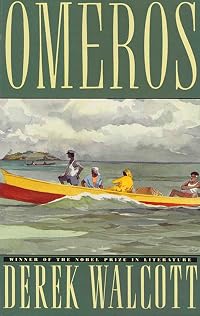
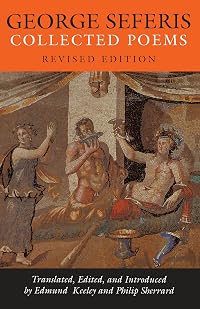













Member Recommendations
Member Reviews
Editing at some (temporal) distance, which is always a problem and which I shouldn't do. But here I am.
I love Homer and am always in some stage or other of trying to learn Ancient Greek so I can read The Iliad or The Odyssey in the original.
This, of course, is not Homer. It's Kazantzakis ... and translated Kazantzakis, at that. So perhaps it's unfair of me to criticize (even as little as I am able, again, at this time gap) the poetry ... what I remember of this very long, very VERY uneven work is that it felt like some kind of Nietzsche mashup / dumbdown, so perhaps something like Ayn Rand but with more creativity. I don't know. It's (predictably?) very pushy and annoying about its "dance [presumably like Zorba] on the lip of a show more volcano"/"the best sort of man [person, but here it's a man] to be is a really self-absorbed a-hole" kind of "philosophy" (so-called: I don't).
So no, I didn't like it very much. Way too serious and pleased with itself. show less
I love Homer and am always in some stage or other of trying to learn Ancient Greek so I can read The Iliad or The Odyssey in the original.
This, of course, is not Homer. It's Kazantzakis ... and translated Kazantzakis, at that. So perhaps it's unfair of me to criticize (even as little as I am able, again, at this time gap) the poetry ... what I remember of this very long, very VERY uneven work is that it felt like some kind of Nietzsche mashup / dumbdown, so perhaps something like Ayn Rand but with more creativity. I don't know. It's (predictably?) very pushy and annoying about its "dance [presumably like Zorba] on the lip of a show more volcano"/"the best sort of man [person, but here it's a man] to be is a really self-absorbed a-hole" kind of "philosophy" (so-called: I don't).
So no, I didn't like it very much. Way too serious and pleased with itself. show less
Holy shit, this book reminded me what the word 'epic' really means. I was drawn to it after having loved Zorba the Greek, but I was unprepared for its depth. I read part of it in Canada, part in Kephalonia (Greece), and did not pass the 3/4 mark (or thereabouts).
In the early parts it was, in a word, badass. Odysseus refused to be shackled by domestic life and yearned for the open sea. As he and his friends built their ship by day, and caroused by night, I felt the joy of working hard on a project of my dreams. The joy of community, also, as I long for the society of strong and fierce men who share my projects.
As they sailed the Mediterranean, raping, pillaging, burning, and conquering, I felt the joy of power. The morality of strength. show more Bloodlust. As they sailed the Nile, casting their fortune into the sea, I felt the burden of worldly possessions, and the noble struggle of poverty on the open road. As they joined the workers' revolt, I felt the oppression of the wealthy, and as they joined the barbarians, I felt disdain for decadence. I envied their empty bellies and burning minds as they crossed the desert, and felt proud as they raised their town high.
When Odysseus climbed the mountain to commune with the God within, I felt his thirst for enlightenment, and the combination of his compassion and his disdain for his fellow men. I stopped shortly after this - I couldn't stay engaged, which says to me that I simply wasn't ready, or in the right headspace. There is a long road ahead, and this book has given me a moral compass. For that, I am grateful. show less
In the early parts it was, in a word, badass. Odysseus refused to be shackled by domestic life and yearned for the open sea. As he and his friends built their ship by day, and caroused by night, I felt the joy of working hard on a project of my dreams. The joy of community, also, as I long for the society of strong and fierce men who share my projects.
As they sailed the Mediterranean, raping, pillaging, burning, and conquering, I felt the joy of power. The morality of strength. show more Bloodlust. As they sailed the Nile, casting their fortune into the sea, I felt the burden of worldly possessions, and the noble struggle of poverty on the open road. As they joined the workers' revolt, I felt the oppression of the wealthy, and as they joined the barbarians, I felt disdain for decadence. I envied their empty bellies and burning minds as they crossed the desert, and felt proud as they raised their town high.
When Odysseus climbed the mountain to commune with the God within, I felt his thirst for enlightenment, and the combination of his compassion and his disdain for his fellow men. I stopped shortly after this - I couldn't stay engaged, which says to me that I simply wasn't ready, or in the right headspace. There is a long road ahead, and this book has given me a moral compass. For that, I am grateful. show less
I read the first 1/3, but lost interest. It has some wonderful lines and metaphors, but they are mixed with trite phrases, and obscure references. It just didn't hold me. You have to work hard to read this book and for me the good elements of the book did not outweigh the bad.
A poem full of the life-affirming philosophy of the Mediterranean.
at Ulysses does after he gets home.....
Ratings
Members
- Recently Added By
Published Reviews
By taking for his own the name of Homer’s poem, by adopting Odysseus as his own hero, Kazantzakis has underlined the audacity of his undertaking. His 33,333 lines measure its vastness. But the poem’s real boldness lies not so much in affinities or in size as in what it sets out to do: to relate man to the earth and his own appetites, to describe his need for God and the tortuous spiritual show more route of the search, and finally to show how man attempts to exorcise his private and worldly devils in a never-ending quest, not for peace of mind but for freedom of soul. show less
added by lilithcat
Lists

The wanderings of Odysseus
61 works; 6 members

Myth (Reuse and Retelling)
188 works; 24 members

Narrative verse for pleasure
75 works; 8 members

Harold Bloom - The Western Canon: D. The Chaotic Age
833 works; 24 members

1930s
262 works; 5 members

Books Read in 2024
4,623 works; 126 members
Talk Discussions
Past Discussions
The lead-off article to start the discussion in The Arresting Life & Writings Of Nikos Kazantzakis (December 2012)
Author Information

140+ Works 12,329 Members
This distinguished novelist, poet, and translator was born in Crete and educated in Athens, Germany, Italy, and Paris, where he studied philosophy. He found time to write some 30 novels, plays, and books on philosophy, to serve his government, and to travel widely. He ran the Greek ministry of welfare from 1919 to 1921 and was minister of state show more briefly in 1945. A political activist, he spent his last years in France and died in Germany. Kazantzakis's character Zorba has been called "one of the great characters of modern fiction," in a novel that "reflects Greek exhilaration at its best" (TLS). A film version of 1965, starring Anthony Quinn, made Kazantzakis widely known in the West. Intensely religious, he imbued his novels with the passion of his own restless spirit, "torn between the active and the contemplative, between the sensual and the aesthetic, between nihilism and commitment" (Columbia Encyclopedia). Judas, the hero of The Last Temptation of Christ (1951) is asked by Christ to betray him so that he can fulfill his mission through the crucifixion. For this book Kazantzakis was excommunicated from the Greek Orthodox Church. The Fratricides, Kazantzakis's last novel, portrays yet another religious hero, a priest caught between Communists and Royalists in the Greek Civil War. (Bowker Author Biography) show less
Some Editions
Awards and Honors
Distinctions
Work Relationships
Is a (non-series) sequel to
The Odyssey by Homer
Was inspired by
The Odyssey by Homer
Has as a commentary on the text
Common Knowledge
- Original publication date
- 1938 (original Greek) (original Greek); 1958 (English: Friar) (English: Friar)
- First words
- O Sun, great Oriental, my proud mind's golden cap, / I love to wear you cocked askew, to play and burst / in song throughout our lives, and so rejoice our hearts.
- Last words
- (Click to show. Warning: May contain spoilers.)Then the earth vanished, the sea dimmed, all flesh dissolved, / the body turned to fragile spirit and spirit to air, / till the air moved and sighed as in the hollow hush / was heard the ultimate and despairing cry of Earth, / the sun's lament, but with no throat or mouth or voice: / "Mother, enjoy the food you've cooked, the wine you hold, / Mother, if you've a rose-bed, rest your weary bones, / Mother, I don't want wine to drink or bread to eat— / today I've seen my loved one vanish like a dwindling thought."
Classifications
- Genres
- Poetry, Fiction and Literature
- DDC/MDS
- 883.1 — Literature & rhetoric Classical & modern Greek literatures Classical Greek epic poetry and fiction Homer
- LCC
- PA5610 .K39 .O33 — Language and Literature Greek language and literature. Latin language and literature Byzantine and modern Greek literature Individual authors
- BISAC
Statistics
- Members
- 543
- Popularity
- 54,703
- Reviews
- 5
- Rating
- (4.21)
- Languages
- English, German, Spanish
- Media
- Paper, Ebook
- ISBNs
- 8
- ASINs
- 18