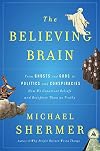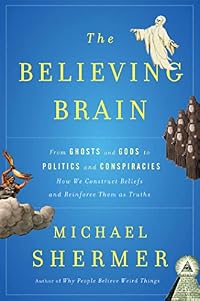
The Believing Brain: From Ghosts and Gods to Politics and Conspiracies - How We Construct Beliefs and Reinforce Them as Truths
by Michael Shermer
On This Page
Description
Shermer demonstrates how our brains selectively assess data in an attempt to confirm the conclusions (beliefs) we've already reached. Drawing on evolution, cognitive science, and neuroscience, he considers not only supernatural beliefs but political and economic ones as well.Tags
Recommendations


































Member Reviews
I really enjoyed this. Shermer argues that the human capacity for self-deception, which is not only wired into the brain, but an unintended property of the neural circuitry responsible for abstract thinking, is why people think badly and believe "stupid" things.
[Updated review below:]
Thinkers of the Enlightenment, mostly pre-scientific philosophers struggling with the nature of human thought and behavior, operated on the conclusion that a human being was a rational, analytical decision-maker. The sophisticated, civilized man was removed from the crude passions of the animals; humans were a thing above, capable of language and culture and all manner of reason. The legacy of the classical view stays with us today, though most of us don't show more realize it; any time we characterize a person's actions as a "choice", however, we're betraying the classical belief of human nature. Decisions are made rationally, by evaluating the evidence and drawing a conclusion; the influence of biological or environmental circumstance need not apply.
Modern neuroscience points to the brain as a pattern-recognition machine. Unlike the computer that sits on your desk or in your phone, the brain is meant to sift through the noise of our surroundings and pick out meaningful patterns. Brains that are good at this, seeing the snake lying in the grass and reacting before it can bite, tend to live longer and thus were selected for. But the downside is that nature didn't care much whether we actually saw a snake, or just a twig on the ground -- false positives were acceptable as long as the real dangers were spotted, and brains that were good at finding snakes and lions happened to generate a lot of false positives. Consequently, we're really good at finding meaning in noise, but we have no error-checking module to discriminate between genuine meaning and the intellectual equivalent of a twig mistaken for a rattlesnake.
From that premise Shermer argues that all the cool and interesting things the brain does, like science, math, music, and art, stem from the exact same pattern-matching features that cause biased, distorted, and irrational thinking. Without any way of comparing the patterns we see to objective reality, it all winds up feeling right to us -- what Shermer calls belief-dependent realism. Human reason, he argues, begins with the belief, which we accept because of that built-in feels-right intuition, and only then do we concern ourselves with evidence and a coherent narrative to explain the belief.
Aliens, gods, conspiracy theories and political views are all dissected and analyzed in light of belief-dependent realism. The latter half of the book devotes a chapter to each, explaining why these beliefs aren't "stupid" -- implying that the believer is intellectually incapable, clueless, uninformed, and willingly believing in obvious nonsense -- but a property of the neurological activity that makes us intelligent in the first place. In an observation that brought a smile to my face, Shermer notes that education and IQ-measured intelligence are no defense against irrationality. Quite the opposite -- intelligent, educated people not only believe in all kinds of strange things, but their cognitive advantages make them better at spinning a good yarn to rationalize their weird beliefs.
Out of the bewildering array of cognitive biases -- errors of distorted thinking -- that we demonstrate, most of them are errors of estimation. We are very good at over-estimating our own capability compared to others, at believing ourselves to be variously in control or subject to circumstances beyond our control (as suits our ego), as products of rational thinking and inborn talent and hard work. Of course everyone else is an idiot, who chose to be lazy and believe stupid things (that I would never believe in), and clearly an irrational thinker who simply can't see things from the right point of view.
This pretty well sums up, oh, only every argument ever, and most everyone you ever meet will go through life blissfully unaware that this is how we function on a very basic biological level.
Shermer closes on an optimistic note, with the last few chapters covering the history and process of science, debunking common misconceptions and laying out his case for why scientific thinking is the best tool we have to avoid the trickery of our own brains. I found this an especially useful and readable summary, explaining why science isn't simply a matter of crusty researchers publishing papers on subjects entirely divorced from reality.
Science is, at heart, a thought process, a way of parsing the world though skepticism, which provides the error-checking machinery absent from our pattern-matching brains. Science draws on experiment, yes, but we can -- must -- infer from data, and balance our empiricism with solid theory. Before science, we were forced to accept theory based on authority, and got dogma; inferring from data, without the context of a larger theory, can lead to the wrong conclusions.
Science is the framework for both theory and data, allowing for converging lines of evidence -- positive evidence, rather than the intellectually-weak "you can't prove it" negative evidence often used to attack a disagreeable conclusion -- to paint a larger picture of the world.
Shermer warns that, being a human institution, even science can fall victim to belief-dependent thinking, but this is no inherent flaw; anything that human beings do carries the risk of turning into self-interested bias. Science remains a process of discrimination through testing, and it's the best tool we have for understanding reality independent of our biased beliefs.
Shermer's writing is always clear and easy to follow, making for an entertaining read even if you don't agree with his conclusions. Shermer is an unapologetic right-wing capital-l Libertarian, a political viewpoint about which I have strong reservations, but he presents his views with a subtlety and humility, parsed in the context of his own argument about human bias, that it was more an interesting case-study in belief rather than advancement of a personal agenda. Also, I give bonus points for a defense of conservative beliefs which was both reasonable and thought-provoking, and which cast the modern-day left-right argument in a new light. I still don't agree with the Other Side, but at least I can understand why we disagree -- and it has less to do with objective Right Or Wrong as it does with biologically-dependent values.
Half the fun of this book is the realization that, even as you read and find yourself going "no, that's wrong!", your visceral, almost knee-jerk disagreement is a product of the very distorted thinking under discussion.
The Believing Brain gets five stars for being a concise, accessible, and well-written treatment of modern trends in neuroscience, motivated reasoning, and scientific thinking. As per my policy, I don't give out bad reviews for disagreement with the author's personal beliefs, nor do I tell the author what his real motives are in writing such obvious propaganda (which would require an extra layer of ironic self-delusion for this particular book); neither is a good rating an endorsement of every last point. I rate highly for presenting a solid thought-provoking argument, for entertainment value, compelling ideas, or any combination thereof. show less
[Updated review below:]
Thinkers of the Enlightenment, mostly pre-scientific philosophers struggling with the nature of human thought and behavior, operated on the conclusion that a human being was a rational, analytical decision-maker. The sophisticated, civilized man was removed from the crude passions of the animals; humans were a thing above, capable of language and culture and all manner of reason. The legacy of the classical view stays with us today, though most of us don't show more realize it; any time we characterize a person's actions as a "choice", however, we're betraying the classical belief of human nature. Decisions are made rationally, by evaluating the evidence and drawing a conclusion; the influence of biological or environmental circumstance need not apply.
Modern neuroscience points to the brain as a pattern-recognition machine. Unlike the computer that sits on your desk or in your phone, the brain is meant to sift through the noise of our surroundings and pick out meaningful patterns. Brains that are good at this, seeing the snake lying in the grass and reacting before it can bite, tend to live longer and thus were selected for. But the downside is that nature didn't care much whether we actually saw a snake, or just a twig on the ground -- false positives were acceptable as long as the real dangers were spotted, and brains that were good at finding snakes and lions happened to generate a lot of false positives. Consequently, we're really good at finding meaning in noise, but we have no error-checking module to discriminate between genuine meaning and the intellectual equivalent of a twig mistaken for a rattlesnake.
From that premise Shermer argues that all the cool and interesting things the brain does, like science, math, music, and art, stem from the exact same pattern-matching features that cause biased, distorted, and irrational thinking. Without any way of comparing the patterns we see to objective reality, it all winds up feeling right to us -- what Shermer calls belief-dependent realism. Human reason, he argues, begins with the belief, which we accept because of that built-in feels-right intuition, and only then do we concern ourselves with evidence and a coherent narrative to explain the belief.
Aliens, gods, conspiracy theories and political views are all dissected and analyzed in light of belief-dependent realism. The latter half of the book devotes a chapter to each, explaining why these beliefs aren't "stupid" -- implying that the believer is intellectually incapable, clueless, uninformed, and willingly believing in obvious nonsense -- but a property of the neurological activity that makes us intelligent in the first place. In an observation that brought a smile to my face, Shermer notes that education and IQ-measured intelligence are no defense against irrationality. Quite the opposite -- intelligent, educated people not only believe in all kinds of strange things, but their cognitive advantages make them better at spinning a good yarn to rationalize their weird beliefs.
Out of the bewildering array of cognitive biases -- errors of distorted thinking -- that we demonstrate, most of them are errors of estimation. We are very good at over-estimating our own capability compared to others, at believing ourselves to be variously in control or subject to circumstances beyond our control (as suits our ego), as products of rational thinking and inborn talent and hard work. Of course everyone else is an idiot, who chose to be lazy and believe stupid things (that I would never believe in), and clearly an irrational thinker who simply can't see things from the right point of view.
This pretty well sums up, oh, only every argument ever, and most everyone you ever meet will go through life blissfully unaware that this is how we function on a very basic biological level.
Shermer closes on an optimistic note, with the last few chapters covering the history and process of science, debunking common misconceptions and laying out his case for why scientific thinking is the best tool we have to avoid the trickery of our own brains. I found this an especially useful and readable summary, explaining why science isn't simply a matter of crusty researchers publishing papers on subjects entirely divorced from reality.
Science is, at heart, a thought process, a way of parsing the world though skepticism, which provides the error-checking machinery absent from our pattern-matching brains. Science draws on experiment, yes, but we can -- must -- infer from data, and balance our empiricism with solid theory. Before science, we were forced to accept theory based on authority, and got dogma; inferring from data, without the context of a larger theory, can lead to the wrong conclusions.
Science is the framework for both theory and data, allowing for converging lines of evidence -- positive evidence, rather than the intellectually-weak "you can't prove it" negative evidence often used to attack a disagreeable conclusion -- to paint a larger picture of the world.
Shermer warns that, being a human institution, even science can fall victim to belief-dependent thinking, but this is no inherent flaw; anything that human beings do carries the risk of turning into self-interested bias. Science remains a process of discrimination through testing, and it's the best tool we have for understanding reality independent of our biased beliefs.
Shermer's writing is always clear and easy to follow, making for an entertaining read even if you don't agree with his conclusions. Shermer is an unapologetic right-wing capital-l Libertarian, a political viewpoint about which I have strong reservations, but he presents his views with a subtlety and humility, parsed in the context of his own argument about human bias, that it was more an interesting case-study in belief rather than advancement of a personal agenda. Also, I give bonus points for a defense of conservative beliefs which was both reasonable and thought-provoking, and which cast the modern-day left-right argument in a new light. I still don't agree with the Other Side, but at least I can understand why we disagree -- and it has less to do with objective Right Or Wrong as it does with biologically-dependent values.
Half the fun of this book is the realization that, even as you read and find yourself going "no, that's wrong!", your visceral, almost knee-jerk disagreement is a product of the very distorted thinking under discussion.
The Believing Brain gets five stars for being a concise, accessible, and well-written treatment of modern trends in neuroscience, motivated reasoning, and scientific thinking. As per my policy, I don't give out bad reviews for disagreement with the author's personal beliefs, nor do I tell the author what his real motives are in writing such obvious propaganda (which would require an extra layer of ironic self-delusion for this particular book); neither is a good rating an endorsement of every last point. I rate highly for presenting a solid thought-provoking argument, for entertainment value, compelling ideas, or any combination thereof. show less
Why do people believe in...anything? Well, mostly because we are wired to believe in stuff -- any stuff. The only thing we can do to help ourselves is be more scientific.
That's the basic message I got from this book. It's an interesting trip, this skeptic's journey. I can't really say a lot about it because, well, most of it is right up front there. Schermer goes into a lot of detail about the various little heuristics and mechanisms in our brains that lead us down the path to belief, but the gist is that we are set up for it and it's hard work not to go with that.
Much of what he said I found myself agreeing with. However, I could have accepted his arguments much more readily if he hadn't, more than once, defaulted to the "If you don't show more agree with me, you're an idiot" stance. And, occasionally, he just fell right off the scientific method platform he holds up as the only method for getting around our limitations. For instance, in listing a variety of current theories about the origins of the universe, he says (referring to the "many-worlds multiverse" theory, he says "The idea of their being multiple versions of me and you out there -- and in an infinite multiverse model there would be an infinite number of us -- just seems prima facia absurd and even less likely than the theistic alternative." (bold is mine) It "just seems"? That's an opinion, and an opinion is a belief (per other areas of the book). Even when you put a Latin phrase behind it, it doesn't meet the standard of logical argumentation he promotes. The lack of the phrase "to me" behind that word "absurd" is a trick to make the statement look like it isn't an opinion.
He does this in several places in the book, even at times tossing insulting descriptions at those whom he classifies as being ruled by their beliefs. Of course, he does state that not believing and basing everything on fact is difficult, and he demonstrates that frequently enough. I understand what he's doing in this book, but it seems to me to be a stance fraught with conflict. That is, one doesn't get to climb up on the platform of scientific method, pure logic, and experimental data to hurl insults at those you do not see as agreeing with your platform, or whom you accuse of misusing the platform.
When he sticks to listing researched data and how knowledge is derived from his particular platform, the book is very good. But those little divergences nagged at me like flies. It isn't even that I agree with the conflicting information or that he stepped on any of my personal beliefs. It was the failure to maintain a non-personal stance throughout rather than taking it on and off like a lab coat. The verbal ju-jitsu he used, trying to phrase his authorial statements of opinion as if they were incontrovertible fact, chipped away at my acceptance of everything. Yes, I could do the research and test what he has said for myself, but that certainly wasn't the intention with which he wrote this book, and in any case I don't have the time to do that for myself, which is why I read the book and others like it.
That just nagged at me, even as I was learning and wondering at other things in the text. I think this book has much of interest in it, but it isn't a last word, or even a penultimate word, on the understanding of why humans belief. show less
That's the basic message I got from this book. It's an interesting trip, this skeptic's journey. I can't really say a lot about it because, well, most of it is right up front there. Schermer goes into a lot of detail about the various little heuristics and mechanisms in our brains that lead us down the path to belief, but the gist is that we are set up for it and it's hard work not to go with that.
Much of what he said I found myself agreeing with. However, I could have accepted his arguments much more readily if he hadn't, more than once, defaulted to the "If you don't show more agree with me, you're an idiot" stance. And, occasionally, he just fell right off the scientific method platform he holds up as the only method for getting around our limitations. For instance, in listing a variety of current theories about the origins of the universe, he says (referring to the "many-worlds multiverse" theory, he says "The idea of their being multiple versions of me and you out there -- and in an infinite multiverse model there would be an infinite number of us -- just seems prima facia absurd and even less likely than the theistic alternative." (bold is mine) It "just seems"? That's an opinion, and an opinion is a belief (per other areas of the book). Even when you put a Latin phrase behind it, it doesn't meet the standard of logical argumentation he promotes. The lack of the phrase "to me" behind that word "absurd" is a trick to make the statement look like it isn't an opinion.
He does this in several places in the book, even at times tossing insulting descriptions at those whom he classifies as being ruled by their beliefs. Of course, he does state that not believing and basing everything on fact is difficult, and he demonstrates that frequently enough. I understand what he's doing in this book, but it seems to me to be a stance fraught with conflict. That is, one doesn't get to climb up on the platform of scientific method, pure logic, and experimental data to hurl insults at those you do not see as agreeing with your platform, or whom you accuse of misusing the platform.
When he sticks to listing researched data and how knowledge is derived from his particular platform, the book is very good. But those little divergences nagged at me like flies. It isn't even that I agree with the conflicting information or that he stepped on any of my personal beliefs. It was the failure to maintain a non-personal stance throughout rather than taking it on and off like a lab coat. The verbal ju-jitsu he used, trying to phrase his authorial statements of opinion as if they were incontrovertible fact, chipped away at my acceptance of everything. Yes, I could do the research and test what he has said for myself, but that certainly wasn't the intention with which he wrote this book, and in any case I don't have the time to do that for myself, which is why I read the book and others like it.
That just nagged at me, even as I was learning and wondering at other things in the text. I think this book has much of interest in it, but it isn't a last word, or even a penultimate word, on the understanding of why humans belief. show less
This is a truly ambitious work that attempts to bring an understanding to why and how we form our beliefs and rationalize them. The book goes through the ways in which we form beliefs and then find ways to justify those beliefs. Mr. Shermer's theory attempt to persuade us that this is in fact the default human behavior, that rational scientific thought is actually harder for us. And looking at the range of science denialism I see in the world today this seems to make some sense. Several different types of belief systems are covered, from the typical religious belief to conspiracy theories and aliens, with a focus within each type of belief on how our brain seeks patterns and gives agent to those patterns.
I feel that the book presents a show more significant argument that we do indeed form our beliefs first, and rationalize them after the fact, even the most dedicated scientist. And this is why the use of the scientific method and constant peer review is essential to the process of revealing the real facts and truths about the universe in which we live. It's just too easy as individuals to get caught up in what we want to be true instead of what is.
The end of the book goes through a review of our current scientific beliefs and how we got to the point we are now. Here Mr. Shermer uses what was discussed previously in the book to show how old beliefs continue to hold sway and are difficult to overcome even in the light of new evidence.
I found this book to be a fascinating must read for anyone who ponders the questions of how we think and believe within our minds. show less
I feel that the book presents a show more significant argument that we do indeed form our beliefs first, and rationalize them after the fact, even the most dedicated scientist. And this is why the use of the scientific method and constant peer review is essential to the process of revealing the real facts and truths about the universe in which we live. It's just too easy as individuals to get caught up in what we want to be true instead of what is.
The end of the book goes through a review of our current scientific beliefs and how we got to the point we are now. Here Mr. Shermer uses what was discussed previously in the book to show how old beliefs continue to hold sway and are difficult to overcome even in the light of new evidence.
I found this book to be a fascinating must read for anyone who ponders the questions of how we think and believe within our minds. show less
We Want to Believe!
(Full disclosure: I received a free advanced review copy of this book through Library Thing’s Early Reviewer program.)
I requested a copy of Michael Shermer’s The Believing Brain through Library Thing’s Earlier Reviewer program on behalf of my husband, who – as a fellow libertarian skeptic – is a huge fan of Shermer’s work. (I’m also a skeptic and an atheist, but economically liberal – so still a fan, but not nearly as much as he!) In addition to owning most of Shermer’s books, he even had the good fortune to interview Shermer for his podcast, The Libertarian Dime, a few years back (during the Amazing Meeting, natch!). So he was rather enthusiastic when we snagged a review copy and it arrived in the show more mail a few weeks later. Busy as he was at work, it then sat around for a few months, gathering dust, until I finally picked it up and started leafing through…and quickly became engrossed.
The basic premise of The Believing Brain is that people form beliefs, and then the explanations for these beliefs follow. (Which is exactly the opposite of how things “should” work – or the opposite of how we’d like to think our rational human minds function, anyhow.) Far from being logical, unbiased, free-thinking agents, we are instead driven by minds that function as “belief engines,” designed by evolution to see patterns in the world – whether real or imagined - and to infuse them with meaning. Thus, beliefs are formed, and the (selective) gathering of (supporting) evidence is secondary. Of course, Shermer’s thesis is much more complicated than this, and draws from the fields of psychology and neurobiology, with a heavy emphasis on behavioral neuroscience (biopsychology) and evolutionary psychology. (Shermer has a bachelor’s degree in biopsychology and a doctorate in the history of science.) He cites a wealth of evidence to support his argument, including research examining the link between activity in different areas of the brain and the propensity to believe in pseudoscience, superstitions, conspiracy theories and other forms of “bunk.” (The book includes a generous, twenty-three page appendix.)
The Believing Brain is divided into four parts. Part I, “Journeys of Belief,” features profiles of skeptics-turned-believers and believers-turned-skeptics, including Shermer himself. Though perhaps unnecessary (the book does clock in at almost 400 pages, after all!), this is a nice, light read, and helps to guide the reader into the meat of the book: Part II, “The Biology of Belief,” which introduces the topics of patternicity and agenicity and discusses how the brain, through neural activity, is involved in each. Part III shows these principles in action: belief in the afterlife, god, aliens and conspiracies all serve as examples of false beliefs preceding valid evidence. Finally, we see in Part IV how beliefs manifest in politics, and how a whole host of biases (e.g., confirmation, self-justification, attribution, sunk-cost and status quo, to name a few) help to trick our minds into believing that we are almost always right (and, conversely, those who disagree with us are almost always wrong). (Those who’ve ever taken a social psychology course will find “Confirmations of Belief” reassuringly familiar.) Lastly, In “Geographies of Belief” and “Cosmologies of Belief,” Shermer illustrates how popular beliefs evolve over time, and positively so through the application of science and the scientific method.
Though I mostly enjoyed The Believing Brain, I do have a few quibbles. Since his thesis draws so heavily upon evolutionary psychology, I would have liked for Shermer to have at least acknowledged some of the criticisms of the field. Additionally, while the research discussed in The Believing Brain suggests that not all of the variations in belief can be attributed to biological factors – for example, environmental and social factors may also play also a role - Shermer doesn’t seem to want to touch either with a ten-foot pole! I found myself especially frustrated by one of the book’s parting chapters, “Cosmologies of Belief,” which draws upon the history of cosmology to demonstrate how beliefs can be changed. Since all of my knowledge about space and time comes from Doctor Who and Battlestar Galactica, I found myself struggling to understand the science in the chapter; science in action became the forest to cosmology’s trees. A more widely understood topic might make this chapter more accessible to a wider audience.
My biggest complaint, however, is perhaps the most minor of them all (well, “minor” inasmuch as it occupies the least space – less than a page, to be exact). Early on, in his introduction on patternicity, Shermer singles out celebrities Jenny McCarthy and Jim Carrey in order to chastise them for their crusade against vaccinations (supposedly because of their link to autism). My problem isn’t with the scolding – it’s well-deserved – but with how Shermer goes about it. He describes a 2009 Autism Awareness Day episode of Larry King Live: on one side of the debate, medical researchers. “On the other side of the table were the actor Jim Carrey and his ex-Playboy bunny partner Jenny McCarthy.” Not only is this an ad hominem attack (they’re celebrities! so they must be stupid and ill-informed!) and appeal to authority (misguided at best, given how Shermer spends the next 300 pages demonstrating how we’re all subject to irrational, misguided beliefs, education be damned), but in describing McCarthy as an “ex-Playboy bunny” – instead of an actress, comedian, or (more generally) a celebrity or entertainer – he engages in a pernicious, subtle bit of slut-shaming as well. Not only is she vacuous and gullible like her partner the actor - but she takes her clothes off for money, to boot! (The horror of it all!) Reductive and sexist. I nearly quit reading the book after choking on this tripe, but pushed on and am happy to report that it’s an anomaly. Still, I hope Shermer revises his choice of words in future editions of the book. (Mine is an ARC.)
Anyhow, given the complexity of the subject matter, it’s helpful if you have some background in biopsychology; while Shermer does a good enough job of explaining the basics of neural communication, I found myself pulling out my old college textbook for extra help (and especially illustrations!). Even so, The Believing Brain is an engaging – if not always easy and breezy – read for the layperson. Methinks this book will appeal most to those in the skeptical/atheist community, as well as those interested in popular psychology books.
http://www.easyvegan.info/2011/09/01/the-believing-brain-by-michael-shermer/ show less
(Full disclosure: I received a free advanced review copy of this book through Library Thing’s Early Reviewer program.)
I requested a copy of Michael Shermer’s The Believing Brain through Library Thing’s Earlier Reviewer program on behalf of my husband, who – as a fellow libertarian skeptic – is a huge fan of Shermer’s work. (I’m also a skeptic and an atheist, but economically liberal – so still a fan, but not nearly as much as he!) In addition to owning most of Shermer’s books, he even had the good fortune to interview Shermer for his podcast, The Libertarian Dime, a few years back (during the Amazing Meeting, natch!). So he was rather enthusiastic when we snagged a review copy and it arrived in the show more mail a few weeks later. Busy as he was at work, it then sat around for a few months, gathering dust, until I finally picked it up and started leafing through…and quickly became engrossed.
The basic premise of The Believing Brain is that people form beliefs, and then the explanations for these beliefs follow. (Which is exactly the opposite of how things “should” work – or the opposite of how we’d like to think our rational human minds function, anyhow.) Far from being logical, unbiased, free-thinking agents, we are instead driven by minds that function as “belief engines,” designed by evolution to see patterns in the world – whether real or imagined - and to infuse them with meaning. Thus, beliefs are formed, and the (selective) gathering of (supporting) evidence is secondary. Of course, Shermer’s thesis is much more complicated than this, and draws from the fields of psychology and neurobiology, with a heavy emphasis on behavioral neuroscience (biopsychology) and evolutionary psychology. (Shermer has a bachelor’s degree in biopsychology and a doctorate in the history of science.) He cites a wealth of evidence to support his argument, including research examining the link between activity in different areas of the brain and the propensity to believe in pseudoscience, superstitions, conspiracy theories and other forms of “bunk.” (The book includes a generous, twenty-three page appendix.)
The Believing Brain is divided into four parts. Part I, “Journeys of Belief,” features profiles of skeptics-turned-believers and believers-turned-skeptics, including Shermer himself. Though perhaps unnecessary (the book does clock in at almost 400 pages, after all!), this is a nice, light read, and helps to guide the reader into the meat of the book: Part II, “The Biology of Belief,” which introduces the topics of patternicity and agenicity and discusses how the brain, through neural activity, is involved in each. Part III shows these principles in action: belief in the afterlife, god, aliens and conspiracies all serve as examples of false beliefs preceding valid evidence. Finally, we see in Part IV how beliefs manifest in politics, and how a whole host of biases (e.g., confirmation, self-justification, attribution, sunk-cost and status quo, to name a few) help to trick our minds into believing that we are almost always right (and, conversely, those who disagree with us are almost always wrong). (Those who’ve ever taken a social psychology course will find “Confirmations of Belief” reassuringly familiar.) Lastly, In “Geographies of Belief” and “Cosmologies of Belief,” Shermer illustrates how popular beliefs evolve over time, and positively so through the application of science and the scientific method.
Though I mostly enjoyed The Believing Brain, I do have a few quibbles. Since his thesis draws so heavily upon evolutionary psychology, I would have liked for Shermer to have at least acknowledged some of the criticisms of the field. Additionally, while the research discussed in The Believing Brain suggests that not all of the variations in belief can be attributed to biological factors – for example, environmental and social factors may also play also a role - Shermer doesn’t seem to want to touch either with a ten-foot pole! I found myself especially frustrated by one of the book’s parting chapters, “Cosmologies of Belief,” which draws upon the history of cosmology to demonstrate how beliefs can be changed. Since all of my knowledge about space and time comes from Doctor Who and Battlestar Galactica, I found myself struggling to understand the science in the chapter; science in action became the forest to cosmology’s trees. A more widely understood topic might make this chapter more accessible to a wider audience.
My biggest complaint, however, is perhaps the most minor of them all (well, “minor” inasmuch as it occupies the least space – less than a page, to be exact). Early on, in his introduction on patternicity, Shermer singles out celebrities Jenny McCarthy and Jim Carrey in order to chastise them for their crusade against vaccinations (supposedly because of their link to autism). My problem isn’t with the scolding – it’s well-deserved – but with how Shermer goes about it. He describes a 2009 Autism Awareness Day episode of Larry King Live: on one side of the debate, medical researchers. “On the other side of the table were the actor Jim Carrey and his ex-Playboy bunny partner Jenny McCarthy.” Not only is this an ad hominem attack (they’re celebrities! so they must be stupid and ill-informed!) and appeal to authority (misguided at best, given how Shermer spends the next 300 pages demonstrating how we’re all subject to irrational, misguided beliefs, education be damned), but in describing McCarthy as an “ex-Playboy bunny” – instead of an actress, comedian, or (more generally) a celebrity or entertainer – he engages in a pernicious, subtle bit of slut-shaming as well. Not only is she vacuous and gullible like her partner the actor - but she takes her clothes off for money, to boot! (The horror of it all!) Reductive and sexist. I nearly quit reading the book after choking on this tripe, but pushed on and am happy to report that it’s an anomaly. Still, I hope Shermer revises his choice of words in future editions of the book. (Mine is an ARC.)
Anyhow, given the complexity of the subject matter, it’s helpful if you have some background in biopsychology; while Shermer does a good enough job of explaining the basics of neural communication, I found myself pulling out my old college textbook for extra help (and especially illustrations!). Even so, The Believing Brain is an engaging – if not always easy and breezy – read for the layperson. Methinks this book will appeal most to those in the skeptical/atheist community, as well as those interested in popular psychology books.
http://www.easyvegan.info/2011/09/01/the-believing-brain-by-michael-shermer/ show less
 This review was written for LibraryThing Early Reviewers.
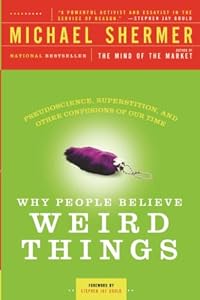
In many ways, The Believing Brain is what I expected and hoped Shermer's earlier Why People Believe Weird Things would be. The earlier title promised an explanation of why, exactly, so many people believe strange things for which there is no evidence, but instead consisted mostly of short overviews of strange things that various people believe. The Believing Brain is much nearer the mark.
In a nutshell, belief -- weird or otherwise -- is the result of an overactive pattern-matching system in the human brain. Long ago, this was evolutionarily advantageous and thus selected for; if an early human wrongly decided that the rustle in the grass was a leopard and ran away, she'd lose the food she was gathering. If she wrongly decided that it show more wasn't and kept collecting food, she'd be rapidly removed from the gene pool. The very different consequences between these "Type 1" and "Type 2" errors have, Shermer argues, predisposed humans to find patterns where there are none, and the related "agenticity" to attribute these patterns to deliberate actions by unseen entities. Shermer cites some fascinating research to back up these claims; self-identified "believers" (on a host of issues ranging from UFOs to angels) are more likely than "skeptics" to identify images that have been significantly degraded by noise; however, they're also far more likely to make wrong identifications.
Armed with this framework for the biological and evolutionary underpinnings of belief, Shermer proceeds to outline how it applies to various classes of common human belief systems. Unlike in his earlier book, he doesn't exclude religion from this analysis (a weak point in the earlier book). Since the fundamental underpinnings are, in fact, the same, this portion of the book drags a bit, though individual issues (such as the tendency for people alone and under physical stress -- mountain climbers, solo sailors, and the like -- to hallucinate helpers or supporters) were fascinating. By far the weakest portion of the book, and one I would certainly have skipped if I hadn't been writing a review, was the section on political beliefs. Despite having pointed out that even people aware of the irrational nature of belief and the tendency for belief to precede the construction of supporting "evidence" do exactly the same things, Shermer doesn't recognize that this applies to him as well. There's an entirely out-of-place ode to libertarianism as the only "rational" political viewpoint, complete with a set of "stereotypes about libertarians" (corresponding to sets he described earlier for liberals and conservatives) that bears zero resemblance either to any libertarians or to any common perceptions of libertarians that I've ever encountered. Unless you share Shermer's political predilictions and are in the mood for some self-congratulatory back-patting, I strongly recommend skipping this section.
Overall, however, this is a very interesting book and well worth reading at least the first portion, and whatever of the later portions you find particularly interesting. show less
In a nutshell, belief -- weird or otherwise -- is the result of an overactive pattern-matching system in the human brain. Long ago, this was evolutionarily advantageous and thus selected for; if an early human wrongly decided that the rustle in the grass was a leopard and ran away, she'd lose the food she was gathering. If she wrongly decided that it show more wasn't and kept collecting food, she'd be rapidly removed from the gene pool. The very different consequences between these "Type 1" and "Type 2" errors have, Shermer argues, predisposed humans to find patterns where there are none, and the related "agenticity" to attribute these patterns to deliberate actions by unseen entities. Shermer cites some fascinating research to back up these claims; self-identified "believers" (on a host of issues ranging from UFOs to angels) are more likely than "skeptics" to identify images that have been significantly degraded by noise; however, they're also far more likely to make wrong identifications.
Armed with this framework for the biological and evolutionary underpinnings of belief, Shermer proceeds to outline how it applies to various classes of common human belief systems. Unlike in his earlier book, he doesn't exclude religion from this analysis (a weak point in the earlier book). Since the fundamental underpinnings are, in fact, the same, this portion of the book drags a bit, though individual issues (such as the tendency for people alone and under physical stress -- mountain climbers, solo sailors, and the like -- to hallucinate helpers or supporters) were fascinating. By far the weakest portion of the book, and one I would certainly have skipped if I hadn't been writing a review, was the section on political beliefs. Despite having pointed out that even people aware of the irrational nature of belief and the tendency for belief to precede the construction of supporting "evidence" do exactly the same things, Shermer doesn't recognize that this applies to him as well. There's an entirely out-of-place ode to libertarianism as the only "rational" political viewpoint, complete with a set of "stereotypes about libertarians" (corresponding to sets he described earlier for liberals and conservatives) that bears zero resemblance either to any libertarians or to any common perceptions of libertarians that I've ever encountered. Unless you share Shermer's political predilictions and are in the mood for some self-congratulatory back-patting, I strongly recommend skipping this section.
Overall, however, this is a very interesting book and well worth reading at least the first portion, and whatever of the later portions you find particularly interesting. show less
This review was written for LibraryThing Early Reviewers.In The Believing Brain, Michael Shermer has succeeded in making a serious analysis of the human brain both highly entertaining and informative.
If you are a baseball fan you will never view the curious antics of a hitter entering the batter's box in quite the same way again after reading Michael's book. You will likely be reminded of the pigeon in a Skinner's Box learning pigeon patternicity: the learning of a superstition.
If you are a Liberal and you cannot understand how those crazy Conservatives can actually believe the things they do, it will be explained to you in Michael's book. The same goes for Conservatives who think that Liberalism is some kind of mental disorder....they will understand why Liberals believe what they believe. show more Michael also explains why neither Liberal nor Conservative is likely to change: it's all based on the way the human brain works.
The first two sections of the book, comprising 135 pages, pretty much lay the scientific foundation for the remainder of the book. Reading it requires some attention to detail, but you will learn quite a bit, and the writing is accessible to the non-scientist, and the author is mindful of his audience and avoids scientific jargon, explaining such jargon when it is impossible to avoid, and reinforcing the explanations when jargon must be used later after the reader may have forgotten the meaning from a few pages earlier. I found this very helpful.
Part 3 of the book is devoted to examining Belief in the Afterlife, Belief in God, Belief in Aliens, and Belief in Conspiracies, using the scientific facts from Parts I & 2 of the book. I was tempted to skip one or two of these Beliefs, but I got sucked in. They are handled quite interestingly. I learned, for instance, that Albert Einstein carried on a correspondence with a lowly ensign named Guy H. Raner aboard the USS Bougainville in the Pacific during World War II regarding the existence of God. I thought I knew a good deal about Einstein, but I hadn't known this! It blew my mind. And the correspondence is included for your reading pleasure.
Even the Alien stuff and the Conspiracy stuff sucked me in. I couldn't put it down.
The final parts of the book bring us back once more to the science behind it all, but more to the history of the science. It is all quite fascinating. There were issues I wish that Michael had examined further: for instance, on p. 274 Michael mentions "The Consistency Bias"...the tendency to recall one's past beliefs as resembling present beliefs more than they actually do. There is the implication here that we DO change our beliefs etc. over time despite the primary idea behind the book being that we first construct beliefs and then reinforce them as time goes by. I would have liked an explanation of how this changes. I can see that as children we may have believed in Santa Claus and the tooth fairy etc., and have learned to discard these beliefs along the way, but I would have appreciated an examination of the mechanisms involved. If Michael happens to read my review I would like him to know that I too missed the gorilla. (this won't make sense to anyone who hasn't read the book...sorry.)
I want to thank Michael Shermer for his work. I shall be returning to his book again when I've finished reading some other books on my must read list. Five Stars...Easy. show less
If you are a baseball fan you will never view the curious antics of a hitter entering the batter's box in quite the same way again after reading Michael's book. You will likely be reminded of the pigeon in a Skinner's Box learning pigeon patternicity: the learning of a superstition.
If you are a Liberal and you cannot understand how those crazy Conservatives can actually believe the things they do, it will be explained to you in Michael's book. The same goes for Conservatives who think that Liberalism is some kind of mental disorder....they will understand why Liberals believe what they believe. show more Michael also explains why neither Liberal nor Conservative is likely to change: it's all based on the way the human brain works.
The first two sections of the book, comprising 135 pages, pretty much lay the scientific foundation for the remainder of the book. Reading it requires some attention to detail, but you will learn quite a bit, and the writing is accessible to the non-scientist, and the author is mindful of his audience and avoids scientific jargon, explaining such jargon when it is impossible to avoid, and reinforcing the explanations when jargon must be used later after the reader may have forgotten the meaning from a few pages earlier. I found this very helpful.
Part 3 of the book is devoted to examining Belief in the Afterlife, Belief in God, Belief in Aliens, and Belief in Conspiracies, using the scientific facts from Parts I & 2 of the book. I was tempted to skip one or two of these Beliefs, but I got sucked in. They are handled quite interestingly. I learned, for instance, that Albert Einstein carried on a correspondence with a lowly ensign named Guy H. Raner aboard the USS Bougainville in the Pacific during World War II regarding the existence of God. I thought I knew a good deal about Einstein, but I hadn't known this! It blew my mind. And the correspondence is included for your reading pleasure.
Even the Alien stuff and the Conspiracy stuff sucked me in. I couldn't put it down.
The final parts of the book bring us back once more to the science behind it all, but more to the history of the science. It is all quite fascinating. There were issues I wish that Michael had examined further: for instance, on p. 274 Michael mentions "The Consistency Bias"...the tendency to recall one's past beliefs as resembling present beliefs more than they actually do. There is the implication here that we DO change our beliefs etc. over time despite the primary idea behind the book being that we first construct beliefs and then reinforce them as time goes by. I would have liked an explanation of how this changes. I can see that as children we may have believed in Santa Claus and the tooth fairy etc., and have learned to discard these beliefs along the way, but I would have appreciated an examination of the mechanisms involved. If Michael happens to read my review I would like him to know that I too missed the gorilla. (this won't make sense to anyone who hasn't read the book...sorry.)
I want to thank Michael Shermer for his work. I shall be returning to his book again when I've finished reading some other books on my must read list. Five Stars...Easy. show less
This review was written for LibraryThing Early Reviewers.I have read Shermer's columns in the Scientific American, and a previous book, and agree strongly with his stance as a skeptic, but have always thought he is a little dismissive and superficial in his approach. This was a more satisfying book, with a lot of information about psychological processes in the brain that make it likely that one will abstract a pattern from sense data, and assign preferentialy an agent to cause the phenomenon. Unfortunately, this argument forms only two or three chapters of the book, the rest being investigations of belief in god, the afterlife, alien abductions, conspiracies, and the like, and a last section on the formation of theories in astronomy. It will not convince people who are not skeptical in the show more beginning, but in an example of "confirmation bias" reinforces the belief of the skeptic in the correctness of his approach. show less
Members
- Recently Added By
Lists

Atheism, humanism, freethought, &c. — Best nonfiction books in favour of
167 works; 14 members

The Great Courses: Your Deceptive Mind
60 works; 1 member

Vlogbrothers Book Recommendations
307 works; 4 members
Author Information

148+ Works 9,561 Members
Michael Shermer is the director of the Skeptics Society and the host of the Skeptics Lecture Series at the California Institute of Technology. He teaches science, technology, and evolutionary thought in the Cultural Studies Program at Occidental College.
Some Editions
Awards and Honors
Awards
Common Knowledge
- Canonical title
- The Believing Brain: From Ghosts and Gods to Politics and Conspiracies---How We Construct Beliefs and Reinforce Them as Truths; The Believing Brain: From Ghosts and Gods to Politics and Conspiracies - How We Construct Beliefs and Reinforce Them as Truths
- Original publication date
- 2011
- Epigraph
- For the mind of man is far from the nature of a clear and equal glass, wherein the beams of things should reflect according to their true incidence; nay, it is rather like an enchanted glass, full of superstition and impostur... (show all)e, if it be not delivered and reduced. —Francis Bacon, Novum Organum, 1620
- Dedication
- To Devin Ziel Shermer
For our small contribution—6,895 days or 18.9 years from birth to independence—to the metaphorically miraculous 3.5-billion-year continuity of life on Earth from one generation to the next, u... (show all)nbroken over the eons, glorious in its continguity, spiritual in its contemplation. The mantle is now yours. - First words
- Prologue
I Want to Believe
The 1990s' uber conspiracy-theory television series The X-Files was a decade-defining and culture-reflecting mosh pit of UFOs, extraterrestrials, psychics, demons, monsters, mutants... (show all), shape-shifters, serial killers, paranormal phenomena, urban legends turned real, corporate cabals and government cover-ups, and leakages that included a Deep Throat-like "cigarette smoking man" character played, ironically, by real-life skeptic William B. Davis. - Last words
- (Click to show. Warning: May contain spoilers.)Ad astra per aspera!
- Publisher's editor
- Jones, Serena; Daniel, Michelle
- Blurbers
- Harris, Sam; Krauss, Lawrence M.; Bloom, Paul; Mlodinow, Leonard; Nye, Bill; Hood, Bruce
Classifications
- Genres
- Nonfiction, General Nonfiction, Science & Nature, Religion & Spirituality, Philosophy
- DDC/MDS
- 153.4 — Philosophy & psychology Psychology Conscious mental processes and intelligence Thought, thinking, reasoning, intuition, value, judgment
- LCC
- BF773 .S54 — Philosophy, Psychology and Religion Psychology Psychology
- BISAC
Statistics
- Members
- 886
- Popularity
- 30,365
- Reviews
- 28
- Rating
- (3.88)
- Languages
- English, Portuguese, Turkish
- Media
- Paper, Audiobook, Ebook
- ISBNs
- 8
- ASINs
- 9