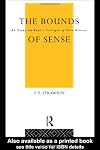
The Bounds of Sense: An Essay on Kant's Critique of Pure Reason
by P. F. Strawson
On This Page
Description
The Bounds of Sense is one of the most influential books ever written about Kant's philosophy, and is one of the key philosophical works of the late Twentieth century. Although it is probably best known for its criticism of Kant's transcendental idealism, it is also famous for the highly original manner in which Strawson defended and developed some of Kant's fundamental insights into the nature of subjectivity, experience and knowledge. The book had a profound effect on the interpretation of show more Kant's philosophy when it was first published in 1966 and continues to influence discussion show lessTags
Recommendations



















Member Reviews
Strawson presents a fairly thorough critical evaluation of Kant's first critique, with the goal of seeing how much of Kant is salvageable and how much must be discarded due. The Bounds of Sense does a good job addressing (and tearing down) many of the most contentious and sketchy aspects of the Critique of Pure Reason, e.g. the mania for systematicity, the problem of the "affective" relationship between things in themselves and appearances, and the self-knowledge. Strawson also provides some good criticism of the analogies of experience, and the antinomies.
Overall, his goal is to show how flimsy the arguments for transcendental idealism are, and yet also how much of Kant can be maintained without this doctrine.
Overall, his goal is to show how flimsy the arguments for transcendental idealism are, and yet also how much of Kant can be maintained without this doctrine.
The bounds of the real, we may say, are indeed not co-extensive with the types of sensible experience we in fact enjoy. We must not suppose that the nature of reality is exhausted by the kinds of knowledge which we have of it. To suppose this would be a kind of restrictive dogmatism unjustified in its way as the inflated dogmatism which pretends to a knowledge transcending experience. The latter makes an unjustifiable a priori claim to expand knowledge beyond experience. The former would make an equally unjustifiable a priori claim to restrict reality within the bounds of the kind of experience we in fact have.
Ratings
Members
- Recently Added By
Lists

In Our Time books
4,934 works; 2 members
Author Information

23+ Works 1,182 Members
Although the ordinary-language branch of analytic philosophy began as an effort to dissolve philosophy, Peter F. Strawson, who has been one of its major voices, has shown that this approach can be enlarged to address many of the great themes of the Western tradition. Strawson was born in England and educated at Oxford University. After military show more service during World War II and a brief period of teaching in Wales, he returned to Oxford, where he has remained. Strawson's Introduction to Logical Theory (1952) shows that symbolic logic does not capture the complexity of ordinary language. He therefore argues for a logic of everyday discourse that can capture the conditions under which we use logical construction to express ourselves. He tries to show that some classes of valid arguments are not recognized as such within formal systems and that Aristotelian logic can be defended as preferable to modern logic. Strawson's emphasis on language continues in his later work, in which he uses linguistic structures to address metaphysics and epistemology. His book on Immanuel Kant, for example, uses language to rework a priori knowledge. Individuals (1959) begins his work in descriptive metaphysics by proposing that the concept of the person be taken as philosophically primitive. This, he believes, would avoid two equally incoherent views, the first being Cartesian dualism, the second being the view that states of consciousness can be discussed without reference to a knowing subject. (Bowker Author Biography) show less
Common Knowledge
- Original publication date
- 1966
- People/Characters
- Kant, Immanuel, 1724-1804
Classifications
Statistics
- Members
- 236
- Popularity
- 138,429
- Reviews
- 3
- Rating
- (3.89)
- Languages
- 6 — English, German, Hungarian, Italian, Japanese, Spanish
- Media
- Paper, Ebook
- ISBNs
- 16
- ASINs
- 8