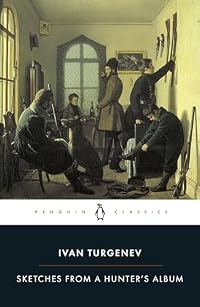
Sketches from a Hunter's Album
by Ivan Turgenev
И.С. Тургенев. Сочинения в двенадцати томах (Collections and Selections — )
On This Page
Description
The first major writing by Turgenev that gained him recognition. The stories in this collection were written based on Turgenev's own observations while hunting at his mothers' estate. This work exposed many injustices of serfdom and led to Turgenev's house arrest and eventual abolishment of serfdom in Russia. A fine example of realist tradition in Russian literature.Tags
Recommendations

















Member Recommendations

Kudos by Rachel Cusk
aprille I felt that Kudos was a modern version of A Sportsman's Notebook. In both, a nearly silent narrator travels through the world and transcribes the stories that people tell. In Turgenev, the stories accumulate to give a sense of the unjust misery of serfs' lives and in Cusk's book, a sense of the struggle of middle-aged women to live and work in a space where men take up most of the oxygen.
Member Reviews
On the face of it this seems a very modest, unassuming collection of short stories, most of them little more than sketches or anecdotes, narrated by a gentleman who has inherited his grandfather's estate in the Russian countryside and goes there to shoot for a few weeks of the year. But it's considered to be one of the most politically influential texts in 19th century Russian literature.
The reason for that seems to lie in the way Turgenev's sportsman-narrator engages with the country people he meets and tries to discover their stories and the way they live. Naturally, they all turn out to be complex human individuals, each with a unique background and personal characteristics, and highly-specific relationships, problems, hopes and show more dreams. The serfs stubbornly refuse to dissolve into the romantic notion of "Russian peasant" (spirituality, resignation, stubbornness, tradition); the landowners equally fail to fall into any stereotypical notions we might have of gentlemanly or aristocratic attitudes.
Moreover, it often turns out that the serf characters have had their lives messed up in multiple ways by the thoughtless and arbitrary behaviour of their owners. The narrator never explicitly criticises this behaviour, but he notes its effects, and he leaves us to draw our own conclusions about whether that sort of thing is acceptable in a modern European country in the middle of the progressive nineteenth century.
The narrator is always described as a sportsman, but shooting birds doesn't enter much into the stories. The usual pattern is that he goes to a particular place in order to shoot, there's a lyrical description of the landscape, and then something happens to prevent him from getting to grips with the birds, and he meets someone who turns out to have an interesting story. More often than not, something else then happens to prevent that person from quite getting to the end of the story, so we are left dangling slightly, and have to work things out for ourselves a little. A couple of times we get someone who appears as a minor character in one story and is then fully developed in their own right in the next, but apart from that there is no overall development between the stories.
Oddly enough, Turgenev's technique reminded me very strongly of Mary Russell Mitford, a writer from a rather different background, but with the same kind of intelligent interest in how rural life works and what problems country people have to deal with. And the same sort of mix of lyrical-but-precise scenic description and realistic observation of human behaviour. Lovely, compassionate and very compelling writing in both cases.
The 2020 Ecco edition of the Hepburn translation (originally published by Everyman) comes with an extra introduction by Pakistani-American writer Daniyal Mueenuddin, who talks about how relevant he still finds Turgenev's stories to the semi-feudal agricultural society he grew up in. show less
The reason for that seems to lie in the way Turgenev's sportsman-narrator engages with the country people he meets and tries to discover their stories and the way they live. Naturally, they all turn out to be complex human individuals, each with a unique background and personal characteristics, and highly-specific relationships, problems, hopes and show more dreams. The serfs stubbornly refuse to dissolve into the romantic notion of "Russian peasant" (spirituality, resignation, stubbornness, tradition); the landowners equally fail to fall into any stereotypical notions we might have of gentlemanly or aristocratic attitudes.
Moreover, it often turns out that the serf characters have had their lives messed up in multiple ways by the thoughtless and arbitrary behaviour of their owners. The narrator never explicitly criticises this behaviour, but he notes its effects, and he leaves us to draw our own conclusions about whether that sort of thing is acceptable in a modern European country in the middle of the progressive nineteenth century.
The narrator is always described as a sportsman, but shooting birds doesn't enter much into the stories. The usual pattern is that he goes to a particular place in order to shoot, there's a lyrical description of the landscape, and then something happens to prevent him from getting to grips with the birds, and he meets someone who turns out to have an interesting story. More often than not, something else then happens to prevent that person from quite getting to the end of the story, so we are left dangling slightly, and have to work things out for ourselves a little. A couple of times we get someone who appears as a minor character in one story and is then fully developed in their own right in the next, but apart from that there is no overall development between the stories.
Oddly enough, Turgenev's technique reminded me very strongly of Mary Russell Mitford, a writer from a rather different background, but with the same kind of intelligent interest in how rural life works and what problems country people have to deal with. And the same sort of mix of lyrical-but-precise scenic description and realistic observation of human behaviour. Lovely, compassionate and very compelling writing in both cases.
The 2020 Ecco edition of the Hepburn translation (originally published by Everyman) comes with an extra introduction by Pakistani-American writer Daniyal Mueenuddin, who talks about how relevant he still finds Turgenev's stories to the semi-feudal agricultural society he grew up in. show less
The Book Report: This edition of "A Sportsman's Sketches" or "Sketches from a Hunter's Album" contains 13 of a possible 25 short fictions published by the tyro writer in Russia's preeminent literary magazine, The Contemporary, from 1847 to 1851. These were his first prose outpourings, designed to sustain his independent life far away from his autocratic and abusive mother. He brought these luminous, beautiful vignettes to life in partial imitation of his beloved's husband's work...Louis Viardot, much older husband of opera singer Pauline Viardot, and author of Souvenirs de chasse, a very similar collection of huntsman's memories of the countryside and people of Viardot's youth...but of his own youthful world at his mother's country show more estate.
The stories all illustrate the young author's liberalism, his disdain for the serf system sustaining a luxurious lifestyle for some and penury and privation for most. They were hailed by his fellow liberals, and entered the canon of Russian literature on the strength of that appeal. But generations of readers will attest that what keeps people reading these vignettes is a certain deftness and facility with characters and descriptions that is so robust that it even survives translation. These are objects of rare beauty. Not much when considered as stories, they blossom into beauty when viewed as moments lived by a very acute observer.
My Review: "Singers" is possibly my favorite of the sketches. The bleakness of the village, the unexpectedness of the singing contest in such a place, and the sheer animal drive of humans to find SOME joy in life...memorable.
"Kasyan from the Beautiful Lands" makes me weep...the dwarf, his simple belief that the world is good but mankind is not, his strength and certainty, all in contrast to our helpless and feckless narrator...how clear is Turgenev's picture of the unfairness of privilege unearned.
"Forest and Steppe" is, alone, the best reason I can give to you to go and get this book and read it. It shimmers. Its beauty of image and of imagination is simply unsurpassable. It is as close to perfect as any piece of writing I've ever seen.
So many of the others are, while good and worthy pieces of fiction, just not superb, that I feel it's best to say...the reason to read this collection is the cumulative effect of many a small, beautiful moment, not a Grand Revelation. More like walking in the woods by yourself, noticing birdsong and small shy flowers, than stumbling all unaware across the Grand Canyon. show less
The stories all illustrate the young author's liberalism, his disdain for the serf system sustaining a luxurious lifestyle for some and penury and privation for most. They were hailed by his fellow liberals, and entered the canon of Russian literature on the strength of that appeal. But generations of readers will attest that what keeps people reading these vignettes is a certain deftness and facility with characters and descriptions that is so robust that it even survives translation. These are objects of rare beauty. Not much when considered as stories, they blossom into beauty when viewed as moments lived by a very acute observer.
My Review: "Singers" is possibly my favorite of the sketches. The bleakness of the village, the unexpectedness of the singing contest in such a place, and the sheer animal drive of humans to find SOME joy in life...memorable.
"Kasyan from the Beautiful Lands" makes me weep...the dwarf, his simple belief that the world is good but mankind is not, his strength and certainty, all in contrast to our helpless and feckless narrator...how clear is Turgenev's picture of the unfairness of privilege unearned.
"Forest and Steppe" is, alone, the best reason I can give to you to go and get this book and read it. It shimmers. Its beauty of image and of imagination is simply unsurpassable. It is as close to perfect as any piece of writing I've ever seen.
So many of the others are, while good and worthy pieces of fiction, just not superb, that I feel it's best to say...the reason to read this collection is the cumulative effect of many a small, beautiful moment, not a Grand Revelation. More like walking in the woods by yourself, noticing birdsong and small shy flowers, than stumbling all unaware across the Grand Canyon. show less
Turgenev lays bare the injustices and arbitrariness of the serf system simply through recounting stories in which the humanity of all the characters, good, bad and middling, and with all their flaws, is allowed to speak, and his breathtakingly beautiful evocations of the natural world of the Russian countryside create the background and context. There's humour too, as there must be in all accounts of human interactions, and pathos which at times is almost unbearable. As with the 'A Russian Gentleman' and 'Years of Childhood' volumes of Sergei Aksakov's autobiographical trilogy, Turgenev's 'Sketches from a Hunter's Album' seems to take you to the actual living reality of rural Russia under serfdom. A wonderfully evocative book and a joy show more to read. show less
One reason I decided to read Turgenev's Sketches is because I very much appreciated his colorful and vivid character descriptions in the novels by him that I had already read, and he makes full use of that particular talent of his in this collection of short-stories. It's not just simply a collection of short-stories though since the narrator stays the same and there’s also his constant hunting companion Yermolay, who figures in several of these stories. Turgenev's descriptions of the landowning gentry and peasants are based on his experiences while out hunting in the areas surrounding his estate at Spasskoye – and they are often told with wry humor and sometimes imbued with that particular sense of sadness that I have found only in show more Russian literature. Besides the many different fascinating – and sometimes unforgettable - characters of these stories there’s also Turgenev's absorbing descriptions of the Russian countryside – though while in just this area he is sometimes bordering a bit too much on Romanticism (for my own taste), it’s easily forgivable not only when taking into account that these stories were first published in 1852, but also because Turgenev's genuine appreciation of nature is so obvious. As he writes in Forest and Steppe, "suppose you are not a born hunter, though you still love nature; in that case you can hardly fail to envy the lot of your brother hunters.." - I read this book while moving house, thinking that short-stories could be the perfect reading material in the course of this busy period, and the slow, lingering pace of most of this stories was indeed a great "antidote" for just that predicament. As a matter of fact, it could also be a great remedy for anyone heavily inflicted with the "modern condition". I read the complete edition containing all twenty-five of the Sketches, in a translation by Richard Freeborn, and to put it briefly: most of them are both both captivating and outstanding. I’ve read that Hemingway admired Turgenev for his short stories, now I know why.
This work is licensed under a Creative Commons Attribution-NonCommercial-ShareAlike 3.0 Unported License. show less
This work is licensed under a Creative Commons Attribution-NonCommercial-ShareAlike 3.0 Unported License. show less
A Sportsman’s Sketches by Ivan Turgenev is a collection of short stories or observations (sketches) from the viewpoint of a Russian nobleman traveling his lands to both survey them and hunt for sport. [Note that this book is sometimes titled Sketches from a Hunter’s Album.]
When you can’t enjoy a novel in the original language, then the book is only as good as the translation you have at hand. This particular edition was translated by Constance Garnett who did an excellent job of making Turgenev approachable.
While somewhat pastoral through the idyllic scenery that is described in detail, Turgenev’s main focus is the people that the sportsman encounters. Through discussions and business dealings, we learn that most people are not show more as they initially appear. Poor, unhealthy peasants display some of the deepest wisdom while privileged and well respected gentry are abusive and take advantage of their position. Class distinctions are important in this book, but the narrator tends to take a more positive view of those well below his station. One lesson that is consistent through most sketches is that your actions have a great impact on how others treat you.
My favorite descriptive passage in the book was when the hunter is lying on his back and looking up through the trees into sky. In the middle of his detailed description, he flips his viewpoint to be that of peering into the depths of the ocean. This ends in one of my favorite phrases:
“the deep, pure blue stirs on one’s lips a smile, innocent as itself; like the clouds over the sky, and, as it were, with them, happy memories pass in slow procession over the soul”
Turgenev is a Russian master that is more easily understood by Westerners than some of his contemporaries. His sentence structure (depending on the translator) may still be very complex, but the subject matter is simple. This was relatively short for a piece of Russian fiction, but it’s a great sample of Turgenev’s style and made me interested in reading more of his work. show less
When you can’t enjoy a novel in the original language, then the book is only as good as the translation you have at hand. This particular edition was translated by Constance Garnett who did an excellent job of making Turgenev approachable.
While somewhat pastoral through the idyllic scenery that is described in detail, Turgenev’s main focus is the people that the sportsman encounters. Through discussions and business dealings, we learn that most people are not show more as they initially appear. Poor, unhealthy peasants display some of the deepest wisdom while privileged and well respected gentry are abusive and take advantage of their position. Class distinctions are important in this book, but the narrator tends to take a more positive view of those well below his station. One lesson that is consistent through most sketches is that your actions have a great impact on how others treat you.
My favorite descriptive passage in the book was when the hunter is lying on his back and looking up through the trees into sky. In the middle of his detailed description, he flips his viewpoint to be that of peering into the depths of the ocean. This ends in one of my favorite phrases:
“the deep, pure blue stirs on one’s lips a smile, innocent as itself; like the clouds over the sky, and, as it were, with them, happy memories pass in slow procession over the soul”
Turgenev is a Russian master that is more easily understood by Westerners than some of his contemporaries. His sentence structure (depending on the translator) may still be very complex, but the subject matter is simple. This was relatively short for a piece of Russian fiction, but it’s a great sample of Turgenev’s style and made me interested in reading more of his work. show less
Lovely little book of beautifully descriptive stories & observations of a Russian Nobleman's encounters with both nature and people as he traveled about the Russian countryside in the mid 1800's. His discourse relative to peasants was always very respectful, and his unease with the double-class system lurks gently below his text. That was interesting, but even more stellar to me were the unbelievable descriptions of the beauty of unspoiled nature....woods especially, but fields, gardens, roads, rivers, springs, weather.....all with striking descriptions that could actually make you see, feel and smell all that he described....not an easy task. While from the perspective of a hunter, in closing he even admits that not all can appreciate show more the love of hunting.....but how can you anything but envy the hunter whose world is the glory of nature. Interesting read...... show less
In his Preface to "The Seasons" the Scottish poet James Thomson said, "I know no subject more elevating, more amazing, more ready to poetical enthusiasm, the philosophical reflection, and the moral sentiment than the works of nature. Where can we meet such variety, such beauty, such magnificence?"
This is a theme that runs through the Sketches From a Hunter's Album. The beauty of the sylvan glade or the summer sun glistening off the meadows flowers is brought to life by the prose of Turgenev in these vignettes. Certainly the characters are also finely drawn and include all social stratas while emphasizing the narrator's interactions with peasants and serfs. It is the latter that impress the reader by the respect and generosity with which show more they are treated. The combination of fascinating characters and beautiful nature writing made this book a joy to read. I found myself looking forward to the next chapter with expectation that I would be treated to another even more interesting facet of the countryside and its denizens. I was not disappointed until the end of the book and only then because I did not want it to end.
Considering this book was first published in 1852 after having appeared serially as separate sketches, it is a further wonder because the serfs would not be freed for another decade. These short stories revealed Turgenev's unique talent for story-telling. And they greatly influenced Russian short story writers into the early 20th century, including Anton Chekhov, Ivan Bunin, Alexander Kuprin and others. The stories remain fresh today, even in translation, and reward the reader with their magnificence. But let me leave you with a quote from Turgenev himself that expresses my feelings as well:
“the deep, pure blue stirs on one’s lips a smile, innocent as itself; like the clouds over the sky, and, as it were, with them, happy memories pass in slow procession over the soul” show less
This is a theme that runs through the Sketches From a Hunter's Album. The beauty of the sylvan glade or the summer sun glistening off the meadows flowers is brought to life by the prose of Turgenev in these vignettes. Certainly the characters are also finely drawn and include all social stratas while emphasizing the narrator's interactions with peasants and serfs. It is the latter that impress the reader by the respect and generosity with which show more they are treated. The combination of fascinating characters and beautiful nature writing made this book a joy to read. I found myself looking forward to the next chapter with expectation that I would be treated to another even more interesting facet of the countryside and its denizens. I was not disappointed until the end of the book and only then because I did not want it to end.
Considering this book was first published in 1852 after having appeared serially as separate sketches, it is a further wonder because the serfs would not be freed for another decade. These short stories revealed Turgenev's unique talent for story-telling. And they greatly influenced Russian short story writers into the early 20th century, including Anton Chekhov, Ivan Bunin, Alexander Kuprin and others. The stories remain fresh today, even in translation, and reward the reader with their magnificence. But let me leave you with a quote from Turgenev himself that expresses my feelings as well:
“the deep, pure blue stirs on one’s lips a smile, innocent as itself; like the clouds over the sky, and, as it were, with them, happy memories pass in slow procession over the soul” show less
Members
- Recently Added By
Lists

Russian Literature
184 works; 35 members

The Top Ten: Writers Pick Their Favorite Books
240 works; 31 members

Books about Russia and the former USSR
67 works; 12 members

Russian Literature Sequence
28 works; 1 member

O, those Russians (as Boney M sang)
16 works; 1 member

Read These Too
458 works; 9 members

Harold Bloom - The Western Canon: C. The Democratic Age
336 works; 15 members

Trinity College Booklist (1951): Class Nine, Foreign Literatures
161 works; 3 members

Books Read in 2026
1,699 works; 62 members
Author Information

609+ Works 24,357 Members
Ivan Turgenev, 1818 - 1883 Novelist, poet and playwright, Ivan Turgenev, was born to a wealthy family in Oryol in the Ukraine region of Russia. He attended St. Petersburg University (1834-37) and Berlin University (1838-41), completing his master's exam at St. Petersburg. His career at the Russian Civil Service began in 1841. He worded for the show more Ministry of Interior from 1843-1845. In the 1840's, Turgenev began writing poetry, criticism, and short stories under Nikolay Gogol's influence. "A Sportsman's Sketches" (1852) were short pieces written from the point of view of a nobleman who learns to appreciate the wisdom of the peasants who live on his family's estate. This brought him a month of detention and eighteen months of house arrest. From 1853-62, he wrote stories and novellas, which include the titles "Rudin" (1856), "Dvorianskoe Gnedo" (1859), "Nakanune" (1860) and "Ottsy I Deti" (1862). Turgenev left Russia, in 1856, because of the hostile reaction to his work titled "Fathers and Sons" (1862). Turgenev finally settled in Paris. He became a corresponding member of the Imperial Academy of Sciences in 1860 and Doctor of Civil Law at Oxford University in 1879. His last published work, "Poems in Prose," was a collection of meditations and anecdotes. On September 3, 1883, Turgenev died in Bougival, near Paris. (Bowker Author Biography) show less
Some Editions
Awards and Honors
Series

Belongs to Publisher Series
Work Relationships
Is contained in
Is abridged in
Common Knowledge
- Canonical title
- Sketches from a Hunter's Album
- Original title
- Записки охотника; Запи́ски охо́тника
- Alternate titles
- A Sportsman's Sketches; A Sportsman's Notebook; The Hunting Sketches
- Original publication date
- 1852
- People/Characters*
- Jaschka; Kasjan; Kalinytsch; Lukerja; Birjuk; Arina
- Important places
- Russia
- Important events*
- Leibeigenschaft
- First words
- Whoever has happened to travel from Bolkhov County into the Zhizdra region will no doubt have been struck by the the sharp differences between the nature of the people in the Orlov Province and those in Kaluga.
- Last words
- (Click to show. Warning: May contain spoilers.)Farewell, my reader; I wish you lasting happiness and well-being.
- Original language
- Russian
*Some information comes from Common Knowledge in other languages. Click "Edit" for more information.
Classifications
- Genres
- General Fiction, Fiction and Literature
- DDC/MDS
- 891.733 — Literature & rhetoric Literatures of other languages East Indo-European and Celtic literatures Russian and East Slavic languages Russian fiction 1800–1917
- LCC
- PG3421 .Z3 — Language and Literature Slavic languages and literatures. Baltic languages. Albanian language Slavic. Baltic. Albanian Russian literature Individual authors and works 1800-1870 Turgenev
- BISAC
Statistics
- Members
- 2,024
- Popularity
- 10,276
- Reviews
- 32
- Rating
- (4.06)
- Languages
- 21 — Chinese, Czech, Danish, Dutch, English, Estonian, Finnish, French, German, Greek, Hungarian, Italian, Norwegian (Bokmål), Polish, Portuguese, Russian, Croatian, Spanish, Swedish, Turkish, Vietnamese
- Media
- Paper, Audiobook, Ebook
- ISBNs
- 122
- ASINs
- 64