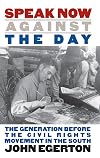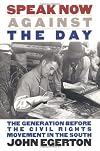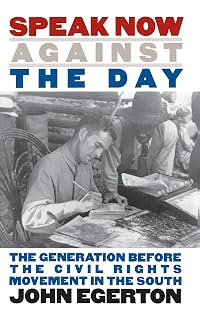
Speak Now Against The Day: The Generation Before the Civil Rights Movement in the South
by John Egerton
On This Page
Description
Speak Now Against the Day is the astonishing, little-known story of the Southerners who, in the generation before the Supreme Court outlawed school segregation and before Rosa Parks refused to surrender her seat on a Montgomery bus, challenged the validity of a white ruling class and a "separate but equal" division of the races. The voices of the dissenters, although present throughout the South's troubled history, grew louder with Roosevelt's election in 1932. An increasing number of men show more and women who grappled daily with the economic and social woes of the South began forcefully and courageously to speak and to work toward the day when the South and the nation would deliver on the historic promises in the country's founding documents. This is the story of those brave prophets-the ministers, writers, educators, journalists, social activists, union members, and politicians, black and white, who pointed the way to higher ground. Published forty years after the Brown v. Board of Education ruling of the Supreme Court, this compelling book is not only a rich trove of forgotten history. It also speaks profoundly to us in the context of today's continuing racial and social conflict. 1995 Robert F. Kennedy Book Award1995 ; Ambassador Book Award in American Studies, English-Speaking Union of the United States1995 Southern Book Award for Nonfiction, Southern Book Critics Circle. The compelling story of the earliest calls for desegregation and racial justice in the South. show lessTags
Recommendations



















Member Reviews
3701. Speak Now Against the Day The Generation Before the Civil Rights Movement in the South, by John Egerton (read 18 Feb 2003) When I read this book I said: I am euphoric over how much I enjoyed this book, especially the final part. The author considers the civil rights movement from FDR's election in 1932 till May 17, 1954, the day Brown v. Board of Education was handed down. This is a stupendous book and while at times I felt much was treading well-trodden ground, and at times the account of the efforts of groups seeking to end segregation was overly heavy in discussing individuals of little present force, the book reads effortlessly and pleasantly. Egerton was born in Atlanta in 1935, but grew up in Cadiz, Tripp County, Kentucky, show more and occasionally he tells what he was doing and thinking--a nice touch which I appreciated. Some of the Book recalled my reading of Simple Justice by Kluger but most of the book is before that book. (I did note a few minor errors: Huey Long was elected Senator in 1930, so it is wrong to say (on page 16) that he rode into the Senate on FDR's coattails. On page 32 "Joining them after the 1932 election would be Huey Long, James F. Byrnes, John H. Bankhead..." All three were elected to the Senate in 1930, NOT 1932. On page 56 it is stated that Tom Connolly took part in the 1922 filibuster against the anti-lynching bill, but he did not enter the Senate till 1929. On page 80 it is stated that Tom Watson "held sway" in the Senate when FDR was Assistant Secretary of the Navy but Watson did not enter the Senate till 1921 and FDR was not Assistant Secretary any more then. On page 105 it is stated that there was only one black Representative until "after World War II" but Adam Clayton Powell entered Congress on Jan 4, 1945--when World War II was still going on. Herman Talmadge did not "defeat" Walter George. as is stated on page 581--George did not run for re-election in 1956.) Egerton quotes Faulkner: "We speak now against the day when our Southern people who will resist to the last these inevitable changes in social relations, will, when they have been forced to accept what they at one time might have accepted with dignity and good will, will say: 'Why didn't someone tell us this before? Tell us this in time?'" show less
Ratings
Members
- Recently Added By
Author Information

18+ Works 649 Members
John Egerton was born on June 14, 1935. He received an undergraduate degree from the University of Kentucky after serving two years in the Army and then went into public relations. He moved to Nashville, Tennessee in 1965 to work for the Southern Education Reporting Service, which monitored integration efforts following the Supreme Court's show more decision in Brown v. Board of Education. The job led to a prolific career filled with newspaper jobs, magazine assignments and books. His first book, A Mind to Stay Here, was published in 1970. During his lifetime, he wrote 10 historical and literary books and contributed to several more as a writer and editor. His other works include The Americanization of Dixie: The Southernization of America and Southern Food: At Home, on the Road, in History. He won the Robert F. Kennedy Book Award for Speak Now Against the Day: The Generation Before the Civil Rights Movement in the South and the Lillian Smith Book Award for Generations: An American Family. He was the co-creator of the documentary A Child Shall Lead Them, about the desegregation of Nashville's schools. He co-founded the Southern Foodways Alliance, dedicated to Southern food and culture. He died of an apparent heart attack on November 21, 2013 at the age of 78. (Bowker Author Biography) show less
Awards and Honors
Awards
Notable Lists
Common Knowledge
- Important places
- Mississippi, USA
- Important events
- African-American Civil Rights Movement
Classifications
- Genres
- Nonfiction, Politics and Government, History, General Nonfiction
- DDC/MDS
- 323.092 — Society, government, & culture Political science Civil Rights & Liberties/ Human Rights Civil Rights Biography And History Biography
- LCC
- E185.61 .E28 — History of the United States United States Elements in the population Afro-Americans Status and development since emancipation
- BISAC
Statistics
- Members
- 158
- Popularity
- 206,746
- Reviews
- 1
- Rating
- (4.30)
- Languages
- English
- Media
- Paper, Ebook
- ISBNs
- 3
- ASINs
- 3