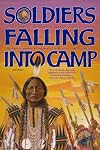
Soldiers Falling into Camp: The Battles at the Rosebud and the Little Big Horn
by Robert Kammen
On This Page
Description
The battles at the Rosebud and the Little Big Horn.Tags
Recommendations



















Member Recommendations
Member Reviews
(Disclaimer: This review is from my personal blog, and, as such, it is written from a Christian perspective.)
Our story dawns on the evening of June 16, 1876. A large summer encampment of Lakota and Cheyenne is threatened by the approach of Three Stars (General George Crook). The camp had gathered together for the purpose of organizing themselves against the current onslaught of white soldiers and civilians, when news came that Three Stars was approaching from south of Rosebud Creek. The Lakota are strengthened by their number of warriors, by the knowledge that the helpless ones depend on them, and by Sitting Bull’s vision of dead white soldiers “falling into camp”. Emboldened by these things, Crazy Horse gathers almost a thousand show more warriors and leads them in a night march south to the Rosebud. On the dawn of June 17, he leads a valiant attack on Three Stars’ soldiers, and though General Crook declares it a victory for himself, he cannot be said to have won as he loses many more soldiers than the courageous, determined Lakota.
General Crook retreats to lick his wounds, but, unbeknownst to the Lakota and their allies, a new force under General George Custer is moving swiftly to catch up to the great camp. General Custer’s Crow scouts have discovered signs of the Lakota’s recent Sun Dance and Sitting Bull’s vision, but this is not enough to discourage Custer. He moves on, determined to claim the glory for himself. Meanwhile in the great camp, life goes on. A young man pursues friendship with an elderly mentor, a frail old man views the beauty and grandeur of the massive encampment, and Sitting Bull meditates on a hill. Crazy Horse rewards the young woman Buffalo Calf Road with a war pony and an eagle feather for her bravery at the Rosebud fight, a fight that because of her bravery will come to be known as the Battle Where the Girl Saved Her Brother. As we read these things, we get a sense of the pulsing life of the camp and the loves and duties of its members.
In the night, two young Lakota men capture a Crow scout who has strayed too far inside the encampment. From him they learn of the approach of another group of soldiers, different from the ones they have just chased away. Meantime, Custer is driving his men closer and closer, punishing their horses, in order to get close enough to launch a strike at the big camp. Finally, his scouts spot the encampment from a tall viewpoint called the Crow’s Nest. Custer prepares to move out. He drives his men toward the Lakota, splitting his command in three and ordering Major Reno to attack the camp from the south while he attacks from the north. Benteen, meanwhile, will be expected to act as backup.
Major Reno leads his charge, but it is hopeless. He quickly finds that there are far more warriors than they anticipated and is forced back disastrously. This attack of his has interrupted a council in the Lakota village. The Lakota and their allies meet the attack with bravery, but, as they are defeating Reno, they learn that another attack is being made on the north end of the village. At this end, Custer has gouged his weary men and horses into a charge, and, unfortunately, with all the warriors defending the south end against Reno, there are only a handful to resist Custer. Even so, the few warriors and old men fight valiantly in defense of their women and children, and manage to hold them off until others, fresh from the Reno fight, arrive to swell their numbers. Custer soon finds that he has bitten off more than he can chew. The Lakota and their allies are fighting with unbridled courage stemming from their concern for their helpless ones, and Custer is forced into a rout. He is forced to take a final stand on a hilltop and is destroyed, down to the last man.
In the meantime, unable to find Custer, Benteen goes to Reno’s assistance, and they are soon fighting for their existence on their own high place. They try to send help to Custer but are forced back. No one knows what is going on, and their only hope is for General Terry and his troops to arrive and save the day. With Custer completely defeated and Benteen and Reno reduced to a battered few on a hilltop, the Lakota decide not to waste any more precious lives trying to root them out. Filled with exultant joy by their victory and sorrow for their dead, the women singing strongheart songs, they break camp and move towards the Shining Mountains. The Lakota and their allies have won the Battle of the Greasy Grass (Battle of the Little Bighorn).
[Content Warning: Some form of the word “d..n” was used thirteen times, and the Lord’s name was taken in vain twice, with Jesus’ name being one of those times. The word “Negro” was used several times to refer to an African American man but never in a pejorative way. The book does go into a little detail sometimes when there is fighting. For instance, it talks about blood spattering, sightless eyes, and the grayness of bodies. It describes bullets hitting people, a man slashing his arms in grief, and “screams of anguish and pain“. It also depicts dead bodies as being bloated and goes on to some degree of detail on what the Lakota people did to the soldiers’ dead bodies (scalping, mutilating, cutting off private parts {this is mentioned in passing and never gets worse than what I have just said}, etc.) There are two parts that are a little bit bloodier. These are Bloody Knife’s death and what Rain in the Face did to a white soldier. Bloody Knife’s death comes about when a bullet hits him in the head, making it explode like a “melon”, and spraying blood all over Major Reno. Rain in the Face has a grudge against a particular white soldier, and, when he finds his body, he cuts his belly open so that his intestines spill out. The motive behind this being so that he would have to carry them in the afterlife. The final somewhat disturbing violent thing is that the book several times refers to the smell of the dead or blood or rotting flesh. Kinda gross. The Greasy Grass fight was a bitter fight. And in some ways you can’t avoid a little gore. Overall, I think this book did a good job at keeping the violence down to a navigable level. Lastly, for the spiritual content. Crazy Horse is frustrated that whites call the Lakota Great Spirit a false god and their God the right one. I do believe we both worship a Creator God, but I am uncertain as to whether we are differently worshipping the same God. But I do know the Lakota didn’t and mostly still don’t worship Jesus, and He is God and the only Way to heaven. One of the Lakota men calls out to the Creator as “Grandfather” instead of “Father”. Sitting Bull leaves an offering of tobacco and at another point is said to have made an offering of his flesh, and it is said that his vision was given in answer to this sacrifice. I don’t really question Sitting Bull having a vision of soldiers falling into camp, because I know in the Bible God gave dreams of what would happen even to unbelievers such as Pharoah and Nebuchadnezzar. White soldiers talk of a spell, “sorcery practiced by Indian Shamans“. Finally, the Lakota’s Native enemies are said to know the Earth and this makes them honorable enemies. And the Lakota refer to themselves as “true human beings.”]
This book is full of the Lakota’s strength and commitments as a people. We learn that it is frequently the women who make the men strong, and this they do by their standing by their men’s side, gathering the weapons and singing the strongheart songs. We are made aware of the young men’s dedication to the helpless ones, the young, the old, and the women. We are given a view of the beautiful side of Lakota life and culture. There is an ugly side to it too, as in any culture, but we see little of this here. Instead, we see dedicated husbands and fathers, faithful wives and sisters.
“A hunter and a warrior, a family’s protector and provider, was the hardest and most frightening kind of a loss. It was hard because the hunter and warrior was also a man, a husband, father, son, grandson, and friend. It was frightening because the empty place at the back of the lodge was a dark hole in the tomorrows yet to come. That many, many more bluecoats had died was no consolation. One warrior, one man, one true human being lost dimmed any victory. And a memory could not hunt, or hold his children, or be a warmth beneath the sleeping robes. The price of victory had been high.”
One of the things I like about this book is how naturally it includes cultural material. We are immersed into Lakota life without it being too obvious. Cultural tidbits pop up naturally. We learn where an honored guest sits in the lodge, how names are not used but rather titles such as sister, uncle, or cousin, how the women trill in honor of the victorious or to raise their fighting courage, even the custom of having a kȟolá is briefly alluded to as a “brother-friend”.
“Soldiers Falling Into Camp” moves a little slow and is difficult to follow sometimes, but I thought it was worth it for the excellent writing and presentation of culture. Besides which, I felt like I was finally reading a book that was rooting for the Lakota just like I was. The good parts of Lakota culture were presented so beautifully. This book could be used to teach high-schoolers and adults that there are beautiful, worthwhile pieces to every culture, and that God values each culture wherever it does not disobey Him. The other thing I can say for this book is that it encouraged me to write. And I don’t mean a blog post, I mean really write, like a book. It got my imagination going and stirred up happy, creative juices that have been too long asleep. It made me one to write something that presents Lakota culture as valuable the way this book did.
Now, as to accuracy, I believe this book to be accurate where it needs to be. Obviously the authors took some license where they were putting dialogue in historical characters’ mouths and attributing emotions to them. This is natural, and I feel like they didn’t take it too far. As to actual historical material, the events are mainly based on first-hand accounts from Native people on both sides, as well as some on the written record. The authors represent both the Crow and Lakota nations and the white Americans. Frederick Voget Lefthand (Crow) and Joseph M. Marshall III (Lakota) are both known for their tribal knowledge and teaching. I don’t know who did the majority of the actual writing, but it is obvious from reading the book that these two men had a heavy influence. I find the book to be accurate culturally. Additionally, since it is so accurate culturally and since Joseph M. Marshall III is a known Indigenous author I trust and since it is based on first-hand accounts, I believe it to be accurate historically as well. In summary, I believe this book to be accurate and trustworthy.
This is a book I will probably be returning to (though if you’re sensitive to violence, it is probably not for you). I especially appreciate the heartfelt descriptions of Lakota camp life and relationships. There is so much rich cultural content here and courage and loyalty to stir the soul. Besides that, I am grateful to have a Native perspective on the Battle of the Greasy Grass (Little Bighorn). Combined with the fact that it is a well-written book, this is one that I am glad to include in my library. I recommend this book. show less
Our story dawns on the evening of June 16, 1876. A large summer encampment of Lakota and Cheyenne is threatened by the approach of Three Stars (General George Crook). The camp had gathered together for the purpose of organizing themselves against the current onslaught of white soldiers and civilians, when news came that Three Stars was approaching from south of Rosebud Creek. The Lakota are strengthened by their number of warriors, by the knowledge that the helpless ones depend on them, and by Sitting Bull’s vision of dead white soldiers “falling into camp”. Emboldened by these things, Crazy Horse gathers almost a thousand show more warriors and leads them in a night march south to the Rosebud. On the dawn of June 17, he leads a valiant attack on Three Stars’ soldiers, and though General Crook declares it a victory for himself, he cannot be said to have won as he loses many more soldiers than the courageous, determined Lakota.
General Crook retreats to lick his wounds, but, unbeknownst to the Lakota and their allies, a new force under General George Custer is moving swiftly to catch up to the great camp. General Custer’s Crow scouts have discovered signs of the Lakota’s recent Sun Dance and Sitting Bull’s vision, but this is not enough to discourage Custer. He moves on, determined to claim the glory for himself. Meanwhile in the great camp, life goes on. A young man pursues friendship with an elderly mentor, a frail old man views the beauty and grandeur of the massive encampment, and Sitting Bull meditates on a hill. Crazy Horse rewards the young woman Buffalo Calf Road with a war pony and an eagle feather for her bravery at the Rosebud fight, a fight that because of her bravery will come to be known as the Battle Where the Girl Saved Her Brother. As we read these things, we get a sense of the pulsing life of the camp and the loves and duties of its members.
In the night, two young Lakota men capture a Crow scout who has strayed too far inside the encampment. From him they learn of the approach of another group of soldiers, different from the ones they have just chased away. Meantime, Custer is driving his men closer and closer, punishing their horses, in order to get close enough to launch a strike at the big camp. Finally, his scouts spot the encampment from a tall viewpoint called the Crow’s Nest. Custer prepares to move out. He drives his men toward the Lakota, splitting his command in three and ordering Major Reno to attack the camp from the south while he attacks from the north. Benteen, meanwhile, will be expected to act as backup.
Major Reno leads his charge, but it is hopeless. He quickly finds that there are far more warriors than they anticipated and is forced back disastrously. This attack of his has interrupted a council in the Lakota village. The Lakota and their allies meet the attack with bravery, but, as they are defeating Reno, they learn that another attack is being made on the north end of the village. At this end, Custer has gouged his weary men and horses into a charge, and, unfortunately, with all the warriors defending the south end against Reno, there are only a handful to resist Custer. Even so, the few warriors and old men fight valiantly in defense of their women and children, and manage to hold them off until others, fresh from the Reno fight, arrive to swell their numbers. Custer soon finds that he has bitten off more than he can chew. The Lakota and their allies are fighting with unbridled courage stemming from their concern for their helpless ones, and Custer is forced into a rout. He is forced to take a final stand on a hilltop and is destroyed, down to the last man.
In the meantime, unable to find Custer, Benteen goes to Reno’s assistance, and they are soon fighting for their existence on their own high place. They try to send help to Custer but are forced back. No one knows what is going on, and their only hope is for General Terry and his troops to arrive and save the day. With Custer completely defeated and Benteen and Reno reduced to a battered few on a hilltop, the Lakota decide not to waste any more precious lives trying to root them out. Filled with exultant joy by their victory and sorrow for their dead, the women singing strongheart songs, they break camp and move towards the Shining Mountains. The Lakota and their allies have won the Battle of the Greasy Grass (Battle of the Little Bighorn).
[Content Warning: Some form of the word “d..n” was used thirteen times, and the Lord’s name was taken in vain twice, with Jesus’ name being one of those times. The word “Negro” was used several times to refer to an African American man but never in a pejorative way. The book does go into a little detail sometimes when there is fighting. For instance, it talks about blood spattering, sightless eyes, and the grayness of bodies. It describes bullets hitting people, a man slashing his arms in grief, and “screams of anguish and pain“. It also depicts dead bodies as being bloated and goes on to some degree of detail on what the Lakota people did to the soldiers’ dead bodies (scalping, mutilating, cutting off private parts {this is mentioned in passing and never gets worse than what I have just said}, etc.) There are two parts that are a little bit bloodier. These are Bloody Knife’s death and what Rain in the Face did to a white soldier. Bloody Knife’s death comes about when a bullet hits him in the head, making it explode like a “melon”, and spraying blood all over Major Reno. Rain in the Face has a grudge against a particular white soldier, and, when he finds his body, he cuts his belly open so that his intestines spill out. The motive behind this being so that he would have to carry them in the afterlife. The final somewhat disturbing violent thing is that the book several times refers to the smell of the dead or blood or rotting flesh. Kinda gross. The Greasy Grass fight was a bitter fight. And in some ways you can’t avoid a little gore. Overall, I think this book did a good job at keeping the violence down to a navigable level. Lastly, for the spiritual content. Crazy Horse is frustrated that whites call the Lakota Great Spirit a false god and their God the right one. I do believe we both worship a Creator God, but I am uncertain as to whether we are differently worshipping the same God. But I do know the Lakota didn’t and mostly still don’t worship Jesus, and He is God and the only Way to heaven. One of the Lakota men calls out to the Creator as “Grandfather” instead of “Father”. Sitting Bull leaves an offering of tobacco and at another point is said to have made an offering of his flesh, and it is said that his vision was given in answer to this sacrifice. I don’t really question Sitting Bull having a vision of soldiers falling into camp, because I know in the Bible God gave dreams of what would happen even to unbelievers such as Pharoah and Nebuchadnezzar. White soldiers talk of a spell, “sorcery practiced by Indian Shamans“. Finally, the Lakota’s Native enemies are said to know the Earth and this makes them honorable enemies. And the Lakota refer to themselves as “true human beings.”]
This book is full of the Lakota’s strength and commitments as a people. We learn that it is frequently the women who make the men strong, and this they do by their standing by their men’s side, gathering the weapons and singing the strongheart songs. We are made aware of the young men’s dedication to the helpless ones, the young, the old, and the women. We are given a view of the beautiful side of Lakota life and culture. There is an ugly side to it too, as in any culture, but we see little of this here. Instead, we see dedicated husbands and fathers, faithful wives and sisters.
“A hunter and a warrior, a family’s protector and provider, was the hardest and most frightening kind of a loss. It was hard because the hunter and warrior was also a man, a husband, father, son, grandson, and friend. It was frightening because the empty place at the back of the lodge was a dark hole in the tomorrows yet to come. That many, many more bluecoats had died was no consolation. One warrior, one man, one true human being lost dimmed any victory. And a memory could not hunt, or hold his children, or be a warmth beneath the sleeping robes. The price of victory had been high.”
One of the things I like about this book is how naturally it includes cultural material. We are immersed into Lakota life without it being too obvious. Cultural tidbits pop up naturally. We learn where an honored guest sits in the lodge, how names are not used but rather titles such as sister, uncle, or cousin, how the women trill in honor of the victorious or to raise their fighting courage, even the custom of having a kȟolá is briefly alluded to as a “brother-friend”.
“Soldiers Falling Into Camp” moves a little slow and is difficult to follow sometimes, but I thought it was worth it for the excellent writing and presentation of culture. Besides which, I felt like I was finally reading a book that was rooting for the Lakota just like I was. The good parts of Lakota culture were presented so beautifully. This book could be used to teach high-schoolers and adults that there are beautiful, worthwhile pieces to every culture, and that God values each culture wherever it does not disobey Him. The other thing I can say for this book is that it encouraged me to write. And I don’t mean a blog post, I mean really write, like a book. It got my imagination going and stirred up happy, creative juices that have been too long asleep. It made me one to write something that presents Lakota culture as valuable the way this book did.
Now, as to accuracy, I believe this book to be accurate where it needs to be. Obviously the authors took some license where they were putting dialogue in historical characters’ mouths and attributing emotions to them. This is natural, and I feel like they didn’t take it too far. As to actual historical material, the events are mainly based on first-hand accounts from Native people on both sides, as well as some on the written record. The authors represent both the Crow and Lakota nations and the white Americans. Frederick Voget Lefthand (Crow) and Joseph M. Marshall III (Lakota) are both known for their tribal knowledge and teaching. I don’t know who did the majority of the actual writing, but it is obvious from reading the book that these two men had a heavy influence. I find the book to be accurate culturally. Additionally, since it is so accurate culturally and since Joseph M. Marshall III is a known Indigenous author I trust and since it is based on first-hand accounts, I believe it to be accurate historically as well. In summary, I believe this book to be accurate and trustworthy.
This is a book I will probably be returning to (though if you’re sensitive to violence, it is probably not for you). I especially appreciate the heartfelt descriptions of Lakota camp life and relationships. There is so much rich cultural content here and courage and loyalty to stir the soul. Besides that, I am grateful to have a Native perspective on the Battle of the Greasy Grass (Little Bighorn). Combined with the fact that it is a well-written book, this is one that I am glad to include in my library. I recommend this book. show less
Ratings
Members
- Recently Added By
Lists

Lakota (Sioux) Nation
12 works; 1 member
Author Information
28 Works 142 Members
Some Editions
Common Knowledge
- People/Characters
- Gen. George "Three Stars" Crook, USA; Sitting Bull; Crazy Horse son of Worm; Good Weasel; Curly; Isaiah Dorman (show all 35); Mitch Boyer; "Lonesome" Charlie Reynolds; Stabbed; Hairy Moccasin; Goes Ahead; White Man Runs Him; Buffalo Ancestor; Bloody Knife; Walks Alone; Eagle That Talks; George Armstrong Custer; Mark Kellogg; Capt. Frederick W. Benteen, USA; Lt. William Cooke, USA; Vic (Custer's horse); Pvt. John Burkman; Half Yellow Face; Lt. Charles Varnum, USA; Lt. Charles C. DeRudio, USA; Boston Custer; Capt. Tom Custer, USA; Major. Marcus A. Reno, USA; Capt. Miles Keogh, USA; Uses Cane; White Feather Tail; Bear (Sicangu Lakota, cousin of White Feather Tail); Gall; Crazy Horse; Buffalo Calf Road Woman
- Important places
- South Dakota, USA; Montana, USA; Black Hills, South Dakota, USA
Classifications
Statistics
- Members
- 45
- Popularity
- 660,848
- Reviews
- 1
- Rating
- (4.00)
- Languages
- English
- Media
- Paper
- ISBNs
- 2