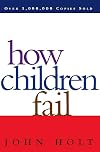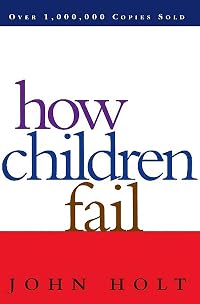
How Children Fail
by John Holt
On This Page
Description
First published in the mid 1960s, How Children Fail began an education reform movement that continues today. In his 1982 edition, John Holt added new insights into how children investigate the world, into the perennial problems of classroom learning, grading, testing, and into the role of the trust and authority in every learning situation.Tags
Recommendations








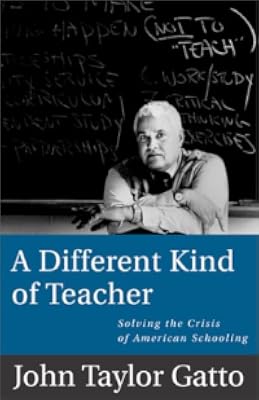
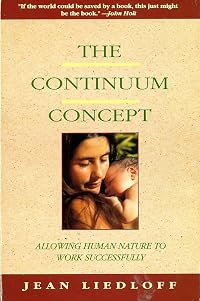
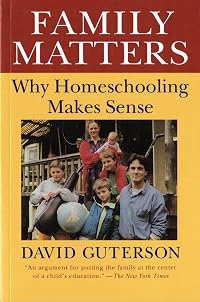
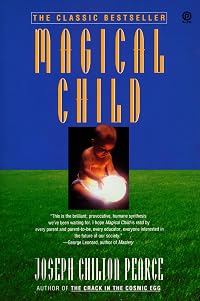






Member Recommendations
Member Reviews
I just discovered John Holt and, although I am quite prejudiced against home schooling and/or unschooling (nothing wrong with it per se but, to me it sounds more like an ideal of an education accessible to only a privileged few than something applicable to a whole society) I was really enthusiastic reading this.
As Holt insists beautifully here, 'intelligence is not how much we know how to do, but how we behave when we don't know what to do'. In other words, intelligence can only be rooted and tested in practical and concrete situations, to develop into a frame of mind not unlike the ones of toddlers that is, curious, experimenting and exploring, trying, making mistakes, bouncing back on them and, basically, taking everything life show more throws at us as an opportunity to naturally learn something new every time. Applied to pupils, this is what he calls a thinker mentality that is, trying 'to think about the meaning, the reality, of whatever it was he [the pupil] (is) working on'. Sadly, schools (or at least the way most of our schools are functioning) do not encourage such a thinker mentality. On the contrary, it actually kills it by forcing another way of learning, that of the producer 'only interested in getting the right answers, and who made more or less critical use of rules and formulae to get them'. Schools, hence, are failing children's learning by being inefficient and boring.
Such idea is quite bold and radical coming from a teacher but, I personally can fully relate to it from my own experience (up to a certain point though) both when I was a child and now even more so as a dad. Schools are indeed factories manufacturing parrots, where children just do what is expected of them without, most of the time, understanding what they are doing (while understanding should be the main purpose of learning!) nor seeing how relevant (if it is) what is forced down their brains can be to their lives.
It gets even worst than that as, obsessed by 'right answers', schools are indirectly teaching children that making mistakes and being wrong is a bad thing, a statement of failure while, on the contrary, learning is all about trying, taking risks and exploring which involve making mistakes, certainly not avoiding them! Schools can thus, paradoxically, kill the will to learn by being counterproductive.
I cannot but recommend warmly such a book to anyone with even just a slight interest in education. Reading these humble memos by such a teacher, either focusing on his own experience with children (in and out of the classroom) or, observing some of his colleagues, is touching and funny (well, it's about children!). It is, most of all, enlightening, insightful and very telling. I cannot wait to read his other works! show less
As Holt insists beautifully here, 'intelligence is not how much we know how to do, but how we behave when we don't know what to do'. In other words, intelligence can only be rooted and tested in practical and concrete situations, to develop into a frame of mind not unlike the ones of toddlers that is, curious, experimenting and exploring, trying, making mistakes, bouncing back on them and, basically, taking everything life show more throws at us as an opportunity to naturally learn something new every time. Applied to pupils, this is what he calls a thinker mentality that is, trying 'to think about the meaning, the reality, of whatever it was he [the pupil] (is) working on'. Sadly, schools (or at least the way most of our schools are functioning) do not encourage such a thinker mentality. On the contrary, it actually kills it by forcing another way of learning, that of the producer 'only interested in getting the right answers, and who made more or less critical use of rules and formulae to get them'. Schools, hence, are failing children's learning by being inefficient and boring.
Such idea is quite bold and radical coming from a teacher but, I personally can fully relate to it from my own experience (up to a certain point though) both when I was a child and now even more so as a dad. Schools are indeed factories manufacturing parrots, where children just do what is expected of them without, most of the time, understanding what they are doing (while understanding should be the main purpose of learning!) nor seeing how relevant (if it is) what is forced down their brains can be to their lives.
It gets even worst than that as, obsessed by 'right answers', schools are indirectly teaching children that making mistakes and being wrong is a bad thing, a statement of failure while, on the contrary, learning is all about trying, taking risks and exploring which involve making mistakes, certainly not avoiding them! Schools can thus, paradoxically, kill the will to learn by being counterproductive.
I cannot but recommend warmly such a book to anyone with even just a slight interest in education. Reading these humble memos by such a teacher, either focusing on his own experience with children (in and out of the classroom) or, observing some of his colleagues, is touching and funny (well, it's about children!). It is, most of all, enlightening, insightful and very telling. I cannot wait to read his other works! show less
Pretty interesting book about Holt's experiences in the classroom. I really liked the notebook-esque format as well as the later commentary. As I was thinking about my own frustrations with work at the time, this seemed to also be a useful book about company management.
A few takeaways:
- "children fail because they are afraid, confused, and bored:" this seems like a pretty helpful framework, not only for thinking about the circumstances in which children disengage, but also for thinking about how adults lose motivation.
- the idea of "producers" vs. "thinkers." I see "producer" behavior frequently, even among adults, where people freeze up and stop thinking when they feel pressure to give the right answer. I do think that framing it as show more behaviors instead of character traits might be more helpful.
- John Holt's journey from "how can I make school work for these kids?" to "School sucks, kids need to learn in self-directed ways" is fascinating to follow. show less
A few takeaways:
- "children fail because they are afraid, confused, and bored:" this seems like a pretty helpful framework, not only for thinking about the circumstances in which children disengage, but also for thinking about how adults lose motivation.
- the idea of "producers" vs. "thinkers." I see "producer" behavior frequently, even among adults, where people freeze up and stop thinking when they feel pressure to give the right answer. I do think that framing it as show more behaviors instead of character traits might be more helpful.
- John Holt's journey from "how can I make school work for these kids?" to "School sucks, kids need to learn in self-directed ways" is fascinating to follow. show less
John Holt summarizes perfectly the problem with contemporary education: it emphasizes right answers rather than learning, production rather than thinking. Read this book to understand this problem and its results, as seen through his experience as a collaborative teacher and thoughtful observer. The rewards for "right answers" over thinking even persists at higher education levels. "What would happen at Harvard or Yale if a prof gave a surprise test in March on work covered in October? Everyone knows what would happen; that's why they don't do it." (p. 232)
He advocates for schooling at home (and in the world) as the best method of education. "People teaching their children at home consistently do a good job because they have the time - show more and the desire - to know their children, their interest, the signs by which they show and express their feelings." (p. 36) Four key principles: 1. Children do not need to be "taught" in order to learn, and they often learn best when not taught, 2. Children are very interested in the adult world, 3. Children learn best when the subject is "embedded in the context of real life," 4. "Children learn best when their learning is connected with an immediate and serious purpose."
Holt blames the current system, pointing out that if a system consistently fails, the problem is with it, not its inputs or participants. In the summary section, he forcefully points out the negative effects of the current system - low self-esteem, ignorance about how to learn, and a mind trained not to want to do so. show less
He advocates for schooling at home (and in the world) as the best method of education. "People teaching their children at home consistently do a good job because they have the time - show more and the desire - to know their children, their interest, the signs by which they show and express their feelings." (p. 36) Four key principles: 1. Children do not need to be "taught" in order to learn, and they often learn best when not taught, 2. Children are very interested in the adult world, 3. Children learn best when the subject is "embedded in the context of real life," 4. "Children learn best when their learning is connected with an immediate and serious purpose."
Holt blames the current system, pointing out that if a system consistently fails, the problem is with it, not its inputs or participants. In the summary section, he forcefully points out the negative effects of the current system - low self-esteem, ignorance about how to learn, and a mind trained not to want to do so. show less
Holt's first book Is primarily a collection of his notes from his early years at teaching, primarily at the Colorado Mountain School. A private school for rich "progressives."
The copy I read was a later re-issue. It was certainly a different way of doing an updated revision. Normally when I read such its the exact same book with only a few paragraphs re-edited due to some new information, or updated references, since the original publishing. However This one kept the entire original in tact and the added additional commentary where the author had changed his mind since the original publishing, marked as such. I'm not clear if I really liked that or not, but it certainly made for a significantly longer book.
Holt argues that children show more fail because school is set up in a way that most kids are too afraid to actually learn. They need or want the right answer, but cramming for tests only ensures they don't actually know what they are being taught.
I lot of focus on math and the wildly disconnected "ideas" children have about it. show less
The copy I read was a later re-issue. It was certainly a different way of doing an updated revision. Normally when I read such its the exact same book with only a few paragraphs re-edited due to some new information, or updated references, since the original publishing. However This one kept the entire original in tact and the added additional commentary where the author had changed his mind since the original publishing, marked as such. I'm not clear if I really liked that or not, but it certainly made for a significantly longer book.
Holt argues that children show more fail because school is set up in a way that most kids are too afraid to actually learn. They need or want the right answer, but cramming for tests only ensures they don't actually know what they are being taught.
I lot of focus on math and the wildly disconnected "ideas" children have about it. show less
"How Children Fail" is a classic book in the field of child development by educational theorist John Holt. The book provides a critical analysis of the American education system and argues that the traditional approach to teaching is flawed and ultimately fails to nurture the natural curiosity and creativity of children. Holt suggests that young learners are often defeated by the rigid structure of education, and that by placing too much emphasis on rote memorization and standardized testing, teachers are hindering true learning. The book also offers practical advice for parents and educators on how to help children succeed in school and in life. "How Children Fail" remains a must-read for anyone interested in the education system and show more the development of young minds. show less
John Holt's How Children Fail is one of those books that seems like something of a cultural artifact of the late 1950s and early 1960s. The book's premise is that schools are places that essentially set kids up to fail and drain their enthusiasm for learning. The kids find ways to manipulate the system and are driven by fear to obey but not learn in any meaningful ways. Holt's treatise reads like a clarion call for the rebellion of the 1960s and all of the excesses of that era. And yet there's a lot more here than cultural critics might believe.
How Children Fail, for me at least, reveals some truths that have existed in American education for decades, if not centuries. His assessment of the system seems pretty reasonable to me. My show more experience backs up his observations of kids who come to hate learning as a direct result of their experiences in school.
Now this might be seen as a defense of the overly permissive excesses of the 1960s, but I don't think so. There were certainly excesses, but was the basic premise of educational reformers really all that far off the mark? Holt's book calls for kids to be more engaged in what they do; for educators to link education to the world we live in without creating an artificial and ultimately sterile "academic environment".
As a piece of writing, How Children Fail isn't great literature and much of the text seem pretty disjointed. But there is a lot of wisdom contained in these pages. As we move into the age of connectivity, the singularity, web 2.0, and all that kind of stuff, I think Holt's ideas are going to become a lot more feasible than they were 40 years ago. I remember reading Rousseau's Emile in graduate school and thinking that the ideas were good, but no society could ever produce the 1 on 1 teacher/student relationship outlined in the book. Technology doesn't quite get us there, but it gets us awfully close. Likewise, Holt's call for homeschooling seemed far-fetched at the time, but hasn't technological change made it too far more likely? show less
How Children Fail, for me at least, reveals some truths that have existed in American education for decades, if not centuries. His assessment of the system seems pretty reasonable to me. My show more experience backs up his observations of kids who come to hate learning as a direct result of their experiences in school.
Now this might be seen as a defense of the overly permissive excesses of the 1960s, but I don't think so. There were certainly excesses, but was the basic premise of educational reformers really all that far off the mark? Holt's book calls for kids to be more engaged in what they do; for educators to link education to the world we live in without creating an artificial and ultimately sterile "academic environment".
As a piece of writing, How Children Fail isn't great literature and much of the text seem pretty disjointed. But there is a lot of wisdom contained in these pages. As we move into the age of connectivity, the singularity, web 2.0, and all that kind of stuff, I think Holt's ideas are going to become a lot more feasible than they were 40 years ago. I remember reading Rousseau's Emile in graduate school and thinking that the ideas were good, but no society could ever produce the 1 on 1 teacher/student relationship outlined in the book. Technology doesn't quite get us there, but it gets us awfully close. Likewise, Holt's call for homeschooling seemed far-fetched at the time, but hasn't technological change made it too far more likely? show less
So far, one of the great quotations I've found is:"It used to puzzle me that the students who made the most mistakes and got the worst marks were so often the first ones to hand in their papers. I used to say, 'If you finish early, take time to check your work, do some problems again.' Typical teacher's advice; I might as well have told them to flap their arms and fly. When the paper was in, the tension was ended. Their fate was in the lap of the gods. They might still worry about flunking the paper, but it was a fatalistic kind of worry.... Worrying about whether you did the right thing, while painful enough, is less painful than worrying about the right thing to do." (74-75) This about sums up (1) the whole reason I was so bad at math show more when I was in grammar school and (2) why I am much better at revising work that I make up for myself than at revising work where it actually matters. My psychology is still that of a schoolchild.All this said, it feels a little dated: people are trying different things in their classrooms now, although (to be fair) change hasn't come terribly quickly. show less
Members
- Recently Added By
Published Reviews
ThingScore 75
This is a much angrier book, though no less humane and caring, and it's equally important, even if there were fewer smiles per page.
added by lampbane
Lists

Bret Victor's Five-Star List
46 works; 5 members

Mind Expanding Books by hackerkid
581 works; 8 members
Author Information

14 Works 3,639 Members
Some Editions
Series
Belongs to Publisher Series
Common Knowledge
- Canonical title
- How Children Fail
- Original publication date
- 1964
- First words
- I can't get Nell off my mind.
- Last words
- (Click to show. Warning: May contain spoilers.)To help all children do this should be our task--and our delight.
- Original language
- English US
Classifications
- Genre
- Nonfiction
- DDC/MDS
- 371.28 — Society, government, & culture Education Schools and their activities; special education School organization; School records Promotions; Degrading
- LCC
- LB1555 .H78 — Education Theory and practice of education Theory and practice of education Elementary or public school education
- BISAC
Statistics
- Members
- 895
- Popularity
- 30,055
- Reviews
- 14
- Rating
- (4.18)
- Languages
- 7 — Czech, English, Finnish, French, German, Norwegian (Bokmål), Swedish
- Media
- Paper, Ebook
- ISBNs
- 21
- ASINs
- 24