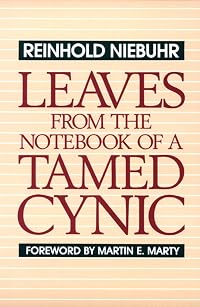
Leaves from the Notebook of a Tamed Cynic
by Reinhold Niebuhr
On This Page
Description
Leaves from the Notebook of a Tamed Cynic is Niebuhr's account of the frustrations and joys he experienced during his years at Bethel. Addressed to young ministers, this book provides reflections and insights for those engaged in the challenging yet infinitely rewarding occupation of pastoral ministry.Tags
Recommendations






























Member Reviews
Excellent--the kind of thing that can be read both by the religious and the non-, and really anyone who is interested in watching a quality mind at work. Niebuhr says so many smart things, and says them so attractively, that I'm a little bit in awe.
Some great stuff on pastoral ministry alongside incredible, insightful cultural analysis. I was going to remove a star because of some major theological problems—sacraments, Christology, general 19th century liberal theology trendiness—but it really is a great and accessible and helpful book.
Ratings
Members
- Recently Added By
Author Information

60+ Works 6,125 Members
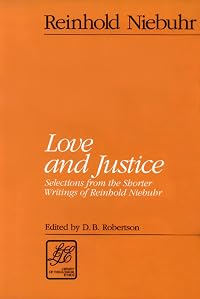
Walter Lippmann once called Reinhold Niebuhr the greatest mind America had produced since Jonathan Edwards. It was fitting, then, that Niebuhr died at home in Stockbridge, Massachusetts, in the town where Edwards had preached. He was born in Wright City, Missouri, and his father was a German immigrant who served those German-speaking churches that show more preserved both the Lutheran and Reformed (Calvinist) traditions and piety. After seminary in St. Louis, he studied for two years at Yale University, and the M.A. he received there was the highest degree he earned. Rather than work for a doctorate, he became a pastor in Detroit, where in his 13 years of service a tiny congregation grew to one of 800 members. Part of his diary from those years was published in 1929 as Leaves from the Notebook of a Tamed Cynic. During that time he began to attract attention through articles on social issues; as he said, he "cut [his] eyeteeth fighting [Henry] Ford." But the socialism to which he was attracted soon seemed naive to him: human problems could not be solved just by appealing to the good in people or by promulgating programs for change. Power, economic clout, was needed to change the systems set up by sinful groups, a position expressed in his 1932 book, Moral Man and Immoral Society. By this time Niebuhr was teaching at Union Theological Seminary in New York, where he spent the rest of his career. Niebuhr's theology always took second place to ethics. He ran for office as a socialist, rescued Paul Tillich from Germany, became a strong supporter of Israel, gave up pacifism, and was often too orthodox for the liberals, too liberal for the orthodox. His The Nature and Destiny of Man is one of the few seminal theological books written by an American. In it he reiterates a theme that led some to place him in the Barthian camp of Neo-orthodoxy: the radical sinfulness of the human creature. The human condition as illumined by the Christian tradition was always the arena in which he worked. (Bowker Author Biography) show less
Some Editions
Work Relationships
Is contained in
Common Knowledge
- Original publication date
- 1929
Classifications
- Genres
- Nonfiction, Religion & Spirituality, Biography & Memoir, General Nonfiction, Philosophy, History
- DDC/MDS
- 280.4 — Religion Christian denominations Denominations and sects of Christian church Non-denominational Protestants
- LCC
- BX4827 .N5 .A34 — Philosophy, Psychology and Religion Christian Denominations Christian Denominations Protestantism General
- BISAC
Statistics
- Members
- 360
- Popularity
- 87,914
- Reviews
- 2
- Rating
- (4.55)
- Languages
- English
- Media
- Paper, Ebook
- ISBNs
- 12
- ASINs
- 11