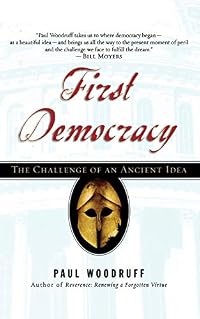
First Democracy: The Challenge of an Ancient Idea
by Paul Woodruff
On This Page
Description
"Americans have an unwavering faith in democracy and are ever eager to export it to nations around the world. But how democratic is our own "democracy"? If you can vote, if the majority rules, if you have elected representatives - does this automatically mean that you have a democracy? In this eye-opening look at an ideal that we all take for granted, classical scholar Paul Woodruff offers some surprising answers to these questions." "Drawing on classical literature, philosophy, and history show more - with many intriguing passages from Sophocles, Aesop, and Plato, among others - Woodruff immerses us in the world of ancient Athens to uncover how the democratic impulse first came to life. If we learn anything from the story of Athens, Woodruff concludes, it should be this - never lose sight of the ideals of democracy. This compact book illuminates these ideals and lights the way as we struggle to keep democracy alive at home and around the world."--Jacket show lessTags
Recommendations









Member Reviews
http://pixxiefishbooks.blogspot.com/2008/06/first-democracy-challenge-of-ancient...
Jury's still out on this one. It was ... fine. But I didn't think it was very well-written (still trying to figure out why, however), and it frightened me how often I disagreed with or disputed some of his claims, leading me to wonder if I really believe in democracy at all!
Highlights (?) include:
* The tale of the frog and the snake, one of Aesop's fables, used to illustrate how our laws are often absurd, yet somehow necessary in order to protect from tyranny (p. 211 et seq.). I found this argument unfounded, illogical, and, frankly, ridiculous. I also think the fable was a poor illustration of the point being made.
* The fallacies in the arguments of show more those who would oppose democracy: mainly, that citizen wisdom will always fail since the ordinary person has neither the time, the education nor the will to make decisions, so best to defer to those with the expertise to do it for them (see p. 159 et seq.). I agree with Woodruff to a point; yet, again, his arguments (remember he is disagreeing with these claims) are not carried out as fully as they should have been.
* In a discussion of whether the United States and other similar so-called 'democracies' are ready for actual democracy (rule actually for and by the people), Woodruff has a throwaway paragraph about Canada in which he points to the actions of a citizen activist group in British Columbia as proof that Canada is, in fact, ready for actual democratic reform such as proportional representation (see 213 et seq.). Not likely, Mr. Woodruff. First of all, while proportional representation is a popular idea generally, the chances of it becoming the norm in Canada as a whole is highly unlikely, given the structure of our government. Second of all, a citizen group in B.C. is unfortunately not going to have the leverage to get this idea successfully promoted cross-Canada ... even if they could get the B.C. legislative assembly to agree. Their activism cannot be taken as representative of Canada's prevailing political will.
On the plus side, Woodruff knows a lot about the workings of Greek democracy, and that was fairly interesting. However, there are better books on the origins of democracy, and while this is a short read at just over 200 pages, I'm not sure it's worth the time. show less
Jury's still out on this one. It was ... fine. But I didn't think it was very well-written (still trying to figure out why, however), and it frightened me how often I disagreed with or disputed some of his claims, leading me to wonder if I really believe in democracy at all!
Highlights (?) include:
* The tale of the frog and the snake, one of Aesop's fables, used to illustrate how our laws are often absurd, yet somehow necessary in order to protect from tyranny (p. 211 et seq.). I found this argument unfounded, illogical, and, frankly, ridiculous. I also think the fable was a poor illustration of the point being made.
* The fallacies in the arguments of show more those who would oppose democracy: mainly, that citizen wisdom will always fail since the ordinary person has neither the time, the education nor the will to make decisions, so best to defer to those with the expertise to do it for them (see p. 159 et seq.). I agree with Woodruff to a point; yet, again, his arguments (remember he is disagreeing with these claims) are not carried out as fully as they should have been.
* In a discussion of whether the United States and other similar so-called 'democracies' are ready for actual democracy (rule actually for and by the people), Woodruff has a throwaway paragraph about Canada in which he points to the actions of a citizen activist group in British Columbia as proof that Canada is, in fact, ready for actual democratic reform such as proportional representation (see 213 et seq.). Not likely, Mr. Woodruff. First of all, while proportional representation is a popular idea generally, the chances of it becoming the norm in Canada as a whole is highly unlikely, given the structure of our government. Second of all, a citizen group in B.C. is unfortunately not going to have the leverage to get this idea successfully promoted cross-Canada ... even if they could get the B.C. legislative assembly to agree. Their activism cannot be taken as representative of Canada's prevailing political will.
On the plus side, Woodruff knows a lot about the workings of Greek democracy, and that was fairly interesting. However, there are better books on the origins of democracy, and while this is a short read at just over 200 pages, I'm not sure it's worth the time. show less
I think this is an important book. The Author describes the 200 year Athenian struggle for democracy. He identifies 7 traits of Democracy and examines each with respect to events in ancient Athens. He believes that the United States have been on a path toward democracy but that recently we may be retreating from rather than advancing toward it. A very thought-provoking and informative book.
Ratings
Members
- Recently Added By
Author Information

10+ Works 719 Members
Classifications
- Genres
- Politics and Government, Nonfiction, History, General Nonfiction, Philosophy
- DDC/MDS
- 320.938509014 — Society, government, & culture Political science Types of Government Political situation and conditions Ancient World Greece to 323 Attica to 323
- LCC
- JC75 .D36 .W66 — Political Science Political theory Political theory. The state. Theories of the state Ancient state
- BISAC
Statistics
- Members
- 114
- Popularity
- 284,508
- Reviews
- 2
- Rating
- (3.60)
- Languages
- English
- Media
- Paper, Ebook
- ISBNs
- 5