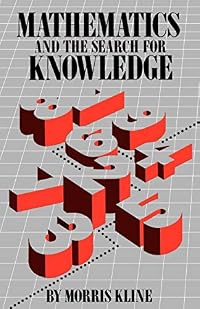
Mathematics and the Search for Knowledge
by Morris Kline
On This Page
Description
Requires a minimum of technical knowledge and gives an illuminating oversight of the historical developments...with many interesting observations along the way."--Proceedings of the Edinburgh Mathematical Society "The lively writing makes this suitable supplementary reading for advanced undergraduates from many disciplines. An extensive and often technical bibliography is included for those who want to go further.Tags
Recommendations















Member Reviews
This book starts and ends with deep philosophical reflections. The initial material is about how can know what we feel we know. What certainty is knowledge obtained from unreliable senses and/or the concepts generated by our own minds? In this early parts of the book is a very nice summary of Descartes four-step process to reasoning:
Galileo is an example of trusting foremost in those senses through careful observation, which Descartes resisted:
In this struggle to understand reality, mathematics proved a tool useful as observed in "The Unreasonable Effectiveness of Mathematics in the Natural Sciences", the 1960 article by physicist Eugene Wigner. In the paper, Wigner observes that a physical theory's mathematical structure often points the way to further advances in that theory and even to empirical predictions.
In this book there are examples of areas where mathematics led the way.
This is also how it went with gravity, thermodynamics, and atomic theory.
This is not always a comfortable arrangement.
This really gained steam in the early Twentieth Century with the dawn of relativity, etc.
The new physics has turned away from mechanical models or even pictures of physical realities and has emphasized and even concentrated on mathematical description, a trend that, as far as one can foretell, will continue and from which there is no likelihood of any reversal. The newer realms of physics are so remote from ordinary experience, from sensuous perception, that only mathematics can grasp them.
Moving on into quantum mechanics and thus away from determinism, it seemed deterministic math was less a reliable guide while probability was on the shelf as a helpful model.
The once solid ground seems now like shifting sand.
This brings up back to consider in the final chapters, the ancient problems brought up in the initial pages. Idealism or Realism (or Logical Positivism)? Is there a reality described by mathematics or any mental concept? Much is also made of how mathematical models were tied closely to God so long as they were deterministic... show less
From his study of mathematical method he isolated in his Rules for the Direction of the Mind the following principles for securing exact knowledge in any field. He would accept nothing as true that was not so clearly and distinctly so to his own mind as to exclude all doubt. Heshow more
would divide difficulties into smaller ones; he would proceed from the simple to the complex; and finally, he would enumerate and
review the steps of his reasoning so thoroughly that nothing would be omitted.
Galileo is an example of trusting foremost in those senses through careful observation, which Descartes resisted:
Galileo stressed that the way to obtain correct and basic principles is to pay attention to what nature says rather than what the mind prefers.
...
Yet the modernist Descartes did not grant the wisdom of Galileo's reliance on experimentation. The facts of the senses, Descartes said, can only lead to delusion. Reason penetrates such delusions. From the innate general principles supplied by the mind we can deduce particular phenomena of nature and understand them. In much of his scientific work Descartes did experiment and require that theory fit facts, but in his philosophy he was still tied to truths of the mind.
In this struggle to understand reality, mathematics proved a tool useful as observed in "The Unreasonable Effectiveness of Mathematics in the Natural Sciences", the 1960 article by physicist Eugene Wigner. In the paper, Wigner observes that a physical theory's mathematical structure often points the way to further advances in that theory and even to empirical predictions.
In this book there are examples of areas where mathematics led the way.
...electromagnetic theory is entirely a mathematical theory illustrated by a few crude physical pictures. These pictures are no more than the clothes that dress up the body of mathematics and make it appear presentable in the society of physical sciences. This fact may disturb or elate the mathematical physicist, depending on whether the mathematician or the physicist is dominant.
...
We can appreciate now what Alfred North Whitehead meant when he said, "The paradox is now fully established that the utmost abstractions [of mathematics] are the true weapons with which to control our thought of concrete facts."
This is also how it went with gravity, thermodynamics, and atomic theory.
To account for the motions of the planets in their orderly elliptical paths, Sir Isaac Newton provided a theory of gravitation whose physical nature neither he nor his successors for three hundred years have explained. Sense perception in this case has proved useless.
Purely mathematical considerations led Clerk Maxwell to assert that there are electromagnetic waves that are not at all detectable by any one of the five human senses. Yet the reality of these waves can hardly be questioned; every radio and television set proclaims their reality. Maxwell also concluded that light is one type of electromagnetic wave. In this case, one could say that a mystery was replaced by mathematics.
This is not always a comfortable arrangement.
...physical axioms must be used cautiously. This was emphasized by Bertrand Russell in his The Scientific Outlook (1931). He gave the following example. If one starts from the assumptions that bread is made of stone and that stone is nourishing, one can logically conclude that bread is nourishing. The conclusion can be verified experimentally. However, needless to say, the assumptions are absurd.
On the other hand, mathematics proves to be even sturdier than the physics it purportedly describes. Joseph Fourier (1768-1830) wrote a complete and elaborate mathematical theory of the conduction of heat that seemed to apply to the caloric theory that heat was a fluid, a theory that has long since been discarded. As Edmund Burke put it, "But too often different is rational conjecture from melancholic fact." However, Fourier's mathematics has proved to be essential in the analysis of musical sounds and other phenomena.
There is indeed some reason to question what mathematics tells us about what is real.
This really gained steam in the early Twentieth Century with the dawn of relativity, etc.
The new physics has turned away from mechanical models or even pictures of physical realities and has emphasized and even concentrated on mathematical description, a trend that, as far as one can foretell, will continue and from which there is no likelihood of any reversal. The newer realms of physics are so remote from ordinary experience, from sensuous perception, that only mathematics can grasp them.
Moving on into quantum mechanics and thus away from determinism, it seemed deterministic math was less a reliable guide while probability was on the shelf as a helpful model.
Einstein, Planck, and Schrodinger objected to the probabilistic interpretation. Einstein stated his objections in a paper of 1935. His argument was that quantum theory is approximate and incomplete:I reject the basic idea of contemporary statistical quantum theory, insofar as I do not believe that this fundamental concept will prove a useful basis for all of physics. . . . I am in fact firmly convinced that the essentially statistical character of contemporary quantum theory is solely to be ascribed to the fact that this theory operates with an incomplete description of physical systems.
Although the probabilistic interpretation is now accepted, perhaps with further investigation one might be able to determine the precise location of the electron with certitude. However, according to one of the novel features of quantum theory, some indeterminism is unavoidable. This is the principle of uncertainty enunciated by Werner Heisenberg...
The once solid ground seems now like shifting sand.
As John Herman Randall says in the The Making of the Modern Mind,
"Science was born of a faith in the mathematical interpretation of Nature, held long before it had been empirically verified."
....
The problem has been posed repeatedly, notably by Albert Einstein in his Sidelights on Relativity:Here arises a puzzle that has disturbed scientists of all periods. How is it possible that mathematics, a product of human thought that is independent of experience, fits so excellently the objects of physical reality? Can human reason without experience discover by pure thinking properties of real things?
Although Einstein understood that the axioms of mathematics and principles of logic derive from experience, he was questioning why the many deductions from these axioms and principles, which are made by human minds, should still fit experience.
This brings up back to consider in the final chapters, the ancient problems brought up in the initial pages. Idealism or Realism (or Logical Positivism)? Is there a reality described by mathematics or any mental concept? Much is also made of how mathematical models were tied closely to God so long as they were deterministic... show less
Ratings
Members
- Recently Added By
Author Information

31+ Works 3,093 Members
The late Morris Kline was Professor of Mathematics, Emeritus, at the Courant Institute of Mathematical Sciences, New York University, where he directed the Division of Electromagnetic Research for twenty years
Awards and Honors
Notable Lists
Classifications
- Genres
- Nonfiction, Science & Nature, General Nonfiction, Philosophy, History
- DDC/MDS
- 510 — Natural sciences & mathematics Mathematics Mathematics
- LCC
- QA99 .K55 — Science Mathematics Mathematics
- BISAC
Statistics
- Members
- 197
- Popularity
- 165,382
- Reviews
- 1
- Rating
- (4.00)
- Languages
- English, Japanese
- Media
- Paper, Ebook
- ISBNs
- 5
- ASINs
- 2