
Edward Rothstein
Author of Emblems of Mind. The Inner Life of Music and Mathematics
Works by Edward Rothstein
Attacks on U.S. Challenge Postmodern True Believers — Author — 1 copy
Associated Works
Tagged
Common Knowledge
- Birthdate
- 1952-10-16
- Gender
- male
- Education
- Yale University (BA)
Columbia University (MA|English literature)
University of Chicago (PhD) - Occupations
- music critic
- Organizations
- Guggenheim Foundation
- Awards and honors
- ASCAP-Deems Taylor Award
- Nationality
- USA
- Associated Place (for map)
- USA
Members
Reviews

This is a book with both musical scores and mathematical formulas! No harm in not understanding the formulas or scores, but one should not be frightened off, either!
I am reasonably well trained in mathematics, but hardly at all in music. I love them both, though! This is certainly the book for me! In places, amazingly so! My, hmmm, obsession, I suppose, is algorithmic composition of music using lots of different unconventional tuning systems. I use a thermodynamic approach, using phase show more transitions to allow order to emerge. I think of my pieces as being little universes, like I am mimicking the processes right after the big bang when the masses of elementary particles were frozen in place. And here Rothstein describes musical compositions as little universes! He also talks about the topology of music, which is very much what my unconventional tuning systems explore. I don't get to talk to too many people who come at this stuff the way I do, so for me this book was a bit like a desert oasis.
I didn't learn much math here but I did learn some music. Rothstein goes on about how that famous opening riff of Beethoven's 5th symphony does not start on the 1, but on the 2. Well, I sure never paid any attention to that! I am constantly trying to gain any aptitude on guitar and piano. I have now adopted that rhythm 2341 for all sorts of scale and arpeggio exercises.
Rothstein really focuses on the classical European art music tradition. We dive into Bach, Chopin, Beethoven. Rothstein will nod in the direction of other traditions around the world and from other times. A lot of the points he makes are probably limited... well, it's hard to say. Yeah, looking at the sonata form,
OK, here is an insight that I got from this book. I don't think Rothstein said it explicitly, or maybe he did, but anyway. Sonata, sonnet. They sound similar! I think of a sonnet having a key characteristic where we see some nice image at the start and then it gets twisted around so by the end that nice image has a whole other meaning. And that is very much like what happens in sonata form, where some pattern gets twisted around so we can see different aspects of it.
I wonder, though, with various folk musics. People will know a lot of common songs and images. So when a new song is created, it is heard in the context of all those existing forms. Yeah maybe that gets to it. European art music, the concert hall, the whole experience is packaged up, is more self-contained, more disconnected. Yeah, it is its own world!
Fun, because really my musical project these days is to let go of my algorithms, my little worlds... I am working through a book of Old Time music, Bonaparte's Retreat etc. I want to connect and immerse myself in *this* world! show less
I am reasonably well trained in mathematics, but hardly at all in music. I love them both, though! This is certainly the book for me! In places, amazingly so! My, hmmm, obsession, I suppose, is algorithmic composition of music using lots of different unconventional tuning systems. I use a thermodynamic approach, using phase show more transitions to allow order to emerge. I think of my pieces as being little universes, like I am mimicking the processes right after the big bang when the masses of elementary particles were frozen in place. And here Rothstein describes musical compositions as little universes! He also talks about the topology of music, which is very much what my unconventional tuning systems explore. I don't get to talk to too many people who come at this stuff the way I do, so for me this book was a bit like a desert oasis.
I didn't learn much math here but I did learn some music. Rothstein goes on about how that famous opening riff of Beethoven's 5th symphony does not start on the 1, but on the 2. Well, I sure never paid any attention to that! I am constantly trying to gain any aptitude on guitar and piano. I have now adopted that rhythm 2341 for all sorts of scale and arpeggio exercises.
Rothstein really focuses on the classical European art music tradition. We dive into Bach, Chopin, Beethoven. Rothstein will nod in the direction of other traditions around the world and from other times. A lot of the points he makes are probably limited... well, it's hard to say. Yeah, looking at the sonata form,
OK, here is an insight that I got from this book. I don't think Rothstein said it explicitly, or maybe he did, but anyway. Sonata, sonnet. They sound similar! I think of a sonnet having a key characteristic where we see some nice image at the start and then it gets twisted around so by the end that nice image has a whole other meaning. And that is very much like what happens in sonata form, where some pattern gets twisted around so we can see different aspects of it.
I wonder, though, with various folk musics. People will know a lot of common songs and images. So when a new song is created, it is heard in the context of all those existing forms. Yeah maybe that gets to it. European art music, the concert hall, the whole experience is packaged up, is more self-contained, more disconnected. Yeah, it is its own world!
Fun, because really my musical project these days is to let go of my algorithms, my little worlds... I am working through a book of Old Time music, Bonaparte's Retreat etc. I want to connect and immerse myself in *this* world! show less

An exquisite and one-of-a-kind book that examines the relationship between music and mathematics in a novel way. The use of mathematical idiom to illustrate musical beauty is both captivating and striking.
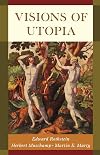
A look at the history of utopian thinking from the perspective of three cultural critics --- Edward Rothstein, Herbert Muschamp, and Martin E. Marty. This is an interesting and lucid dissection of the results of noble thinking that often leads to disastrous consequences.
You May Also Like


Associated Authors
Statistics
- Works
- 5
- Also by
- 4
- Members
- 307
- Popularity
- #76,699
- Rating
- 3.3
- Reviews
- 3
- ISBNs
- 10
- Languages
- 1