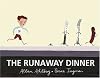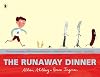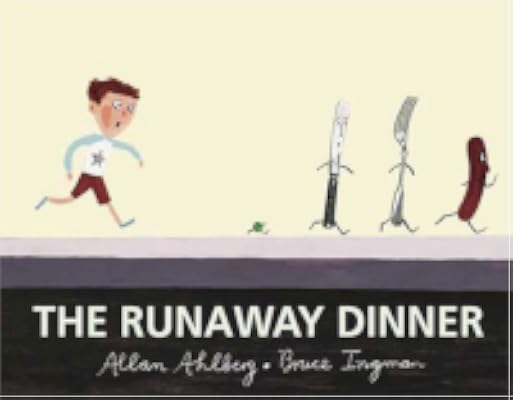
The Runaway Dinner
by Allan Ahlberg, Bruce Ingman (Illustrator)
On This Page
Description
A young boy named Banjo Cannon always eats a sausage for dinner, until the night that his sausage--and the rest of his meal--runs away.Tags
Recommendations

Member Reviews
While some may find the outrageously long sentences tedious or exhausting, we find them humorous. I credit repeated exposure to Ahlberg's excessive(?) use of interrupting conjunctive adverbs for my five-year-old's penchant for using them in his own story telling. For older readers, The Runaway Dinner offers a fine study in the appropriate use of the comma.
An anthropomorphic sausage named Melvin makes a break for his freedom in this rather surreal picture-book adventure from Allan Ahlberg and Bruce Ingman, followed in short order by: the fork, the knife, the plate, the table and chair, three fat peas (named Peter, Percival and Paul), four baby carrots (Caroline, Clara, Camilla and Christabel), and a handful of fries (all French, of course). Pursuing this string of unconventional runaways is a hungry boy named Banjo Cannon, Banjo's cat, Mildred, the neighbor's dog (pursuing Mildred, really), and Banjo's parents. Many mishaps (or not, depending upon one's perspective) ensue. Will Banjo catch his sausage? Will Melvin be eaten? Read and find out...
Like some other reviewers, I had mixed show more feelings about The Runaway Dinner, which has a zany, madcap sense of fun that will appeal to some, and leave others cold. The acrylic illustrations, done by Bruce Ingman, are also likely to appeal, or not, as the case may be. Truthfully, this was one I appreciated more than enjoyed - the artwork just isn't to my taste, and the story, while hilarious upon occasion, was rather uneven. Still, I think children who enjoy the bizarre and offbeat will like it, particularly if they have a fondness for "pursuit tales" (think The Gingerbread Man, and the like). show less
Like some other reviewers, I had mixed show more feelings about The Runaway Dinner, which has a zany, madcap sense of fun that will appeal to some, and leave others cold. The acrylic illustrations, done by Bruce Ingman, are also likely to appeal, or not, as the case may be. Truthfully, this was one I appreciated more than enjoyed - the artwork just isn't to my taste, and the story, while hilarious upon occasion, was rather uneven. Still, I think children who enjoy the bizarre and offbeat will like it, particularly if they have a fondness for "pursuit tales" (think The Gingerbread Man, and the like). show less
Just as little Banjo is about to sit down to his nice little sausage for dinner it decides to get up and run away. The sausage, named Melvin, is followed by the rest of his dinner, cutlery and china, the kitchen furniture, pets and, of course, Banjo and his parents. Along the way French fries take boat trips on the lake, poor peas are culled through avian misadventure, a plate is appropriated for a Frisbee, a chair gets sat on just as it's resting all while the carrots take refuge in a paper bag. Finally, as Banjo catches up with Melvin the sausage he is forbidden to partake in his dinner as his mother chides "it's been on the ground." Happily giving up the chase, Banjo and his family (and furniture, pets, &c.) head home to desert while show more Melvin is seen walking hand-in-hand into the sunset with a baseball (named Marlon) he met while hiding out in the tall grass.
At the start Ahlberg's sing-songy text felt very mid-century, in that way that children's books often spoke directly to children as if being read aloud. There may be a more technical term for this (or at least a better way to describe it) but it's a lot of what I think of as reassurance text.
...the sausage -- Melvin, his name was --
jumped, yes, jumped right up off the plate...
Maybe it's because I had a creepy librarian growing up who did picture book story time with a condescending drawn out way of interjecting just such phrases whether they were written or not, but that sort of text has always set my teeth on edge. Ahlberg, however, manages not only to keep it in check but sends the story into such unexpected territories that by the end I was liking the book a whole lot more than when I started. And Bruce Ingman's child-like paintings capture the spirit and zeal of the chase even before it's begun.
It's all in the details. A pea goes missing and only after some searching can it be spotted apparently reading a small newspaper in a tree. How is it that no one at the baseball game seems to notice the bleachers are filled with fries enjoying the game? Why do the food items running around have names but the salt and pepper shaker, the table and chair, not have names? Ah, the delightful mysteries of nonsense. show less
At the start Ahlberg's sing-songy text felt very mid-century, in that way that children's books often spoke directly to children as if being read aloud. There may be a more technical term for this (or at least a better way to describe it) but it's a lot of what I think of as reassurance text.
...the sausage -- Melvin, his name was --
jumped, yes, jumped right up off the plate...
Maybe it's because I had a creepy librarian growing up who did picture book story time with a condescending drawn out way of interjecting just such phrases whether they were written or not, but that sort of text has always set my teeth on edge. Ahlberg, however, manages not only to keep it in check but sends the story into such unexpected territories that by the end I was liking the book a whole lot more than when I started. And Bruce Ingman's child-like paintings capture the spirit and zeal of the chase even before it's begun.
It's all in the details. A pea goes missing and only after some searching can it be spotted apparently reading a small newspaper in a tree. How is it that no one at the baseball game seems to notice the bleachers are filled with fries enjoying the game? Why do the food items running around have names but the salt and pepper shaker, the table and chair, not have names? Ah, the delightful mysteries of nonsense. show less
Reviewed again here http://jeanlittlelibrary.blogspot.com/2014/09/the-runaway-dinner-by-allan-ahlber...
I have a cold so I am pulling out some of my favorite storytime books as significant portions of my brain are no longer functioning.
I am not, in general, a fan of Ahlberg's work. Put away the pitchforks, please! We are all entitled to our own opinion! It just never grabbed me and I've felt generally unenthusiastic about the various illustrators he's teamed up with.
But when I discovered this book on our library shelves several years ago, I fell in love with it. It's now one of my favorite stories, although it doesn't always work well in storytime.
Banjo, a little boy, sits down to eat his dinner. But the dinner, a nice sausage, has other show more ideas and runs away. Soon there's a gingerbread-boy-parade of food, furniture, cutlery, and people running through the city. One by one things drop out of the race; the carrots escape, the peas are eaten, the chair gets sat on, the plate becomes a frisbee, until finally Banjo catches the sausage and...well, you'll have to read the story to find out Melvin's fate.
Ingram's illustrations depend on broad swatches of color, against which the food and utensils trot briskly on spindly legs. Background people and details are sketched in outline, focusing the story on the various animated objects as they have their adventures.
The real draw for this story is Ahlberg's text. He perfectly creates a flowing rhythm that draws the listener and reader through the story. Repetition and exclamation blend smoothly together creating a sing-song poetry of the quirky story. "Well, he was a little boy, this boy, lived in a house, slept in a bed, wore all the usual sorts of clothes, socks and scarves and such."
This story is a little long for the average storytime, but it has that special quality that catches children's interest and holds it throughout a longer tale. I've found it works best if you read it quickly in a good storytelling voice. Expression depends on the audience; younger kids need guidance to catch the jokes, while you can read it completely deadpan to older, say 4s and 5s, and get howls of laughter.
Verdict: This is one of my personal and storytime favorites and if your library doesn't own it I highly recommend it.
ISBN: 076361426; Published August 2006 by Candlewick; Reviewed from my personal copy; Purchased for the library; Purchased for my personal library show less
I have a cold so I am pulling out some of my favorite storytime books as significant portions of my brain are no longer functioning.
I am not, in general, a fan of Ahlberg's work. Put away the pitchforks, please! We are all entitled to our own opinion! It just never grabbed me and I've felt generally unenthusiastic about the various illustrators he's teamed up with.
But when I discovered this book on our library shelves several years ago, I fell in love with it. It's now one of my favorite stories, although it doesn't always work well in storytime.
Banjo, a little boy, sits down to eat his dinner. But the dinner, a nice sausage, has other show more ideas and runs away. Soon there's a gingerbread-boy-parade of food, furniture, cutlery, and people running through the city. One by one things drop out of the race; the carrots escape, the peas are eaten, the chair gets sat on, the plate becomes a frisbee, until finally Banjo catches the sausage and...well, you'll have to read the story to find out Melvin's fate.
Ingram's illustrations depend on broad swatches of color, against which the food and utensils trot briskly on spindly legs. Background people and details are sketched in outline, focusing the story on the various animated objects as they have their adventures.
The real draw for this story is Ahlberg's text. He perfectly creates a flowing rhythm that draws the listener and reader through the story. Repetition and exclamation blend smoothly together creating a sing-song poetry of the quirky story. "Well, he was a little boy, this boy, lived in a house, slept in a bed, wore all the usual sorts of clothes, socks and scarves and such."
This story is a little long for the average storytime, but it has that special quality that catches children's interest and holds it throughout a longer tale. I've found it works best if you read it quickly in a good storytelling voice. Expression depends on the audience; younger kids need guidance to catch the jokes, while you can read it completely deadpan to older, say 4s and 5s, and get howls of laughter.
Verdict: This is one of my personal and storytime favorites and if your library doesn't own it I highly recommend it.
ISBN: 076361426; Published August 2006 by Candlewick; Reviewed from my personal copy; Purchased for the library; Purchased for my personal library show less
It's the tale of The Gingerbread Man moved to teatime and told minus the hubris and nemesis, which enables the story to be satisfactorily circular whilst remaining artfully unresolved.
In my opinion this is a very fun book! I love this book because of the language and illustrations. The language in this book is very descriptive. One part that I love is not only did the author go into detail about what the runaway food looks like, but also gave the food names. For example, when the french-fries were running away two names that were given to the french-fries were Francois and Fifi because they were French. I thought this was very creative and added silliness in the book. The language in this book was also fun because there was no pattern. This really added suspense to the book because you never knew who was going to be caught next or who was going to be eaten next! The illustrations in this book were also great. The show more pictures in this book really enhance the story. Since this book has a lot of descriptive language, it can get overwhelming. I believe the pictures help take the silly language and bring it to life. The illustrations in this book also fit the written text, which is organized. The pictures are neatly painted and also have the same color scheme of soft colors.
After re-reading this book multiple times I do not believe that there is an overall moral to this book. I think this book was created for all different reading ages and for them to have a good laugh at such a silly story. show less
After re-reading this book multiple times I do not believe that there is an overall moral to this book. I think this book was created for all different reading ages and for them to have a good laugh at such a silly story. show less
Amusing story, if not quite as funny as I was expecting. This book seemed like a logical choice, after reading the hilariously funny [b:Spoon|5499910|Spoon|Amy Krouse Rosenthal|https://d202m5krfqbpi5.cloudfront.net/books/1360564754s/5499910.jpg|5574333] by [a:Amy Krouse Rosenthal|21674|Amy Krouse Rosenthal|https://d202m5krfqbpi5.cloudfront.net/authors/1220138789p2/21674.jpg]. We've been reading a few [a:Allan Ahlberg|45317|Allan Ahlberg|https://d202m5krfqbpi5.cloudfront.net/authors/1272988209p2/45317.jpg] books, including for instance [b:The Jolly Postman|385250|The Jolly Postman, or Other People's Letters|Janet Ahlberg|https://d202m5krfqbpi5.cloudfront.net/books/1174352523s/385250.jpg|374972], which I can heartily recommend. I'm show more beginning to appreciate the recurring characters in many of Ahlberg's books, such as [b:Each Peach Pear Plum|833550|Each Peach Pear Plum|Janet Ahlberg|https://d202m5krfqbpi5.cloudfront.net/books/1347785603s/833550.jpg|819179] and [b:The Baby's Catalogue|1208498|The Baby's Catalogue|Janet Ahlberg|https://d202m5krfqbpi5.cloudfront.net/books/1348065777s/1208498.jpg|2444709], although these have Ahlberg's drawings whereas this one does not. My son, like me, was really drawn in by the idea of "The Runaway Dinner" but lost some of his enthusiasm for the story as it carried along ... show less
Members
- Recently Added By
Author Information

244+ Works 20,696 Members
Allan Ahlberg was born in 1938 in South London, and grew up in the Black Country. He worked as a teacher, postman, grave digger, soldier and plumber's mate before he became a full-time writer. He met his wife and creative partner, Janet at teacher training college. It was because Janet wanted to illustrate a book that Allan wrote his first book, show more the Brick Street boys. After that, together they wrote 37 books. Janet died in 1994 and Ahlberg discontinued his writing career for a few years before picking it up again. (Bowker Author Biography) show less

Awards and Honors
Awards
Classifications
Statistics
- Members
- 224
- Popularity
- 145,227
- Reviews
- 16
- Rating
- (4.05)
- Languages
- English
- Media
- Paper, Audiobook
- ISBNs
- 16
- ASINs
- 1