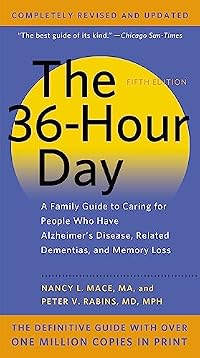
The 36-Hour Day: A Family Guide to Caring for People Who Have Alzheimer Disease, Related Dementias, and Memory Loss
by Nancy L. Mace, Peter V. Rabins
On This Page
Description
Through five editions, The 36-Hour Day has been an essential resource for families who love and care for people with Alzheimer disease. Whether a person has Alzheimer disease or another form of dementia, he or she will face a host of problems. The 36-Hour Day will help family members and caregivers address these challenges and simultaneously cope with their own emotions and needs. Featuring useful takeaway messages and informed by recent research into the causes of and the search for show more therapies to prevent or cure dementia, this edition includes new information on - devices to make life simpler and safer for people who have dementia - strategies for delaying behavioral and neuropsychiatric symptoms - changes in Medicare and other health care insurance laws - palliative care, hospice care, durable power of attorney, and guardianship - dementia due to traumatic brain injury - choosing a residential care facility - support groups for caregivers, friends, and family members The central idea underlying the book, that much can be done to improve the lives of people with dementia and of those caring for them, remains the same. The 36-Hour Day is the definitive dementia care guide. show lessTags
Recommendations












Member Reviews
Developed to help caregivers and family members who are coping with a loved one with mental impairment due to disease, I wished, while reading, that someone had referred me to this book years ago. Most of what it contains I have learned already through trial and error or independent research, but it is a fairly comprehensive, but easy to read, book on the subject.
As someone who is dealing daily with the problems this book addresses, I felt I needed to review the book and encourage anyone who is seeing those early symptoms, the mood changes, the short-term memory loss, the confusion, the complaints of eyesight problems when the ophthalmologist says nothing is wrong with the eyes, or a sudden lack of interest in doing things, to please show more pay attention and get an early diagnosis and help.
One thing people should realize, but often don’t, is that there are many diseases that fall under the umbrella of dementia. Alzhiemer’s is only one of them. This book does go into the different types and points you in the direction that you need to go for the specific type of dementia you are dealing with. My husband has dementia associated with Parkinson’s, but also that brought on by stroke, so I am dealing with a two-fold disease. And, very important--your loved one may have delirium, which is treatable and often reversible, so you need a true diagnosis and the sooner the better.
Don’t stop pushing for a diagnosis, particularly if you are dealing with an elderly individual. I went through a number of health professionals who patted my husband on the head and said “not fun getting old, is it?” before I found one who would listen to me that there was much more going on here than aging. Once I got the diagnosis, I got some help, and that has made a great deal of difference for him, and for me. You cannot stop dementia or Parkinsons, they are degenerative diseases, but you can help with symptoms, know what to do in the face of what seems unfaceable, and you can feel a little more in control when you know what to expect and what new symptoms mean.
I read a fair amount of medical information and I do not tend to review those kinds of books here, but I truly felt that if only one person who suspects there might be a problem read this book early on, I might be actually helping. My husband first began to display symptoms in 2014; I got a diagnosis in 2019. Those five years of not knowing and no help were the hardest to bear. I made radical changes in our lives to get that diagnosis, and the last two years have been easier, despite the fact that his disease has become more pronounced and harder to manage.
Forgive me if this review is just too personal. I could find no way to write it without bringing my own situation fully into the picture. My prayers are with everyone out there who is dealing with these horrendous diseases that steal our loved ones in bits and pieces. BTW, if you are not directly involved in taking care of someone with dementia, but you know someone who is, you might want to read this book and know what they are dealing with. They need your understanding; they need your prayers. show less
As someone who is dealing daily with the problems this book addresses, I felt I needed to review the book and encourage anyone who is seeing those early symptoms, the mood changes, the short-term memory loss, the confusion, the complaints of eyesight problems when the ophthalmologist says nothing is wrong with the eyes, or a sudden lack of interest in doing things, to please show more pay attention and get an early diagnosis and help.
One thing people should realize, but often don’t, is that there are many diseases that fall under the umbrella of dementia. Alzhiemer’s is only one of them. This book does go into the different types and points you in the direction that you need to go for the specific type of dementia you are dealing with. My husband has dementia associated with Parkinson’s, but also that brought on by stroke, so I am dealing with a two-fold disease. And, very important--your loved one may have delirium, which is treatable and often reversible, so you need a true diagnosis and the sooner the better.
Don’t stop pushing for a diagnosis, particularly if you are dealing with an elderly individual. I went through a number of health professionals who patted my husband on the head and said “not fun getting old, is it?” before I found one who would listen to me that there was much more going on here than aging. Once I got the diagnosis, I got some help, and that has made a great deal of difference for him, and for me. You cannot stop dementia or Parkinsons, they are degenerative diseases, but you can help with symptoms, know what to do in the face of what seems unfaceable, and you can feel a little more in control when you know what to expect and what new symptoms mean.
I read a fair amount of medical information and I do not tend to review those kinds of books here, but I truly felt that if only one person who suspects there might be a problem read this book early on, I might be actually helping. My husband first began to display symptoms in 2014; I got a diagnosis in 2019. Those five years of not knowing and no help were the hardest to bear. I made radical changes in our lives to get that diagnosis, and the last two years have been easier, despite the fact that his disease has become more pronounced and harder to manage.
Forgive me if this review is just too personal. I could find no way to write it without bringing my own situation fully into the picture. My prayers are with everyone out there who is dealing with these horrendous diseases that steal our loved ones in bits and pieces. BTW, if you are not directly involved in taking care of someone with dementia, but you know someone who is, you might want to read this book and know what they are dealing with. They need your understanding; they need your prayers. show less
This was a difficult book to read from an emotional standpoint; much of it made me think of my father's ordeal with Primary CNS Lymphoma and a little bit of when my grandmother dealt with Alzheimer's though I was a bit more removed from that case. It can also be a little overwhelming to read about the possibilities of what might be coming in the future. However, it was far easier to read than I thought it would be, not dry at all and very reaffirming and caring toward the person reading it. I thought the research part at the end was very interesting although I was reading the 5th edition from 2011; I thought I had purchased the most recent but apparently I had not. I highly recommend this to anyone who has a loved one dealing with any show more sort of disease that causes dementia, or memory loss. It has helped me become (and still working on it) more understanding. show less
I bought this in a rush to understand what my mother was descending into, and I found it quite helpful. I do wish that I had recognized her memory loss earlier as I think this would have been much more help. As it was, I read it three months before she died, but what the book taught me was that the signs were there ten years earlier, I just failed to recognize them. I think anyone that is dealing with an aging parent or other friend or relative would do well to use this in their research at the beginning, even if on a just-in-case basis.
This book was updated to a fifth edition in 2011. It is primarily about Alzheimer's and dementias in general, and does not really address the type my mother has (FTD-PPA). The first eight chapters define dementia and discuss getting medical help, characteristic behavioral symptoms of the disease (two chapters), problems in independent living and daily care, and medical problems and symptoms that appear as changes in mood. The next six chapters focus more on the caregiver and the family. The last five chapters address financial and legal issues, nursing homes and other living arrangements (but not really the settings that have come to be known as "memory care"), preventing or delaying cognitive decline, and more detail on brain disorders show more and causes of and research in dementia. Although it is now somewhat outdated, I was glad to receive a mass-market paperback copy of this book for reference. show less
Not bad and some good information, although some of it seems like common sense.
I read a more recent update than this 2006 edition. Provided comprehensive information. It tended to refer to the Alzheimer's Association a lot for more information. I tried the local chapter and found it didn't provide many of the resources referred to in the book but am sure that is different depending on where one lives. Well worth the read. I did skip sections that were not relevant to my particular situation.
This was very informative and I will keep it for a reference book. It describes the many different types of dementia, what the effect is on the brain and the person afflicted, what to expect in their behavior and how to cope as a caregiver. It also explains the medical research going on and various treatments. Very practical advice.
Members
- Recently Added By
Lists

Alzheimer's/Dementia Reading
14 works; 1 member
Author Information
4 Works 1,367 Members
7 Works 1,441 Members
Peter V. Rabins, MD, MPH, is professor emeritus of psychiatry and medicine at the Johns Hopkins University School of Medicine. He was the founding director of its geriatric psychiatry program and the first holder of the Richman Family Professorship of Alzheimer Disease and Related Disorders.
Some Editions
Common Knowledge
- Original publication date
- 1981
- Dedication
- This book is dedicated to everyone who gives a "36-hour day" to the care of a person with dementia.
- Last words
- (Click to show. Warning: May contain spoilers.)[Foreword] As we can foresee the liklihood of a major advance in our powers o treatment and preention before the next edition will be conceived, we can also recognize how much of the energy spurring such progress should be attributed to the readers of this book and their caregiving commitments to patients as valued people.
(Click to show. Warning: May contain spoilers.)[Preface] Until total prevention is achieved, compassionate care will remain central to the treatment of dementia.
(Click to show. Warning: May contain spoilers.)It is still possible that one or several treatments might treat or prevent the disease no matter what the original trigger, but it is also possible that multiple treatments will need to be developed because the different causes need to be treated or prevented by different approaches or agents. - Canonical DDC/MDS
- 616.831 MAC
Classifications
- Genres
- Nonfiction, General Nonfiction
- DDC/MDS
- 616.831 — Applied science & technology Medicine & health Diseases, Allergies, Skin Conditions Nervous Disorders: Autism, Anorexia, OCD Other organic diseases of central nervous system Alzheimer
- LCC
- RC523 .M33 — Medicine Internal medicine Internal medicine Neurosciences. Biological psychiatry. Neuropsychiatry Psychiatry Psychopathology Psychoses
- BISAC
Statistics
- Members
- 1,359
- Popularity
- 17,485
- Reviews
- 21
- Rating
- (3.93)
- Languages
- 7 — Catalan, Chinese, Danish, English, German, Spanish, Swedish
- Media
- Paper, Audiobook, Ebook
- ISBNs
- 64
- ASINs
- 15
