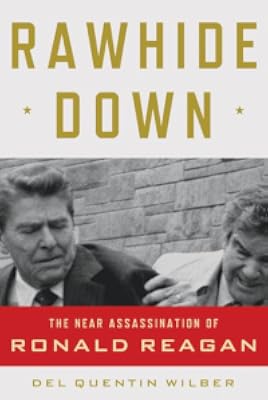
Rawhide Down: The Near Assassination of Ronald Reagan
by Del Quentin Wilber
On This Page
Description
A minute-by-minute account of the 1981 assassination attempt on the fortieth president reveals how close he came to dying, in a report that pays tribute to the individuals who saved his life and oversaw national security throughout the crisis.Tags
Recommendations




Member Reviews
"Today, Mr. President, we are all Republicans."
On March 30, 1981, President Ronald Reagan was leaving a speaking engagement at the Washington Hilton when six shots were fired at him and his staff. It took only 1.7 seconds for John Hinckley Jr. to unload all six explosive-tipped Devastator bullets. Three men - the President's press secretary, a Secret Service agent, and a Washington D.C. police officer - lay wounded as the President was sped away. Initially, no one realized the President had been hit as well, but when Special Agent Jerry Parr saw blood on Reagan's lips, he instructed the driver to head directly to George Washington University Hospital. His instincts saved the President's life.
Del Quentin Wilber has written a riveting show more account of the events that day. It is not an exhaustive detailing of every fact surrounding the attempted assassination of President Reagan, but is a readable narrative that is as hard to put down as an engrossing novel. He includes the experiences of dozens of agents, officers, medical personnel, and those in the Reagan Administration in a real-time manner as it unfolded. It is both moving and terrifying to view the assassination attempt from the perspective of those who were there. It is highly inspiring to see the reaction of those around him - the agent who used his body to block the bullets, Parr's automatic response in protecting Reagan, and the medical personnel who cared for him. It is also chillingly interesting to see the motives behind John Hinckley's actions that day. Most of all it was nice to read of the way Reagan handled himself, from insisting on walking into the hospital to the jokes and words he used to offer comfort to others.
I remember hearing about the shooting in my 8th grade algebra class, and the shocked feeling that followed the teacher's sober announcement. But my memories from 30 years ago were fuzzy and it was amazing to read of everything that occurred. I re-watched the videos of the shooting online and was surprised to realize you could see the gun being fired and the wounded men going down - if they showed all that back then I certainly didn't remember it. I highly recommend this worthwhile book. show less
On March 30, 1981, President Ronald Reagan was leaving a speaking engagement at the Washington Hilton when six shots were fired at him and his staff. It took only 1.7 seconds for John Hinckley Jr. to unload all six explosive-tipped Devastator bullets. Three men - the President's press secretary, a Secret Service agent, and a Washington D.C. police officer - lay wounded as the President was sped away. Initially, no one realized the President had been hit as well, but when Special Agent Jerry Parr saw blood on Reagan's lips, he instructed the driver to head directly to George Washington University Hospital. His instincts saved the President's life.
Del Quentin Wilber has written a riveting show more account of the events that day. It is not an exhaustive detailing of every fact surrounding the attempted assassination of President Reagan, but is a readable narrative that is as hard to put down as an engrossing novel. He includes the experiences of dozens of agents, officers, medical personnel, and those in the Reagan Administration in a real-time manner as it unfolded. It is both moving and terrifying to view the assassination attempt from the perspective of those who were there. It is highly inspiring to see the reaction of those around him - the agent who used his body to block the bullets, Parr's automatic response in protecting Reagan, and the medical personnel who cared for him. It is also chillingly interesting to see the motives behind John Hinckley's actions that day. Most of all it was nice to read of the way Reagan handled himself, from insisting on walking into the hospital to the jokes and words he used to offer comfort to others.
I remember hearing about the shooting in my 8th grade algebra class, and the shocked feeling that followed the teacher's sober announcement. But my memories from 30 years ago were fuzzy and it was amazing to read of everything that occurred. I re-watched the videos of the shooting online and was surprised to realize you could see the gun being fired and the wounded men going down - if they showed all that back then I certainly didn't remember it. I highly recommend this worthwhile book. show less
"Today, Mr. President, we are all Republicans."
On March 30, 1981, President Ronald Reagan was leaving a speaking engagement at the Washington Hilton when six shots were fired at him and his staff. It took only 1.7 seconds for John Hinckley Jr. to unload all six explosive-tipped Devastator bullets. Three men - the President's press secretary, a Secret Service agent, and a Washington D.C. police officer - lay wounded as the President was sped away. Initially, no one realized the President had been hit as well, but when Special Agent Jerry Parr saw blood on Reagan's lips, he instructed the driver to head directly to George Washington University Hospital. His instincts saved the President's life.
Del Quentin Wilber has written a riveting show more account of the events that day. It is not an exhaustive detailing of every fact surrounding the attempted assassination of President Reagan, but is a readable narrative that is as hard to put down as an engrossing novel. He includes the experiences of dozens of agents, officers, medical personnel, and those in the Reagan Administration in a real-time manner as it unfolded. It is both moving and terrifying to view the assassination attempt from the perspective of those who were there. It is highly inspiring to see the reaction of those around him - the agent who used his body to block the bullets, Parr's automatic response in protecting Reagan, and the medical personnel who cared for him. It is also chillingly interesting to see the motives behind John Hinckley's actions that day. Most of all it was nice to read of the way Reagan handled himself, from insisting on walking into the hospital to the jokes and words he used to offer comfort to others.
I remember hearing about the shooting in my 8th grade algebra class, and the shocked feeling that followed the teacher's sober announcement. But my memories from 30 years ago were fuzzy and it was amazing to read of everything that occurred. I re-watched the videos of the shooting online and was surprised to realize you could see the gun being fired and the wounded men going down - if they showed all that back then I certainly didn't remember it. I highly recommend this worthwhile book. show less
On March 30, 1981, President Ronald Reagan was leaving a speaking engagement at the Washington Hilton when six shots were fired at him and his staff. It took only 1.7 seconds for John Hinckley Jr. to unload all six explosive-tipped Devastator bullets. Three men - the President's press secretary, a Secret Service agent, and a Washington D.C. police officer - lay wounded as the President was sped away. Initially, no one realized the President had been hit as well, but when Special Agent Jerry Parr saw blood on Reagan's lips, he instructed the driver to head directly to George Washington University Hospital. His instincts saved the President's life.
Del Quentin Wilber has written a riveting show more account of the events that day. It is not an exhaustive detailing of every fact surrounding the attempted assassination of President Reagan, but is a readable narrative that is as hard to put down as an engrossing novel. He includes the experiences of dozens of agents, officers, medical personnel, and those in the Reagan Administration in a real-time manner as it unfolded. It is both moving and terrifying to view the assassination attempt from the perspective of those who were there. It is highly inspiring to see the reaction of those around him - the agent who used his body to block the bullets, Parr's automatic response in protecting Reagan, and the medical personnel who cared for him. It is also chillingly interesting to see the motives behind John Hinckley's actions that day. Most of all it was nice to read of the way Reagan handled himself, from insisting on walking into the hospital to the jokes and words he used to offer comfort to others.
I remember hearing about the shooting in my 8th grade algebra class, and the shocked feeling that followed the teacher's sober announcement. But my memories from 30 years ago were fuzzy and it was amazing to read of everything that occurred. I re-watched the videos of the shooting online and was surprised to realize you could see the gun being fired and the wounded men going down - if they showed all that back then I certainly didn't remember it. I highly recommend this worthwhile book. show less
This is an absorbing, minute by minute account of that day 30 years ago, in March of 1981, when President Ronald Reagan was nearly assassinated. I was in college at the time and, prior to reading this book, had only a vague notion of what happened that day. This book superbly filled in the blanks for me. I, and many others apparently, never realized how close Reagan came to dying that day. In fact, if the lead Secret Service agent, who pushed the President into his limo, had not made a quick decision to go to the hospital, Reagan might well have died.
Once started, this book is tough to put down, as the author goes into remarkable detail about what Reagan, the Secret Service agents, the medical staff, would-be-assassin John Hinkley, and show more others, including the First Lady and Vice President Bush, said, did, and thought that day.
I'd recommend this book to anyone who likes to read about American history. show less
Once started, this book is tough to put down, as the author goes into remarkable detail about what Reagan, the Secret Service agents, the medical staff, would-be-assassin John Hinkley, and show more others, including the First Lady and Vice President Bush, said, did, and thought that day.
I'd recommend this book to anyone who likes to read about American history. show less
 This review was written for LibraryThing Early Reviewers.
RAWHIDE DOWN
Del Quentin Wilber
Reviewed by William C. Hagen
Although filtered by faded memory and jumbled news accounts compounded by administration spin doctors at the time, many of us still remember the events of March 1981 when John Hinckley attempted to assassinate President Ronald Reagan. Del Quentin Wilber reignites those recollections in “Rawhide Down”. In the process of filling long lost gaps and providing insight into the background machinations going on during those hours while our country was leaderless and our president’s life was in the hands of others, Wilber captures the personalities of a diverse collection of cast members as well as the tempo of the time – the trance-like action of Hinckley, the steady beat of show more the Secret Service, the deliberate calm of the medical teams in spite of racing emotions, all against the backdrop of a chaotic White House staff with, apparently, no metronome. It is a compelling and engrossing drama worth a read in a single session.
While switching from one locale and cast member to the next, Wilber maintains the clear timeline of events and captures the ever increasing sense of urgency. The focus subtly goes from setting the scene to action to personality descriptions with minimal disruption of story. Although he does so with meticulous detail with what each individual was doing and thinking, the author sometimes adds more flesh than sinew to the bare skeleton of our recollections of the event. The ending is precipitous; I expected more than a rather lame epilogue, maybe a bridge between Reagan’s hospital room and his retaking of the reins in the Oval Office, at least a recap of Hinckley’s adjudication, anything more to neatly wrap the package. As it is, we are left with the illusion that maybe we made more of it than was warranted – one moment we are led to believe that Reagan is on death’s doorstep and on the next page he has on his red cardigan walking into the White House. At least I needed to be taken down more gradually.
The most serious criticism I have with the book has nothing to do with the narrative and is something the reader can overlook if forewarned. The book includes nearly fifty pages of notes documenting the source of every fact included in the text plus – in Wilber’s own words – “ those [facts] that might help the reader better understand . . . “ That is all well and good and certainly certifies its authenticity but the text itself is devoid of citations and transfers the task of authentication to the reader. The references are reversed with the notes referencing the page instead of the more orthodox insertion of superscripts in the text referencing the notes. Reading the text gives no clue as to the fact being cited or the point needing further explanation. The mistake I made was to read his introduction to the notes section first and to focus on that phrase that hinted at the inclusion of nuggets of information not included in the text. I periodically thumbed through the notes to ensure that I wasn’t missing something, thereby, interrupting the flow and rhythm of the narration. I don’t know if the author or his editors were conforming to an arcane Manual of Style with which I am ignorant or that it is a monster of their own invention but it was disconcerting and should not be repeated. The general reader should ignore the notes and, if compelled, reread the book a second time with particular attention to the notes. Those with some compulsive tendencies to identify primary sources might be rewarded; the nuggets are elusive.
Is it worth the read? Definitely. show less
Del Quentin Wilber
Reviewed by William C. Hagen
Although filtered by faded memory and jumbled news accounts compounded by administration spin doctors at the time, many of us still remember the events of March 1981 when John Hinckley attempted to assassinate President Ronald Reagan. Del Quentin Wilber reignites those recollections in “Rawhide Down”. In the process of filling long lost gaps and providing insight into the background machinations going on during those hours while our country was leaderless and our president’s life was in the hands of others, Wilber captures the personalities of a diverse collection of cast members as well as the tempo of the time – the trance-like action of Hinckley, the steady beat of show more the Secret Service, the deliberate calm of the medical teams in spite of racing emotions, all against the backdrop of a chaotic White House staff with, apparently, no metronome. It is a compelling and engrossing drama worth a read in a single session.
While switching from one locale and cast member to the next, Wilber maintains the clear timeline of events and captures the ever increasing sense of urgency. The focus subtly goes from setting the scene to action to personality descriptions with minimal disruption of story. Although he does so with meticulous detail with what each individual was doing and thinking, the author sometimes adds more flesh than sinew to the bare skeleton of our recollections of the event. The ending is precipitous; I expected more than a rather lame epilogue, maybe a bridge between Reagan’s hospital room and his retaking of the reins in the Oval Office, at least a recap of Hinckley’s adjudication, anything more to neatly wrap the package. As it is, we are left with the illusion that maybe we made more of it than was warranted – one moment we are led to believe that Reagan is on death’s doorstep and on the next page he has on his red cardigan walking into the White House. At least I needed to be taken down more gradually.
The most serious criticism I have with the book has nothing to do with the narrative and is something the reader can overlook if forewarned. The book includes nearly fifty pages of notes documenting the source of every fact included in the text plus – in Wilber’s own words – “ those [facts] that might help the reader better understand . . . “ That is all well and good and certainly certifies its authenticity but the text itself is devoid of citations and transfers the task of authentication to the reader. The references are reversed with the notes referencing the page instead of the more orthodox insertion of superscripts in the text referencing the notes. Reading the text gives no clue as to the fact being cited or the point needing further explanation. The mistake I made was to read his introduction to the notes section first and to focus on that phrase that hinted at the inclusion of nuggets of information not included in the text. I periodically thumbed through the notes to ensure that I wasn’t missing something, thereby, interrupting the flow and rhythm of the narration. I don’t know if the author or his editors were conforming to an arcane Manual of Style with which I am ignorant or that it is a monster of their own invention but it was disconcerting and should not be repeated. The general reader should ignore the notes and, if compelled, reread the book a second time with particular attention to the notes. Those with some compulsive tendencies to identify primary sources might be rewarded; the nuggets are elusive.
Is it worth the read? Definitely. show less
This review was written for LibraryThing Early Reviewers.Rawhide Down is a detailed account of that fateful day in 1981 when John Hinckley gunned down President Ronald Reagan and several members of his party outside a hotel in Washington DC.
This was of course a momentous day, but it seems in recent years it’s faded quite drastically into the cultural background. ‘Oh yeah, that’s right – Reagan got shot just after he took office . . .’. Reagan’s two terms were so eventful that this early incident seems far in the past indeed, and since Reagan seemed to recover so rapidly, it’s easy to forget how very close he came to dying.
This book brings back the memories of that day, vividly, and adds a great deal of fascinating detail and insight. It’s not a macabre book at all, though – show more in fact, strangely enough, it’s almost a ‘feel-good’ read. Not only did the President himself show remarkable bravery and savoir-faire, the medical team that saved his life was extraordinary. The sequences in the book that highlight, almost minute by minute, this team’s actions in saving Reagan’s life are gripping and often moving.
Most of the rest of the book focuses on the goings-on in the White House, as shocked members of the administration scrambled, sometimes ineffectively, to say and do the right things in the face of the great uncertainty and confusion that accompanies a threat to the life a world leader. Wilber recounts Vice-President Bush’s flight back from Texas to Washington, and the behind-the-scenes White House meetings that culminated in Al Haig’s bizarre announcement to the press. I found these parts of the book more interesting than compelling. At this historical distance – it’s over 30 years ago, now – I was more interested in what was happening to Reagan himself than to the ephemeral machinations of his administration.
But that is no criticism of Rawhide Down. Wilber’s account deserves to read by anyone interested in American history, in the life of one of our greatest presidents, and in human drama in general. show less
This was of course a momentous day, but it seems in recent years it’s faded quite drastically into the cultural background. ‘Oh yeah, that’s right – Reagan got shot just after he took office . . .’. Reagan’s two terms were so eventful that this early incident seems far in the past indeed, and since Reagan seemed to recover so rapidly, it’s easy to forget how very close he came to dying.
This book brings back the memories of that day, vividly, and adds a great deal of fascinating detail and insight. It’s not a macabre book at all, though – show more in fact, strangely enough, it’s almost a ‘feel-good’ read. Not only did the President himself show remarkable bravery and savoir-faire, the medical team that saved his life was extraordinary. The sequences in the book that highlight, almost minute by minute, this team’s actions in saving Reagan’s life are gripping and often moving.
Most of the rest of the book focuses on the goings-on in the White House, as shocked members of the administration scrambled, sometimes ineffectively, to say and do the right things in the face of the great uncertainty and confusion that accompanies a threat to the life a world leader. Wilber recounts Vice-President Bush’s flight back from Texas to Washington, and the behind-the-scenes White House meetings that culminated in Al Haig’s bizarre announcement to the press. I found these parts of the book more interesting than compelling. At this historical distance – it’s over 30 years ago, now – I was more interested in what was happening to Reagan himself than to the ephemeral machinations of his administration.
But that is no criticism of Rawhide Down. Wilber’s account deserves to read by anyone interested in American history, in the life of one of our greatest presidents, and in human drama in general. show less
It's OK. I think it's biggest draw is that it does provide a complete, well-written, minute-by-minute set of events of where President Reagan and his Secret Service officers were and their decisions, and also the thoughts of the doctors and nurses who treated him, on the day that he was shot.
However. The first portion and the ending portion of the book, and also peppered throughout, are overblown homages to Reagan and his spot in US Presidential history. He alone is credited with ending the Cold War and the Soviet threat; not once are the names Lech Walensa" of Poland and the late "Vaclev Havel" of then Czechoslovakia mentioned. Not in the index, and not in the book. When the writer ventures into this mythologized, Reagan-as-hero show more writing, the reason for his writing the book becomes bogged down into glamorizing this polarizing person.
However. He has done amazing research, filled with recollected details, notes, medical records, and even the plans of the hospital where Reagan was taken (torn down in 2003) to better describe the enormity of his injury and how confusing those first few minutes after his shooting were.
It's worth reading with an eye to the political bent." show less
However. The first portion and the ending portion of the book, and also peppered throughout, are overblown homages to Reagan and his spot in US Presidential history. He alone is credited with ending the Cold War and the Soviet threat; not once are the names Lech Walensa" of Poland and the late "Vaclev Havel" of then Czechoslovakia mentioned. Not in the index, and not in the book. When the writer ventures into this mythologized, Reagan-as-hero show more writing, the reason for his writing the book becomes bogged down into glamorizing this polarizing person.
However. He has done amazing research, filled with recollected details, notes, medical records, and even the plans of the hospital where Reagan was taken (torn down in 2003) to better describe the enormity of his injury and how confusing those first few minutes after his shooting were.
It's worth reading with an eye to the political bent." show less
Wilber is a much greater admirer of Reagan than I am -- and really, enough with the whole respected-the-Oval-Office-too-much-to-wear-shirtsleeves bit, it took me thirty seconds to Google a picture of Reagan in shirtsleeves in the Oval Office. But that aside, this is a pretty interesting and -- inability to Google images of Reagan notwithstanding -- well-researched account of the day Reagan was shot. Recommended if you like these sort of tick-tocks.
Members
- Recently Added By
Lists

Books on Ronald Reagan and His Administration
37 works; 2 members
Author Information
2 Works 452 Members
Awards and Honors
Distinctions
Common Knowledge
- People/Characters
- Ronald Reagan; John W. Hinckley, Jr.; James Brady; Richard V. Allen
- Important places
- Washington, D.C., USA
- Dedication
- To Laura
- First words
- When President Ronald Reagan awoke a seven a.m. on March 30, 1981, the world outside the White House was gray and dreary.
- Last words
- (Click to show. Warning: May contain spoilers.)"I know that for America there will always be a bright dawn ahead."
- Publisher's editor
- John Sterling
- Blurbers
- Cannon, Lou; Woodward, Bob; Will, George F.; Maraniss, David
Classifications
- Genres
- History, Nonfiction, General Nonfiction, Biography & Memoir
- DDC/MDS
- 973.927092 — History & geography History of North America United States 1901- Cold War, Vietnam War, Digital Age (1953-2001) Ronald Reagan (1981-1989) Reaganomics, Cold War Escalation, Iran-Contra Affair Biography
- LCC
- E877.3 .W55 — History of the United States United States Later twentieth century, 1961-2000 Reagan's administrations, 1981-1989 Assassination attempt
- BISAC
Statistics
- Members
- 341
- Popularity
- 92,761
- Reviews
- 22
- Rating
- (4.06)
- Languages
- English
- Media
- Paper, Audiobook, Ebook
- ISBNs
- 8
- ASINs
- 5