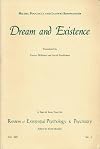
Dream and Existence
by Michel Foucault
31 Members (4.00)
On This Page
Description
Offers two essays: the first, by Foucault - Dream, Imagination and Existence; and the second, by Binswanger, Dream and Existence. Together, they present a strong case for the existential approach to dreams and for reviewing the world of the dreamer in a new, existential light.Tags
Recommendations


































Member Reviews
Members
- Recently Added By
Author Information

348+ Works 49,666 Members
Michel Foucault was born on October 15, 1926, in Poitiers, France, and was educated at the Sorbonne, in Paris. He taught at colleges all across Europe, including the Universities of Lill, Uppsala, Hamburg, and Warsaw, before returning to France. There he taught at the University of Paris and the College of France, where he served as the chairman show more of History of Systems of Thought until his death. Regarded as one of the great French thinkers of the twentieth century, Foucault's interest was in the human sciences, areas such as psychiatry, language, literature, and intellectual history. He made significant contributions not just to the fields themselves, but to the way these areas are studied, and is particularly known for his work on the development of twentieth-century attitudes toward knowledge, sexuality, illness, and madness. Foucault's initial study of these subjects used an archaeological method, which involved sifting through seemingly unrelated scholarly minutia of a certain time period in order to reconstruct, analyze, and classify the age according to the types of knowledge that were possible during that time. This approach was used in Madness and Civilization: A History of Insanity in the Age of Reason, for which Foucault received a medal from France's Center of Scientific Research in 1961, The Birth of the Clinic, The Order of Things, and The Archaeology of Knowledge. Foucault also wrote Discipline and Punishment: The Birth of the Prison, a study of the ways that society's views of crime and punishment have developed, and The History of Sexuality, which was intended to be a six-volume series. Before he could begin the final two volumes, however, Foucault died of a neurological disorder in 1984. (Bowker Author Biography) An outstanding philosopher and intellectual figure on the contemporary scene, Foucault has been influential in both philosophy and the recent interpretation of literature. Trained in philosophy and psychology, he was named to a chair at the College de France in 1970. He also taught in various departments of French literature as a visiting professor in the United States. Until 1968 he was a major figure in the critical movement known as structuralism, a method of intellectual inquiry based on the idea that all human behavior and achievement arises from an innate ability to organize, or "structure," human experiences. In both The Order of Things (1966) and The Archaeology of Knowledge (1969) he was interested in the organization of human knowledge and in the transformations of intellectual categories. His influential history of the prison, Discipline and Punish (1975), contributed to the study of the relationship of power and various forms of knowledge, as did the several volumes of an unfinished History of Sexuality published just before his death. (Bowker Author Biography) show less
Common Knowledge
- Canonical title
- Dream and Existence
- Last words
- (Click to show. Warning: May contain spoilers.)For just as we do not know where life and the dream begin, so we are, in the course of our lives, ever again reminded that it lies beyond man's powers "to be 'the individual' in the highest sense."
- Original language
- French
Classifications
Statistics
- Members
- 31
- Popularity
- 900,489
- Rating
- (4.00)
- Languages
- English
- Media
- Paper
- ISBNs
- 2
- ASINs
- 1