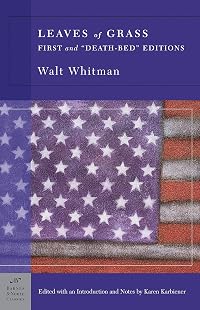
Leaves of Grass: First and "Death-Bed" Editions
by Walt Whitman
On This Page
Description
Whitman employs the cadence of simple, even idiomatic speech to "sing" national identity. Throughout his prolific career, Whitman continually revised and expanded Leaves of Grass, which went through nine editions. This volume include the first edition, the final, authorized "Death-Bed" edition, and selections of the best poems from preceding editions and other sources. Annotation. Whitman employs the cadence of simple, even idiomatic speech to "sing" national identity. Throughout his show more prolific career, Whitman continually revised and expanded Leaves of Grass, which went through nine editions. This volume include the first edition, the final, authorized "Death-Bed" edition, and selections of the best poems from preceding editions and other sources. Annotation. Whitman employs the cadence of simple, even idiomatic speech to "sing" national identity and destiny, philosophy and spiritualism, and frank autobiography. Throughout his prolific writing career, Whitman continually revised and expanded Leaves of Grass--which went through nine editions! This volume is the first to include the first edition, and the final, authorized "death-bed" edition, as well as a deft selection of poems which were eventually omitted. show lessTags
Recommendations

















Member Reviews
So, here's the deal. I took a long time with this, long for me. There were parts that I skimmed over, parts that made me uncomfortable, parts that made me reevaluate personal perceptions, parts that I couldn't identify with, and parts that I reread several times. All of these parts culminated in a five star rating, a five star read.
That's not to say that editing couldn't or shouldn't be had. In fact, Whitman apparently held the same view and did the deed quite often. But that's just it... when you read Whitman you get a sense of a breathing creation that grew out of experience and became simply more of itself. If we had Whitman's consciousness plugged into the sentient machine from Transcendence he'd still be putting out the new and show more extended more frequently than your average modern artist. Hence the potential for skimming to be had, having been had, etc.
What I simply loved was Whitman's wordsmithing. Given his reported love of rhythm one can easily see him as a beat poet, cherishing Ginsberg's Sunflower Sutra and marveling in the midst of a group of spoken word enthusiasts. It's this wordsmithing that communicates Whitman's passion to me so transparently. I can't help but be moved by such.
“Loafe with me on the grass—loose the stop from your throat;
Not words, not music or rhyme I want—not custom or lecture, not even the best;
Only the lull I like, the hum of your valved voice. ”
To me, Whitman's Leaves feels like a stop loosened. A freely flowing form that doused, drenched, quenched my own inspiration at several points. Because nothing is as freeing as that already freed. Even if only perceived in its freedom, it stirs the desire and need and I believe that's oft the majority of the battle. show less
That's not to say that editing couldn't or shouldn't be had. In fact, Whitman apparently held the same view and did the deed quite often. But that's just it... when you read Whitman you get a sense of a breathing creation that grew out of experience and became simply more of itself. If we had Whitman's consciousness plugged into the sentient machine from Transcendence he'd still be putting out the new and show more extended more frequently than your average modern artist. Hence the potential for skimming to be had, having been had, etc.
What I simply loved was Whitman's wordsmithing. Given his reported love of rhythm one can easily see him as a beat poet, cherishing Ginsberg's Sunflower Sutra and marveling in the midst of a group of spoken word enthusiasts. It's this wordsmithing that communicates Whitman's passion to me so transparently. I can't help but be moved by such.
“Loafe with me on the grass—loose the stop from your throat;
Not words, not music or rhyme I want—not custom or lecture, not even the best;
Only the lull I like, the hum of your valved voice. ”
To me, Whitman's Leaves feels like a stop loosened. A freely flowing form that doused, drenched, quenched my own inspiration at several points. Because nothing is as freeing as that already freed. Even if only perceived in its freedom, it stirs the desire and need and I believe that's oft the majority of the battle. show less
Leaves of Grass: First and “Death-Bed” Editions contains best known work of American poet Walt Whitman as well as additional poems that he published before his breakthrough work and that he didn’t include in his final publication. Containing hundreds of poems from the “father of free verse”, the reader gets a essentially a full view of Whitman’s career from beginning to end. In additional each new section of the book has an introduction by Dr. Karen Karbiener who also wrote the Notes at the end of the book giving the reader a better understanding of the essence surrounding Whitman’s work. Though many Whitman loves will enjoy this book, for some like myself this turned out to be too much of something that it turns out I show more didn’t like after all. show less
I had to read this text when I was in undergrad for English lit. While I absolutely hated my American lit class, I did enjoy Whitman (for the most part, although Leaves of Gras is SO long). There are so many beautiful lines in this text though!
Ratings
Members
- Recently Added By
Author Information

630+ Works 32,376 Members
Walt Whitman was born on Long Island and raised in Brooklyn, New York, the son of a carpenter. He left school when he was 11 years old to take a variety of jobs. By the time he was 15, Whitman was living on his own in New York City, working as a printer and writing short pieces for newspapers. He spent a few years teaching, but most of his work show more was either in journalism or politics. Gradually, Whitman became a regular contributor to a variety of Democratic Party newspapers and reviews, and early in his career established a rather eccentric way of life, spending a great deal of time walking the streets, absorbing life and talking with laborers. Extremely fond of the opera, he used his press pass to spend many evenings in the theater. In 1846, Whitman became editor of the Brooklyn Eagle, a leading Democratic newspaper. Two years later, he was fired for opposing the expansion of slavery into the west. Whitman's career as a poet began in 1885, with the publication of the first edition of his poetry collection, Leaves of Grass. The book was self-published (Whitman probably set some of the type himself), and despite his efforts to publicize it - including writing his own reviews - few people read it. One reader who did appreciate it was essayist Ralph Waldo Emerson, who wrote a letter greeting Whitman at "the beginning of a great career." Whitman's poetry was unlike any verse that had ever been seen. Written without rhyme, in long, loose lines, filled with poetic lists and exclamations taken from Whitman's reading of the Bible, Homer, and Asian poets, these poems were totally unlike conventional poetry. Their subject matter, too, was unusual - the celebration of a free-spirited individualist whose love for all things and people seemed at times disturbingly sensual. In 1860, with the publication of the third edition on Leaves of Grass, Whitman alienated conventional thinkers and writers even more. When he went to Boston to meet Emerson, poet Henry Wadsworth Longfellow, essayist Oliver Wendell Holmes, and poet James Russell Lowell, they all objected to the visit. With the outbreak of the Civil War, Whitman's attentions turned almost exclusively to that conflict. Some of the greatest poetry of his career, including Drum Taps (1865) and his magnificent elegy for President Abraham Lincoln, "When Last in the Dooryard Bloom'd" (1865), was written during this period. In 1862, his brother George was wounded in battle, and Whitman went to Washington to nurse him. He continued as a hospital volunteer throughout the war, nursing other wounded soldiers and acting as a benevolent father-figure and confidant. Parts of his memoir Specimen Days (1882) record this period. After the war, Whitman stayed on in Washington, working as a government clerk and continuing to write. In 1873 he suffered a stroke and retired to Camden, New Jersey, where he lived as an invalid for the rest of his life. Ironically, his reputation began to grow during this period, as the public became more receptive to his poetic and personal eccentricities. Whitman tried to capture the spirit of America in a new poetic form. His poetry is rough, colloquial, sweeping in its vistas - a poetic equivalent of the vast land and its varied peoples. Critic Louis Untermeyer has written, "In spite of Whitman's perplexing mannerisms, the poems justify their boundless contradictions. They shake themselves free from rant and bombastic audacities and rise into the clear air of major poetry. Such poetry is not large but self-assured; it knows, as Whitman asserted, the amplitude of time and laughs at dissolution. It contains continents; it unfolds the new heaven and new earth of the Western world." American poetry has never been the same since Whitman tore it away from its formal and thematic constraints, and he is considered by virtually all critics today to be one of the greatest poets the country has ever produced. (Bowker Author Biography) show less
All Editions
Work Relationships
Contains
Common Knowledge
- Canonical title
- Leaves of Grass: First and "Death-Bed" Editions
- Original publication date
- 1855
- Important places
- Long Island, New York, USA; Brooklyn, New York, USA; New Orleans, Louisiana, USA; Boston, Massachusetts, USA; Camden, New Jersey, USA; Philadelphia, Pennsylvania, USA
- Disambiguation notice
- This entry represents works containing both the 1855 and 1892 "Death-bed" editions of Leaves of Grass. Please do not combine with the entry for either edition, nor with the entry for unknown editions of Leaves of Grass.
Classifications
Statistics
- Members
- 574
- Popularity
- 51,506
- Reviews
- 3
- Rating
- (4.46)
- Languages
- Czech, English
- Media
- Paper, Ebook
- ISBNs
- 4
- ASINs
- 3