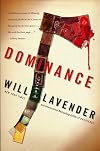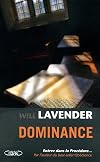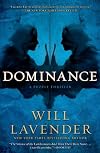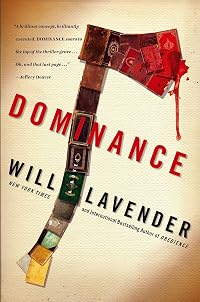
Dominance
by Will Lavender
On This Page
Description
Attending a controversial literary mystery night class taught by a professor who has been convicted of murder, Alex Shipley unravels an elaborate literary hoax that acquits the teacher, only for her to be targeted years later by a determined killer.Tags
Recommendations

















Member Reviews
Dominance is not what I expected it to be. I was afraid I’d be reading a gruesome tale of an ax-murdering serial killer, but that’s not really what this book is about. It’s about a game, specifically literature as a game. It’s a game based on the works of a writer whose identity is unknown. When a literature class is brought together to study the works of this unknown author, their assignment is to use clues from the books to discover the writer’s identity. Their professor is a convicted killer whose guilt is also called into question during the course of the class. The game continues long after the class is over, and just as some mysteries appear to be solved, others begin. What are intriguing about this book are its show more intricacies and puzzles. It reminded me somewhat of the Da Vinci code because of the embedding of codes, clues and maps throughout. Even when I figured out the whodunit part of the story, I learned I didn’t really know what I thought I did. The book’s ending leaves the reader questioning everything they thought they knew about the characters. How many of them were still playing the game and will the game ever really end? Although it starts a little slow, Dominance is a fascinating novel that the reader will still be pondering long after reading the last page. show less
I probably should have known better. On the one hand, I despise the kind of novels that have transformed Dan Brown and James Patterson into multi-millionaires. On the other, I love “books about books,” especially novels involving mystery and murder. Those always start with a bonus point or two in hand when I begin them, so I had high hopes for Will Lavender’s new thriller, Dominance. My hopes, however, were misplaced in this case.
Dominance is about little Jasper College and a special night class, “Unraveling a Literary Mystery,” being taught there to an elite group of senior American Literature majors. The most unusual thing about the class is that it is being taught via closed-circuit television from the prison cell of a show more former professor who is there because he murdered two female college students at a different school. Strangely, copies of Paul Fallows novels ornamented the bodies of both victims.
Paul Fallows, himself, is a mystery. Despite the stature of his work, and the notoriety connecting his books to the brutal axe-murders, no one has ever seen or spoken with him. Now, Professor Aldiss hopes that one of the nine students in his class will finally be able to solve the Paul Fallows mystery. With that purpose in mind, he feeds them a series of tantalizing clues that will have them competing to see which of them will finally solve the riddle that has frustrated Paul Fallows scholars for decades.
Lavender presents the novel in a series of flashbacks to the 1994 class alternated with flashes forward to the present day. One student, it seems, did make a major discovery during the class, a discovery so important that it forever changed the life of the professor and eventually led to a professorship at Harvard for the student. The story begins on the evening of the first class, and proceeds like an out-of-control train rushing down a mountainside to its destiny.
One can see from this brief synopsis that the book’s plot has a lot going for it. Booklovers (who will, of course, love the premise) will be jumping all over this one – as did I. My quarrel is not with the plot; it is with the book’s style.
At first glance, Lavender’s book seems to be more than 350 pages long. Within those pages, the author has crammed 53 chapters – which is not necessarily unreasonable. But it turns out that the chapters are really much shorter even than one would suppose because, almost every time there is a shift between past and present, the publisher has inserted a little three-page break with a title on the middle one (“The Class,” “Iowa,” “Alex,” etc.). That is bad enough, but it gets worse.
As the book nears its dramatic climax, the chapters grow shorter and shorter, each of them ending with the type of cliffhanger that reminds of those old Saturday morning serials kids used to love so much. The chapters grow shorter - but not the white space between them. I suppose that by making the reader turn the pages more often to get to the meat of the story, the publisher is hoping to build the tension involved in the reading process. That might work on some, but many others will react as I did: with snarling frustration at the silliness of it all.
Novels that read more like screenplays are precisely why I cannot read Dan Brown and James Patterson novels. I reluctantly add Will Lavender to the list (and I feel sure that he will not at all mind being lumped in with that highly successful pair). Don’t get me wrong: fans of Brown and Patterson will love this book. If you’re one of those, don’t miss Dominance.
Rated at: 3.0 show less
Dominance is about little Jasper College and a special night class, “Unraveling a Literary Mystery,” being taught there to an elite group of senior American Literature majors. The most unusual thing about the class is that it is being taught via closed-circuit television from the prison cell of a show more former professor who is there because he murdered two female college students at a different school. Strangely, copies of Paul Fallows novels ornamented the bodies of both victims.
Paul Fallows, himself, is a mystery. Despite the stature of his work, and the notoriety connecting his books to the brutal axe-murders, no one has ever seen or spoken with him. Now, Professor Aldiss hopes that one of the nine students in his class will finally be able to solve the Paul Fallows mystery. With that purpose in mind, he feeds them a series of tantalizing clues that will have them competing to see which of them will finally solve the riddle that has frustrated Paul Fallows scholars for decades.
Lavender presents the novel in a series of flashbacks to the 1994 class alternated with flashes forward to the present day. One student, it seems, did make a major discovery during the class, a discovery so important that it forever changed the life of the professor and eventually led to a professorship at Harvard for the student. The story begins on the evening of the first class, and proceeds like an out-of-control train rushing down a mountainside to its destiny.
One can see from this brief synopsis that the book’s plot has a lot going for it. Booklovers (who will, of course, love the premise) will be jumping all over this one – as did I. My quarrel is not with the plot; it is with the book’s style.
At first glance, Lavender’s book seems to be more than 350 pages long. Within those pages, the author has crammed 53 chapters – which is not necessarily unreasonable. But it turns out that the chapters are really much shorter even than one would suppose because, almost every time there is a shift between past and present, the publisher has inserted a little three-page break with a title on the middle one (“The Class,” “Iowa,” “Alex,” etc.). That is bad enough, but it gets worse.
As the book nears its dramatic climax, the chapters grow shorter and shorter, each of them ending with the type of cliffhanger that reminds of those old Saturday morning serials kids used to love so much. The chapters grow shorter - but not the white space between them. I suppose that by making the reader turn the pages more often to get to the meat of the story, the publisher is hoping to build the tension involved in the reading process. That might work on some, but many others will react as I did: with snarling frustration at the silliness of it all.
Novels that read more like screenplays are precisely why I cannot read Dan Brown and James Patterson novels. I reluctantly add Will Lavender to the list (and I feel sure that he will not at all mind being lumped in with that highly successful pair). Don’t get me wrong: fans of Brown and Patterson will love this book. If you’re one of those, don’t miss Dominance.
Rated at: 3.0 show less
Will Lavender is inventing his own genre--"puzzle thrillers", which his website describes as "novels that are not quite mysteries and not quite thrillers but incorporate elements of both". Whatever else they may be, they are tantalizing reads to a mystery buff and book lover such as myself.
"Dominance" jumps back and forth between 1994 and the present day, following nine very special literature students and their highly controversial professor. The students were handpicked and Richard Aldiss, the professor, was teaching via a video feed from prison,ul Fallows, who is a mystery in and of himself as he had only written two (possibly three) books of cultishly fascinating literature. This new class was charged with solving the literary show more mystery of just who this author was. To do so, they had to learn to play The Procedure, developed from Fellow's book, and cryptically mysterious. Startling things happen during the course of the class, making one student very famous in the literary world.
Flash forward to the present day when the class is called together because of the suicide (or was it?) of one of their own. Strange things begin as the old friends meet each other again, and begin to die one by one.
This is a gloriously frustrating book to puzzle through as you are given clues from two different mysteries nearly two decades apart but very much having to do with each other. The deeper into the book you get, the faster the clues come until there is just NO way
you can put it down until the last page is turned. And even then...well, read it and see. show less
"Dominance" jumps back and forth between 1994 and the present day, following nine very special literature students and their highly controversial professor. The students were handpicked and Richard Aldiss, the professor, was teaching via a video feed from prison,ul Fallows, who is a mystery in and of himself as he had only written two (possibly three) books of cultishly fascinating literature. This new class was charged with solving the literary show more mystery of just who this author was. To do so, they had to learn to play The Procedure, developed from Fellow's book, and cryptically mysterious. Startling things happen during the course of the class, making one student very famous in the literary world.
Flash forward to the present day when the class is called together because of the suicide (or was it?) of one of their own. Strange things begin as the old friends meet each other again, and begin to die one by one.
This is a gloriously frustrating book to puzzle through as you are given clues from two different mysteries nearly two decades apart but very much having to do with each other. The deeper into the book you get, the faster the clues come until there is just NO way
you can put it down until the last page is turned. And even then...well, read it and see. show less
Dominance got my attention in the very first pages and hung on to it right to the end. It’s a book about a book with an author who may not even exist. It’s about the night class, taken a decade ago, and how it changed the lives of the students who took it. It’s about The Procedure, and the danger it represents. And it’s about a present-day murder and how it may change everything they thought they learned in the night class.
Back in 1994, tiny Jasper College offered a very special night class. It was taught by Richard Aldiss, a literary genius, and he would be teaching from his prison cell: Aldiss had been convicted of the brutal murders of two female graduate students at his former university. He is also an expert on author Paul show more Fallows, a recluse whose identity has never really been established. Aldiss challenges his students to discover Fallows’ identity and hints that in the process, they will uncover the real murderer.
In the present day, they have a new murder to solve: the death of a night classmate brings the students back to Jasper College. Alex Shipley, the star of the night class, has been asked to work with the local police — she solved the previous mystery and has at least some relationship with the genius professor. The former students congregate at the home of aged Dean Fisk for the funeral, while Alex and the police hunt for a murderer — and wonder if the night class turned one loose.
The pacing is what really draws you into the story. Writer Will Lavender doles out little nuggets of information, hints and tidbits that aren’t quite enough to really tell you what’s going on, but certainly make you keep reading. What is the Procedure, exactly? What happened in Iowa? What is the name of the man in the dark coat? What did Alex uncover in the night class?
The story has a bit of a locked-room feel to it, with all the students/suspects staying in the Dean’s home. That’s a bit of a stretch, but not completely improbable. Alex has to worry about whether there’s a murderer in the next room, plus she gets to wonder what’s going on amongst her old classmates while she is off working with the police or talking to her former professor. The story brings out Alex’s insecurities about what she discovered in the night class, about her position at Harvard, and the way she relates to her former professor and fellow students.
Dominance is a story full of juicy twists and turns. There are secrets, lies and unexpected revelations. You get enough information to keep you involved in the story, but not enough to know what it all means. I was curious at the start and every bit of revealed information fed the fires a little further. Definitely an intriguing read! show less
Back in 1994, tiny Jasper College offered a very special night class. It was taught by Richard Aldiss, a literary genius, and he would be teaching from his prison cell: Aldiss had been convicted of the brutal murders of two female graduate students at his former university. He is also an expert on author Paul show more Fallows, a recluse whose identity has never really been established. Aldiss challenges his students to discover Fallows’ identity and hints that in the process, they will uncover the real murderer.
In the present day, they have a new murder to solve: the death of a night classmate brings the students back to Jasper College. Alex Shipley, the star of the night class, has been asked to work with the local police — she solved the previous mystery and has at least some relationship with the genius professor. The former students congregate at the home of aged Dean Fisk for the funeral, while Alex and the police hunt for a murderer — and wonder if the night class turned one loose.
The pacing is what really draws you into the story. Writer Will Lavender doles out little nuggets of information, hints and tidbits that aren’t quite enough to really tell you what’s going on, but certainly make you keep reading. What is the Procedure, exactly? What happened in Iowa? What is the name of the man in the dark coat? What did Alex uncover in the night class?
The story has a bit of a locked-room feel to it, with all the students/suspects staying in the Dean’s home. That’s a bit of a stretch, but not completely improbable. Alex has to worry about whether there’s a murderer in the next room, plus she gets to wonder what’s going on amongst her old classmates while she is off working with the police or talking to her former professor. The story brings out Alex’s insecurities about what she discovered in the night class, about her position at Harvard, and the way she relates to her former professor and fellow students.
Dominance is a story full of juicy twists and turns. There are secrets, lies and unexpected revelations. You get enough information to keep you involved in the story, but not enough to know what it all means. I was curious at the start and every bit of revealed information fed the fires a little further. Definitely an intriguing read! show less
Who is Paul Fallows? He's an American literary giant, the author of a pair of novels scoured in college English departments around the country for deep, eternal truths about the human condition. For decades, brilliant English literature students at elite universities across the nation participate in a twisted game called the Procedure in attempting to discover the recondite Fallow's long-obscured true identity. The object of the game is to win, of course. The best players find winning the game comes not so much from trying to uncover who is Fallows, but why is Fallows? And the cost of victory may well prove fatal.
"Dominance" is Will Lavender's second novel, and it's a good book. It's billed as a thriller, but the majority of it reads show more more like a cozy literary mystery sporadically spattered with murders of varyingly violent description. The story lurches back and forth in time between events set in the present-day and 1994. Though Lavender handles the flashback aspect of his tale reasonably well, it can still make for a disconcerting read, and adds unnecessary confusion to a fairly straightforward murder mystery. Lavender writes well -- despite the recurrent flashbacks the plot progresses at a decent clip, his dialogue is generally realistic, and he's very good at setting tone, mood and atmosphere.
Readers will note obvious correlations linking "Dominance" to popular works preceding it. The relationship between Lavender's main characters, Harvard professor Alex Shipley and her (unjustly?) imprisoned former professor Richard Aldiss, is heavily influenced by the similar contretemps between Hannibal Lecter and Clarice Starling in Thomas Harris' 1988 novel, "The Silence of the Lambs." Much of the present-day plot happens in a creepy old house on a fictional college campus, where seven of Aldiss' former students gather to mourn the death of a recently murdered classmate only to each find him- or herself as much prey as suspect while freshly killed corpses pile up. It's reminiscent of any number of locked room murder mysteries, and sprinkled too with elements from Shirley Jackson's 1959 horror novel "The Haunting of Hill House," and Stephen King's 2002 television miniseries "Rose Red" (which itself owes homage to Jackson's novel).
It's an intelligent and worthwhile read, but readers with an appetite for an action-packed serial killer thriller won't be sated by "Dominance." show less
"Dominance" is Will Lavender's second novel, and it's a good book. It's billed as a thriller, but the majority of it reads show more more like a cozy literary mystery sporadically spattered with murders of varyingly violent description. The story lurches back and forth in time between events set in the present-day and 1994. Though Lavender handles the flashback aspect of his tale reasonably well, it can still make for a disconcerting read, and adds unnecessary confusion to a fairly straightforward murder mystery. Lavender writes well -- despite the recurrent flashbacks the plot progresses at a decent clip, his dialogue is generally realistic, and he's very good at setting tone, mood and atmosphere.
Readers will note obvious correlations linking "Dominance" to popular works preceding it. The relationship between Lavender's main characters, Harvard professor Alex Shipley and her (unjustly?) imprisoned former professor Richard Aldiss, is heavily influenced by the similar contretemps between Hannibal Lecter and Clarice Starling in Thomas Harris' 1988 novel, "The Silence of the Lambs." Much of the present-day plot happens in a creepy old house on a fictional college campus, where seven of Aldiss' former students gather to mourn the death of a recently murdered classmate only to each find him- or herself as much prey as suspect while freshly killed corpses pile up. It's reminiscent of any number of locked room murder mysteries, and sprinkled too with elements from Shirley Jackson's 1959 horror novel "The Haunting of Hill House," and Stephen King's 2002 television miniseries "Rose Red" (which itself owes homage to Jackson's novel).
It's an intelligent and worthwhile read, but readers with an appetite for an action-packed serial killer thriller won't be sated by "Dominance." show less
A Total Mind Freak
Generally speaking, were I to use the term “contrived” in a book review, that would be a bad thing. But Will Lavender’s sophomore novel, Dominance, exudes contrivance, and it totally works. It reminds me of those classic scenes where one character states, “I suppose you’re all wondering why I’ve brought you here…” And that’s not too far from the set-up in Dominance. A group of old college classmates has been reunited by the death of one of their own. More precisely, by his murder.
Nine of them had been students in a most extraordinary literature class years ago. Their professor, an expert on the subject, is a convicted murderer. He is teaching them via telecast from inside a maximum security prison. show more The subject of the class, Unraveling a Literary Mystery, is the elusive novelist Paul Fallows. Fallows had published two acclaimed novels back in the 70’s, and his true identity has never been known. Scholars had been digging for it for years. Some believed that the novels themselves held clues to the author’s identity, and that the answer would be found through playing a game called “the Procedure.”
Got that? It’s a lot of set-up. Dominance is told in two times. Part is set in 1994 during the Fallows class and the events that led to the professor’s exoneration for the crimes of which he was convicted. (This is not a spoiler; it’s known from the opening of the novel.) The other half of the novel is set in the present day, as one by one the students from that class are picked off by an unknown murderer.
The atmosphere throughout is contrived, gothic, and ridiculously melodramatic, but it’s all sort of fun. Lavender does a great job of creating suspense. Partly this is mechanical. The first half of the book is composed of 21 chapters; the second half is 37—nearly twice as many. The story speeds up exponentially as it goes, so if things feel slow at first, hang on. There’s a lot of white space on these 368 pages, so it’s a quick read.
I don’t think Dominance is a complete success. It’s 150 pages before you get an inkling of what the mysterious “Procedure” really is. And once I found out, I was like, “That’s it?” I consider it to be a weak element of the story. Plus, I don’t think any of the characters are particularly well-developed, most of them serving as Breakfast Club stereotypes and pawns: the jock, the actor, the tramp—or their adult counterparts: the coach, the drunk, the soccer mom.
But despite any flaws, I have to admit I stayed up past 2:00AM to get to the dénouement. And when you get there, it really is (to use the PG version of the phrase) a mind freak. It’s been quite a while since I’ve read a puzzle like this, so I have to say, “Thumbs up!” show less
Generally speaking, were I to use the term “contrived” in a book review, that would be a bad thing. But Will Lavender’s sophomore novel, Dominance, exudes contrivance, and it totally works. It reminds me of those classic scenes where one character states, “I suppose you’re all wondering why I’ve brought you here…” And that’s not too far from the set-up in Dominance. A group of old college classmates has been reunited by the death of one of their own. More precisely, by his murder.
Nine of them had been students in a most extraordinary literature class years ago. Their professor, an expert on the subject, is a convicted murderer. He is teaching them via telecast from inside a maximum security prison. show more The subject of the class, Unraveling a Literary Mystery, is the elusive novelist Paul Fallows. Fallows had published two acclaimed novels back in the 70’s, and his true identity has never been known. Scholars had been digging for it for years. Some believed that the novels themselves held clues to the author’s identity, and that the answer would be found through playing a game called “the Procedure.”
Got that? It’s a lot of set-up. Dominance is told in two times. Part is set in 1994 during the Fallows class and the events that led to the professor’s exoneration for the crimes of which he was convicted. (This is not a spoiler; it’s known from the opening of the novel.) The other half of the novel is set in the present day, as one by one the students from that class are picked off by an unknown murderer.
The atmosphere throughout is contrived, gothic, and ridiculously melodramatic, but it’s all sort of fun. Lavender does a great job of creating suspense. Partly this is mechanical. The first half of the book is composed of 21 chapters; the second half is 37—nearly twice as many. The story speeds up exponentially as it goes, so if things feel slow at first, hang on. There’s a lot of white space on these 368 pages, so it’s a quick read.
I don’t think Dominance is a complete success. It’s 150 pages before you get an inkling of what the mysterious “Procedure” really is. And once I found out, I was like, “That’s it?” I consider it to be a weak element of the story. Plus, I don’t think any of the characters are particularly well-developed, most of them serving as Breakfast Club stereotypes and pawns: the jock, the actor, the tramp—or their adult counterparts: the coach, the drunk, the soccer mom.
But despite any flaws, I have to admit I stayed up past 2:00AM to get to the dénouement. And when you get there, it really is (to use the PG version of the phrase) a mind freak. It’s been quite a while since I’ve read a puzzle like this, so I have to say, “Thumbs up!” show less
In 1994, nine English majors met for a night class at Jasper College. What made the night class special was its professor: Richard Aldiss, a convicted murderer. The nine students are given the task of discovering the identity of reclusive, renowned author Paul Fallows.
Years later, after the class resulted in Aldiss’ acquittal and the revelation of Fallows’ identity, the students reunite at a funeral. One of their classmates was murdered in an eerie imitation of the crimes of which Aldiss was accused.
Dominance by Will Lavender keeps both timelines in the air smoothly by focusing on Alex Shipley. In 1994, she’s the student responsible for solving the 1994 mysteries. In present day, she’s a Harvard professor. The reputation from show more her student days lead the police and Jasper officials to ask her to help solve the current crime.
That should be the signal that Dominance is not a piece of literature, that it’s nothing more than a Lifetime movie in book form. How Lavender juggles the two stories, however, makes it a little more than that, requiring a little more from readers expecting a James-Patterson-esque mystery to leave behind on the airplane or forget after reading. The final twist of Dominance makes it a novel readers won’t soon forget.
In 1994, the students don’t know what’s about to happen to them. In the present, they’ve all lived through it and don’t need to discuss it in detail. Lavender cleverly avoids exposition traps by doling out information almost on a need-to-know basis.
For example, the night class introduces the students to a game known as the Procedure. They refer to it in the present day setting as well. The rules of the game or how the students are involved remain unclear for a good while. Lavender explains it at exactly the right time, when readers are just about to give up caring about the game out of frustration. Granted, the game is odd and it’s hard to picture anyone taking it as seriously as its proponents, but, at the same time, it’s popular on college campuses where young adults may be more indulgent. That is, it’s popular on Lavender’s fictional campuses, although it’s not far fetched to see it catching on in reality.
The biggest problem with the game is its dependence on Fallows. Although the author is a central part of the mysteries, Lavender doesn’t do much to establish why he carries such importance in modern literature and why his works would captivate students so.
Aside from Alex and Aldiss (who although innocent of murder seems capable of everything else and more of which he’s accused), many of the characters blend into each other. The grieving widow, herself a former member of the class, appears on scene only to cry and serve as a brief red herring. That’s not a spoiler; it’s evident she’s never really a suspect. Another classmate appears to serve only as a sexual diversion. Alex’s former boyfriend is a little more fleshed out, but not fully enough to prevent some contradictions. Oddly, the minor character who does stand out is Daniel Hayden, one of the students. Hayden dies between 1994 and the current story, but his behavior in 1994 makes him someone Lavender should used as an example for how to create the remaining characters.
These flaws don’t matter all that much. Dominance remains an entertaining and suspenseful read. Lavender builds tension, increasing the stakes as the novel progresses. Readers can’t sit back and wait for the answers to the novel’s central mysteries to be handed to them. As Alex investigates each time’s mystery, every piece of information leads to the next, with clues intertwining across time. Sometimes the characters miss obvious connections, but there’s plenty for the reader to have to work to figure out. Much like Aldiss points his students in the right direction (or occasional wrong direction) and leaves it to them to identify and answer the correct question, Dominance expects its readers to do the same.
Not all answers readers come up with turn out to be correct. And the last pages of Dominance have the potential to cast the previous pages in a new light. A re-read promises a new experience.
Dominance is an above-average summer read. Pages will turn quickly. show less
Years later, after the class resulted in Aldiss’ acquittal and the revelation of Fallows’ identity, the students reunite at a funeral. One of their classmates was murdered in an eerie imitation of the crimes of which Aldiss was accused.
Dominance by Will Lavender keeps both timelines in the air smoothly by focusing on Alex Shipley. In 1994, she’s the student responsible for solving the 1994 mysteries. In present day, she’s a Harvard professor. The reputation from show more her student days lead the police and Jasper officials to ask her to help solve the current crime.
That should be the signal that Dominance is not a piece of literature, that it’s nothing more than a Lifetime movie in book form. How Lavender juggles the two stories, however, makes it a little more than that, requiring a little more from readers expecting a James-Patterson-esque mystery to leave behind on the airplane or forget after reading. The final twist of Dominance makes it a novel readers won’t soon forget.
In 1994, the students don’t know what’s about to happen to them. In the present, they’ve all lived through it and don’t need to discuss it in detail. Lavender cleverly avoids exposition traps by doling out information almost on a need-to-know basis.
For example, the night class introduces the students to a game known as the Procedure. They refer to it in the present day setting as well. The rules of the game or how the students are involved remain unclear for a good while. Lavender explains it at exactly the right time, when readers are just about to give up caring about the game out of frustration. Granted, the game is odd and it’s hard to picture anyone taking it as seriously as its proponents, but, at the same time, it’s popular on college campuses where young adults may be more indulgent. That is, it’s popular on Lavender’s fictional campuses, although it’s not far fetched to see it catching on in reality.
The biggest problem with the game is its dependence on Fallows. Although the author is a central part of the mysteries, Lavender doesn’t do much to establish why he carries such importance in modern literature and why his works would captivate students so.
Aside from Alex and Aldiss (who although innocent of murder seems capable of everything else and more of which he’s accused), many of the characters blend into each other. The grieving widow, herself a former member of the class, appears on scene only to cry and serve as a brief red herring. That’s not a spoiler; it’s evident she’s never really a suspect. Another classmate appears to serve only as a sexual diversion. Alex’s former boyfriend is a little more fleshed out, but not fully enough to prevent some contradictions. Oddly, the minor character who does stand out is Daniel Hayden, one of the students. Hayden dies between 1994 and the current story, but his behavior in 1994 makes him someone Lavender should used as an example for how to create the remaining characters.
These flaws don’t matter all that much. Dominance remains an entertaining and suspenseful read. Lavender builds tension, increasing the stakes as the novel progresses. Readers can’t sit back and wait for the answers to the novel’s central mysteries to be handed to them. As Alex investigates each time’s mystery, every piece of information leads to the next, with clues intertwining across time. Sometimes the characters miss obvious connections, but there’s plenty for the reader to have to work to figure out. Much like Aldiss points his students in the right direction (or occasional wrong direction) and leaves it to them to identify and answer the correct question, Dominance expects its readers to do the same.
Not all answers readers come up with turn out to be correct. And the last pages of Dominance have the potential to cast the previous pages in a new light. A re-read promises a new experience.
Dominance is an above-average summer read. Pages will turn quickly. show less
Members
- Recently Added By
Lists

Dark Academia Novels
59 works; 11 members

Books Read in 2014
2,343 works; 89 members
Author Information
3 Works 699 Members
Common Knowledge
- Canonical title
- Dominance
- Original title
- Dominance
- Original publication date
- 2011-07
- People/Characters
- Richard Aldiss; Dr. Alex Shipley; Paul Fallows
- Important places
- Jasper College, Vermont, USA
- Epigraph
- "The heart of the matter is that in this gentleman's article all people are divisible into 'ordinary' and 'extraordinary'. The ordinary must live obediently and have no right to transgress the law - because, you see, they're ... (show all)ordinary. The extraordinary, on the other hand, have the right to commit all kinds of crimes and to transgress the law in all kinds of ways, for the simple reason that they are extraordinary. That would seem to have been your argument, if I am not mistaken."
Raskolnikov smiled again.
Dostoyevsky, Crime and Punishment
Oh, what we once thought we had, we didn't
And what we have now will never be that way again
So we call upon the author to explain
Nick Cave and the Bad Seeds, "We Call Upon the Author" - First words
- The Jasper College Faculty Board has approved a controversial night class on a vote of 5 to 4.
- Last words
- (Click to show. Warning: May contain spoilers.)The doorbell rang.
- Publisher's editor
- Knight, Sarah
- Blurbers
- Deaver, Jeffery; Moore, Graham; Unger, Lisa; Verdon, John
Classifications
Statistics
- Members
- 208
- Popularity
- 157,512
- Reviews
- 36
- Rating
- (3.33)
- Languages
- 6 — Chinese, Dutch, English, French, German, Italian
- Media
- Paper, Audiobook, Ebook
- ISBNs
- 17
- ASINs
- 5