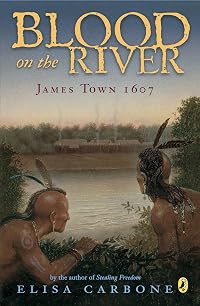
Blood on the River: James Town 1607
by Elisa Carbone
On This Page
Description
Traveling to the New World in 1606 as the page to Captain John Smith, twelve-year-old orphan Samuel Collier settles in the new colony of James Town, where he must quickly learn to distinguish between friend and foe.Tags
Recommendations




Member Reviews
An enjoyable account of the early years of Jamestown from a child's perspective. Carbone shows the tenuousness of the early settlement and both the good and bad of the English settlers. Alongside this we get a look into the culture of Powhatan's empire and see friendships that grew between the two groups despite the situation. It's an interesting look at the actions and interactions of individuals compared to the groups of which they are members. It makes me wonder if there is any scenario in which Europeans arriving in the Americas wouldn't have been a disaster for the people already living here.
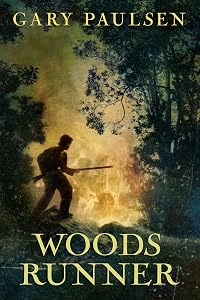
I love historical fiction so I'm an easy sell on this book. Unfortunately this book does not have the same punch as a book like Woods Runner by Gary Paulsen so I had to give it a lower rating. I do highly recommend it for teachers who like to assign books to their students. Every student studies the colonial period and this book helps bring to life the story of he founding of Jamestown.
The story is told from the perspective of Samuel Collier, who was formally a boy living on the streets in England and then in an orphanage. He and another orphan are sent to start the Virginia Colony along with Reverand Hunt from the orphanage. He is chosen by Captain John Smith to be his page because Smith knows he will be a hard worker, unlike the show more wealthy men on the trip who have never had a day of hard work in their lives.
Kids love reading about tragedy, especially when it really happened. Here's some of the tragic moments in the book: long, grueling voyage across the ocean; drought that made growing crops a crapshoot; constant threat from attack by the natives; lack of food; infighting among the leaders (the wealthy men did not like the commoners); cold winters.
What I liked
I thought the author did a good job of depicting the relationship between the natives and the Englishmen. It was a love/hate relationship because they each had something the other wanted. John Smith knew the native ways from when he visited with the Roanoke Colony. He was the only one who could keep the peace. The gentrified men in the colony thought the natives were savages and didn't want to befriend them. This caused constant friction between the gentlemen and John Smith. They tried to get him arrested time and again. As the author tells it, the gentlemen's attitude is the cause for the attacks by the natives.
What I didn't like
I know this book is written for kids, but I don't think the author did enough to evoke a sense of just how dire the situation really was. I did not feel the desperation. The horrible starving winter of 1609 when colonists literally had no food was only mentioned in the afterword. In fact, there was so much left for the afterword that I felt this book needed a sequel. This is such a compelling story on its own. Something is missing that could have made this book a standout in children's literature. The emotional connection is not there. That's a major disappointment for me, but still a great reading choice for history buffs. show less
The story is told from the perspective of Samuel Collier, who was formally a boy living on the streets in England and then in an orphanage. He and another orphan are sent to start the Virginia Colony along with Reverand Hunt from the orphanage. He is chosen by Captain John Smith to be his page because Smith knows he will be a hard worker, unlike the show more wealthy men on the trip who have never had a day of hard work in their lives.
Kids love reading about tragedy, especially when it really happened. Here's some of the tragic moments in the book: long, grueling voyage across the ocean; drought that made growing crops a crapshoot; constant threat from attack by the natives; lack of food; infighting among the leaders (the wealthy men did not like the commoners); cold winters.
What I liked
I thought the author did a good job of depicting the relationship between the natives and the Englishmen. It was a love/hate relationship because they each had something the other wanted. John Smith knew the native ways from when he visited with the Roanoke Colony. He was the only one who could keep the peace. The gentrified men in the colony thought the natives were savages and didn't want to befriend them. This caused constant friction between the gentlemen and John Smith. They tried to get him arrested time and again. As the author tells it, the gentlemen's attitude is the cause for the attacks by the natives.
What I didn't like
I know this book is written for kids, but I don't think the author did enough to evoke a sense of just how dire the situation really was. I did not feel the desperation. The horrible starving winter of 1609 when colonists literally had no food was only mentioned in the afterword. In fact, there was so much left for the afterword that I felt this book needed a sequel. This is such a compelling story on its own. Something is missing that could have made this book a standout in children's literature. The emotional connection is not there. That's a major disappointment for me, but still a great reading choice for history buffs. show less
Blood on the River: James Town 1607 by Elisa Carbone is a rich and intriguing historical fiction book about one of the first settlements in the New World. I liked seeing the way the story showed us what this new settlement meant for the native people and the settlers. This book really brought the scene to life and, after reading the author’s note, it was interesting to learn that the characters mentioned in the story are true to history. Anyone who enjoys reading about history will enjoy this book. It would be a challenging book for most kids that are younger than fifth grade, but if they are interested in the time period and they read it with an adult, they will probably be as fascinated as I was. Samuel really grew throughout the show more story and it was great to see the lessons he learned. This would be a wonderful read for people who are interested in seeing the start of our nation unfold before them. A book you will learn from! show less
It is 1606, and Samuel Collier is an eleven-year-old orphan. His father had drunk himself to death, and his mother died in the poorhouse. Upon his mother’s death, her locket was taken to a pawn shop to fetch a little money to cover Samuel’s food. However, Sam runs away from the poorhouse, lives on the streets, and then steals the locket but is caught and turned over to a minister named Hunt who runs an orphanage. It just so happens that Mr. Hunt is accompanying a Virginia Company expedition to establish a settlement in the New World, and he offers Samuel the opportunity to become the page for Captain John Smith. This historical fiction book chronicles the first couple of years in the history of Jamestown through the eyes of young show more Samuel Collier. The question is, will he survive?
Author Elisa Carbone, who grew up in Virginia, has written several other books of historical fiction for young people about the region. Her Stealing Freedom (1998), based on a true story of a young Maryland slave girl’s harrowing escape to freedom on the Underground Railroad around 1855, was an ALA Best Book for Young Adults, and her Storm Warriors(2001), about racial prejudice against the African American surfmen of the U.S. Lifesaving Service on Pea Island off the North Carolina shore in 1895, won Virginia’s 2002 Jefferson Cup Award. When I saw Blood on the River on sale in a discount book store and noticed that it was historical fiction for young people about Jamestown, I immediately picked it up.
The author evidently did a lot of detailed research to present a very accurate picture of the Jamestown colony and what happened there.
She writes, “Though in some instances the dialogue is taken from the original records, for the most part I have invented dialogue, thoughts, personalities, and the like. And I have simplified a story that is far too complex to be contained in one book.” Samuel Collier was a real person, though Carbone says that she had to invent his family life and origins. He did accompany Captain Smith on two expeditions, was left to live at a Warraskoyack village for a time, stayed in Virginia when Smith returned to England, and when he grew up was appointed the leader of a Virginia town. There are a few references to drinking ale and wine and a couple of instances where people were said to be completely naked in public. Also, the terms “by God” and “my Lord” are each used once as an interjection. And Sam does a little bit of lying, especially towards the beginning, although he does learn to accept responsibility as he works with John Smith. Otherwise, this is a very well-written and interesting historical fiction account of the Jamestown story for middle and high school students. show less
Author Elisa Carbone, who grew up in Virginia, has written several other books of historical fiction for young people about the region. Her Stealing Freedom (1998), based on a true story of a young Maryland slave girl’s harrowing escape to freedom on the Underground Railroad around 1855, was an ALA Best Book for Young Adults, and her Storm Warriors(2001), about racial prejudice against the African American surfmen of the U.S. Lifesaving Service on Pea Island off the North Carolina shore in 1895, won Virginia’s 2002 Jefferson Cup Award. When I saw Blood on the River on sale in a discount book store and noticed that it was historical fiction for young people about Jamestown, I immediately picked it up.
The author evidently did a lot of detailed research to present a very accurate picture of the Jamestown colony and what happened there.
She writes, “Though in some instances the dialogue is taken from the original records, for the most part I have invented dialogue, thoughts, personalities, and the like. And I have simplified a story that is far too complex to be contained in one book.” Samuel Collier was a real person, though Carbone says that she had to invent his family life and origins. He did accompany Captain Smith on two expeditions, was left to live at a Warraskoyack village for a time, stayed in Virginia when Smith returned to England, and when he grew up was appointed the leader of a Virginia town. There are a few references to drinking ale and wine and a couple of instances where people were said to be completely naked in public. Also, the terms “by God” and “my Lord” are each used once as an interjection. And Sam does a little bit of lying, especially towards the beginning, although he does learn to accept responsibility as he works with John Smith. Otherwise, this is a very well-written and interesting historical fiction account of the Jamestown story for middle and high school students. show less
This book illustrates just how good historical fiction can be. Carbone has written a compelling mix of fact and fiction in this retelling of the Jamestown story. This is the perfect vehicle for teaching young people about the hardships endured in these early colonies, the tenuous relationships with the native people, and the many mistakes that were made.
Blood on the River tells the story of an orphaned pre-teen, Samuel, who gets sent to the New World as the page to Captain John Smith. The tale details what it was like to be a founder of the Jamestown colony. It shows the hardships, gives insight to the politics that went on between the rich gentlemen and the common workers, and also gives great perspective on the relationship between the colonists and the Native Americans. At one point Samuel lives with a tribe of Native Americans and they become his friends. As a reader you get to understand the complexities of surviving in the New World.This book definitely brings the settlement of Jamestown to life for young readers.
Following Stealing Freedom (1998) and Storm Warriors (2001), both set in the nineteenth century, Carbone dips further back in U.S. history to the founding of James Town. Young orphan Samuel Collier narrates from his viewpoint as Captain John Smith's page, and the gripping historical fiction reflects Carbone's heavy reliance on primary source material, which she cites in an appendix. The dense particulars of daily life may tire readers who demand high-action plots. Others, though, will be easily caught up in the meticulously drawn scenes, from the fetid ship's hold to the snowy forests where Samuel learns to hunt with Powhatan friends. The cover, showing two crouched Powhatan Indians surveying the settlement, is a puzzling choice, show more particularly since the British characters are the focus. Still, like Joseph Bruchac's Pocahontas (2003), the text offers a view of Indian life that is far from the Disney stereotypes. An author's note offers more historical contest. A strong, visceral story of the hardship and peril settlers faced, as well as the brutal realities of colonial conquest. Category: Books for Middle Readers--Fiction. 2006, Viking, $16.99. Gr. 5-8. show less
Members
- Recently Added By
Lists

Build Your Library Level 5
27 works; 1 member

School Made Us Read It
380 works; 196 members
Author Information

16 Works 3,277 Members
Elisa Carbone lives in Montgomery County, Maryland, where Ann Maria Weems lived. Carbone is a faculty member at the University of Maryland, lecturer, and author of several books for young people
Some Editions
Awards and Honors
Awards
Distinctions
Notable Lists
Common Knowledge
- Canonical title
- Blood on the River: James Town 1607
- Original publication date
- 2006
- People/Characters
- Samuel Collier; Captain John Smith
- Important places
- Jamestown, Virginia, USA
Classifications
Statistics
- Members
- 1,777
- Popularity
- 12,329
- Reviews
- 28
- Rating
- (3.95)
- Languages
- English, French, Spanish
- Media
- Paper, Audiobook, Ebook
- ISBNs
- 22
- ASINs
- 5