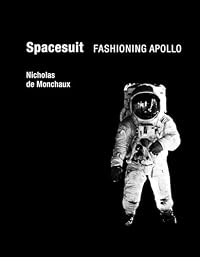
Spacesuit: Fashioning Apollo
by Nicholas De Monchaux
On This Page
Description
Chronicles the creation of the Apollo 11 spacesuits worn by Neil Armstrong and Buzz Aldrin, which were designed by the women's undergarment-maker Playtex and consisted of 21 specialized layers, in a book that includes 140 full-color illustrations.Tags
Recommendations




















Member Reviews
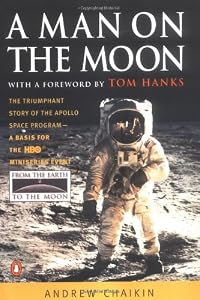
A man on the moon: one of the most iconic photographs in history. But you don't really see the man himself, do you? What you see is the spacesuit he wears. That suit is a wonderment of engineering and chemical design. Nylon, Lycra, Nomex, Neoprene, Mylar, Dacron, Kapton and Teflon made it possible to survive the rigors of the lunar environment but the truth is that men were able to walk around on the lunar surface because women knew how to sew.
When engineers and designers first went about creating a spacesuit they naturally looked at other garments for inhospitable environments - the hard deep-dive suits of the ocean and the pressure garments worn by fighter pilots. There began the two schools of thought: hard or soft? Is the spacesuit show more clothing that a man wears, or a container for the man within? There were many designs from many companies - the pictures in this book are really wonderful to browse - but, as we know from photos and videos, the soft suit won out.
It wasn't that soft was ultimately the best design. Cloth was prone to ballooning and was more susceptible to corrosives and micrometeors but it was the constraints of the rocket that would launch the mission into orbit that made the final decision. Weight and space in the capsule were really at a premium. Soft suits collapse and weigh less, so they were the final choice. ILC won the bid and they came through for NASA. Oh, that's International Latex Corporation - maker of Playtex bras and girdles. That's correct, women who made lingerie handmade the garments that kept the Apollo astronauts alive in the vacuum of space.
What I find amazing is that an agency that demanded so much redundancy for it's hardware went with a manufacturing process that really hinged on a few individuals. Parts of these suits were sewn on one or two specialized machines and only a few seamstresses had the skill and the knack to get them correct. In a time when all the astronauts, managers and engineers were male, this was a process in the female domain.
Spacesuit: Fashioning Apollo does showcase a great story but it does not utilize a traditional narrative structure. It's a rabbit-warren of a book, each chapter a topic that may or may not discuss the spacesuit directly but all come together in a mosaic to give you the flavor of its genesis. Honestly, I did lose my patience with it a time or two but ultimately I'm glad I stuck it out. It's uncovering facets of the space race story, such as this, that continue to make it interesting even today. show less
When engineers and designers first went about creating a spacesuit they naturally looked at other garments for inhospitable environments - the hard deep-dive suits of the ocean and the pressure garments worn by fighter pilots. There began the two schools of thought: hard or soft? Is the spacesuit show more clothing that a man wears, or a container for the man within? There were many designs from many companies - the pictures in this book are really wonderful to browse - but, as we know from photos and videos, the soft suit won out.
It wasn't that soft was ultimately the best design. Cloth was prone to ballooning and was more susceptible to corrosives and micrometeors but it was the constraints of the rocket that would launch the mission into orbit that made the final decision. Weight and space in the capsule were really at a premium. Soft suits collapse and weigh less, so they were the final choice. ILC won the bid and they came through for NASA. Oh, that's International Latex Corporation - maker of Playtex bras and girdles. That's correct, women who made lingerie handmade the garments that kept the Apollo astronauts alive in the vacuum of space.
What I find amazing is that an agency that demanded so much redundancy for it's hardware went with a manufacturing process that really hinged on a few individuals. Parts of these suits were sewn on one or two specialized machines and only a few seamstresses had the skill and the knack to get them correct. In a time when all the astronauts, managers and engineers were male, this was a process in the female domain.
Spacesuit: Fashioning Apollo does showcase a great story but it does not utilize a traditional narrative structure. It's a rabbit-warren of a book, each chapter a topic that may or may not discuss the spacesuit directly but all come together in a mosaic to give you the flavor of its genesis. Honestly, I did lose my patience with it a time or two but ultimately I'm glad I stuck it out. It's uncovering facets of the space race story, such as this, that continue to make it interesting even today. show less
Ratings
Members
- Recently Added By
Author Information

3 Works 167 Members
Awards and Honors
Common Knowledge
- People/Characters
- NASA
- Important events
- Apollo program
Classifications
- Genres
- Nonfiction, General Nonfiction, Science & Nature, History, Technology, Art & Design
- DDC/MDS
- 629.47 — Technology Engineering Other branches of engineering Astronautics
- LCC
- TL1550 .D46 — Technology Motor vehicles. Aeronautics. Astronautics Motor vehicles. Aeronautics. Astronautics Astronautics. Space travel
- BISAC
Statistics
- Members
- 143
- Popularity
- 225,900
- Reviews
- 1
- Rating
- (3.83)
- Languages
- English
- Media
- Paper, Audiobook
- ISBNs
- 1
- ASINs
- 2