
Alan Shepard (1) (1923–1998)
Author of Moon Shot: The Inside Story of America's Race to the Moon
For other authors named Alan Shepard, see the disambiguation page.
Alan Shepard (1) has been aliased into Alan B. Shepard.
About the Author
Image credit: Photo created by NASA
Works by Alan Shepard
Works have been aliased into Alan B. Shepard.
Tagged
Common Knowledge
- Birthdate
- 1923-11-18
- Date of death
- 1998-07-21
- Gender
- male
- Education
- United States Naval Academy
Naval War College - Occupations
- astronaut
- Organizations
- US Navy
National Aeronautics and Space Administration - Nationality
- USA
- Places of residence
- Derry, New Hampshire, USA
Pebble Beach, California, USA - Associated Place (for map)
- USA
Members
Reviews

If The Right Stuff is the trashy tabloid tell-all, Moon Shot is the authorized biography version of the heroic age of the American space program, from Mercury to Apollo. The overall tone is one of awed cosmism. Astronauts are larger than life figures, top test pilots and engineers who manage to save their own lives and the mission by taming faulty space capsules. Beyond the atmosphere, floating weightless in zero-G, and looking down on our fragile blue marble, they serve as both the most show more exceptional Americans, and as pan-national unifying archetypes. Arrayed against them is of course the hostility of space, but also the small-minded cowardice of bureaucrats and Congress, who are unwilling to let these brave men risk it all.
The book is structured as a mission by mission account, and is light on technical details in favor of somewhat repetitive purple prose. Alan Shepard and Deke Slayton are the clear protagonists, two of the original Mercury 7 astronauts grounded by medical issues, who beat the doctors to eventually fly on Apollo missions.
I did learn something from this book, like how vital Gemini was as a bridge to maneuvering in space, performing the precision burns and dockings vital to the Apollo mission plan. Shepard's Apollo 14 was almost a failure, with a docking problem between the capsule and LEM solved by ramming the docking ring at higher than designed speed, and a radar fault in the LEM fixed by turning it off and turning it back on again.
Moon Shot is a decent, if unambitious history, and probably a good first pass for more extensive reading on the space age. show less
The book is structured as a mission by mission account, and is light on technical details in favor of somewhat repetitive purple prose. Alan Shepard and Deke Slayton are the clear protagonists, two of the original Mercury 7 astronauts grounded by medical issues, who beat the doctors to eventually fly on Apollo missions.
I did learn something from this book, like how vital Gemini was as a bridge to maneuvering in space, performing the precision burns and dockings vital to the Apollo mission plan. Shepard's Apollo 14 was almost a failure, with a docking problem between the capsule and LEM solved by ramming the docking ring at higher than designed speed, and a radar fault in the LEM fixed by turning it off and turning it back on again.
Moon Shot is a decent, if unambitious history, and probably a good first pass for more extensive reading on the space age. show less
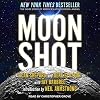
Alan Shepard and Deke Slayton’s Moon Shot: The Inside Story of America’s Race to the Moon traces the history of American spaceflight from the earliest postwar experiments with captured German V-2 rockets through Mercury, Gemini, Apollo, and the Skylab and Apollo-Soyuz Test Project flights. Shepard and Slayton worked with Jay Barbree and Howard Benedict, two journalists with experience writing about aerospace, in order to craft a narrative that both encompasses their lives and work as show more well as the activities driving spaceflight in the U.S. and Soviet Union, crosscutting between events as necessary to keep the reader apprised of the bigger picture that shaped Shepard and Slayton’s training and flights. Between Shepard and Slayton, the book encompasses an entire era of U.S. spaceflight and single-use rockets. Those familiar with Tom Wolfe’s The Right Stuff will find this a detailed narrative continuing the stories of two of the Mercury Seven. Christopher Grove does an admirable job narrating the unabridged audiobook, though his occasional attempts to mimic the speaking patterns of his subjects in direct quotes can be distracting. This 2011 edition includes a warning for NASA’s future when it was facing serious budget cuts and an uncertain future. With the hindsight of 2026, it shows what projects were in consideration prior to Artemis and ends with a reference to Konstantin Tsiolkovsky’s quote, “The Earth is the cradle of humanity, but mankind cannot stay in the cradle forever.” show less
I admit I had high hopes of this book. Someone had told me it was their favourite book on the Apollo programme, and the identities of the two authors promised much. Perhaps my expectations were too high...
Moon Shot covers the entire Space Race, from Sputnik to the Apollo Soyuz Test Project. It is an accessible read, written by two astronauts, Alan B Shepard and Donald K Slayton, who were important to the American effort. With the help of journalists Jay Barbree and Howard Benedict.
But. This show more is non-fiction, it is documented history... so I fail to understand how the authors can know what the Soviet Ambassador to the US was actually thinking when he heard of the Apollo 1 fire. Throughout the book, the authors imagine themselves in the heads of various people. Such "fictionalisation" of real people and events may make Moon Shot easier to read, but it also undermines its authority. How can it be an accurate depiction of events if it makes things up?
Read the rest of the review here : http://spacebookspace.blogspot.com/2009/03/moon-shot-alan-shepard-deke-slayton.h... show less
Moon Shot covers the entire Space Race, from Sputnik to the Apollo Soyuz Test Project. It is an accessible read, written by two astronauts, Alan B Shepard and Donald K Slayton, who were important to the American effort. With the help of journalists Jay Barbree and Howard Benedict.
But. This show more is non-fiction, it is documented history... so I fail to understand how the authors can know what the Soviet Ambassador to the US was actually thinking when he heard of the Apollo 1 fire. Throughout the book, the authors imagine themselves in the heads of various people. Such "fictionalisation" of real people and events may make Moon Shot easier to read, but it also undermines its authority. How can it be an accurate depiction of events if it makes things up?
Read the rest of the review here : http://spacebookspace.blogspot.com/2009/03/moon-shot-alan-shepard-deke-slayton.h... show less
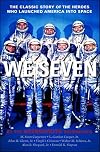
I really enjoyed this book. Lengthy descriptions of so many aspects of getting humans into space. This was the Mercury Project from the point of view of the initial seven astronauts selected, from 1959 to 1962, and covered the first four Americans in Space. From the psychology tests to lying in a capsule, absolutely gripping reading. I wished the book carried on to the end of the project to include the last two manned flights. I found it useful to watch the old period videos of television show more coverage at the time. Sometimes it seemed I was learning rocket-science. I wonder what the "Voss Meter" actually looked like? Interesting to compare this book to "Starman : Truth Behind the Legend of Yuri Gagarin", some major obvious similarities, but We Seven is much more detailed and personal. show less
Awards

You May Also Like
Associated Authors
Statistics
- Works
- 2
- Members
- 1,662
- Popularity
- #15,459
- Rating
- 3.9
- Reviews
- 28
- ISBNs
- 23
- Languages
- 2

