
Jay Barbree (1933–2021)
Author of Moon Shot: The Inside Story of America's Race to the Moon
About the Author
Jay Barbree has worked for NBC News for over 50 years. He is the only reporter to have covered all 166 American astronaut flights and moon landings. He received an Emmy for his coverage of Neil Armstrong's first walk on the moon. He wrote several books including Neil Armstrong: A Life of Flight and show more Moon Shot: The Inside Story of America's Apollo Moon Landings with astronauts Alan Shepard, Deke Slayton, and Neil Armstrong. (Bowker Author Biography) show less
Image credit: Official NASA photo
Works by Jay Barbree
Moon Shot: The Inside Story of America's Race to the Moon (1994) — Collaboration — 1,180 copies, 18 reviews
"Live from Cape Canaveral": Covering the Space Race, from Sputnik to Today (2007) 188 copies, 4 reviews
Tagged
Common Knowledge
- Birthdate
- 1933-11-26
- Date of death
- 2021-05-14
- Gender
- male
- Occupations
- News correspondent
- Organizations
- NBC
- Nationality
- USA
- Associated Place (for map)
- USA
Members
Reviews

If The Right Stuff is the trashy tabloid tell-all, Moon Shot is the authorized biography version of the heroic age of the American space program, from Mercury to Apollo. The overall tone is one of awed cosmism. Astronauts are larger than life figures, top test pilots and engineers who manage to save their own lives and the mission by taming faulty space capsules. Beyond the atmosphere, floating weightless in zero-G, and looking down on our fragile blue marble, they serve as both the most show more exceptional Americans, and as pan-national unifying archetypes. Arrayed against them is of course the hostility of space, but also the small-minded cowardice of bureaucrats and Congress, who are unwilling to let these brave men risk it all.
The book is structured as a mission by mission account, and is light on technical details in favor of somewhat repetitive purple prose. Alan Shepard and Deke Slayton are the clear protagonists, two of the original Mercury 7 astronauts grounded by medical issues, who beat the doctors to eventually fly on Apollo missions.
I did learn something from this book, like how vital Gemini was as a bridge to maneuvering in space, performing the precision burns and dockings vital to the Apollo mission plan. Shepard's Apollo 14 was almost a failure, with a docking problem between the capsule and LEM solved by ramming the docking ring at higher than designed speed, and a radar fault in the LEM fixed by turning it off and turning it back on again.
Moon Shot is a decent, if unambitious history, and probably a good first pass for more extensive reading on the space age. show less
The book is structured as a mission by mission account, and is light on technical details in favor of somewhat repetitive purple prose. Alan Shepard and Deke Slayton are the clear protagonists, two of the original Mercury 7 astronauts grounded by medical issues, who beat the doctors to eventually fly on Apollo missions.
I did learn something from this book, like how vital Gemini was as a bridge to maneuvering in space, performing the precision burns and dockings vital to the Apollo mission plan. Shepard's Apollo 14 was almost a failure, with a docking problem between the capsule and LEM solved by ramming the docking ring at higher than designed speed, and a radar fault in the LEM fixed by turning it off and turning it back on again.
Moon Shot is a decent, if unambitious history, and probably a good first pass for more extensive reading on the space age. show less

Some individuals are lucky enough to be present at the genesis of something special and such is the case with Jay Barbree. He was a young journalist when he first filed a report on Sputnik and his world changed that very night. He moved to Cocoa Beach and began to transmit radio reports from the Cape for NBC News.
Barbree tells it all. Snatches of unguarded conversations overheard in the men's room. The day he and Alan Shepard took cover under the same pylon while a tower rocket off a show more Redstone spectacularly blew itself up over their heads. He remembers the night Gus Grissom begged him to go national with the story that Apollo was not safe and not ready to fly and his intense horror a few days later when his friend died in that very capsule. The Christmas evening he spent covering Apollo 8 and had dinner at a coffee shop counter with John Glenn. The glory of the moon landings. The hope he felt during the Apollo-Soyuz program. The lean times when he had to take a newspaper job to cover his bills because Apollo was over and the Shuttle was not yet flying. His awe at seeing Columbia lift off for the first time. His outrage over seeing both the Columbia and Challenger destroyed due to bad decisions. The heart attack he suffered while jogging on the beach which didn't end his life, but did end his candidacy for Journalist in Space program.
Yes, Barbree saw a lot of history. He's billed as the only reporter to cover every mission flown by astronauts. I wasn't quite swept away by his telling and I think it's mostly a stylistic thing. He is a man of his generation and I grew up in a much younger time - reporting has changed a lot. What I did take from Barbree is his incredible optimism. He believes there is a future in space. That we are going back to the moon and someday, to Mars. All of his years, the friends he lost, the politics that he saw played out, have not tarnished the shine on his sheer joy at the endeavor of space exploration. He wants to be around to report on America's next launch and I sure hope he is. show less
Barbree tells it all. Snatches of unguarded conversations overheard in the men's room. The day he and Alan Shepard took cover under the same pylon while a tower rocket off a show more Redstone spectacularly blew itself up over their heads. He remembers the night Gus Grissom begged him to go national with the story that Apollo was not safe and not ready to fly and his intense horror a few days later when his friend died in that very capsule. The Christmas evening he spent covering Apollo 8 and had dinner at a coffee shop counter with John Glenn. The glory of the moon landings. The hope he felt during the Apollo-Soyuz program. The lean times when he had to take a newspaper job to cover his bills because Apollo was over and the Shuttle was not yet flying. His awe at seeing Columbia lift off for the first time. His outrage over seeing both the Columbia and Challenger destroyed due to bad decisions. The heart attack he suffered while jogging on the beach which didn't end his life, but did end his candidacy for Journalist in Space program.
Yes, Barbree saw a lot of history. He's billed as the only reporter to cover every mission flown by astronauts. I wasn't quite swept away by his telling and I think it's mostly a stylistic thing. He is a man of his generation and I grew up in a much younger time - reporting has changed a lot. What I did take from Barbree is his incredible optimism. He believes there is a future in space. That we are going back to the moon and someday, to Mars. All of his years, the friends he lost, the politics that he saw played out, have not tarnished the shine on his sheer joy at the endeavor of space exploration. He wants to be around to report on America's next launch and I sure hope he is. show less
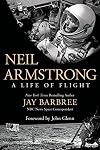
Neil Armstrong - the first man to step on the moon. This is not a story of Armstrong's lifelong flight from the police, as a friend jokingly questioned. Rather, this covers his training, his career as a pilot in the Korean War, his NASA career, and his life after he left the space program. There is excellent background on all the Mercury and Gemini flights, and most of the Apollo flights, as well as some of the Soviet flights. We meet most of the astronauts and some of the cosmonauts. We show more also get a full five enthralling chapters on Apollo 11's historic flight to, and return from, the moon. There are photos on nearly every page, a good many I hadn't seen before and some are very moving. My only complaint - all the photos are black & white. When tragedy struck again, Armstrong returned to NASA briefly as Vice Chairman of the commission that investigated the Challenger accident. Barbree was best friends with Armstrong, good friends with most of the astronauts and we get some good stories. Definitely a bromance with the fliers and the space program but Barbree doesn't cut NASA any slack for its mistakes and later failures. A must-read for the space fan and I defy you to not tear up throughout the telling. show less
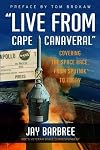
Space flight is mankind's greatest adventure, and Jay Barbree has been there for all ot it. He started covering space-related stories shortly after Sputnik was launched, and has not stopped yet.
He conveys beautifully the beauty, mystery, and wonder; the pranks, the engineering successes and failures, and the tragedies. The saddest part of the whole book is that none of the three tragedies - the Apollo 1 fire and the two lost shuttles - was inevitable. They could have been prevented. Prior to show more the Apollo 1 fire in which Gus Grissom, Ed White, and Roger Chafee died, Grissom came to Barbree and asked for help. He said the contracts for the Apollo components had been given to cronies, and the items they were producing were of poor quality. Barbree tried to persuade NBC to cover the story of the poor quality, but the higher ups didn't want to do so. As for the two shuttle explosions, fears were raised in both instances about exactly the things that went wrong, but in both cases it was decided the flaws weren't serious enough to stop the flights.
Barbree also conveys the joys of space flght, and a sense of some of the personalities involved. His admiration for the astronauts and others who work with them is clear. Barbree doesn't expect to be around when humankind lands on Mars, but if he is, he'll happily cover the story! show less
He conveys beautifully the beauty, mystery, and wonder; the pranks, the engineering successes and failures, and the tragedies. The saddest part of the whole book is that none of the three tragedies - the Apollo 1 fire and the two lost shuttles - was inevitable. They could have been prevented. Prior to show more the Apollo 1 fire in which Gus Grissom, Ed White, and Roger Chafee died, Grissom came to Barbree and asked for help. He said the contracts for the Apollo components had been given to cronies, and the items they were producing were of poor quality. Barbree tried to persuade NBC to cover the story of the poor quality, but the higher ups didn't want to do so. As for the two shuttle explosions, fears were raised in both instances about exactly the things that went wrong, but in both cases it was decided the flaws weren't serious enough to stop the flights.
Barbree also conveys the joys of space flght, and a sense of some of the personalities involved. His admiration for the astronauts and others who work with them is clear. Barbree doesn't expect to be around when humankind lands on Mars, but if he is, he'll happily cover the story! show less
Awards

You May Also Like


Associated Authors
Statistics
- Works
- 9
- Members
- 1,766
- Popularity
- #14,575
- Rating
- 3.8
- Reviews
- 34
- ISBNs
- 45
- Languages
- 6