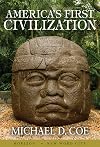
America's First Civilization
by Michael D. Coe
On This Page
Description
Here is the story of America's oldest - and oddest - civilization, the Olmecs of the southern Mexican jungles. Virtually unknown to archaeologists until the early twentieth century, their true importance is only now being realized and shedding new light on how the Indian peoples of the Americas came to be here.Tags
Recommendations




















Member Reviews
What a fascinating book. Michael Coe is a recognised expert on archeology in mesoamerica and this expertise shines through in this book. It's quite short but has a wealth of information and is partly biographic in that it describes a lot of the author's own field work and discoveries.He makes a good case for the Olmecs being the first civilisation in the Americas and has some interesting observations about what a civilisation actually is. scholars "are also in accord that a civilization is a class society organized as a state, that is, with a power superordinate over the diverse tribal, ethnic, and class elements that are found within its borders. ......There were not only classes but many ethnic groups subsumed by the sovereign might show more of the great Olmec centers, extending from coast to coast and down into lower Central America. No chiefdom could have accomplished this. Thus, there was an Olmec state, and the Olmec were civilized".
I find these distinctions interesting when contrasted with the oft heard descriptions thrown about in Australia recently that the aboriginals have 60,000 years of civilisation behind them. But they would certainly not qualify as a civilisation in Coe's terms.Having lived in Mexico, I was, of course, aware of the giant Olmec heads and I'd seen at least one at the Museum of Anthropology in Mexico City but I really knew very little about the Olmec Civilization and Coe teases out the known history extremely well. They date back about 3000 years....well before the Mayans and had extended their reach from near Veracruz across the spine of Mexico to Guerro. In Coe's words: "Why did the Olmec cross the Isthmus and establish posts down the Pacific Coast of Chiapas and Central America? I am again speculating, but the answer I would again give is: jade. Some of the loveliest jades known for the Pre-Columbian New World have come from richly stocked graves in the Nicoya Peninsula of northwestern Costa Rica.
In all of this expansion, the Olmec took more along with them than just their art style and commerce: They disseminated civilization itself, unknown before they appeared. Mesoamerica as we know it was really their creation. Where they did not go, or where their influence was unfelt, civilized life never took hold, not even in the two and a half millennia that elapsed between then and the Spanish conquest".
Certainly some significant mysteries remain....a lot of the great cultures that Coe uncovers had been defaced and then buried. (obviously requiring a lot of work to bury). Coe's explanation: "The amount of pent-up hatred and fury represented by this enormous act of destruction must have been awesome, indeed. These monuments are large, and basalt is a hard stone. Wherever possible, heads were smashed from bodies, “altars” were smashed to pieces, and strange, dimpled depressions and slots were cut into Colossal Heads. There are no signs that wedges or the fire-and-water treatment were used to break up the larger stones: I suspect that they built huge tripods over monuments, hoisted other monuments over these, and let them drop from great heights. Why was this done? Because the Olmec monuments must have stood for the class of leaders that held the tributary, populace in such a firm grip, forcing from them incredible expenditures of labor. These stones must have been the symbols of all that had held them in thrall, and they destroyed these symbols with fervor. But the Olmec must also have feared their power after the act, for by burying them with such care, they removed the hated objects from their sight without incurring their posthumous wrath". Well he may be right but it seems to me that without corroborating evidence that this is just speculation.
I was also quite fascinated by his suggestion that he learned a lot by studying the contemporary people and their habits. He reasons along the following lines: "The really prime land, however, is, like the savannas, the gift of the floods: the natural levees along the rivers that are covered with a deep layer of rich silt after the waters recede. Although only a dry-season crop can be brought in, the corn yield is fantastic, as high as 3,200 pounds per acre as compared with 1,780 pounds for the hillier lands. The upper limit of population must have been about 5,000 people. It took seventeen men to lift and transport the half-ton Monument 17 at San Lorenzo a mere two miles to the schoolhouse in Tenochtitlán. My guess is that at least 2,000 able-bodied men would have been involved in the operation, [bringing the huge stone heads from their source} representing the effective labor of a population of 8,000 to 10,000 persons. There are now sixty of these monuments known for San Lorenzo Tenochtitlán
The only possible conclusion is that the political power of each center was exerted many dozens of miles away from it, and that the force and authority of the Olmec were felt far beyond the heartland itself. Three thousand years ago, there just could not have been enough able-bodied men in the immediate area to have carried out all the physical labor required.
These speak to us of secular, rather than religious, leadership, with power in the hands of a hereditary lineage or dynasty. This conforms with what we know about all other Mesoamerican societies for which we have evidence. In these, the priesthood, while admittedly important, played second fiddle to the civil rulers".
I have a strong recollection of attending a reception in Mexico City in early 1974 where the work of a German artist was being displayed and it was the most beautiful reproduction of mayan glyphs and stela inscriptions and I have the vague recollection that she was working with Michael Coe...but alas, it is so long ago and memories are unreliable.
But Coe has put together quite a delightful publication about the Olmec and their obvious massive contribution to civilisation in central America. As he observes: What had once been the Olmec civilization eventually transformed itself into the Maya civilization. .......But a great deal of the brilliant Classic Maya civilization of CE 300-900 is unparalleled elsewhere in Mesoamerica. .......But what makes the Maya even more outstanding was that they alone among all the native peoples of the New World were fully literate; that is, they had a script sufficiently developed so they could write down anything in their language, which has been substantially deciphered.
The Classic Maya civilization fell to ruin around CE 900. Archeologists still have no firm answers as to why and how this happened, but there is ample evidence that a Toltec or Toltec-influenced people were pushing into the central Maya area from the Gulf Coast of Mexico and invading the remaining Maya centers at this time. Perhaps they were but a symptom",
Happy to give five stars to this book but it would have been greatly improved with illustrations. show less
I find these distinctions interesting when contrasted with the oft heard descriptions thrown about in Australia recently that the aboriginals have 60,000 years of civilisation behind them. But they would certainly not qualify as a civilisation in Coe's terms.Having lived in Mexico, I was, of course, aware of the giant Olmec heads and I'd seen at least one at the Museum of Anthropology in Mexico City but I really knew very little about the Olmec Civilization and Coe teases out the known history extremely well. They date back about 3000 years....well before the Mayans and had extended their reach from near Veracruz across the spine of Mexico to Guerro. In Coe's words: "Why did the Olmec cross the Isthmus and establish posts down the Pacific Coast of Chiapas and Central America? I am again speculating, but the answer I would again give is: jade. Some of the loveliest jades known for the Pre-Columbian New World have come from richly stocked graves in the Nicoya Peninsula of northwestern Costa Rica.
In all of this expansion, the Olmec took more along with them than just their art style and commerce: They disseminated civilization itself, unknown before they appeared. Mesoamerica as we know it was really their creation. Where they did not go, or where their influence was unfelt, civilized life never took hold, not even in the two and a half millennia that elapsed between then and the Spanish conquest".
Certainly some significant mysteries remain....a lot of the great cultures that Coe uncovers had been defaced and then buried. (obviously requiring a lot of work to bury). Coe's explanation: "The amount of pent-up hatred and fury represented by this enormous act of destruction must have been awesome, indeed. These monuments are large, and basalt is a hard stone. Wherever possible, heads were smashed from bodies, “altars” were smashed to pieces, and strange, dimpled depressions and slots were cut into Colossal Heads. There are no signs that wedges or the fire-and-water treatment were used to break up the larger stones: I suspect that they built huge tripods over monuments, hoisted other monuments over these, and let them drop from great heights. Why was this done? Because the Olmec monuments must have stood for the class of leaders that held the tributary, populace in such a firm grip, forcing from them incredible expenditures of labor. These stones must have been the symbols of all that had held them in thrall, and they destroyed these symbols with fervor. But the Olmec must also have feared their power after the act, for by burying them with such care, they removed the hated objects from their sight without incurring their posthumous wrath". Well he may be right but it seems to me that without corroborating evidence that this is just speculation.
I was also quite fascinated by his suggestion that he learned a lot by studying the contemporary people and their habits. He reasons along the following lines: "The really prime land, however, is, like the savannas, the gift of the floods: the natural levees along the rivers that are covered with a deep layer of rich silt after the waters recede. Although only a dry-season crop can be brought in, the corn yield is fantastic, as high as 3,200 pounds per acre as compared with 1,780 pounds for the hillier lands. The upper limit of population must have been about 5,000 people. It took seventeen men to lift and transport the half-ton Monument 17 at San Lorenzo a mere two miles to the schoolhouse in Tenochtitlán. My guess is that at least 2,000 able-bodied men would have been involved in the operation, [bringing the huge stone heads from their source} representing the effective labor of a population of 8,000 to 10,000 persons. There are now sixty of these monuments known for San Lorenzo Tenochtitlán
The only possible conclusion is that the political power of each center was exerted many dozens of miles away from it, and that the force and authority of the Olmec were felt far beyond the heartland itself. Three thousand years ago, there just could not have been enough able-bodied men in the immediate area to have carried out all the physical labor required.
These speak to us of secular, rather than religious, leadership, with power in the hands of a hereditary lineage or dynasty. This conforms with what we know about all other Mesoamerican societies for which we have evidence. In these, the priesthood, while admittedly important, played second fiddle to the civil rulers".
I have a strong recollection of attending a reception in Mexico City in early 1974 where the work of a German artist was being displayed and it was the most beautiful reproduction of mayan glyphs and stela inscriptions and I have the vague recollection that she was working with Michael Coe...but alas, it is so long ago and memories are unreliable.
But Coe has put together quite a delightful publication about the Olmec and their obvious massive contribution to civilisation in central America. As he observes: What had once been the Olmec civilization eventually transformed itself into the Maya civilization. .......But a great deal of the brilliant Classic Maya civilization of CE 300-900 is unparalleled elsewhere in Mesoamerica. .......But what makes the Maya even more outstanding was that they alone among all the native peoples of the New World were fully literate; that is, they had a script sufficiently developed so they could write down anything in their language, which has been substantially deciphered.
The Classic Maya civilization fell to ruin around CE 900. Archeologists still have no firm answers as to why and how this happened, but there is ample evidence that a Toltec or Toltec-influenced people were pushing into the central Maya area from the Gulf Coast of Mexico and invading the remaining Maya centers at this time. Perhaps they were but a symptom",
Happy to give five stars to this book but it would have been greatly improved with illustrations. show less
Despite being nearly 50 years old, this short book is still a great introduction to the Olmec civilization. Well written, with excellent illustrations.
Ratings
Members
- Recently Added By
Author Information

45+ Works 4,090 Members
Michael D. Coe is Professor Emeritus of Anthropology and Curator Emeritus in the Peabody Museum of Natural History at Yale University. His many other books include The Maya, Mexico, and The True History of Chocolate (with Sophie D. Coe), all published by Thames Hudson.
Classifications
Statistics
- Members
- 71
- Popularity
- 443,911
- Reviews
- 2
- Rating
- (4.40)
- Languages
- English
- Media
- Paper, Ebook
- ISBNs
- 2
- ASINs
- 5