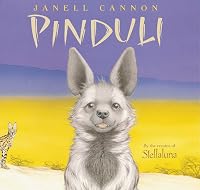
Pinduli
by Janell Cannon
On This Page
Description
Pinduli, a young striped hyena, is hurt by the unkind words of Dog, Lion, and Zebra, but her clever trick in return promotes her clan's survival and spreads harmony throughout the savannah. Includes backmatter notes about hyenas and other animals of the African savannah.Tags
Recommendations



Member Recommendations
madu Both of these stories tell of animals making comments about each other's physical appearance. "Somos como somos" is more positive because it doesn't involve teasing.
Member Reviews
I adored this book! The first reason I liked this book is for its cultural and rustic illustrations. The book’s setting is on an African savannah and follows a hyena on an outing where she gets bullied by other savannah animals. The illustrations throughout the book are similar to those you’d find in an informational book that details African culture, except drawn using finely tipped colored pencils. This makes the setting come to life even more than simply illustrating the characters, making the reader more engaged with the story. The illustrations also help the reader visualize the emotions of the characters within the story. At times where the main character is upset or embarrassed, her ears are down and she is frowning. In show more contrast, when the main character and her mother are reunited at the end, they both are depicted with smiles. I like this aspect of the book because it helps me, a visual and kinesthetic learner, better understand what the characters are thinking and feeling. I also like this book for the informational section at the end. Titled “Meet the Hyena Family,” the section details physical attributes of all of the animals found throughout the book, which ultimately explains why the animals were so bothered by being told they look a certain way. For example, the lion of the story made fun of the hyena’s hair because the lion was told by another animal that his mane looked “mangy.” The section in the back of the book explained that some lions have big, beautify manes, while others have small, ruffled ones. The author put a spin on that and made the lion of the story self-conscious about his small, thinning mane, which is what led to him calling out the hyena’s hair. The big idea of this book is bullying is not a positive act, even if you were bullied first. If you find yourself bullying someone, think about why you are doing it and address that reason instead of spreading the harmful act onto others. show less
When I think of my favorite books, this is one of them. The art is gorgeous, the story is about karma and humbling yourself, and the plot twist is great. There is a lot of big works, and the art's very detailed, a lot of it goes over kid's heads, but teenagers and adults definitely can enjoy reading this book to younger kids or with adults.
Pinduli, by Janell Cannon is another treasure by this author. Janell Cannon was the type of kid who was always coming home with a new pet. Although, we're not talking about your standard kitten in a shoebox or errant neighborhood mutt. Janell has always had a soft spot in her heart for animals most people might find, well, kind of gross. Upon visiting a zoo, she encountered the resident striped hyena, an endangered animal, and was immediately struck by her remarkable beauty. One of Janell's friends at the zoo told her how he had watched people drawn to this stunning animal who instantly turned away when they saw the hyena label on her enclosure. "It was all just a word that shifted their attitude," Janell said. That shift in attitude show more was all she needed to get the story of Pinduli (a Swahili word for "catalyst") in motion.
In Pinduli, the young Hyena wakes up, her mother asks her not to wonder far from camp. While at the watering hole, Pinduli comes across various animals who say insulting things to make fun of her. After each insult, Pinduli tries to change the thing that each animal has made fun of. After each round, Pinduli looks less and less like a hyena. Finally she appears, and the animals see her and think she is the “Great Spirit”. Pinduli discovers the source of each animal’s meanness; it originated from the meanness of other animals. It has a pay-it forward context. Pinduli convinces the others to be nice to the ones that were mean to them, and also convinces then to leave some of their food after each meal. Thus, Pinduli solves two problems with her cleverness – the animals are being nice to each other, and she and her mother are always able to eat because of the food that is left by the others.
I really enjoyed this story. It incorporated unusual animals and taught several valuable lessons. Readers will read that their actions affect others, that kindness is contagious, everyone is different, and be clever and think your way out of situations. Graphic paintings illustrate the stark savannah and it's variety of inhabitants. They will catch the reader’s attention. Children will find Pinduli’s hurt feelings understandable and her quick thinking admirable. show less
In Pinduli, the young Hyena wakes up, her mother asks her not to wonder far from camp. While at the watering hole, Pinduli comes across various animals who say insulting things to make fun of her. After each insult, Pinduli tries to change the thing that each animal has made fun of. After each round, Pinduli looks less and less like a hyena. Finally she appears, and the animals see her and think she is the “Great Spirit”. Pinduli discovers the source of each animal’s meanness; it originated from the meanness of other animals. It has a pay-it forward context. Pinduli convinces the others to be nice to the ones that were mean to them, and also convinces then to leave some of their food after each meal. Thus, Pinduli solves two problems with her cleverness – the animals are being nice to each other, and she and her mother are always able to eat because of the food that is left by the others.
I really enjoyed this story. It incorporated unusual animals and taught several valuable lessons. Readers will read that their actions affect others, that kindness is contagious, everyone is different, and be clever and think your way out of situations. Graphic paintings illustrate the stark savannah and it's variety of inhabitants. They will catch the reader’s attention. Children will find Pinduli’s hurt feelings understandable and her quick thinking admirable. show less
I really enjoyed Pinduli. The story was great for showing relationships between others as well as cause and effect and a powerful message of self-worth and being nice to others.. Pinduli was full of different animals readers may not be familiar with, as well as descriptions of the type of animal and where it lives. The pictures help extend the plot, especially through the use of the small pictures on the text pages, where the reader can see what Pinduli's mother is doing while Pinduli is interacting with the other animals in the story. The artwork is done in smoky and sandy colors, which enhances the text as the setting is in the desert. Pinduli is a great story where readers can ask questions and make inferences about the interactions show more of the animals before the entire plot is uncovered. The message of the text is to be friendly to whomever you meet because you do not know how it will affect them and that is important for young readers to know. show less
I really enjoyed this book! The first reason I liked this book is for its cultural and rustic illustrations. The illustrations were also very bold! The illustrations also help the reader visualize the emotions of the characters within the story which enhances the text. At times where the main character is upset or embarrassed, her ears are down and she is frowning. In contrast, when the main character and her mother are reunited at the end, they both are drawn with smiles. Another really interesting part of this book was the informational section at the end! Titled “Meet the Hyena Family,” the section describes of all of the animals found throughout the book. The main idea of this book is not to be a bully! Everyone is unique and show more special in their own way! Truly a great book! show less
Summary:
Pinduli is about a hayena that is made fun of by different animals. As each animal makes fun of a part of her, she tries to change that thing about herself until finally she ends up looking like a ghost. When the other animals see her they are scared and call her the great spirit. Through some questioning the hyaena learns that they animals were mean to her because other animals had been mean to them. So Pinduli declares that all the animals should talk it our and that they must leave food for the great spirit when they eat. The animals all apologize and Pinduli is never hungry or made fun of anymore.
Review:
Many critics of this book say that it is a n ill attempt at sharing a lesson and that it focuses on that so much that show more the story line drags on but i disagree. The story is entertaining. As per Cannon's usual style the writing is low level but written in proper English and with a good vocabulary. The story is creative and as always the illustrations are very detailed, colorful and convey real feeling from the animals with out giving them silly cartoonish faces. Over all a really good read for all ages. show less
Pinduli is about a hayena that is made fun of by different animals. As each animal makes fun of a part of her, she tries to change that thing about herself until finally she ends up looking like a ghost. When the other animals see her they are scared and call her the great spirit. Through some questioning the hyaena learns that they animals were mean to her because other animals had been mean to them. So Pinduli declares that all the animals should talk it our and that they must leave food for the great spirit when they eat. The animals all apologize and Pinduli is never hungry or made fun of anymore.
Review:
Many critics of this book say that it is a n ill attempt at sharing a lesson and that it focuses on that so much that show more the story line drags on but i disagree. The story is entertaining. As per Cannon's usual style the writing is low level but written in proper English and with a good vocabulary. The story is creative and as always the illustrations are very detailed, colorful and convey real feeling from the animals with out giving them silly cartoonish faces. Over all a really good read for all ages. show less
Pinduli was a hyena who was made fun of by other animals in the African safari. When the animals made fun of his ears he started keeping them down. When the lion made fun of his furry coat he swam in the water hole to smooth it out. And when the zebras made fun of his coloring he rolled in the white dirt. So when he came around to the animals they thought he was a white ghost and they all bowed to him. Pinduli told them to get into his good graces they had to apologize to everyone they had wronged so the rest of the day they went around asking forgiveness. At the end of the book is a nonfiction section where it talks about the advantages of all the traits that Pinduli was criticized about from the other animals.
I really liked the book. show more It's a very touching story with great morals. The illustrations are wonderful. The nonfiction section in the back is also a great resource for kids. show less
I really liked the book. show more It's a very touching story with great morals. The illustrations are wonderful. The nonfiction section in the back is also a great resource for kids. show less
Members
- Recently Added By
Author Information

12+ Works 18,618 Members
Picture book author and illustrator Janell Cannon was born November 3, 1957, in St. Paul, Minnesota. The left-handed artist claims she drew so much in high school that her hand was perpetually black from smearing the ink of her favorite Bic pens. Cannon worked at the Carlsbad Library in southern California, where she discovered that there were few show more books about bats available for children, so she decided to make her own. The result, Stellaluna (1994), became a best seller, allowing Cannon to leave her job at the library and write Trupp: A Fuzzhead Tale (1995), and other books. Janell Cannon lives in California. (Bowker Author Biography) show less
Awards and Honors
Awards
Common Knowledge
- Canonical title
- Pinduli
- Original title
- Pinduli
- Original publication date
- 2004
- People/Characters
- Pinduli
- Important places
- Africa
- Dedication
- For Alice J. Contreras
- First words
- The sun was low in the East African sky.
- Last words
- (Click to show. Warning: May contain spoilers.)"You're not only the most beautiful hyena ever," said Mama, "you're the smartest hyena ever!"
- Original language
- English
Classifications
Statistics
- Members
- 1,963
- Popularity
- 10,804
- Reviews
- 24
- Rating
- (4.11)
- Languages
- Catalan, English, Spanish
- Media
- Paper, Audiobook
- ISBNs
- 20
- ASINs
- 4