On This Page
Description
Escaping from an attic where they had been held captive over the long, dark winter, a family of tiny people sets up house in an old rectory.Tags
Recommendations




































Member Reviews
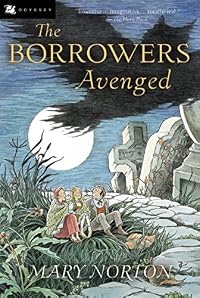
The Borrowers Avenged is the fifth and final book in the series, and was published quite a bit later than the others, in 1982. In this book, Norton takes up the story where it left off with the Clocks escaping Little Fordham once more in case the Platters come back searching for them. Spiller takes them up the river to the human village Fordham, where they find a home in the rectory right near the church. Here they meet another borrower, Peagreen, a former Overmantel who lives quite alone in the house. He is slightly lame from having fallen off the mantelpiece as a young boy.
This story gets a bit deeper into the lives of the humans as well as the borrowers. We learn so much about the people just by observing them (borrower-like) in the show more flower-arranging at the church. The Platters come into this story again, and there is a very satisfactory ending in store for them. Avenged is certainly the right title for this book — and it's all brought about by the Platters' own selfishness.
One thing I don't like about this book is how Norton seemingly changed her mind about Arrietty marrying Spiller. In Aloft, it seemed quite settled — but there are so many hints thrown out in this one that it seems obvious it will never happen. Arrietty muses on Spiller's wildness and how he will never consent to live indoors, but he will always be "kind" to them; he hasn't yet told Miss Menzies, Arrietty's particular human friend, that they are safe; and when she accuses him of cowardice he throws her a look "almost of loathing." Oh dear! And stepping shyly into the gap is Peagreen, of all borrowers! I don't think he would be a good match for Arrietty; he's too weak. I like him, to be sure, but he loves security and Arrietty has always wanted freedom and the outdoors.
The name-humor pops up again with the Whitlaces, who are the caretakers of the rectory and live in the house. The borrowers call them the Witlesses (quite innocently), and it reminds me so much of C. S. Lewis' The Silver Chair, in which Eustace is mistakenly called "Useless" by the deaf Trumpkin. Norton and Lewis both belong to that rare breed of authors who really understand what makes children laugh, and have the intelligence to create humorous situations that feel so unforced and natural.
I love how this book ends. It's a conversation between Arrietty and Peagreen about why Spiller hasn't yet told Miss Menzies what happened. It captures perfectly the tone of their lives and the constant care they must take to protect themselves and those they love.
"I only wanted her to know we are safe..."
"'Are we?" said Peagreen gently. "Are we? Ever?" show less
This story gets a bit deeper into the lives of the humans as well as the borrowers. We learn so much about the people just by observing them (borrower-like) in the show more flower-arranging at the church. The Platters come into this story again, and there is a very satisfactory ending in store for them. Avenged is certainly the right title for this book — and it's all brought about by the Platters' own selfishness.
One thing I don't like about this book is how Norton seemingly changed her mind about Arrietty marrying Spiller. In Aloft, it seemed quite settled — but there are so many hints thrown out in this one that it seems obvious it will never happen. Arrietty muses on Spiller's wildness and how he will never consent to live indoors, but he will always be "kind" to them; he hasn't yet told Miss Menzies, Arrietty's particular human friend, that they are safe; and when she accuses him of cowardice he throws her a look "almost of loathing." Oh dear! And stepping shyly into the gap is Peagreen, of all borrowers! I don't think he would be a good match for Arrietty; he's too weak. I like him, to be sure, but he loves security and Arrietty has always wanted freedom and the outdoors.
The name-humor pops up again with the Whitlaces, who are the caretakers of the rectory and live in the house. The borrowers call them the Witlesses (quite innocently), and it reminds me so much of C. S. Lewis' The Silver Chair, in which Eustace is mistakenly called "Useless" by the deaf Trumpkin. Norton and Lewis both belong to that rare breed of authors who really understand what makes children laugh, and have the intelligence to create humorous situations that feel so unforced and natural.
I love how this book ends. It's a conversation between Arrietty and Peagreen about why Spiller hasn't yet told Miss Menzies what happened. It captures perfectly the tone of their lives and the constant care they must take to protect themselves and those they love.
"I only wanted her to know we are safe..."
"'Are we?" said Peagreen gently. "Are we? Ever?" show less
So...after the "What...???" reaction I had as I finished The Borrowers Avenged, I found out the rather open-ended conclusion of the previous book is a rewrite, intended to make room for this next book that didn't come until decades later.
Well. It's another open-ended, dissatisfying conclusion here. It seems there was supposed to be at least one more book after this one, but it never came.
And although this fifth novel is the last and longest of the series, it has no real need to be so long, since it's a pretty redundant story for the borrowers. Different locations. Villains with different names. But nothing truly new driving the plot, and no growth for the main characters who had such an interesting, promising start in the first, show more wonderful novel.
I'm rather disappointed that the overall progression of the series doesn't do justice to the way it began. Still, I understand this kind of thing just happens sometimes.
Not everything always pans out as planned in publishing, and authors are human.
So. Unless you're dying to see the various ways this last novel goes wrong, I'd recommend either getting your hands on an original copy of Book Four, The Borrowers Aloft, or finding its original conclusion online somewhere. Then let that original ending be The End. show less
Well. It's another open-ended, dissatisfying conclusion here. It seems there was supposed to be at least one more book after this one, but it never came.
And although this fifth novel is the last and longest of the series, it has no real need to be so long, since it's a pretty redundant story for the borrowers. Different locations. Villains with different names. But nothing truly new driving the plot, and no growth for the main characters who had such an interesting, promising start in the first, show more wonderful novel.
I'm rather disappointed that the overall progression of the series doesn't do justice to the way it began. Still, I understand this kind of thing just happens sometimes.
Not everything always pans out as planned in publishing, and authors are human.
So. Unless you're dying to see the various ways this last novel goes wrong, I'd recommend either getting your hands on an original copy of Book Four, The Borrowers Aloft, or finding its original conclusion online somewhere. Then let that original ending be The End. show less
The final Borrowers book (written much later than the rest of the series) and one that was new to me. It continues the tale of the tiny family - Arrietty, her parents Pod and Homily - and their search for a safe home. Here the evil Platters (who the family had escaped from in "The Borrowers Aloft") get their comeuppance but quite a lot is still left hanging. Still it's an enjoyable finale to the series. (And now I need to find which family member has Afloat and Aloft as I need to read these to complete the cycle!)
Mary Norton was one of my all time favorite authors as a child and I am pleased to say that her books stand the test of time as I still enjoy them as an adult. I find her premise to be super creative and well thought out and I really like her characters. I think the books are wonderful and I also think you should never watch the movie as it's awful and shouldn't even share a name with the novels.
This is the fifth and final book in the series. Firstly, after the disappointment of the previous book, I started this one with low expectations. However, it turned out to be much better than I thought it would be and I enjoyed it.
The story picks up where the previous one left off (as do all the books) and we follow the family to their new life at the rectory. Arrietty’s aunt and uncle have moved into the church next door and we meet a new character, Pea Green, who is already living in the rectory (and seems quite lonely so it was good to see the family move in and provide companionship for him).
There is mention of Arrietty planning her future with Spiller, who isn’t in this book very much. There’s also a strong bond developing show more with Pea Green. And we get a strong notion that the family will settle in their new home and be happy.
The book ends ... in a way that felt to me that the author planned on writing a sixth book, but never had the chance before her death. I suppose the ending allows the reader to fill in the blanks. This means what I think will happen is purely up to my imagination. And that is the case for any reader. And there’s always the truth—there is no real end to a story.
The series is good. The concept is brilliant and easily accepted. The author did a good job yet there were many flaws, unresolved plots, out of whack timelines and little things that really should have been fixed because of consistency issues. However, if the reader can get passed all this and just accept the story, the characters and the plots for what they are then they are in for a treat.
Recommended. show less
The story picks up where the previous one left off (as do all the books) and we follow the family to their new life at the rectory. Arrietty’s aunt and uncle have moved into the church next door and we meet a new character, Pea Green, who is already living in the rectory (and seems quite lonely so it was good to see the family move in and provide companionship for him).
There is mention of Arrietty planning her future with Spiller, who isn’t in this book very much. There’s also a strong bond developing show more with Pea Green. And we get a strong notion that the family will settle in their new home and be happy.
The book ends ... in a way that felt to me that the author planned on writing a sixth book, but never had the chance before her death. I suppose the ending allows the reader to fill in the blanks. This means what I think will happen is purely up to my imagination. And that is the case for any reader. And there’s always the truth—there is no real end to a story.
The series is good. The concept is brilliant and easily accepted. The author did a good job yet there were many flaws, unresolved plots, out of whack timelines and little things that really should have been fixed because of consistency issues. However, if the reader can get passed all this and just accept the story, the characters and the plots for what they are then they are in for a treat.
Recommended. show less
This book was one of the staples of my childhood. The whole series was a favorite of mine, in fact. I owned them all in hard cover but along the line, someone seems to have borrowed them all, and I'm not going to tear up the floor boards to search for them. Instead, I bought a paperback compendium that contains all of the Borrowers books together...
After their narrow escape from the Platters' attic in "The Borrowers Aloft," Pod, Homily, and Arrietty Clock return to their miniature village. But it is no longer a safe refuge, and so once again the Borrowers must go looking for another place to live.
But finding a new home is hard when you're running for your life.
The villainous Platters will not rest until they recapture the tiny family, and they hound the Clocks' every move. When the Borrowers finally do set up house under a window seat in an old rectory, it seems they have found safety at last - until the platters turn up in the church one night, forcing the Borrowers into a final desperate struggle for their freedom.
But finding a new home is hard when you're running for your life.
The villainous Platters will not rest until they recapture the tiny family, and they hound the Clocks' every move. When the Borrowers finally do set up house under a window seat in an old rectory, it seems they have found safety at last - until the platters turn up in the church one night, forcing the Borrowers into a final desperate struggle for their freedom.
Members
- Recently Added By
Lists

Miniature, little, tiny characters -- children's/young adult fiction
278 works; 13 members
Author Information

46+ Works 23,585 Members
Some Editions
Awards and Honors
Series

Work Relationships
Is contained in
Common Knowledge
- Original publication date
- 1982
- People/Characters
- Spiller; Peagreen; Arrietty Clock; Miss Menzies
- Important places
- Little Fordham; England, UK
- Dedication
- To all our dear ones at the Old Rectory, Monks Risborough
- First words
- Mr. Pomfert, the village constable at Little Fordham, was a thin young man with very soft, brown eyes (Miss Menzies often said he looked 'wistful').
Classifications
- Genres
- Fiction and Literature, Children's Books
- DDC/MDS
- 823.914 — Literature & rhetoric English & Old English literatures English fiction 1900- 1901-1999 1945-1999
- LCC
- PZ7 .N8248 .B — Language and Literature Fiction and juvenile belles lettres Fiction and juvenile belles lettres Juvenile belles lettres
- BISAC
Statistics
- Members
- 1,903
- Popularity
- 11,178
- Reviews
- 12
- Rating
- (3.78)
- Languages
- 5 — Chinese, Dutch, English, French, Swedish
- Media
- Paper, Ebook
- ISBNs
- 28
- ASINs
- 16