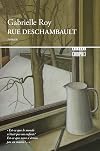
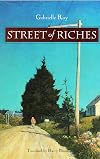
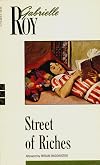
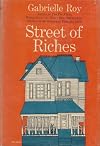
Street of Riches
by Gabrielle Roy
On This Page
Description
The eighteen stories in Gabrielle Roy’s Street of Riches centre upon the bittersweet experiences of a young girl growing up in the francophone community of St. Boniface, Manitoba. In the persona of her narrator Christine, Roy transfigures the incidents and characters of her own childhood, reflecting with gentle irony upon her youthful awakening to the beauty and the sorrow of life. Acclaimed upon its original publication in French in 1955, this superb collection infuses the authenticity of show more memoir with the timeliness and universality of the best imaginative art. Street of Riches won the Governor General’s Award for 1957. show lessTags
Recommendations
























Member Reviews
This is a collection of short stories. With the same characters, and presented chronologically, they make up the story of a family in rural Manitoba as told through the eyes of the youngest child, Christine. I've read several books by this author, but this is the first one I've read in the original language (French). I usually avoid linked stories, but these were done with an attention to presenting the characters -- I felt I'd come to know the family by the end of the book. I wish there was a sequel! Christine is only 20 by the end....now what?
Perfect! Worth reading in French; otherwise seek it out in translation.
Manitoba, early 20th century. Linked stories that make up a novel. Rekindled in me a love for the genre (contemporary mainstream novels mostly don't work for me). Subtlety of character built from a profound knowledge of a landscape, a mode of life, & the complexities of human relationships. Tracks the intellectual, affective and social maturation of a French-Canadian girl, Christine, otherwise known as La Petite or Petite Misere, the youngest of 9 children. Fiction of a sort that perhaps can no longer be written.
Manitoba, early 20th century. Linked stories that make up a novel. Rekindled in me a love for the genre (contemporary mainstream novels mostly don't work for me). Subtlety of character built from a profound knowledge of a landscape, a mode of life, & the complexities of human relationships. Tracks the intellectual, affective and social maturation of a French-Canadian girl, Christine, otherwise known as La Petite or Petite Misere, the youngest of 9 children. Fiction of a sort that perhaps can no longer be written.
Right from the start I could relate to the young girl and her story. The language flowed and was at times almost poetic without being too much. This is the second book that I have read from the author and you can bet that I will be keeping my eyes open for more of her books. I gave it 5 big stars.
Cette oeuvre appartient, comme la Route d'Altamont et Ces enfants de ma vie, au cycle des oeuvres directement inspirées par la vie de l'auteur même s'il ne s'agit pas, à proprement parler, d'une autobiographie. On y découvre le personnage de Christine qui vit au sein d'une famille de plusieurs enfants dans le Manitoba du début du siècle entre une mère qui tente de joindre les deux bouts et un père agant de colonisation.
Au début j'ai eu un peu de mal à m'habituer à cette série de nouvelles, notamment à cause de la première, tel le reflet de son époque, si raciste... et ce n'est pas la seule. Hélas, ou que voulez-vous!, ces histoires racontent un moment de l'histoire canadienne avec son ministère de la Colonisation, sa méfiance des étrangers et son combat contre l'inclémence et les hivers glacials. Mais en fin de compte, on se laisse conquérir par la plume de Roy, sa simplicité, sa précision et son regard si fin sur la société. Car Roy, et la petite fille qu'elle raconte, ne sont pas dupes. Elles savent les personnes qui les entourent aussi bien leurs qualités que leurs défauts, et la lecture de ces nouvelles n'en est que plus show more riche.
Au final, c'est une merveilleuse incursion dans les Plaines, pleine des émotions les plus vives et des moments les plus tendres et les durs, un rappel de la puissance de l'écriture de Roy. show less
Au final, c'est une merveilleuse incursion dans les Plaines, pleine des émotions les plus vives et des moments les plus tendres et les durs, un rappel de la puissance de l'écriture de Roy. show less
May 26, 2024French
À travers les dix-huit récits qui composent ce livre, Gabrielle Roy a transformé les souvenirs de sa jeunesse manitobaine en un roman racontant l’apprentissage d’un écrivain. Christine découvre peu à peu la réalité — familière et pourtant inépuisable — de la petite rue de Saint-Boniface où elle est née et où l’humanité montre ses visages les plus variés. Mais surtout, ses propres rêves lui sont révélés, c’est-à-dire à la fois ce qui la rapproche des autres et l’en sépare, ce qui la fait les aimer profondément et l’oblige en même temps à les quitter pour toujours.
Quatrième livre de Gabrielle Roy, Rue Deschambault a été publié pour la première fois en 1955. Il a été traduit en anglais et en show more italien et a valu à la romancière son deuxième Prix du Gouverneur général du Canada. show less
Quatrième livre de Gabrielle Roy, Rue Deschambault a été publié pour la première fois en 1955. Il a été traduit en anglais et en show more italien et a valu à la romancière son deuxième Prix du Gouverneur général du Canada. show less
Dec 20, 2016French
Ratings
Members
- Recently Added By
Lists

Governor General of Canada's English Fiction Awards
89 works; 3 members

New Canadian Library
191 works; 7 members

Best Books set in Manitoba
85 works; 2 members
Author Information

33+ Works 2,047 Members
Gabrielle Roy was born on March 22, 1909 in St. Boniface, Manitoba, Canada. She attended the Winnipeg Normal Institute, where she earned top honors in both her English and French classes. After she completed her schooling, she spent a month teaching in the summer before accepting a job at a school for a year. In 1930, after that first year of show more teaching, she was offered a permanent position in St. Boniface. Roy decided that she wanted to go to Europe for a year with the meagre savings she had managed to accumulate throughout her seven years teaching in St. Boniface. When asked, she would tell people that she was going to France and England to study Drama. She had been a member of a drama troupe, Le Cercle Molière, throughout her teaching years. Once there, she took a teaching post in the summer of 1937 to gain enough to survive in Europe. She had planned to only stay a year, but that turned into two, and would have been longer if not for the outbreak of World War II. It was here that Roy began to write, and published a few articles in a French journal. Roy returned to Canada and made her home in Montreal where for six years she earned a living as a freelance reporter. Her first novel, Bonheur d'Occasion started out as a newspaper article and turned into a novel over 800 pages long. It was published in 1945. In 1947, she won the Prix Fémina from France for Bonheur d'Occasion, and the Governor General's award for the English translation, The Tin Flute. She returned to France, to the place that had originally inspired her writing and in 1950 published La Petite Poule d'Eau (Where Nests the Water Hen), after her return to Canada. 1957 also brought Roy her second Governor General's award, this time for the English translation of Rue Deschambault (Street of Riches), a novel she published in 1955. For the next several years, Roy received many awards as well as critical success, but it was not until 1978 that she won her third and final Governor General's award for Ces Enfants de Ma Vie (Children of My Heart). This was her final novel, although a compilation of some of her work as a journalist, and several children's books followed this last book. Roy's autobiography La Détresse et l'Enchantement (Enchantment and Sorrow) was not published until 1984, a year after her death. Gabrielle Roy died on July 13, 1983 of heart failure. (Bowker Author Biography) show less
Some Editions
Awards and Honors
Awards
Distinctions
Series
Belongs to Publisher Series
New Canadian Library (56)
Common Knowledge
- Original title
- Rue Deschambault : roman
- Alternate titles
- Street of Riches
- Original publication date
- 1955
- People/Characters
- Christine
- Important places
- St. Boniface, Manitoba, Canada
- First words
- When He built our home, my father took as model the only other house then standing on the brief length of Rue Deschambault - still unencumbered by any sideswalk, as virginal as a country path stretching through thickets of wi... (show all)ld roses, and, in April, resonant with the music of frogs.
- Last words
- (Click to show. Warning: May contain spoilers.)Was not all the world a child? Were we not at day's morning?...
- Disambiguation notice
- Original title: Rue Deschambault : roman
Classifications
Statistics
- Members
- 160
- Popularity
- 204,770
- Reviews
- 6
- Rating
- (4.00)
- Languages
- English, French
- Media
- Paper, Audiobook, Ebook
- ISBNs
- 11
- ASINs
- 12