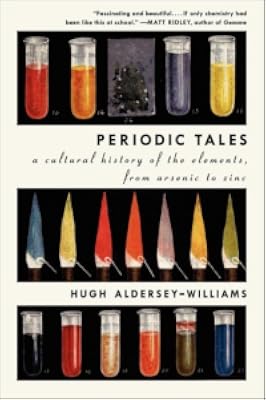
Periodic Tales: A Cultural History of the Elements, from Arsenic to Zinc
by Hugh Aldersey-Williams
On This Page
Description
"In the spirit of A SHORT HISTORY OF NEARLY EVERYTHING, an energetic and wide-ranging book of discovery and discoverers, of exploitation and celebration, and of superstition and science, all in search of the ways the chemical elements are woven into our culture, history, and language"--Tags
Recommendations




Member Reviews
Aldersey-Williams takes readers along on his quest to collect all of the elements in the periodic table. While a bit of a slog at times, this book is mostly entertaining as it highlights the humanity of scientific discovery---the ego and the ambition, the odd mix of hubris and humility that leads to the conviction that everything is ultimately knowable, and the sometimes shocking carelessness of chemists in pre-OSHA days---and makes me wonder what's tinting my sunglasses. Especially appealing to me are the dry wit and the urge for classification and the comfort that comes with the feeling that the world is a place of order, despite appearances to the contrary.
I was going to fill this review with little plays on words involving each of the 114 named elements, but everyone knows that all the good chemistry puns argon. Also have you tried making a pun involving praseodymium? It's impossible. (That wasn't a pun.)
Periodic Tales is an odd little piece. As much picaresque as Dead Souls or Don Quixote, Hugh Aldersey-Williams wanders pell-mell and everywhither amongst forty or so of the known elements, pointing out their unusual properties, uses, or histories.
Some editions of Periodic Tales are subtitled A Cultural History of the Elements, whereas others – mine included – opt for The Curious Lives of the Elements. It's not much of a change, sure, but the subtleties in subtitles do seem to show more reflect the two opposing sides of the book. Hugh Aldersey-Williams has a master's degree in science but is a fellow of the Royal Society of Arts. Ostensibly, then, he's in the perfect position to write about the elements from both a scientific viewpoint and a more arts-oriented side. In practice he seems far happier with the former than the latter.
The sections on scientists' ever more refined attempts to break down compounds into purer and purer substances, on Mendeleev's sagacious formulation of the periodic table, and on the zany japes those kooks at Las Alamos got up to are all fun to read and thoroughly interesting. But when the subject turns to, say, the cultural value of gold and that slightly disturbing statue of Kate Moss at the British Museum, the tone becomes more forced. Sometimes it's as if the author isn't quite sure why he's writing about the deep culturohistorical significance of collections of atoms unified by their having the same number of protons in their nucleus. Worse, sometimes he seems to have decided that the best way to discuss the elements' role in the arts is to set off on a flight of romantic prose. Anyone who has read Jules Verne's [b:The Castle in Transylvania|7937245|The Castle in Transylvania|Jules Verne|http://d.gr-assets.com/books/1320559907s/7937245.jpg|1533080] will know what happens when an author more suited to solid science writing tries their hand at impersonating Shelley.
As with many modern non-fiction works, Periodic Tales has tried to take a slightly different approach to its subject matter, and explained in its introduction that this is because there already exist many marvellous books about the elements. This one might not have been marvellous, but it was a nice appetiser until I find one that is. show less
Periodic Tales is an odd little piece. As much picaresque as Dead Souls or Don Quixote, Hugh Aldersey-Williams wanders pell-mell and everywhither amongst forty or so of the known elements, pointing out their unusual properties, uses, or histories.
Some editions of Periodic Tales are subtitled A Cultural History of the Elements, whereas others – mine included – opt for The Curious Lives of the Elements. It's not much of a change, sure, but the subtleties in subtitles do seem to show more reflect the two opposing sides of the book. Hugh Aldersey-Williams has a master's degree in science but is a fellow of the Royal Society of Arts. Ostensibly, then, he's in the perfect position to write about the elements from both a scientific viewpoint and a more arts-oriented side. In practice he seems far happier with the former than the latter.
The sections on scientists' ever more refined attempts to break down compounds into purer and purer substances, on Mendeleev's sagacious formulation of the periodic table, and on the zany japes those kooks at Las Alamos got up to are all fun to read and thoroughly interesting. But when the subject turns to, say, the cultural value of gold and that slightly disturbing statue of Kate Moss at the British Museum, the tone becomes more forced. Sometimes it's as if the author isn't quite sure why he's writing about the deep culturohistorical significance of collections of atoms unified by their having the same number of protons in their nucleus. Worse, sometimes he seems to have decided that the best way to discuss the elements' role in the arts is to set off on a flight of romantic prose. Anyone who has read Jules Verne's [b:The Castle in Transylvania|7937245|The Castle in Transylvania|Jules Verne|http://d.gr-assets.com/books/1320559907s/7937245.jpg|1533080] will know what happens when an author more suited to solid science writing tries their hand at impersonating Shelley.
As with many modern non-fiction works, Periodic Tales has tried to take a slightly different approach to its subject matter, and explained in its introduction that this is because there already exist many marvellous books about the elements. This one might not have been marvellous, but it was a nice appetiser until I find one that is. show less
I was going to fill this review with little plays on words involving each of the 114 named elements, but everyone knows that all the good chemistry puns argon. Also have you tried making a pun involving praseodymium? It's impossible. (That wasn't a pun.)
Periodic Tales is an odd little piece. As much picaresque as Dead Souls or Don Quixote, Hugh Aldersey-Williams wanders pell-mell and everywhither amongst forty or so of the known elements, pointing out their unusual properties, uses, or histories.
Some editions of Periodic Tales are subtitled A Cultural History of the Elements, whereas others – mine included – opt for The Curious Lives of the Elements. It's not much of a change, sure, but the subtleties in subtitles do seem to show more reflect the two opposing sides of the book. Hugh Aldersey-Williams has a master's degree in science but is a fellow of the Royal Society of Arts. Ostensibly, then, he's in the perfect position to write about the elements from both a scientific viewpoint and a more arts-oriented side. In practice he seems far happier with the former than the latter.
The sections on scientists' ever more refined attempts to break down compounds into purer and purer substances, on Mendeleev's sagacious formulation of the periodic table, and on the zany japes those kooks at Las Alamos got up to are all fun to read and thoroughly interesting. But when the subject turns to, say, the cultural value of gold and that slightly disturbing statue of Kate Moss at the British Museum, the tone becomes more forced. Sometimes it's as if the author isn't quite sure why he's writing about the deep culturohistorical significance of collections of atoms unified by their having the same number of protons in their nucleus. Worse, sometimes he seems to have decided that the best way to discuss the elements' role in the arts is to set off on a flight of romantic prose. Anyone who has read Jules Verne's [b:The Castle in Transylvania|7937245|The Castle in Transylvania|Jules Verne|http://d.gr-assets.com/books/1320559907s/7937245.jpg|1533080] will know what happens when an author more suited to solid science writing tries their hand at impersonating Shelley.
As with many modern non-fiction works, Periodic Tales has tried to take a slightly different approach to its subject matter, and explained in its introduction that this is because there already exist many marvellous books about the elements. This one might not have been marvellous, but it was a nice appetiser until I find one that is. show less
Periodic Tales is an odd little piece. As much picaresque as Dead Souls or Don Quixote, Hugh Aldersey-Williams wanders pell-mell and everywhither amongst forty or so of the known elements, pointing out their unusual properties, uses, or histories.
Some editions of Periodic Tales are subtitled A Cultural History of the Elements, whereas others – mine included – opt for The Curious Lives of the Elements. It's not much of a change, sure, but the subtleties in subtitles do seem to show more reflect the two opposing sides of the book. Hugh Aldersey-Williams has a master's degree in science but is a fellow of the Royal Society of Arts. Ostensibly, then, he's in the perfect position to write about the elements from both a scientific viewpoint and a more arts-oriented side. In practice he seems far happier with the former than the latter.
The sections on scientists' ever more refined attempts to break down compounds into purer and purer substances, on Mendeleev's sagacious formulation of the periodic table, and on the zany japes those kooks at Las Alamos got up to are all fun to read and thoroughly interesting. But when the subject turns to, say, the cultural value of gold and that slightly disturbing statue of Kate Moss at the British Museum, the tone becomes more forced. Sometimes it's as if the author isn't quite sure why he's writing about the deep culturohistorical significance of collections of atoms unified by their having the same number of protons in their nucleus. Worse, sometimes he seems to have decided that the best way to discuss the elements' role in the arts is to set off on a flight of romantic prose. Anyone who has read Jules Verne's [b:The Castle in Transylvania|7937245|The Castle in Transylvania|Jules Verne|http://d.gr-assets.com/books/1320559907s/7937245.jpg|1533080] will know what happens when an author more suited to solid science writing tries their hand at impersonating Shelley.
As with many modern non-fiction works, Periodic Tales has tried to take a slightly different approach to its subject matter, and explained in its introduction that this is because there already exist many marvellous books about the elements. This one might not have been marvellous, but it was a nice appetiser until I find one that is. show less
I know nothing about chemistry. I barely passed it in high school. I do not know the difference between organic and inorganic. I do not know much about the difference between a mineral (geology) vs an element (chemistry). I have a very difficult time grasping metals vs gases vs "nonmetals" vs "metalloids" Like...are metalloids just rocks? I don't know! I have very little understanding of the processes used to find these elements. BUT it was interesting to learn the history of so many elements that are simply part of our lives. Also interesting to read about rare-earth elements (the seeds of technology, apparently) when they were literally in the news a couple of weeks ago ("raw earth"). The fact that the periodic table is still legit show more today after 100+ years is pretty incredible, way to go Mendeleev!
The chapters are relatively short, but dense because many topics were covered for one metal in most chapters. It made for a great book to read while falling asleep. show less
The chapters are relatively short, but dense because many topics were covered for one metal in most chapters. It made for a great book to read while falling asleep. show less
For the budding element collector, this is a great read. For the layperson who thinks they're going to get a couple of fun stories about each of the elements, I would suggest looking somewhere else.
I picked this up intrigued by its title and cover. Ever wondered what the rich history of each of the elements of the famous periodic table have in store? You will definitely find that here. I have a deeper understanding of how and why certain elements were named, the geographic clusters of where many elements were "discovered," the origins of the reputations of certain elements like arsenic, and so on. Why was silver considered so valuable, but not so much these days? Where can I get my hands on some plutonium? What is so incredible about show more the lovely liquid metal, mercury? It's a very fascinating read indeed.
I'd recommend this book for someone who is definitely interested in the field of science and particularly chemistry. The text isn't exactly accessible for the typical light reader, in my opinion. But if you are interested in what it has to offer, then take a look. show less
I picked this up intrigued by its title and cover. Ever wondered what the rich history of each of the elements of the famous periodic table have in store? You will definitely find that here. I have a deeper understanding of how and why certain elements were named, the geographic clusters of where many elements were "discovered," the origins of the reputations of certain elements like arsenic, and so on. Why was silver considered so valuable, but not so much these days? Where can I get my hands on some plutonium? What is so incredible about show more the lovely liquid metal, mercury? It's a very fascinating read indeed.
I'd recommend this book for someone who is definitely interested in the field of science and particularly chemistry. The text isn't exactly accessible for the typical light reader, in my opinion. But if you are interested in what it has to offer, then take a look. show less
Each distinct atom (differentiated by the number of protons in their nuclei) makes up an element, one of the “elemental” aspects of life on earth. Elements create bonds to form molecules, which in turn combine to form all matter. Atoms, or elements, were organized into a “periodic table” by Russian chemist Dmitrii Mendeleev in 1869. This table not only changed the way in which scientists categorized elements, but allowed them to predict missing elements according to where they would fit on the table. Now totaling 118, each element is unique not only in its chemical makeup, but also in its physical manifestation and cultural significance. (There are only 92 naturally occurring elements, but addditional elements have been produced show more by nuclear physics technology.)
It is the cultural significance that is the focus of this survey by Hugh Aldersey Williams. His discussion follows a rather meandering path through the elements not in their natural order but grouped by social uses. In sections called Power, Fire, Craft, Beauty, and Earth, he highlights some elements in each group showing how they were discovered, how they have been used, and the meanings with which they have been imbued throughout time. He also chronicles his own interests in the elements, and the ways in which he tried to collect and work with various elements throughout his life.
The forays into chemistry by Aldersey Williams are very basic - you don’t have to understand physics or even chemistry to enjoy his exploration of the elements. Some parts of the book are more interesting than others - for example I thought the whole anecdote about the gold sculpture of the supermodel Kate Moss was drawn out and of marginal interest. But I appreciated the way he integrated the uses of elements by artists and writers into his book. In any event, most of his stories were not only more interesting but full of fascinating factoids.
Evaluation: Overall, I found this survey of elements accessible and entertaining, not only learning a thing or two but renewing my interest in atomic science. I listened to the audiobook narrated by Antony Ferguson, and I have to say the British pronunciations were as fun and interesting to me as the content of the material. For example, who knew the British say gaseous with a long a, or that in Britain, Ulysses is pronounced with the accent on the first syllable: “YOU-liss-ees," instead of as the U.S., where it is pronounced with the accent on the second syllable: “You-LISS-ees." show less
It is the cultural significance that is the focus of this survey by Hugh Aldersey Williams. His discussion follows a rather meandering path through the elements not in their natural order but grouped by social uses. In sections called Power, Fire, Craft, Beauty, and Earth, he highlights some elements in each group showing how they were discovered, how they have been used, and the meanings with which they have been imbued throughout time. He also chronicles his own interests in the elements, and the ways in which he tried to collect and work with various elements throughout his life.
The forays into chemistry by Aldersey Williams are very basic - you don’t have to understand physics or even chemistry to enjoy his exploration of the elements. Some parts of the book are more interesting than others - for example I thought the whole anecdote about the gold sculpture of the supermodel Kate Moss was drawn out and of marginal interest. But I appreciated the way he integrated the uses of elements by artists and writers into his book. In any event, most of his stories were not only more interesting but full of fascinating factoids.
Evaluation: Overall, I found this survey of elements accessible and entertaining, not only learning a thing or two but renewing my interest in atomic science. I listened to the audiobook narrated by Antony Ferguson, and I have to say the British pronunciations were as fun and interesting to me as the content of the material. For example, who knew the British say gaseous with a long a, or that in Britain, Ulysses is pronounced with the accent on the first syllable: “YOU-liss-ees," instead of as the U.S., where it is pronounced with the accent on the second syllable: “You-LISS-ees." show less
Members
- Recently Added By
Lists

The r/AskScience Reading List
159 works; 3 members

The r/Chemistry Recommended Books
87 works; 1 member
Author Information

19+ Works 2,299 Members
Hugh Aldersey-Williams is an author and journalist from the United Kingdom. Aldersey-Williams was educated at Highgate School and studied the natural sciences at the University of Cambridge. he is known for his bestselling book, Periodic Tales: A Cultural History of the Elements, from Arsenic to Zinc, which explains all the elements found in the show more periodic table and their origins. He has also written The Most Beautiful Molecule and Anatomies: A Cultural History of the Human Body. (Bowker Author Biography) show less
Some Editions
Common Knowledge
- Canonical title*
- Grundämnenas sällsamma liv : en kulturguide till det periodiska systemet
- Alternate titles
- Periodic Tales
- Original publication date
- 2011
- Dedication
- To my parents
Mary Redfield Aldersey-Williams
(23 June 1930 - 16 May 2004)
Arthur Grosvenor Aldersey-Williams
(6 June 1929 - 23 December 2008)
with love and gratitude - First words
- Like the alphabet or the zodiac, the periodic table of the elements is one of those graphic images that seem to root themselves for ever in our memories.
- Last words
- (Click to show. Warning: May contain spoilers.)'It looks as if it will be one of the most difficult experiments ever carried out.'
- Blurbers
- Ridley, Matt
- Original language
- English
*Some information comes from Common Knowledge in other languages. Click "Edit" for more information.
Classifications
Statistics
- Members
- 1,408
- Popularity
- 16,771
- Reviews
- 26
- Rating
- (3.58)
- Languages
- 7 — Czech, English, German, Italian, Portuguese, Spanish, Swedish
- Media
- Paper, Audiobook, Ebook
- ISBNs
- 25
- ASINs
- 14