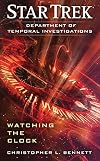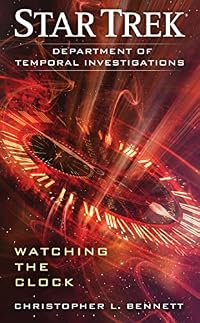
Department of Temporal Investigations: Watching the Clock
by Christopher L. Bennett
Star Trek: Department of Temporal Investigations, Star Trek Relaunch (Book 50) (Chronological Order), Star Trek (novels) (2011.04), Star Trek (2011.04)
On This Page
Description
There's likely no more of a thankless job in the Federation than temporal investigation. While starship explorers get to live the human adventure of traveling to other times and realities, it's up to the dedicated agents of the Federation Department of Temporal Investigations to deal with the consequences to the timestream that the rest of the Galaxy has to live with day by day. But when history as we know it could be wiped out at any moment by time warriors from the future, misused relics show more of ancient races, or accident-prone starships, only the most disciplined, obsessive, and unimaginative government employees have what it takes to face the existential uncertainty of it all on a daily basis . . . and still stay sane enough to complete their assignments. That's where Agents Lucsly and Dulmur come in--stalwart and unflappable, these men are the Federation's unsung anchors in a chaotic universe. Together with their colleagues in the DTI--and with the help and sometimes hindrance of Starfleet's finest--they do what they can to keep the timestream, or at least the paperwork, as neat and orderly as they are. But when a series of escalating temporal incursions threatens to open a new front of the history-spanning Temporal Cold War in the twenty-fourth century, Agents Lucsly and Dulmur will need all their investigative skill and unbending determination to stop those who wish to rewrite the past for their own advantage, and to keep the present and the future from devolving into the kind of chaos they really, really hate. show lessTags
Recommendations







Member Recommendations

Member Reviews
These days, the way New Frontier was populated with popular Next Generation guest stars in order to establish its legitimacy as a literary spin-off of the screen franchise seems positively naïve: here we have a novel based around two characters whose total screentime can be collected in a four-minute video. I have to admit that I was a bit skeptical going in, but Department of Temporal Investigations turned out to be a fun premise. The joy of it is in the way that Bennett approaches the DTI as a long-running cop show, about well-meaning but tired civil servants just trying to do their best in a universe that doesn't appreciate them.
It's the small details that make the book work: I liked the joke about how DTI agents are tired of time show more jokes (the one in the opening chapter was delightful); I liked how uptime temporal agents are higher authorities, basically like when the FBI turns up in a police procedural; I liked the idea that after major disasters, the DTI has more work both because of people trying to change history and because of tourists/researchers coming back to see it; I liked the little digest history of the DTI, where when Starfleet gets time travel, they're all "neat! let's explore time too! what could go wrong!" and the DTI is formed because the government is like, "You keep almost wiping out recorded history. STOP IT." I liked the portrayal of Dulmur and Lucsly. Bennett stated his intention was to turn their very colorlessness into an asset, and the book succeeded in this. I liked both of their fervent devotion to the job, and the sly humor of Lucsly, especially his final line in the penultimate chapter.
The book's strongest parts are its beginning and its ending. The opening chapter, featuring an agent who's snapped after a rough mission in the wake of Star Trek: Destiny is good fun; I loved both his rant ("Kill her, don't kill her, none of this makes a difference to the multiverse.") and Lucsly's putdown of it ("stop abusing temporal physics as an excuse to dodge responsibility for your own choices!"). The whole first chapter leads like the pilot episode of DTI tv show, because it goes straight from this (obviously the opening teaser) into a quick mystery about passenger transport that traveled through time, which has tv-style cutting between suspect interrogations. The whole thing culminates in the induction of a new member of the DTI, a potential viewpoint character. It was fun and entertaining.
Unfortunately, the whole book is not like that. It soon settles into a monotonous format of alternating present-day cases of the DTI in 2381 to 2382 with flashbacks that slowly ascend from 2364 to 2378. None of these cases are as good as the first one, which could stand on its own as a little story-- most of the flashback cases follow the format of "DTI turns up the aftereffects of a Next Generation episode; exposition is delivered to massage the details into the novel's Unified Theory of Star Trek Time Travel." It's definitely small world, and none of them are as zippily written as the introduction, sometimes getting quite belabored in their explaining of temporal theory, Star Trek continuity, or both. It's formulaic and there's not enough at stake in most of them to be interesting. Some are still entertaining, though (I liked the bit where Janeway escapes temporal justice and Lucsly quits the force), and soon a narrative begins to emerge, of the twenty-fourth century's participation in the Temporal Cold War from Enterprise.
I'm not entirely sure what I think about the novel's engagement with this. It works okay on the novel's own terms; the book lays clues about the identity of Enterprise's so called "Future Guy" in each of the flashbacks, and eventually that information pays off. But if you handed a fervent Enterprise fan this book so that they could finally get the answers Enterprise itself never yielded, I don't think they'd be satisfied, as there's absolutely no hints from Enterprise that really pay off here. The true identity and motive of "Future Guy" pay off Watching the Clock itself, not Enterprise. Plus, of course, no Enterprise characters are present to have anything to do with the comeuppance of their long-time nemesis. Maybe they should have plucked Archer out of time to punch him on the jaw or something? But it's as if a long-running mystery in the Father Brown stories was unexpectedly resolved in a Sherlock Holmes story. It jars narratively.
The ending is the other good part; the DTI, some Next Generation characters, the 29th-century Starfleet guys from "Relativity," the 31st-century temporal agents from Enterprise, and many more characters end up in snarled, tangled, temporal mess that was just completely ridiculous in a good way, taking all the goofy possibilities of Star Trek time travel and piling them atop each other to joyous excess. I didn't follow any of it (and I usually have a good head for these things), but I loved reading it. It's like Steven Moffat turned up to eleven.
Also the viewpoint newbie character gets shunted off into her own side story, which completely failed to engage me. The Axis of Time seems like a potentially interesting Big Dumb Object, but the story told with it was completely dull; I couldn't bring myself to care about cross-time artifact smuggling, or super sexy mind control space ladies.
So, a set-up that's more fun in theory than practice, but hopefully that bodes well for future installments of DTI-- I know the third installment onward are novellas, which seems like it would lend itself toward what I liked about the first chapter.
Continuity Notes:
It's the small details that make the book work: I liked the joke about how DTI agents are tired of time show more jokes (the one in the opening chapter was delightful); I liked how uptime temporal agents are higher authorities, basically like when the FBI turns up in a police procedural; I liked the idea that after major disasters, the DTI has more work both because of people trying to change history and because of tourists/researchers coming back to see it; I liked the little digest history of the DTI, where when Starfleet gets time travel, they're all "neat! let's explore time too! what could go wrong!" and the DTI is formed because the government is like, "You keep almost wiping out recorded history. STOP IT." I liked the portrayal of Dulmur and Lucsly. Bennett stated his intention was to turn their very colorlessness into an asset, and the book succeeded in this. I liked both of their fervent devotion to the job, and the sly humor of Lucsly, especially his final line in the penultimate chapter.
The book's strongest parts are its beginning and its ending. The opening chapter, featuring an agent who's snapped after a rough mission in the wake of Star Trek: Destiny is good fun; I loved both his rant ("Kill her, don't kill her, none of this makes a difference to the multiverse.") and Lucsly's putdown of it ("stop abusing temporal physics as an excuse to dodge responsibility for your own choices!"). The whole first chapter leads like the pilot episode of DTI tv show, because it goes straight from this (obviously the opening teaser) into a quick mystery about passenger transport that traveled through time, which has tv-style cutting between suspect interrogations. The whole thing culminates in the induction of a new member of the DTI, a potential viewpoint character. It was fun and entertaining.
Unfortunately, the whole book is not like that. It soon settles into a monotonous format of alternating present-day cases of the DTI in 2381 to 2382 with flashbacks that slowly ascend from 2364 to 2378. None of these cases are as good as the first one, which could stand on its own as a little story-- most of the flashback cases follow the format of "DTI turns up the aftereffects of a Next Generation episode; exposition is delivered to massage the details into the novel's Unified Theory of Star Trek Time Travel." It's definitely small world, and none of them are as zippily written as the introduction, sometimes getting quite belabored in their explaining of temporal theory, Star Trek continuity, or both. It's formulaic and there's not enough at stake in most of them to be interesting. Some are still entertaining, though (I liked the bit where Janeway escapes temporal justice and Lucsly quits the force), and soon a narrative begins to emerge, of the twenty-fourth century's participation in the Temporal Cold War from Enterprise.
I'm not entirely sure what I think about the novel's engagement with this. It works okay on the novel's own terms; the book lays clues about the identity of Enterprise's so called "Future Guy" in each of the flashbacks, and eventually that information pays off. But if you handed a fervent Enterprise fan this book so that they could finally get the answers Enterprise itself never yielded, I don't think they'd be satisfied, as there's absolutely no hints from Enterprise that really pay off here. The true identity and motive of "Future Guy" pay off Watching the Clock itself, not Enterprise. Plus, of course, no Enterprise characters are present to have anything to do with the comeuppance of their long-time nemesis. Maybe they should have plucked Archer out of time to punch him on the jaw or something? But it's as if a long-running mystery in the Father Brown stories was unexpectedly resolved in a Sherlock Holmes story. It jars narratively.
The ending is the other good part; the DTI, some Next Generation characters, the 29th-century Starfleet guys from "Relativity," the 31st-century temporal agents from Enterprise, and many more characters end up in snarled, tangled, temporal mess that was just completely ridiculous in a good way, taking all the goofy possibilities of Star Trek time travel and piling them atop each other to joyous excess. I didn't follow any of it (and I usually have a good head for these things), but I loved reading it. It's like Steven Moffat turned up to eleven.
Also the viewpoint newbie character gets shunted off into her own side story, which completely failed to engage me. The Axis of Time seems like a potentially interesting Big Dumb Object, but the story told with it was completely dull; I couldn't bring myself to care about cross-time artifact smuggling, or super sexy mind control space ladies.
So, a set-up that's more fun in theory than practice, but hopefully that bodes well for future installments of DTI-- I know the third installment onward are novellas, which seems like it would lend itself toward what I liked about the first chapter.
Continuity Notes:
- You could write a list of bullet points for this novel as long as the novel itself; of course, Bennett already has.
- That said, I caught a reference to the notorious Killing Time that he didn't annotate. On p. 205, Lucsly's Romulan counterpart kind of admits that the Romulans may have tried to eliminate the Federation from history "in some... other reality, now rendered irrelevant." (Though Bennett himself said it was less a specific reference to Killing Time and more a general reference to tie-ins about Romulans messing with history.)
- The anecdote about the ringship Enterprise, though, was a particularly belabored continuity fix in a novel full of them. And I'm not even sure the anecdote makes much sense.
- Like S.C.E. / Corps of Engineers before it, Department of Temporal Investigations has a clunky and un-sexy subtitle. I maintain S.C.E. should have just been called Star Trek: Miracle Workers, but it's less obvious to me what Department of Temporal Investigations could have been called instead. Time Cops? Time Patrol? Time Masters?
- I did feel at times that no female character could turn up without having their attractiveness ranked; this culminates in a scene where Dina Elfiki walks past Dulmur and Lucsly while wearing a holo-disguise, and they exchange dialogue that amounts to, "Not even a hologram can disguise dat ass." (Elfiki is apparently modeled on Sarah Shahi.) On the other hand, I think the attractiveness of exactly one male character is commented on, and he's a Deltan sex god. Who says you need visuals to have male gaze?
- I was amused to note that even in the twenty-fourth century, ALOE is a common crossword puzzle filler word. (It's got three vowels!)
- I think this is the first Star Trek novel to include an allusion to pubic hair.
Holy crap. This was so amazing. So awesome. It was up there with Q-Squared because it was so mind bendingly crazy (huh, I don't think that in the actual book there was anything about Q-Squared in there though, although there was almost every other temporal Star Trek thing in there, from both media and books).
It was about the DIT (Department of Temporal Investigations) and the Agents who try to fix the temporal problems of the current time, that either anomalies or Starfleet officers caused. We meet Lucsly, Dulmur, Shelan, Teresa Ortiz, and Clare Raymond amongst so many others.
I have to admit that I wasn't quite sure what the point/theme of the book was supposed to be, but, the two main stories in the book were cool (and super super mind show more bending as I said above). Also, if I wasn't so familiar with the media/book Star Trek universe I probably would have been totally lost.
Still. Taking this department that was only barely seen in the TV series and expanding on it so much and so awesomely. I can't wait for the next book. show less
It was about the DIT (Department of Temporal Investigations) and the Agents who try to fix the temporal problems of the current time, that either anomalies or Starfleet officers caused. We meet Lucsly, Dulmur, Shelan, Teresa Ortiz, and Clare Raymond amongst so many others.
I have to admit that I wasn't quite sure what the point/theme of the book was supposed to be, but, the two main stories in the book were cool (and super super mind show more bending as I said above). Also, if I wasn't so familiar with the media/book Star Trek universe I probably would have been totally lost.
Still. Taking this department that was only barely seen in the TV series and expanding on it so much and so awesomely. I can't wait for the next book. show less
Time travel and the possibilities it represents is one of the coolest aspects of science fiction, a genre that celebrates possibilities. Star Trek has dealt with some madness and has created a pretty mess tapestry in it's canon, with loose threads dangling that would bring hours of joy to a whole pride of domestic cats. Enter Trek literary technician, Christopher L. Bennett and his ability to tighten those loose ends and connect dots that many fans may not have even noticed. Even make sense out of that Temporal Cold War nonsense. He's the man. This is a good read.
Volume 1 of a 5 book series, this one is mostly tied up with introducing characters and placing them in the Star Trek universe. The book is one story arch that is meant to tie several short stories together, this is not one of my favorite structures but will hopefully not be the same for the future books. The time investigators are well-developed and their environment fits the Star Trek model well.
read 8/8/2024
read 8/8/2024
I really enjoyed reading this book. I have been a fan since the sixties, though mostly original series. Yes, there is a lot of back story in this book tieing a lot of episodes, books, etc. together, but I feel it did not get in the way, but added to the story.
3.8 stars.
Ratings
Members
- Recently Added By
Lists

Star Trek: The Typhon Pact and Beyond
33 works; 1 member
Author Information

45+ Works 3,519 Members
Awards and Honors
Awards
Series


Common Knowledge
- Canonical title
- Department of Temporal Investigations: Watching the Clock
- Original publication date
- 2011-04-26
- People/Characters
- Marion Dulmur; Gariff Lucsly; Teresa Garcia; Ajur; Loom Aleek-Om; Alenar (show all 100); Claudia Alisov; Laarin Andos; Avel; B'etath; Nanietta Bacco; Rif jav Balkar; Morgan Bateson; Lloyd Boen; I'stel Borah; Boratus; Borvala; Chall; Chandra; Jasminer Choudhury; Cohen; Damyz; Timot Danlen (Daniels); Falvin Dor; Drash; Juel Duca; Royal Eight; Dina Elfiki; George Faunt; Felbog Bu-Tsop-Vee; Forzrat; Emro Ganazeel; Ghretch; Farimah Hamidi; Daisen Hamor; Hariin; Dennis Harmon; Jamran Harnoth; Kathryn Janeway; Mara Kadray; Virum Kalnota; Kelia; Vorlis Klega; Korath; Gelim Kreinns; Ellec Krotine; Lirahn; Alan Manheim; Erika Manheim; Paul Manheim; M'grash; Meneth; Yvette Michael; Mogon; Rani Mohindra; Naadri; Riroa Nadamé; Nart; Nijen; Coral Nine; Jena Noi; Ojav; Oydia; Melora Pazlar; Stewart Peart; Joaquin Perez; Heather Petersen; Jean-Luc Picard; Preston [in Watching the Clocks]; Ian Purvis; Meyo Ranjea; Ranz; Clare Raymond; Louise Cara Raymond; Revad; William T. Riker; Rodda; Ronarek; Sanioth; Shelan; Selithan ch'Riin; Shiiem; Siemaszko; Vennor Sikran; Sonaj; Sornek; T'Pan; Wataru Takizawa; Temarel; Teyak; T'Manis; T'Viss; Deanna Troi; Vard; Vikei; Steven Wexler; Parvana Whitcomb; Worf; Stijen Yol; Zane [in Watching the Clock]
- Important places
- Aldebaran III; Axis of Time; Château Thelian, France; Delta IV; Endicor; Eris (show all 23); Indianapolis, Indiana, USA; Indiana, USA; Kaferia; London, England, UK; Mars; McKinley Station; Nehru Colony; Nivoch; Paris, France; Pyrellia; Risa; San Francisco, California, USA; California, USA; Tandar Prime; Tau Ceti III; Vandor IV; Warlock Station
- Epigraph
- People like us, who believe in physics, know that the distinction between past, present, and future is only a stubbornly persistent illusion.–Albert Einstein (1955 CE)
People assume that time is a strict progression of cause to effect, but actually, from a non-linear, non-subjective viewpoint, it's more like a big ball of wibbly-wobbly... timey-wimy... stuff.–Steven Moffat (2007 CE) - Dedication
- To my father(1933-2010 CE)"Time is a companion who goes with us on the journey and reminds us to cherish every moment, because they'll never come again."
- First words
- "Stay back, all of you!" cried Special Agent George Faunt.
- Quotations
- The best we can do is take the history we have and deal with it.
Adventure is what happens when things go wrong, and our responsibility is to make sure they don't go wrong.
The people most reluctant to use weapons are the ones who can best be trusted with them. - Last words
- (Click to show. Warning: May contain spoilers.)"People who take a long view enough of time."
Classifications
Statistics
- Members
- 235
- Popularity
- 137,996
- Reviews
- 6
- Rating
- (3.69)
- Languages
- English, French
- Media
- Paper, Ebook
- ISBNs
- 4
- ASINs
- 3