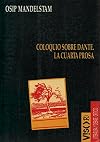
Conversazione su Dante
by Osip Mandelstam
On This Page
Tags
Recommendations



























Member Reviews
This comes in the same volume as Mandelstam's Journey to Armenia and serves as something of a supplement to it, not a conversation but an essay applying Mandelstam's ideas about the singularity and linguistically imbricated nature of human lives and geographies over to The Divine Comedy. So that means things like the impossibility of true translation into one's own terms, and the need instead to stretch the terms to cover the material; or the weaver's and carder's and dyer's metaphors Dante inserts into the work (he seemed to imply that Dante or his people were involved in those trades, but that does not seem to be the case--Dante was a pharmacist--so I dunno). He is very good, very loving, on Dante in general, decrying the tendency show more that makes him a mysterious masked genius with hooked nose, seeing instead a young man with a good tan romancing his Beatrice. It's echt modernist literary criticism, impressionistically traditional and throwing concepts at the wall to see what sticks, and if you like that kind of thing and like Dante this is a fine short read. show less
Ratings
Members
- Recently Added By
Author Information

216+ Works 2,327 Members
Osip Mandelstam was born in Warsaw, Poland and grew up in St.Petersburg, Russia Mandelstam was taught by tutors and governesses at his home. He attended the prestigious Tenishev School from 1900 to 1907 and traveled then to Paris from 1907 to 1908 and Germany from 1908 to 1910, where he studied Old French literature at the University of show more Heidelberg. In 1911 till 1917, he studied philosophy at St. Petersburg University but did not graduate. Mandelstam was a member of the 'Poets Guild' from 1911 and had close personal ties with Anna Akhmatova and Nikolai Gumilev. His first poems appeared in 1910 in the journal Apollon. In 1918 he worked briefly for Anatoly Lunacharskii's Education Ministry in Moskow. In the 1920s Mandelstam supported himself by writing children's books and translating works by Upton Sinclair, Jules Romains, Charles de Coster and others. He did not compose poems from 1925 to 1930 but turned to prose. In 1930 he made a trip to Armenia to escape his influential enemies. Mandelstam's Journey to Armenia (1933) became his last major work published during his life time. Mandelstam was arrested the first time in 1934 for an epigram he had written on Joseph Stalin. In the transit camp, Mandelstam was already so weak that he couldn't stand. He died in the Gulag Archipelago in Vtoraia rechka, near Vladivostok, on December 27, 1938.His body was taken to a common grave. International fame came to Mandelstam in the 1970s, when his works were published in the West and in the Soviet Union. (Bowker Author Biography) show less
Some Editions
Series
Belongs to Publisher Series
Slavische Cahiers (32)
Classifications
- Genres
- Fiction and Literature, Nonfiction, Literature Studies and Criticism
- DDC/MDS
- 851.1 — Literature & rhetoric Italian, Romanian & related literatures Italian poetry Early Italian; Age of Dante –1375
- LCC
- PQ4390 — Language and Literature French, Italian, Spanish and Portuguese literatures Italian literature Individual authors and works to 1400
Statistics
- Members
- 56
- Popularity
- 545,225
- Reviews
- 1
- Rating
- (2.75)
- Languages
- 8 — Finnish, French, German, Italian, Multiple languages, Russian, Serbian, Spanish
- Media
- Paper
- ISBNs
- 8