On This Page
Tags
Recommendations
Member Reviews
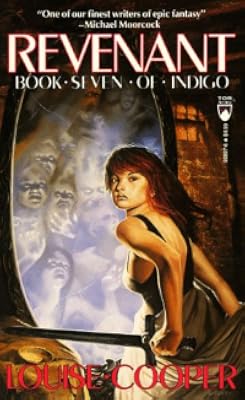
This seventh volume in the series takes up where Indigo and Grimya, the sentient talking wolf who has been her faithful companion on her long quest, have travelled to somewhere on the eastern continent (not marked on the map at the begining slightly frustratingly, but we know that it is not too far from the place where they spent many years in what I think was book 3) to give Indigo some time to recover after the traumas of the previous book. At the end of that story she threw away the talisman that had hitherto led her to where each demon that she must defeat was residing: the demons that she unleashed with her foolish and arrogant behaviour in book one. She has now decided that she will try to find her lost love Fenran instead of show more assuming that she must defeat all the demons first.
They are in a strange country where everything is extremely ordered and hierarchical. The rigid social order is defined by the wearing of coloured sashes. Committees are in charge of each town, and an area is set aside for foreigners such as Indigo. Everyone must have a utilitarian value: luckily, she has some herbal knowledge which leads to her being co-opted as a replacement physician in the community of Joyful Travail, the previous incumbent having died. A family in the foreign enclave become her hosts: parents and son and daughter. But even before her arrival a slightly creepy note has been struck because both Indigo and Grimya have been aware of whispering children's voices that have followed them on the road and now are heard at night, along with glimpses of ghostlike child figures. And it soon becomes apparent that no one, apart from the youngest child in the family, the son, can admit that they are aware of any of these presences.
In this story Indigo finally comes to terms with a longterm adversary. But first she must plunge into conflict with the townspeople, refusing to heed the wise council of Grimya despite the wolf's past demonstration that her instincts are usually better than Indigo's rationalisations and speculations. Quite a large part of the story and its central conflict all turns on Indigo's stubborness, which has been shown several times before. She can be quite an irritating character because of her persistent refusal to learn, thoughit might be partly due to the fact that she has, up to now, been an incomplete personality . Although I enjoyed the interaction with new characters such as The Benefactor, a mysterious man who has a deep connection with the souless and materialistic character of his people, an elderly woman who has managed to keep alive the inner joy that the rest have crushed out of themselves, and the young son of the family, plus my favourite character, Grimya, I have to deduct a star because of Indigo's persistent pig-headedness. But I suppose if she did the sensible thing for once it would be quite a short book! So a 4-star rating from me. show less
They are in a strange country where everything is extremely ordered and hierarchical. The rigid social order is defined by the wearing of coloured sashes. Committees are in charge of each town, and an area is set aside for foreigners such as Indigo. Everyone must have a utilitarian value: luckily, she has some herbal knowledge which leads to her being co-opted as a replacement physician in the community of Joyful Travail, the previous incumbent having died. A family in the foreign enclave become her hosts: parents and son and daughter. But even before her arrival a slightly creepy note has been struck because both Indigo and Grimya have been aware of whispering children's voices that have followed them on the road and now are heard at night, along with glimpses of ghostlike child figures. And it soon becomes apparent that no one, apart from the youngest child in the family, the son, can admit that they are aware of any of these presences.
In this story Indigo finally comes to terms with a longterm adversary. But first she must plunge into conflict with the townspeople, refusing to heed the wise council of Grimya despite the wolf's past demonstration that her instincts are usually better than Indigo's rationalisations and speculations. Quite a large part of the story and its central conflict all turns on Indigo's stubborness, which has been shown several times before. She can be quite an irritating character because of her persistent refusal to learn, though
Maybe 3.5
I was about to give it a 4 because I liked all the plot that went around Indigo, but her behavior just ruined it for me.
Ratings
Members
- Recently Added By
Author Information

101+ Works 6,050 Members
Louise Cooper was a British fantasy writer who lived in Cornwall with her husband, Cas Sandall. She was born on May 29, 1952 and became a prolific writer of fantasy, renowned for her bestselling Time Master trilogy. She published more than 80 fantasy and supernatural novels, both for adults and children. She died in 2009. (Bowker Author Biography)
Some Editions
Series
Common Knowledge
- Canonical title
- Revenant
- Original publication date
- 1992
- People/Characters
- Indigo
- Epigraph
- O Lord, if there is a Lord
Save my soul, if I have a soul
— Ernest J. Renan: “A Sceptic’s Prayer” - Dedication
- For Shân, who has been not only a great agent but a great friend
- First words
- The seasons change slowly and gently in the land that, in the tongue of its inhabitants, is called the Nation of Prosperity.
- Last words
- (Click to show. Warning: May contain spoilers.)Pain and pleasure and glory together swelled in Indigo’s heart, and she ran down the stairs and out into the morning.
- Blurbers
- Moorcock, Michael
Classifications
Statistics
- Members
- 211
- Popularity
- 154,022
- Reviews
- 2
- Rating
- (3.37)
- Languages
- English, Spanish
- Media
- Paper
- ISBNs
- 4