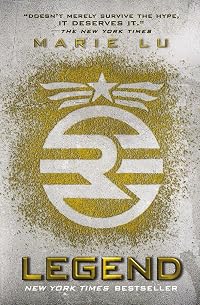
On This Page
Description
In a dark future, when North America has split into two warring nations, fifteen-year-olds Day, a famous criminal, and prodigy June, the brilliant soldier hired to capture him, discover that they have a common enemy.Tags
Recommendations





Member Recommendations

Member Reviews
**minor spoilers**
I really enjoyed the first third of this book. It is quick to read, I liked the different perspectives, the world building wasn't totally established or understood to me but that I could let it go, the pacing was pretty good, and, even though I already kind of knew where it was going to go, I was excited to read along. We've met the main characters, got some of their background, established their personalities, and some big things happened to move the plot along.
Last night, I abandoned it at about 43%. I am actually pretty disappointed in that, but neither could I read any more, and it's due to one big flaw that influenced everything else. It basically has all the same problems as the Daughter of Xanadu series (see my show more review on the first two books from that series to see my thoughts on that). It mimics the problems in that series so well that if I didn't know any better I'd say they were written by the same person, or at least that the Legend author was heavily influenced by the Xanadu author.
At about a third of the way through, the Girl (June) and Boy (Day) meet, and it starts to make absolutely no sense.
June and Day fall in love instantly. And, I mean /instantly/. Within hours of meeting, they are swooningly lovesick for each other for absolutely no reason and promptly fall completely out of character as a result. It's like the first third of the book never happened where establishing their personalities is concerned. I get the whole "love at first sight" thing, but this isn't that. And, even if it arguably were, it can't be used as a way to explain away what these characters are doing because their personalities do not support any of it happening, nor does the story need for this to happen. So, it also means that we must also embrace the "love is blind" platitude and the "love trumps all" platitude to explain away all this, especially when June isn't really even in love with Day because all she talks about is physical stuff. Sorry, but no. The romance /might/ have been okay, but it was not essential to the plot and it needed time to feel natural, rather than forced. I mean, my God! This is a series! Why the rush to fall in love within a few pages? The pacing was very good up until then. The whole first book could have been used as a natural way to develop feelings of love and trust in June and Day, but three pages after the street fight suddenly they are in love. It was very jarring and bizarre, particularly because they also start talking as though they have known the other for years ("hehe, oh, look, we are already an old married couple!") and have each other figured out, but they don't know ANYTHING about each other. You cannot convince me two characters are madly in love when they don't even know the basics about each other.
The love is contrived and obviously generated a mechanism for the book because we know eventually June will figure out who Day is and that he killed her brother and then drama can occur. But, I do not think they have to have a contrived romance for that to be dramatic and meaningful. Being street pals, like the camaraderie soldiers experience in war, would have been quite enough for the reveal of betrayal to be monumental (the fact that June is pretty slow on the pickup here is another issue and likely would not have happened if they hadn't "fallen in love"--more on that later when I talk about how this doesn't fit with their personalities).
It reads like the author wanted things to be true about her characters, so she just wrote thoughts inside the characters' heads as though they were already true. Insisting that something is true because a character thinks it does not make it true for the reader if you have no actual circumstances to support it all, particularly if you are also ignoring the first third of your own book.
As a result of the "romance," all of the dialog painful. I rapidly lost all respect for both June and Day. I began to feel really sorry for Tess (who is in love with Day) and Thomas (who is in love with June). Pretty sure they are both going to get hurt emotionally or even possibly killed altogether in this web. Worst of all, this "romance" starts to take over the whole plot of the book--it is basically a completely different story. It just makes no sense.
More specifically, I have a few other problems with it that require a little more explanation:
After meeting each other, June and Day both seem to have lost all common sense and sense of self. Their personalities totally change in ways that to not behoove either of them or their goals. People like Day and June do not lose themselves that easily, and it would be completely out of character for them to do it so quickly. Maybe, after a long time, it could happen, but the author was in too much of a rush for it to happen naturally because she was convinced their romance is essential to the plot.
Let's look at Day. For him, it's a matter of survival and he's constantly talking about how careful he is with his acquaintances, including Tess, because his identity being kept secret is vital. And that's not even talking about his family, who is also protected by having no clue he's alive (with the exception of his older brother, who does know). I just don't believe that Day would be so careless when it could cost not only him and Tess their lives, but his remaining family their lives, too. He wouldn't let someone, even someone who saved Tess (also convenient!), into his circle of trust so easily or trust her so implicitly, and he would be too wary to fall in love with her without having any idea who she really is. And that is another issue: I don't believe that Day would think that June "is not cynical or jaded." JUNE IS NOTHING BUT THOSE THINGS!! That is about when I almost threw the book across the room and gave up. I know, it could be argued that June is pretending to be someone else and could come off as those things, but Day is too street-smart to fall for that, I am pretty sure he has enough experience to see through it all, and June is just not that good of an actress (and, even if that is what the author is trying to do, we know too much about June as the reader for it to be convincing--very similar to some issues I had with Divergent--see my review on that for more info). Further, I don't believe at all that street-smart Day would have said things to himself like, "The Girl has been on the streets as long as me." REALLY?? Why does he even think that? Yes, June did a pretty good job with her outfit (she got accidentally dirty, which was the most convincing part of her outfit!), but she has really not proven herself in any way that would earn her that kind of street cred from a guy like Day (except that she managed to win a street fight, though she did that using moves that a savvy guy like Day should have known immediately were military! I just... ughhhhhhhhh).
Let's look at June. She has no reason to immediately fall in love with a street urchin and, so far, she seems only to be attracted to him physically, which means it feels disingenuous because she talks like she is in love with him, but can really only talk about how physically attracted she is to him. That is not love. I don't believe at all that June could have so perfectly executed being a street-urchin. June is very smart, but for some reason the author seems to be using this as carte blanche to make June know and do everything perfectly, even things that have nothing to do with being intellectually smart or quick-witted. Being book smart does not mean you are street smart, first of all. June is a pampered rich girl who has suffered some tragedy where her family is concerned, but that in no way makes me believe she could be a spy inside the street urchin community and figure out how to do that all by herself. Further, I do not believe that Jameson would rely on her so heavily and place all the weight of this on a spoiled teenaged girl. And, while I don't believe that June would be as street-smart as she suddenly is, neither do I believe that June would be too stupid to figure out that the Boy is Day.
Like I said, this book had promise, but it went in a direction that made absolutely no sense to me and made it painful to read. I can sometimes suspend actual reality, but I refuse to suspend a reality that the author herself created and then ignores. show less
I really enjoyed the first third of this book. It is quick to read, I liked the different perspectives, the world building wasn't totally established or understood to me but that I could let it go, the pacing was pretty good, and, even though I already kind of knew where it was going to go, I was excited to read along. We've met the main characters, got some of their background, established their personalities, and some big things happened to move the plot along.
Last night, I abandoned it at about 43%. I am actually pretty disappointed in that, but neither could I read any more, and it's due to one big flaw that influenced everything else. It basically has all the same problems as the Daughter of Xanadu series (see my show more review on the first two books from that series to see my thoughts on that). It mimics the problems in that series so well that if I didn't know any better I'd say they were written by the same person, or at least that the Legend author was heavily influenced by the Xanadu author.
At about a third of the way through, the Girl (June) and Boy (Day) meet, and it starts to make absolutely no sense.
June and Day fall in love instantly. And, I mean /instantly/. Within hours of meeting, they are swooningly lovesick for each other for absolutely no reason and promptly fall completely out of character as a result. It's like the first third of the book never happened where establishing their personalities is concerned. I get the whole "love at first sight" thing, but this isn't that. And, even if it arguably were, it can't be used as a way to explain away what these characters are doing because their personalities do not support any of it happening, nor does the story need for this to happen. So, it also means that we must also embrace the "love is blind" platitude and the "love trumps all" platitude to explain away all this, especially when June isn't really even in love with Day because all she talks about is physical stuff. Sorry, but no. The romance /might/ have been okay, but it was not essential to the plot and it needed time to feel natural, rather than forced. I mean, my God! This is a series! Why the rush to fall in love within a few pages? The pacing was very good up until then. The whole first book could have been used as a natural way to develop feelings of love and trust in June and Day, but three pages after the street fight suddenly they are in love. It was very jarring and bizarre, particularly because they also start talking as though they have known the other for years ("hehe, oh, look, we are already an old married couple!") and have each other figured out, but they don't know ANYTHING about each other. You cannot convince me two characters are madly in love when they don't even know the basics about each other.
The love is contrived and obviously generated a mechanism for the book because we know eventually June will figure out who Day is and that he killed her brother and then drama can occur. But, I do not think they have to have a contrived romance for that to be dramatic and meaningful. Being street pals, like the camaraderie soldiers experience in war, would have been quite enough for the reveal of betrayal to be monumental (the fact that June is pretty slow on the pickup here is another issue and likely would not have happened if they hadn't "fallen in love"--more on that later when I talk about how this doesn't fit with their personalities).
It reads like the author wanted things to be true about her characters, so she just wrote thoughts inside the characters' heads as though they were already true. Insisting that something is true because a character thinks it does not make it true for the reader if you have no actual circumstances to support it all, particularly if you are also ignoring the first third of your own book.
As a result of the "romance," all of the dialog painful. I rapidly lost all respect for both June and Day. I began to feel really sorry for Tess (who is in love with Day) and Thomas (who is in love with June). Pretty sure they are both going to get hurt emotionally or even possibly killed altogether in this web. Worst of all, this "romance" starts to take over the whole plot of the book--it is basically a completely different story. It just makes no sense.
More specifically, I have a few other problems with it that require a little more explanation:
After meeting each other, June and Day both seem to have lost all common sense and sense of self. Their personalities totally change in ways that to not behoove either of them or their goals. People like Day and June do not lose themselves that easily, and it would be completely out of character for them to do it so quickly. Maybe, after a long time, it could happen, but the author was in too much of a rush for it to happen naturally because she was convinced their romance is essential to the plot.
Let's look at Day. For him, it's a matter of survival and he's constantly talking about how careful he is with his acquaintances, including Tess, because his identity being kept secret is vital. And that's not even talking about his family, who is also protected by having no clue he's alive (with the exception of his older brother, who does know). I just don't believe that Day would be so careless when it could cost not only him and Tess their lives, but his remaining family their lives, too. He wouldn't let someone, even someone who saved Tess (also convenient!), into his circle of trust so easily or trust her so implicitly, and he would be too wary to fall in love with her without having any idea who she really is. And that is another issue: I don't believe that Day would think that June "is not cynical or jaded." JUNE IS NOTHING BUT THOSE THINGS!! That is about when I almost threw the book across the room and gave up. I know, it could be argued that June is pretending to be someone else and could come off as those things, but Day is too street-smart to fall for that, I am pretty sure he has enough experience to see through it all, and June is just not that good of an actress (and, even if that is what the author is trying to do, we know too much about June as the reader for it to be convincing--very similar to some issues I had with Divergent--see my review on that for more info). Further, I don't believe at all that street-smart Day would have said things to himself like, "The Girl has been on the streets as long as me." REALLY?? Why does he even think that? Yes, June did a pretty good job with her outfit (she got accidentally dirty, which was the most convincing part of her outfit!), but she has really not proven herself in any way that would earn her that kind of street cred from a guy like Day (except that she managed to win a street fight, though she did that using moves that a savvy guy like Day should have known immediately were military! I just... ughhhhhhhhh).
Let's look at June. She has no reason to immediately fall in love with a street urchin and, so far, she seems only to be attracted to him physically, which means it feels disingenuous because she talks like she is in love with him, but can really only talk about how physically attracted she is to him. That is not love. I don't believe at all that June could have so perfectly executed being a street-urchin. June is very smart, but for some reason the author seems to be using this as carte blanche to make June know and do everything perfectly, even things that have nothing to do with being intellectually smart or quick-witted. Being book smart does not mean you are street smart, first of all. June is a pampered rich girl who has suffered some tragedy where her family is concerned, but that in no way makes me believe she could be a spy inside the street urchin community and figure out how to do that all by herself. Further, I do not believe that Jameson would rely on her so heavily and place all the weight of this on a spoiled teenaged girl. And, while I don't believe that June would be as street-smart as she suddenly is, neither do I believe that June would be too stupid to figure out that the Boy is Day.
Like I said, this book had promise, but it went in a direction that made absolutely no sense to me and made it painful to read. I can sometimes suspend actual reality, but I refuse to suspend a reality that the author herself created and then ignores. show less
Legend is one of the best young adult distopian novels I have read in a long while! Ms. Lu's writing is clear and precise without unnecessary flowery details or romantic illusions, but it still paints a detailed picture of a Society with too much control. The story is told equally from the girl's and the boy's perspectives, which allows you to see the Society from the eyes of those within and those without. I found the characters to be beautifully crafted, their imperfections shining through, making them extraordinarily relatable. For young adults, I also liked the realistic way the author handled the relationship between the main characters. Although the boy has beautiful eyes, the girl doesn't automatically give up everything she show more believed in her whole life taking his word at face value. She is highly intelligent, careful with her trust, and takes time to work everything out. I recommend this book to anyone, especially those looking for strong independent characters (a.k.a. those tired of the Bella must listen to all the men in her life and do anything for the boy who sparkles simply because he sparkles Twilight problem)!! I cannot wait for the next in the series!! show less
I devoured this futuristic dystopian young adult novel by debut author Marie Lu. I was lucky enough to snag an ARC of this book from Library Thing Early Reviewers. (The book will be out November 29, 2011.)
"Legend" is told in alternating perspectives between Day, the country's most wanted criminal, and June, a wealthy military prodigy. June makes it her personal mission to capture Day after he is wanted for the murder of her older brother.
Lu creates an eerily believable dystopian society. We've got a sinister dictatorship, an endless war, gritty scenes of slums and street fights, and nasty plagues wreaking havoc all across the known land. Because Day and June are on complete opposite sides - Day having been born in a poor sector, and show more June growing up with every possible advantage - we get two entirely different perspectives of the same world.
What I love reading about dystopian literature is getting to explore just how that particular got to be the way it is. Even if the novel doesn't answer all of my questions - which they usually don't - I still spend a lot of time thinking about them. And I wonder how easily our society could end up like theirs.
Even though there is no direct mention in "Legend," there are two distinct social classes: the poor and the wealthy. There is no middle class. Nothing exists in-between. You're either rich or you're suffering in a poor sector where the government treats you like garbage. This is quite scary to me if you look at how our own middle class in America is shrinking. I don't know if Lu created her Republic with the particular intention of making social commentary, but it has sufficiently creeped me out and got me thinking a lot about how powerless social class can make a person in regards to how their life is decided for them. This may seem crazy obvious to you. But I'm not just talking about in the case of people like Day, who was poor his entire life and is living on the streets when we first meet him in the first chapter. But it's also constricting for June. Even though she has had every need taken care of for her AND has her rare natural intelligence and abilities to rely on, she is just a victim of her society's control as anyone else.
Okay, tangent over.
I blew through the action-packed "Legend" pretty quickly. Lu's writing is vivid and crisp and she doesn't pull any cheap tricks that make the story feel weak or shifty. She doesn't ever tip her hand, and only reveals what is necessary WHEN it is necessary. There are no meandering pages of description or unnecessary dialogue. I also enjoyed her natural way of weaving in local slang without overdoing it. The world-building is so subtle and natural. Still, I hope to get an even deeper understanding in future installments, because there's plenty to explore in this world.
The ending felt a bit abrupt to me (and something that was important to me was ultimately shrugged off as if it never mattered), but all the larger loose ends are tied up enough for the story to be self-contained. I'm eager for the next book to see just how crazy this shiz can get.
The only thing that REALLY bothered me was that Day's sections of the novel were written in a different font and in a goldenrod color. This adds nothing to the story, as it is that way for no reason that I could discern. It only seems to be there to let me know: OH HEY, DAY IS TALKING NOW, PAY ATTENTION. I've read books with alternating viewpoints before. I get how this works, now let me read. The font issue only ended up making me feel as if I needed the publisher to hold my hand as I read the book. Plus it hurt my eyes, especially when things got really intense and I just wanted to read fast.
Nit-picking aside, this was an engaging and entertaining read that I'd recommend to fans of the young adult dystopian genre. Also, I'm going to keep my eyes on Marie Lu's writing career. show less
"Legend" is told in alternating perspectives between Day, the country's most wanted criminal, and June, a wealthy military prodigy. June makes it her personal mission to capture Day after he is wanted for the murder of her older brother.
Lu creates an eerily believable dystopian society. We've got a sinister dictatorship, an endless war, gritty scenes of slums and street fights, and nasty plagues wreaking havoc all across the known land. Because Day and June are on complete opposite sides - Day having been born in a poor sector, and show more June growing up with every possible advantage - we get two entirely different perspectives of the same world.
What I love reading about dystopian literature is getting to explore just how that particular got to be the way it is. Even if the novel doesn't answer all of my questions - which they usually don't - I still spend a lot of time thinking about them. And I wonder how easily our society could end up like theirs.
Even though there is no direct mention in "Legend," there are two distinct social classes: the poor and the wealthy. There is no middle class. Nothing exists in-between. You're either rich or you're suffering in a poor sector where the government treats you like garbage. This is quite scary to me if you look at how our own middle class in America is shrinking. I don't know if Lu created her Republic with the particular intention of making social commentary, but it has sufficiently creeped me out and got me thinking a lot about how powerless social class can make a person in regards to how their life is decided for them. This may seem crazy obvious to you. But I'm not just talking about in the case of people like Day, who was poor his entire life and is living on the streets when we first meet him in the first chapter. But it's also constricting for June. Even though she has had every need taken care of for her AND has her rare natural intelligence and abilities to rely on, she is just a victim of her society's control as anyone else.
Okay, tangent over.
I blew through the action-packed "Legend" pretty quickly. Lu's writing is vivid and crisp and she doesn't pull any cheap tricks that make the story feel weak or shifty. She doesn't ever tip her hand, and only reveals what is necessary WHEN it is necessary. There are no meandering pages of description or unnecessary dialogue. I also enjoyed her natural way of weaving in local slang without overdoing it. The world-building is so subtle and natural. Still, I hope to get an even deeper understanding in future installments, because there's plenty to explore in this world.
The ending felt a bit abrupt to me (and something that was important to me was ultimately shrugged off as if it never mattered), but all the larger loose ends are tied up enough for the story to be self-contained. I'm eager for the next book to see just how crazy this shiz can get.
The only thing that REALLY bothered me was that Day's sections of the novel were written in a different font and in a goldenrod color. This adds nothing to the story, as it is that way for no reason that I could discern. It only seems to be there to let me know: OH HEY, DAY IS TALKING NOW, PAY ATTENTION. I've read books with alternating viewpoints before. I get how this works, now let me read. The font issue only ended up making me feel as if I needed the publisher to hold my hand as I read the book. Plus it hurt my eyes, especially when things got really intense and I just wanted to read fast.
Nit-picking aside, this was an engaging and entertaining read that I'd recommend to fans of the young adult dystopian genre. Also, I'm going to keep my eyes on Marie Lu's writing career. show less
 This review was written for LibraryThing Early Reviewers.
I remember when Legend came out and people were raving about how awesome it was. The hype was so much that when Marie Lu went to the LA Festival of Books to sell signed copies, I stopped by her booth just so I could read it and see what the raving was all about. Of course, I’m terrible at reading books right away since my to-read list is ridiculously long, so now, years later, I am finally getting to see what the hype is all about.
Legend is yet another YA dystopia, this time in a world with a militaristic/war focus rather than an we-are-a-perfect-society focus. People who are born into wealthy families are groomed for the military so they can help in the Republic’s fight against the Colonies. June is a military prodigy — she’s show more smart, athletic, and can think outside the box, and is being groomed for a distinguished military career. She goes on the hunt for Day — who is also smart, athletic, and can think outside the box — the Republic’s most wanted criminal who grew up in a poor district in the Republic.
When Day allegedly commits a crime that hits home for June, she goes on the hunt for him to bring him to justice. What ends up happening is that they both learn a little bit more about what’s really going on behind the closed doors of the Republic.
This book is just straight enjoyable. I love that Lu kept it simple in terms of creating her world: no factions or groups for people to be sorted into, just poor and rich; military and civilian. Because of this, I think this book gives quite an amazing commentary on society in general in terms of how poverty is viewed and taken advantage of, and how people suffer under such strict hierarchical structures.
The conflicts within this world are revealed slowly — no information dumps!!! I enjoyed that I slowly got introduced to the complexities of the government and of what went on behind closed doors. I feel like this is the main reason why I enjoyed Legend. There’s an inherent conflict and pull in trying to figure out what exactly is going on with this dystopia — when the plot needed to stop for character development, I was pulled forward by what I wanted to know about this new world.
However, this book is fairly predictable — I don’t think there was one twist that I didn’t see coming. Also, I have a pet peeve about people being in a life-or-death situation, yet romance seems to be a priority. I get the whole young adult romance angle, but it bothers me, especially from characters who are supposed to be super intelligent, even if they are young.
With that said, I still thoroughly enjoyed the narrative of the book. It’s perfect amounts of tragic and heartwarming and I am very much looking forward to reading the sequels to see what exactly is going on with all the war stuff. I’d recommend this book for any dystopia lover. It’s not the best book I’ve ever read, but it’s certainly better than many other dystopias out there.
Originally posted on Going on to the Next. show less
Legend is yet another YA dystopia, this time in a world with a militaristic/war focus rather than an we-are-a-perfect-society focus. People who are born into wealthy families are groomed for the military so they can help in the Republic’s fight against the Colonies. June is a military prodigy — she’s show more smart, athletic, and can think outside the box, and is being groomed for a distinguished military career. She goes on the hunt for Day — who is also smart, athletic, and can think outside the box — the Republic’s most wanted criminal who grew up in a poor district in the Republic.
When Day allegedly commits a crime that hits home for June, she goes on the hunt for him to bring him to justice. What ends up happening is that they both learn a little bit more about what’s really going on behind the closed doors of the Republic.
This book is just straight enjoyable. I love that Lu kept it simple in terms of creating her world: no factions or groups for people to be sorted into, just poor and rich; military and civilian. Because of this, I think this book gives quite an amazing commentary on society in general in terms of how poverty is viewed and taken advantage of, and how people suffer under such strict hierarchical structures.
The conflicts within this world are revealed slowly — no information dumps!!! I enjoyed that I slowly got introduced to the complexities of the government and of what went on behind closed doors. I feel like this is the main reason why I enjoyed Legend. There’s an inherent conflict and pull in trying to figure out what exactly is going on with this dystopia — when the plot needed to stop for character development, I was pulled forward by what I wanted to know about this new world.
However, this book is fairly predictable — I don’t think there was one twist that I didn’t see coming. Also, I have a pet peeve about people being in a life-or-death situation, yet romance seems to be a priority. I get the whole young adult romance angle, but it bothers me, especially from characters who are supposed to be super intelligent, even if they are young.
With that said, I still thoroughly enjoyed the narrative of the book. It’s perfect amounts of tragic and heartwarming and I am very much looking forward to reading the sequels to see what exactly is going on with all the war stuff. I’d recommend this book for any dystopia lover. It’s not the best book I’ve ever read, but it’s certainly better than many other dystopias out there.
Originally posted on Going on to the Next. show less
First sentence: My mother thinks I'm dead. Obviously I'm not dead, but it's safer for her to think so. At least twice a month, I see my Wanted poster flashed on the JumboTrons scattered throughout downtown Los Angeles. It looks out of place up there. Most of the pictures on the screens are of happy things: smiling children standing under a bright blue sky, tourists posting before the Golden Gate Ruins, Republic commercials in neon colors. There's also anti-Colonies propaganda. "The colonies want our land," the ads declare. "They want what they don't have. Don't let them conquer your homes! Support the cause!"
Premise/plot: Legend is YA dystopia. The novel has two narrators: a guy named Day (Daniel) and a girl named June. Both underwent show more the "trials" at age 10. June received a perfect, perfect score earning her not only the right to higher education (high school and college) but the right to the best education possible, the kind of education that will prepare her for serving the Republic. Day, well, he didn't pass his trials. And like all other low-scoring 10 year olds, he was sent away to labor camp. Once a 10 year old is sent to labor camp, they're never ever heard from again.
When the novel opens, both teens are about 15. Day is a wanted criminal, an outlaw. He doesn't legally exist in the Republic database, in the Republic records. The authorities don't even know what he looks like--what race or ethnicity he may be. So their wanted posters change quite often allowing for every possibility. (It's the occasional finger print on the crime scene that links Day to particular crimes.) Day is in Los Angeles spying on his family. His older brother, John, is the only one in the neighborhood who still knows he's alive. And it is to John he delivers gifts--food, clothes, medicine, money, etc. Day becomes worried when his family's home is marked with a red X--a symbol that someone within the home has the plague. This is very bad news indeed.
June, on the other hand, is at the top of her class. Though she's just fifteen, she's almost finished with her training, her education. June is anxious to start working for the Republic, to start serving in the military, to start tracking down criminals like Day. Her wish comes true--but not in the way she expected. She wanted to start working with her older brother, Metias. Instead, she takes his place after he is murdered. And it appears that Day is the one responsible for his stabbing. Metias was trying to stop Day from escaping from the hospital after a break in. (Day was hoping to find plague cures for his family.) June is on a mission, and it is personal. She'll track down Day and bring him to justice no matter what.
My thoughts: The chapters alternate in narrators, and for once I think this is a great idea. Usually, I'm not a big fan of this in novels, but in this case, it not only works, it works well! I was able to care about Day and June--almost from the start!
Legend is action-packed. It's an intense read. But an enjoyable one! I'd definitely recommend it!!!
I first read this one in June of 2011. I reread it in August of 2024. show less
Premise/plot: Legend is YA dystopia. The novel has two narrators: a guy named Day (Daniel) and a girl named June. Both underwent show more the "trials" at age 10. June received a perfect, perfect score earning her not only the right to higher education (high school and college) but the right to the best education possible, the kind of education that will prepare her for serving the Republic. Day, well, he didn't pass his trials. And like all other low-scoring 10 year olds, he was sent away to labor camp. Once a 10 year old is sent to labor camp, they're never ever heard from again.
When the novel opens, both teens are about 15. Day is a wanted criminal, an outlaw. He doesn't legally exist in the Republic database, in the Republic records. The authorities don't even know what he looks like--what race or ethnicity he may be. So their wanted posters change quite often allowing for every possibility. (It's the occasional finger print on the crime scene that links Day to particular crimes.) Day is in Los Angeles spying on his family. His older brother, John, is the only one in the neighborhood who still knows he's alive. And it is to John he delivers gifts--food, clothes, medicine, money, etc. Day becomes worried when his family's home is marked with a red X--a symbol that someone within the home has the plague. This is very bad news indeed.
June, on the other hand, is at the top of her class. Though she's just fifteen, she's almost finished with her training, her education. June is anxious to start working for the Republic, to start serving in the military, to start tracking down criminals like Day. Her wish comes true--but not in the way she expected. She wanted to start working with her older brother, Metias. Instead, she takes his place after he is murdered. And it appears that Day is the one responsible for his stabbing. Metias was trying to stop Day from escaping from the hospital after a break in. (Day was hoping to find plague cures for his family.) June is on a mission, and it is personal. She'll track down Day and bring him to justice no matter what.
My thoughts: The chapters alternate in narrators, and for once I think this is a great idea. Usually, I'm not a big fan of this in novels, but in this case, it not only works, it works well! I was able to care about Day and June--almost from the start!
Legend is action-packed. It's an intense read. But an enjoyable one! I'd definitely recommend it!!!
I first read this one in June of 2011. I reread it in August of 2024. show less
I've dreamt about being like Day and June since forever.
THINGS I LIKE:
- Day. Absolutely the star of the story. And well, I always have a thing for lethal boy with tragic backstory. Day is loyal and brave and smart and a little bit, uhm, sly? (Wow he has the traits of all four Hogwarts houses). What I love the most about him is that although he seems like a threat to the Republic, with his skills and all those stuffs, he's actually a soft, sensitive boy who just wants to protect those whom he cares about. A pretty interesting protagonist.
- June. I WANT TO BE LIKE HER: to be observant and intelligent enough to pick out the smallest details. Really one of the reason I decided to instantly like these characters is that they're so smart, and show more like I said I've dreamt about being like them since forever. When I was little I always wanted to be a detective or secret agent or something. Surprise people with my intelligence despite my young age. So of course it doesn't take so much to make me fall in love with the characters and the story. Back to June, I like how Marie Lu writes about her emotions, with everything she had to go carry on her shoulder.
- The setting is very important to a dystopian novel, as always. And even though it's nothing new, I still love what Marie Lu created. Simple, yes, but it worked.
- The plot. I'm scrolling through the reviews on Goodreads as I write this, and most of the negative things people had said about the books was the plot being predictable. I didn't think much when I read it, but yeah, with all the movies about apocalypses, books about a society going downhill, I understand that people can find the plot of Legend unoriginal. I don't mind though, I still love it.
- The actions. Of course. Legend was packed with fight scenes and escapade scenes. One more reason why I can easily love this book, and with where the book left off at, I hope the second book would be even more action-packed, and I especially hope the Patriots and/or Day and June would do something, create some rebel to fight back!
THINGS I DON'T LIKE:
- The romance. Too fast, normal people wouldn't develop an emotional connection between each other that quickly, even with the situation like Day and June were in. If only the author gave them some more moments, some stories, something, to make the relationship between Day and June more believable. What a shame though, because otherwise I think this book could be in my list of favorites. show less
THINGS I LIKE:
- Day. Absolutely the star of the story. And well, I always have a thing for lethal boy with tragic backstory. Day is loyal and brave and smart and a little bit, uhm, sly? (Wow he has the traits of all four Hogwarts houses). What I love the most about him is that although he seems like a threat to the Republic, with his skills and all those stuffs, he's actually a soft, sensitive boy who just wants to protect those whom he cares about. A pretty interesting protagonist.
- June. I WANT TO BE LIKE HER: to be observant and intelligent enough to pick out the smallest details. Really one of the reason I decided to instantly like these characters is that they're so smart, and show more like I said I've dreamt about being like them since forever. When I was little I always wanted to be a detective or secret agent or something. Surprise people with my intelligence despite my young age. So of course it doesn't take so much to make me fall in love with the characters and the story. Back to June, I like how Marie Lu writes about her emotions, with everything she had to go carry on her shoulder.
- The setting is very important to a dystopian novel, as always. And even though it's nothing new, I still love what Marie Lu created. Simple, yes, but it worked.
- The plot. I'm scrolling through the reviews on Goodreads as I write this, and most of the negative things people had said about the books was the plot being predictable. I didn't think much when I read it, but yeah, with all the movies about apocalypses, books about a society going downhill, I understand that people can find the plot of Legend unoriginal. I don't mind though, I still love it.
- The actions. Of course. Legend was packed with fight scenes and escapade scenes. One more reason why I can easily love this book, and with where the book left off at, I hope the second book would be even more action-packed, and I especially hope the Patriots and/or Day and June would do something, create some rebel to fight back!
THINGS I DON'T LIKE:
- The romance. Too fast, normal people wouldn't develop an emotional connection between each other that quickly, even with the situation like Day and June were in. If only the author gave them some more moments, some stories, something, to make the relationship between Day and June more believable. What a shame though, because otherwise I think this book could be in my list of favorites. show less
In post-apocalyptic-America, the center of the country is no man's land and there are two warring factions: the Republic (the haves) and the Patriots (the have-nots). Day is a Patriot fighting against an unjust, unfeeling Republic. Jane is an exemplary Republic soldier commissioned to hunt him down. In addition to the political struggles, a virulent plague has broken out in the Patriot quarters. When Day allegedly kills Jane's brother, their worlds collide. Real and figurative sparks fly as Jane and Day realize their mutual feelings and their --surprising--common purpose. Fast-paced action with a great romance to boot.
Members
- Recently Added By
Lists

Best Dystopias
280 works; 277 members

SLJ's 100 Must-Have YA books
36 works; 2 members

Unbound Worlds 100 Best SF Books
100 works; 8 members

Booktok Books
69 works; 8 members

Biggest Disappointments
606 works; 168 members

Alternate Americas
15 works; 7 members

Read in 2014
334 works; 11 members

Children's and YA Dystopias
123 works; 11 members

Dishonourable Mentions of 2014
80 works; 23 members

Books Read in 2016
4,666 works; 197 members
Books Read in 2022
5,226 works; 115 members

Books recommended by Calgary Public Library staff
1,588 works; 4 members
Talk Discussions
Past Discussions
Action/Adventure A boy named "Day" in Name that Book (November 2013)
Author Information

55+ Works 32,605 Members
Marie Lu received an undergraduate degree from the University of Southern California. Before becoming a full-time author, she worked for Disney Interactive Studios as a flash artist. Her works include the Legend Trilogy and the Young Elites series. Book 1 of her Young Elites (same name) series made the New York Times bestseller list. (Bowker show more Author Biography) show less
Awards and Honors
Awards
Distinctions
Notable Lists
Series

Work Relationships
Is contained in
Common Knowledge
- Original publication date
- 2011-11-29
- People/Characters
- June Iparis; Daniel Altan Wing; Metias Iparis; Thomas; Commander Jameson; Tess (show all 10); Kaede; Chian; John Wing; Eden Wing
- Important places
- The Republic
- Related movies
- Legend (2013 | IMDb)
- Dedication
- "For My Mother"
- First words
- My mother thinks I'm dead. Obviously I'm not dead, but it's safer for her to think so.
- Last words
- (Click to show. Warning: May contain spoilers.)We lie there together, watching the lightning and listening to the thunder, and waiting for the beginning of a rainy dawn.
- Publisher's editor
- Besser, Jennifer
- Blurbers
- Brennan, Sarah Rees; Garcia, Kami
- Original language
- English
- Canonical DDC/MDS
- 813.6
- Canonical LCC
- PZ7.L96768
- Disambiguation notice
- Not part of the Claudy Conn Legend series.
Classifications
- Genres
- Teen, Fiction and Literature, Young Adult, Science Fiction
- DDC/MDS
- 813.6 — Literature & rhetoric American literature in English American fiction in English 2000-
- LCC
- PZ7 .L96768 — Language and Literature Fiction and juvenile belles lettres Fiction and juvenile belles lettres Juvenile belles lettres
- BISAC
Statistics
- Members
- 8,103
- Popularity
- 1,385
- Reviews
- 396
- Rating
- (3.92)
- Languages
- 17 — Catalan, Czech, Danish, Dutch, English, Estonian, French, German, Hungarian, Italian, Korean, Polish, Spanish, Swedish, Turkish, Vietnamese, Portuguese (Portugal)
- Media
- Paper, Audiobook, Ebook
- ISBNs
- 59
- ASINs
- 8
