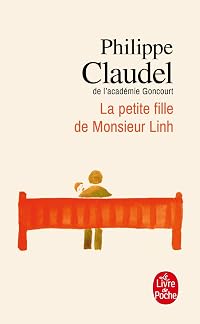
Monsieur Linh and His Child
by Philippe Claudel
On This Page
Description
Traumatized by memories of his war-ravaged country, and with his son and daughter-in-law dead, Monsieur Linh travels to a foreign land to bring the child in his arms to safety. The other refugees in the detention centre are unsure how to help the old man; his caseworkers are compassionate, but overworked. Monsieur Linh struggles beneath the weight of his sorrow, and becomes increasingly bewildered and isolated in this unfamiliar, fast-moving town. And then he encounters Monsieur Bark. They show more do not speak each other's language, but Monsieur Bark is sympathetic to the foreigner's need to care for the child. Recently widowed and equally alone, he is eager to talk, and Monsieur Linh knows how to listen. The two men share their solitude, and find friendship in an unlikely dialogue between two very different cultures. Monsieur Linh and His Child is a remarkable novel with an extraordinary twist, a subtle portrait of friendship and a dialogue between two cultures. show lessTags
Recommendations

























Member Recommendations
by gust


Member Reviews
This is a haunting book that will stay with me. Monsieur Linh is in an unnamed country, living in a refugee centre for those who have, like him, fled on an elderly ship from his homeland which has become a war zone - surely Vietnam? His memories of home conjure up an east Asian destination in any case. His family members have all been killed - except for his baby granddaughter, whom he keeps close and cares for every second of the day and night. One one of his daily wanderings, he meets Monsieur Bark, similarly lonely and isolated since the death of his wife, and the two men, despite having no shared language, develop a deep bond of friendship. Then Monsieur Linh has to be re-homed ... This is a restrained and simply told story, which show more evokes a compelling picture of a gentle man, deeply traumatised by the loss not only of his community and family, but of his homeland, landscapes and daily rhythms. A compassionate, moving book, with an unexpected twist that reveals even more about the losses this elderly man has sustained. show less
WARNING: CONTAINS A SPOILER
This is not a simple story at all.
For a long time, I was puzzled by the title of this book. It is remarkable to see what translators have done with that, but after reading, it is my conclusion that there is no child at all.
Many reviews, here and elsewhere, refer to this short novel as a simple story. The prose is simple, and the story calls up an idealised nostalgia, both of the simple life style as we imagine it in Asia, and the apparent purity of the friendship between the two men.
However, I believe that simplicity is false, or rather, it is the product and expression on Monsieur Linh's mind. The reader is lured into believing this beautiful story through our sympathy for Mr Linh, as the opening and most of show more the story are seen through Mr Linh's eyes. Mr Linh is not the narrator, but the story is told, at least initially, from his point of view.
The simple-mindedness of Mr Linh is never made more explicit, than by the fact that he is locked up in a mental institution.
As the story progresses, the reader may gradually get the feeling that something is wrong about "the little girl". She never cries, we never hear anything else about her apart from Monsieur Linh's comments. She often does not eat, or not much. People smile tenderly, when Monsieur Linh dresses or cares for "the child". Is there a child? Why is "she" not separated from him, sent to school, surely an old man like Mr Linh could not take care of such a little child. In other reviews, it is suggested that Mr Linh is sent to a home for the elderly, but then how to reconcile the idea that "Sang Diû" is not separated from him. A child in a home for the elderly? The only logical conclusion is that there is only a child in the mind of Monsieur Linh, but not in the reality of the novel story. People acknowledge "Sang Diû" because they want to be nice to the old man. They smile, because he is holding .... a doll.
There is one other compelling suggestion that Monsieur Linh has lost his mind. In the book, we are told that Mr Linh knows about a spring outside his village. Villagers who know that they will die, drink the water from this well and hence forget all unpleasantness. Drinking this water will instantly erase all memories, leaving the mind peaceful, only the beautiful moments remain.
That is what is left of Monsieur Linh's mind. show less
This is not a simple story at all.
For a long time, I was puzzled by the title of this book. It is remarkable to see what translators have done with that, but after reading, it is my conclusion that there is no child at all.
Many reviews, here and elsewhere, refer to this short novel as a simple story. The prose is simple, and the story calls up an idealised nostalgia, both of the simple life style as we imagine it in Asia, and the apparent purity of the friendship between the two men.
However, I believe that simplicity is false, or rather, it is the product and expression on Monsieur Linh's mind. The reader is lured into believing this beautiful story through our sympathy for Mr Linh, as the opening and most of show more the story are seen through Mr Linh's eyes. Mr Linh is not the narrator, but the story is told, at least initially, from his point of view.
The simple-mindedness of Mr Linh is never made more explicit, than by the fact that he is locked up in a mental institution.
As the story progresses, the reader may gradually get the feeling that something is wrong about "the little girl". She never cries, we never hear anything else about her apart from Monsieur Linh's comments. She often does not eat, or not much. People smile tenderly, when Monsieur Linh dresses or cares for "the child". Is there a child? Why is "she" not separated from him, sent to school, surely an old man like Mr Linh could not take care of such a little child. In other reviews, it is suggested that Mr Linh is sent to a home for the elderly, but then how to reconcile the idea that "Sang Diû" is not separated from him. A child in a home for the elderly? The only logical conclusion is that there is only a child in the mind of Monsieur Linh, but not in the reality of the novel story. People acknowledge "Sang Diû" because they want to be nice to the old man. They smile, because he is holding .... a doll.
There is one other compelling suggestion that Monsieur Linh has lost his mind. In the book, we are told that Mr Linh knows about a spring outside his village. Villagers who know that they will die, drink the water from this well and hence forget all unpleasantness. Drinking this water will instantly erase all memories, leaving the mind peaceful, only the beautiful moments remain.
That is what is left of Monsieur Linh's mind. show less
Toen het uit was, kwamen bij mij ineens wat tranen los. Wat kan Philippe Claudel schrijven! Zo meevoelend, zo ingetogen. Het kwam flink aan bij mij. Misschien ook wel omdat ik jarenlang met asielzoekerskinderen heb gewerkt en gezien en gehoord heb wat mensen moeten verwerken; trauma's hebben en je dan aanpassen aan een nieuw land is moeilijk. Maar Claudel weet dit allemaal zo poëtisch te brengen, zo menselijk ook. Ik vind dit echt een heel mooi verhaal over verlies en vriendschap.
Monsieur Linh, an elderly widower in a small war-torn southeast Asian village in an unnamed country, escapes with his infant granddaughter Sang diû and other refugees to a large and impersonal city somewhere in western Europe. He and his child are initially placed in a dormitory room with two other families from his country, who treat the older man with minimal respect and disdain, as Linh trusts no one to watch over or come close to Sang diû, his most precious possession. Lost and culturally isolated in his new home, he eventually ventures outside, where he meets Monsieur Bart, a portly man who has lived in the city for years and is equally lonely, having recently and suddenly lost his wife just before they were set to retire. show more Despite their language differences the two men become close friends, spending most of their days with each other, until Linh and Sang diû are suddenly relocated to another part of town.
Monsieur Linh and His Child, originally published in French in 2005 and released in English translation earlier this year, is a haunting and beautiful novella about friendship and love. Linh and Bart, despite their cultural differences, share a sense of isolation and loneliness that is both unique and universal. The ethereal narrative enhances the atmosphere of the story, and Claudel's light but firm touch made this a book that I could not put down once I started it. Highly recommended! show less
Monsieur Linh and His Child, originally published in French in 2005 and released in English translation earlier this year, is a haunting and beautiful novella about friendship and love. Linh and Bart, despite their cultural differences, share a sense of isolation and loneliness that is both unique and universal. The ethereal narrative enhances the atmosphere of the story, and Claudel's light but firm touch made this a book that I could not put down once I started it. Highly recommended! show less
Translated from the French by Euan Cameron
“Sitting on this bench which, within the space of just two days, has become a familiar little spot, a chunk of floating wood he could cling to in the midst of a strange, broad, swirling torrent. And nestling cosily against him he clasps the last twig of the branch, sleeping its fearless sleep for the time being, without melancholy or sadness; that sleep of a satisfied infant, happy to have found the warmth of the skin it loves, its pleasant smoothness and the caress of a loving voice.”
Monsieur Linh has lost almost everything: his wife, his son, and even his city, as war has displaced him and made him a refugee in a French city. To his joy, he has one remaining connection to the past and a show more hope for the future: his infant granddaughter. Brought with him on the rough journey to France, his only concern is her safety and welfare. In the crowded refugee center, he quietly launders her baby clothes, holds her as she sleeps, and in his traditional garb, becomes an eccentric sight to the other visitors. During the day, he takes her out walking for fresh air.
“’I am your grandfather,’ Monsieur Linh tells her, ‘and we are together, there are two of us, the only two, the last two. But don’t be afraid, I am here, nothing can happen to you. I am old, but I’ll still have enough strength, as long as it is needed, as long as you are a little green mango in need of an old mango tree.’”
It’s on these walks that he finds the wood park bench described above, where he watches the city go by and tries to make sense of its foreign tongue. Soon he meets Monsieur Bark, another man beset by losses, and both find the bench to be their place to come to grips with their pasts and the uncertain future. They become virtually inseparable, despite the fact that neither of them can speak each other’s language. Theirs becomes a friendship made up of the language of nods, shared sighs, and companionship. And when difficult changes occur, this unique bond becomes unbreakable.
This is an impossibly elegant novel, one that makes you sort of wistful at the beauty of the words and their meaning. It’s only appropriate that this be an example of translated literature, because the translation of feelings, gestures and moods is at the heart of it, far beyond the translation of mere words. I actually (this is super corny) put it down and sighed a few times…it’s that gorgeous.
The author, Philippe Claudel, has crafted something that manages to combine melancholy and sentimentality without becoming mawkish. The writing is lean and powerful and each character retains a mystery. The mystery is what pushes you on to understand how each man will survive their loss, and how mysterious the nature of friendship can be. The novel asks the reader to examine what makes two people feel connected. Does loss leave a mark that only another kindred spirit can discern? Do the words we speak mean less than who we are? I couldn’t help but think that the story would be entirely different if the two men did share a language, and that Claudel may be commenting on how, very often, words can get in the way. show less
“Sitting on this bench which, within the space of just two days, has become a familiar little spot, a chunk of floating wood he could cling to in the midst of a strange, broad, swirling torrent. And nestling cosily against him he clasps the last twig of the branch, sleeping its fearless sleep for the time being, without melancholy or sadness; that sleep of a satisfied infant, happy to have found the warmth of the skin it loves, its pleasant smoothness and the caress of a loving voice.”
Monsieur Linh has lost almost everything: his wife, his son, and even his city, as war has displaced him and made him a refugee in a French city. To his joy, he has one remaining connection to the past and a show more hope for the future: his infant granddaughter. Brought with him on the rough journey to France, his only concern is her safety and welfare. In the crowded refugee center, he quietly launders her baby clothes, holds her as she sleeps, and in his traditional garb, becomes an eccentric sight to the other visitors. During the day, he takes her out walking for fresh air.
“’I am your grandfather,’ Monsieur Linh tells her, ‘and we are together, there are two of us, the only two, the last two. But don’t be afraid, I am here, nothing can happen to you. I am old, but I’ll still have enough strength, as long as it is needed, as long as you are a little green mango in need of an old mango tree.’”
It’s on these walks that he finds the wood park bench described above, where he watches the city go by and tries to make sense of its foreign tongue. Soon he meets Monsieur Bark, another man beset by losses, and both find the bench to be their place to come to grips with their pasts and the uncertain future. They become virtually inseparable, despite the fact that neither of them can speak each other’s language. Theirs becomes a friendship made up of the language of nods, shared sighs, and companionship. And when difficult changes occur, this unique bond becomes unbreakable.
This is an impossibly elegant novel, one that makes you sort of wistful at the beauty of the words and their meaning. It’s only appropriate that this be an example of translated literature, because the translation of feelings, gestures and moods is at the heart of it, far beyond the translation of mere words. I actually (this is super corny) put it down and sighed a few times…it’s that gorgeous.
The author, Philippe Claudel, has crafted something that manages to combine melancholy and sentimentality without becoming mawkish. The writing is lean and powerful and each character retains a mystery. The mystery is what pushes you on to understand how each man will survive their loss, and how mysterious the nature of friendship can be. The novel asks the reader to examine what makes two people feel connected. Does loss leave a mark that only another kindred spirit can discern? Do the words we speak mean less than who we are? I couldn’t help but think that the story would be entirely different if the two men did share a language, and that Claudel may be commenting on how, very often, words can get in the way. show less
In this short, but Oh, So Powerful novel, we follow Monsieur Linh's progress as he gets on a boat holding a small baby in his arms, as he leaves behind an un-named war-torn Asian country. His village has been decimated by bombs and all it's inhabitants killed, including his own son and daughter in law, though by some kind of miracle, Monsieur Linh's own baby granddaughter, only ten days old, has remained alive. Together they arrive in a French city where Monsieur Linh feels completely alienated; he doesn't understand the language, or why everyone is in such a hurry, or how anyone can live in such cold weather, nor why the food and the very air don't taste or smell like anything. Save for the perfect, silent little baby he cradles all show more day long, he feels profoundly lonely until one day, sitting on a bench, he encounters Monsieur Bark, another lonely soul who has just lost his beloved wife. Though neither man can understand the other, they form a special bond which transcends many barriers and gives them both great happiness.
This is an incredibly touching story about loss, grief, friendship and hope, and Claudel's prose is simply sublime. As such, the novel delivered quite an emotional impact, but the ending makes it a story one is likely never to forget. Most recommended. show less
This is an incredibly touching story about loss, grief, friendship and hope, and Claudel's prose is simply sublime. As such, the novel delivered quite an emotional impact, but the ending makes it a story one is likely never to forget. Most recommended. show less
Philippe Claudel's Monsieur Linh and his child is a wonderful, original and haunting study of an an elderly refugee from an unknown war torn country. His son and daughter-in-law have died in the war and he is left to care for their only child and his grand-daughter.
This a short book with only 130 pages and therefore not one sentence is wasted with unnecessary information. The remarkable story told within those 130 pages will stay with you long after you have finished the tale. Although I finished this book yesterday, I honestly cannot get the characters and story out of my head and find myself thinking about the story and analysing the places and characters.
I love how Claudel crafted the story and the mystery sense of time and place show more unknown, as we are not told the exact location and setting of the happenings within the story, we must work this out with clues that we are given throughout the story.
I enjoyed the fact that I had to think about this as I read the information given.
This is a book where the less said about it the better as the reader needs to go into this one blind in order to get the best from the book.
An exquisitely crafted short story, a book of beautiful prose and a very thought provoking read. show less
This a short book with only 130 pages and therefore not one sentence is wasted with unnecessary information. The remarkable story told within those 130 pages will stay with you long after you have finished the tale. Although I finished this book yesterday, I honestly cannot get the characters and story out of my head and find myself thinking about the story and analysing the places and characters.
I love how Claudel crafted the story and the mystery sense of time and place show more unknown, as we are not told the exact location and setting of the happenings within the story, we must work this out with clues that we are given throughout the story.
I enjoyed the fact that I had to think about this as I read the information given.
This is a book where the less said about it the better as the reader needs to go into this one blind in order to get the best from the book.
An exquisitely crafted short story, a book of beautiful prose and a very thought provoking read. show less
Members
- Recently Added By
Lists

Short and Sweet
243 works; 23 members

Five star books
1,755 works; 108 members

Llibres que he llegit el 2019
42 works; 1 member
Author Information

49+ Works 4,787 Members
Some Editions
Awards and Honors
Series
Belongs to Publisher Series
Tascabili [Bompiani] (1378)
Common Knowledge
- Canonical title
- Monsieur Linh and His Child
- Original title
- La petite fille de Monsieur Linh
- Original publication date
- 2005
- People/Characters
- Monsieur Linh; Monsieur Bark; Sang diû; Tao-Laï
- Dedication*
- Aan alle meneer Linhs van deze wereld
En aan hun kleine meisjes
Voor Nohm en Emélia - First words*
- Een oude man staat op het achterdek van een boot.
- Last words*
- (Click to show. Warning: May contain spoilers.)De kleindochter van meneer Linh.
- Original language*
- Frans
*Some information comes from Common Knowledge in other languages. Click "Edit" for more information.
Classifications
Statistics
- Members
- 987
- Popularity
- 26,511
- Reviews
- 70
- Rating
- (4.08)
- Languages
- 10 — Catalan, Danish, Dutch, English, French, German, Italian, Spanish, Swedish, Turkish
- Media
- Paper, Audiobook, Ebook
- ISBNs
- 45
- ASINs
- 14