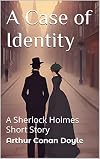
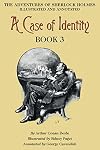
A Case of Identity (short story)
by Arthur Conan Doyle 
On This Page
Description
Sherlock Holmes, the world's ""only unofficial consulting detective"", was first introduced to readers in A Study in Scarlet published by Sir Arthur Conan Doyle in 1887. It was with the publication of The Adventures of Sherlock Holmes, however, that the master sleuth grew tremendously in popularity, later to become one of the most beloved literary characters of all time.In this book series, the short stories comprising The Adventures of Sherlock Holmes have been amusingly illustrated using o...Tags
Recommendations






























Member Reviews
''— Meu caro amigo — disse Sherlock Holmes enquanto nos sentávamos um de cada lado da lareira em seu apartamento da Baker Street —, a vida é infinitamente mais estranha do que qualquer outra coisa que a mente humana possa arquitetar. Não ousaríamos imaginar aquilo que é verdadeiramente corriqueiro na existência. ''
Não estou lendo os causos do Sherlock Holmes e do Dr. Watson cronologicamente, apenas pego algum conto quando me dá na telha, isso talvez possa sabotar minha experiência como um todo, mas prefiro me arriscar assim, já que minha experiência com o Detetive vem apenas dos filmes e das séries, e quero mudar isso logo, indo beber direto na fonte.
A discussão no inicio da história, de onde vem a citação com que show more começo essa breve resenha, é a minha parte favorita do conto; o detetive acredita que a vida real revela mais fatos estranhos que toda a ficção criada pela mente, enquanto o Dr. Watson discorda e diz que os acontecimentos que saem nos jornais são todos estúpidos e dedutíveis.
Holmes usa inteligentemente como exemplo um caso de divórcio que encontra aleatoriamente no jornal, pedindo para que Watson desvende o motivo da separação. O doutor conclui imediatamente que a causa é traição, embriaguez, agressão física, ou algo próximo. Mas Holmes lhe refuta e esclarece que o motivo do divórcio é que o homem tinha o estranho hábito de, após terminar sua refeição, arremessar sua dentadura na esposa. Provando seu argumento inicial.
Agora, voltando ao crime em sí, "O Caso de Identidade" é sobre uma jovem moça que procura por seu noivo que desapareceu da carruagem no dia do casamento.
O caso, é demasiadamente simples, não tão interessante, mas com sua conclusão ele retoma a discussão inicial: de que um caso aparentemente corriqueiro, pode trazer consigo uma resolução fora do normal.
No geral, é um conto com um inicio bom, mas com um desenrolar razoável. show less
Não estou lendo os causos do Sherlock Holmes e do Dr. Watson cronologicamente, apenas pego algum conto quando me dá na telha, isso talvez possa sabotar minha experiência como um todo, mas prefiro me arriscar assim, já que minha experiência com o Detetive vem apenas dos filmes e das séries, e quero mudar isso logo, indo beber direto na fonte.
A discussão no inicio da história, de onde vem a citação com que show more começo essa breve resenha, é a minha parte favorita do conto; o detetive acredita que a vida real revela mais fatos estranhos que toda a ficção criada pela mente, enquanto o Dr. Watson discorda e diz que os acontecimentos que saem nos jornais são todos estúpidos e dedutíveis.
Holmes usa inteligentemente como exemplo um caso de divórcio que encontra aleatoriamente no jornal, pedindo para que Watson desvende o motivo da separação. O doutor conclui imediatamente que a causa é traição, embriaguez, agressão física, ou algo próximo. Mas Holmes lhe refuta e esclarece que o motivo do divórcio é que o homem tinha o estranho hábito de, após terminar sua refeição, arremessar sua dentadura na esposa. Provando seu argumento inicial.
Agora, voltando ao crime em sí, "O Caso de Identidade" é sobre uma jovem moça que procura por seu noivo que desapareceu da carruagem no dia do casamento.
O caso, é demasiadamente simples, não tão interessante, mas com sua conclusão ele retoma a discussão inicial: de que um caso aparentemente corriqueiro, pode trazer consigo uma resolução fora do normal.
No geral, é um conto com um inicio bom, mas com um desenrolar razoável. show less
A young woman whose fiance disappeared on the day of their wedding asks Sherlock Holmes for help finding the missing man. Then her young stepfather tries to talk Holmes out of investigating the case. The young woman’s story, Holmes’s observations, and an inquiry or two are all the great detective needs to deduce what happened to the missing man.
This seems to be one of Holmes’s most frustrating cases. While he solved the mystery,the responsible party hadn’t broken any laws and couldn’t be brought to justice . The solution to the problem is unusual enough that I remembered it as soon as the young woman started telling her story. Conan Doyle was certainly creative!
This seems to be one of Holmes’s most frustrating cases. While he solved the mystery,
As part of my intention to read the Sherlock Holmes novels in their entirety, I'm currently tripping over the short stories published in "The Adventures of Sherlock Holmes" - as well-written as each of them is, I need a while to get accustomed to the differing storylines and to bring up some motivation for reading the next story out of this short story collection.
"A Case of Identity" was probably just as predictable as the previous one, with the title already spoiling the outcome of the mystery, but this didn't degrade my delight about reading about another case of Sherlock Holmes and his assistant, Dr. Watson. Some subtle terms have been included in the story to develop the characteristics of their cooperation, as Sherlock noted that show more "you [Watson] are coming along wonderfully. You have really done very well indeed. It is true that you have missed everything of importance, but you have hit upon the method, and you have a quick eye for colour." Oh, Sherlock. You cannot compare the different versions of Sherlock Holmes which Arthur Conan Doyle in his literary works respectively Benedict Cumberbatch in his performance have created, but I love both of them.
As to the plot itself, the mystery's solution was quite interesting and exposed one of the most shocking schemes I have read of so far in the Sherlock Holmes novels, but, unfortunately, Arthur Conan Doyle gave a lot of the mystery away before the initial reveal, and while he spent plenty of time on establishing the mystery's main construct, the outcome felt rushed and didn't allow the characters to experience any kind of consequences. As a result, I was left disappointed by this story, and while there was some good writing and a strong plot idea, the execution might have been done in another, more satisfactoring way.
2.5 stars, rounded up to 3 stars because I don't want to rate a Sherlock Holmes story that low. show less
"A Case of Identity" was probably just as predictable as the previous one, with the title already spoiling the outcome of the mystery, but this didn't degrade my delight about reading about another case of Sherlock Holmes and his assistant, Dr. Watson. Some subtle terms have been included in the story to develop the characteristics of their cooperation, as Sherlock noted that show more "you [Watson] are coming along wonderfully. You have really done very well indeed. It is true that you have missed everything of importance, but you have hit upon the method, and you have a quick eye for colour." Oh, Sherlock. You cannot compare the different versions of Sherlock Holmes which Arthur Conan Doyle in his literary works respectively Benedict Cumberbatch in his performance have created, but I love both of them.
As to the plot itself, the mystery's solution was quite interesting and exposed one of the most shocking schemes I have read of so far in the Sherlock Holmes novels, but, unfortunately, Arthur Conan Doyle gave a lot of the mystery away before the initial reveal, and while he spent plenty of time on establishing the mystery's main construct, the outcome felt rushed and didn't allow the characters to experience any kind of consequences. As a result, I was left disappointed by this story, and while there was some good writing and a strong plot idea, the execution might have been done in another, more satisfactoring way.
2.5 stars, rounded up to 3 stars because I don't want to rate a Sherlock Holmes story that low. show less
This is not among my favorites in the short stories from Sherlock Holmes series, but it is not completely bad. The story revolves around the case of Miss Mary Sutherland, a woman with a substantial income from the interest on a fund set up for her, which she will get full control upon her marriage. She is engaged to a quiet Londoner who has recently disappeared. Sherlock Holmes's detective powers are barely challenged as this turns out to be quite an elementary case for him, much as it puzzles Watson.
The fiancé, Mr. Hosmer Angel, is a curious character, rather quiet, and rather secretive about his life. Miss Sutherland only knows that he works in an office in Leadenhall Street, but nothing more specific than that. All his letters to show more her are typewritten, even the signature, and he insists that she write back to him through the local Post Office.
The climax of the sad liaison comes when Mr. Angel abandons Miss Sutherland at the altar on their wedding day.
Holmes, noting all these things, Hosmer Angel's description, and the fact that he only seems to meet with Miss Sutherland while her disapproving youngish stepfather, James Windibank, is out of the country on business, reaches a conclusion quite quickly. A typewritten letter confirms his belief beyond doubt. Only one person could have gained by this: Mr. James Windibank. Holmes deduces "Angel" had "disappeared" by simply going out the other side of a four-wheeler cab.
After solving the mystery, Holmes chooses not to tell his client the solution, since "If I tell her she will not believe me. You may remember the old Persian saying, 'There is danger for him who taketh the tiger cub, and danger also for whoso snatches a delusion from a woman.' There is as much sense in Hafiz as in Horace, and as much knowledge of the world." In this, however, he can be accused of not fulfilling his professional duty for which he was paid – namely, to investigate the matter to which she set him, provide her with the results and let her decide what to do with them. Holmes does advise his client to forget "Mr. Angel"; Miss Sutherland refuses to take Holmes' advice and vows to remain faithful to "Angel" until he reappears – for at least ten years.
Holmes predicts Windibank will continue a career in crime and end up on the gallows.
As this is a short story, you should be done reading it in less than a couple of hours. show less
The fiancé, Mr. Hosmer Angel, is a curious character, rather quiet, and rather secretive about his life. Miss Sutherland only knows that he works in an office in Leadenhall Street, but nothing more specific than that. All his letters to show more her are typewritten, even the signature, and he insists that she write back to him through the local Post Office.
The climax of the sad liaison comes when Mr. Angel abandons Miss Sutherland at the altar on their wedding day.
Holmes, noting all these things, Hosmer Angel's description, and the fact that he only seems to meet with Miss Sutherland while her disapproving youngish stepfather, James Windibank, is out of the country on business, reaches a conclusion quite quickly. A typewritten letter confirms his belief beyond doubt. Only one person could have gained by this: Mr. James Windibank. Holmes deduces "Angel" had "disappeared" by simply going out the other side of a four-wheeler cab.
After solving the mystery, Holmes chooses not to tell his client the solution, since "If I tell her she will not believe me. You may remember the old Persian saying, 'There is danger for him who taketh the tiger cub, and danger also for whoso snatches a delusion from a woman.' There is as much sense in Hafiz as in Horace, and as much knowledge of the world." In this, however, he can be accused of not fulfilling his professional duty for which he was paid – namely, to investigate the matter to which she set him, provide her with the results and let her decide what to do with them. Holmes does advise his client to forget "Mr. Angel"; Miss Sutherland refuses to take Holmes' advice and vows to remain faithful to "Angel" until he reappears – for at least ten years.
Holmes predicts Windibank will continue a career in crime and end up on the gallows.
As this is a short story, you should be done reading it in less than a couple of hours. show less
As the story unfolded I began to think that I was seeing a more caring side of Holmes as he seemed genuinely upset at how the lady was wronged, only to find him switching it off and laughing once everyone had left and he had found how the woman was wronged "interesting". Good ol' Holmes, he never disappoints.
No mystery here, I figured it out at the beginning but a fairly even read nonetheless.
Ratings
Members
- Recently Added By
Lists

Books Read in 2015
3,298 works; 126 members
Author Information

3,986+ Works 169,059 Members
The most famous fictional detective in the world is Arthur Conan Doyle's Sherlock Holmes. However, Doyle was, at best, ambivalent about his immensely successful literary creation and, at worst, resentful that his more "serious" fiction was relatively ignored. Born in Edinburgh, Doyle studied medicine from 1876 to 1881 and received his M.D. in show more 1885. He worked as a military physician in South Africa during the Boer War and was knighted in 1902 for his exceptional service. Doyle was drawn to writing at an early age. Although he attempted to enter private practice in Southsea, Portsmouth, in 1882, he soon turned to writing in his spare time; it eventually became his profession. As a Liberal Unionist, Doyle ran, unsuccessfully, for Parliament in 1903. During his later years, Doyle became an avowed spiritualist. Doyle sold his first story, "The Mystery of the Sasassa Valley," to Chambers' Journal in 1879. When Doyle published the novel, A Study in Scarlet in 1887, Sherlock Holmes was introduced to an avid public. Doyle is reputed to have used one of his medical professors, Dr. Joseph Bell, as a model for Holmes's character. Eventually, Doyle wrote three additional Holmes novels and five collections of Holmes short stories. A brilliant, though somewhat eccentric, detective, Holmes employs scientific methods of observation and deduction to solve the mysteries that he investigates. Although an "amateur" private detective, he is frequently called upon by Scotland Yard for assistance. Holmes's assistant, the faithful Dr. Watson, provides a striking contrast to Holmes's brilliant intellect and, in Doyle's day at least, serves as a character with whom the reader can readily identify. Having tired of Holmes's popularity, Doyle even tried to kill the great detective in "The Final Problem" but was forced by an outraged public to resurrect him in 1903. Although Holmes remained Doyle's most popular literary creation, Doyle wrote prolifically in other genres, including historical adventure, science fiction, and supernatural fiction. Despite Doyle's sometimes careless writing, he was a superb storyteller. His great skill as a popular author lay in his technique of involving readers in his highly entertaining adventures. (Bowker Author Biography) show less
Arthur Conan Doyle has a Legacy Library. Legacy libraries are the personal libraries of famous readers, entered by LibraryThing members from the Legacy Libraries group.
Work Relationships
Is contained in
Sherlock Holmes: The Complete Novels and Stories, Vol. 1 (Bantam Classics 1/2) by Arthur Conan Doyle (indirect)
Sherlock Holmes: The Complete Novels and Stories, Vol. 1 and 2 (Bantam) by Arthur Conan Doyle (indirect)
The New Annotated Sherlock Holmes: The Short Stories, Volume 1 of 2 (The Adventures of Sherlock Holmes + The Memoirs of Sherlock Holmes) by Arthur Conan Doyle (indirect)
The Adventures of Sherlock Holmes [and] The Hound of the Baskervilles by Sir Arthur Conan Doyle (indirect)
Las Aventuras de Sherlock Holmes ; Sherlock Holmes sigue en pie ; El archivo de Sherlock Holmes by Sir Arthur Conan Doyle (indirect)
A Study in Scarlet / The Adventures of Sherlock Holmes / The Hound of the Baskervilles / Sign of Four by Arthur Conan Doyle (indirect)
The Sherlock Holmes illustrated omnibus : The adventures of Sherlock Holmes, The memoirs of Sherlock Holmes, The hound of the Baskervilles, The return of Sherlock Holmes : a facsimile of the stories and the adventure as they were first published in the Strand magazine, London by Sir Arthur Conan Doyle (indirect)
A Study In Scarlet, The Sign of the Four, The Adventures of Sherlock Holmes, The Memoirs of Sherlock Holmes, The Return of Sherlock Holmes (Sherlock Holmes - Bouquin Complete works - volume 1/2) by Arthur Conan Doyle (indirect)
The Adventures of Sherlock Holmes, The Memoirs of Sherlock Holmes, The Return of Sherlock Holmes (Classics Omnibus) by Arthur Conan Doyle (indirect)
The adventures of Sherlock Holmes ; The memoirs of Sherlock Holmes ; The return of Sherlock Holmes ; The hound of the Baskervilles ; A study in ... the Bruce-Partington plans (Masters Library) by Arthur Conan Doyle (indirect)
A Study in Scarlet / The Sign of the Four / The Adventures of Sherlock Holmes / The Memoirs of Sherlock Holmes by Arthur C. Doyle (indirect)
Adventures of Sherlock Holmes / Memoirs of Sherlock Holmes / The Sign Of Four by Arthur Conan Doyle (indirect)
A Study in Scarlet / The Sign of Four / The Adventures of Sherlock Holmes / The Memoirs of Sherlock Holmes / The Hound of the Baskervilles (B&N Classics 1/2) by Arthur Conan Doyle (indirect)
The Adventures of Sherlock Holmes, volume 1 : A scandal in Bohemia - The Red-Headed League - A Case of Identity by Arthur Conan Doyle
Common Knowledge
- Canonical title
- A Case of Identity (short story) (short story)
- Original title
- A Case of Identity
- Alternate titles
- The Adventure of a Case of Identity
- Original publication date
- 1891
- People/Characters
- Sherlock Holmes; John H. Watson (M.D.); Mary Sutherland; Hosmer Angel; James Windibank
- Important places
- 221B Baker Street, London, England, UK
- Related movies
- A Case of Identity (1921 | IMDb)
- Original language
- English
- Canonical DDC/MDS
- 823.08721
- Disambiguation notice
- This is the main work for the short story "A Case of Identity". It should not be combined with any adaptation, abridgement, or larger collection.
Classifications
- Genres
- Fiction and Literature, Mystery
- DDC/MDS
- 823.08721 — Literature & rhetoric English & Old English literatures English fiction By type Genre fiction Adventure fiction Mystery fiction Detective fiction
- LCC
- PR4622 — Language and Literature English English Literature 19th century , 1770/1800-1890/1900
- BISAC
Statistics
- Members
- 147
- Popularity
- 221,632
- Reviews
- 6
- Rating
- (3.35)
- Languages
- 6 — English, French, Italian, Portuguese (Brazil), Spanish, Turkish
- Media
- Paper, Audiobook, Ebook
- ISBNs
- 33
- ASINs
- 13