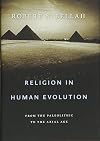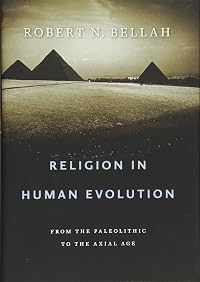
Religion in Human Evolution: From the Paleolithic to the Axial Age
by Robert N. Bellah
On This Page
Description
Religion in Human Evolution is a work of extraordinary ambition ́a wide-ranging, nuanced probing of our biological past to discover the kinds of lives that human beings have most often imagined were worth living. It offers what is frequently seen as a forbidden theory of the origin of religion that goes deep into evolution, especially but not exclusively cultural evolution.How did our early ancestors transcend the "idian demands of everyday existence to embrace an alternative reality that show more called into question the very meaning of their daily struggle? Robert Bellah, one of the leading sociologists of our time, identifies a range of cultural capacities, such as communal dancing, storytelling, and theorizing, whose emergence made this religious development possible. Deploying the latest findings in biology, cognitive science, and evolutionary psychology, he traces the expansion of these cultural capacities from the Paleolithic to the Axial Age (roughly, the first millennium BCE), when individuals and groups in the Old World challenged the norms and beliefs of class societies ruled by kings and aristocracies. These religious prophets and renouncers never succeeded in founding their alternative utopias, but they left a heritage of criticism that would not be quenched. Bellah ́s treatment of the four great civilizations of the Axial Age ́in ancient Israel, Greece, China, and India ́shows all existing religions, both prophetic and mystic, to be rooted in the evolutionary story he tells. Religion in Human Evolution answers the call for a critical history of religion grounded in the full range of human constraints and possibilities. show lessTags
Recommendations


































Member Reviews
A comprehensive historical analysis of human religion and thought, starting with the animal play and ending with the axial age breakthroughs. The major evolutionary theme being the development from the mimetic to mythic and narrative to the theoretic stage of the axial age. The ability to construct narratives that ultimately led to the development of “theoretic culture”.
More of a descriptive work rather than an analytic one, he considers the religious development from tribal to archaic to axial societies. The author presents anthropological case studies for tribal, archaic and axial age societies. For tribal religion, he considers the hunter gatherer societies from the Amazon, Australia and the America's from precolonial period show more rather than any prehistoric cases. He considers the precontact Hawaii as a case for the transition from tribal to archaic, and Egypt and Mesopotamia as cases for archaic societies.
The major bulk of the book though is given to dealing with the axial age societies of India, China, Israel and Greece. The transition from mythic narrative to theoretic culture occupies the bulk of this work. “Theoretical” breakthroughs and the evolution of universal ethics.
The scope of this work is grand and ambitious and I'm not doing any justice to it by this short and broken review. This book is clearly a product of a lifetime of research and learning. A very humanistic work on themes that are central to human experience. Highly recommended. show less
More of a descriptive work rather than an analytic one, he considers the religious development from tribal to archaic to axial societies. The author presents anthropological case studies for tribal, archaic and axial age societies. For tribal religion, he considers the hunter gatherer societies from the Amazon, Australia and the America's from precolonial period show more rather than any prehistoric cases. He considers the precontact Hawaii as a case for the transition from tribal to archaic, and Egypt and Mesopotamia as cases for archaic societies.
The major bulk of the book though is given to dealing with the axial age societies of India, China, Israel and Greece. The transition from mythic narrative to theoretic culture occupies the bulk of this work. “Theoretical” breakthroughs and the evolution of universal ethics.
The scope of this work is grand and ambitious and I'm not doing any justice to it by this short and broken review. This book is clearly a product of a lifetime of research and learning. A very humanistic work on themes that are central to human experience. Highly recommended. show less
Read this book and discover some new best friends that lived in the past. Wonderful, insightful, provocative, see things in a completely different perspective.
Ratings
Members
- Recently Added By
Lists

Books Cited in Blueprint by Nicholas Christakis
261 works; 1 member
Author Information

31+ Works 2,967 Members
Robert N. Bellah, an American sociologist, received his Ph.D. from Harvard University in 1955 and teaches at the University of California at Berkeley. He is best known for his work on community and religion. Although he has written on religions in nonwestern cultures, he has focused much of his research on the notion of civil religion in the West. show more To Bellah, American society confronts a moral dilemma whereby communalism competes with individualism for domination. His most important book, Habits of the Heart (1985), considers the American character and the decline of community. Bellah holds that the radical split between knowledge and commitment is untenable and can result only in a stunted personal and intellectual growth. He argues for a social science guided by communal values. (Bowker Author Biography) show less
Awards and Honors
Classifications
- Genres
- Religion & Spirituality, Nonfiction, History, Anthropology, General Nonfiction, Philosophy
- DDC/MDS
- 200.89 — Religion Religion Religion Groups of people Ethnic groups--religion
- LCC
- BL256 .B435 — Philosophy, Psychology and Religion Religions. Mythology. Rationalism Religions. Mythology. Rationalism Natural theology Religion and science
- BISAC
Statistics
- Members
- 341
- Popularity
- 93,275
- Reviews
- 2
- Rating
- (4.13)
- Languages
- English, Spanish
- Media
- Paper, Audiobook, Ebook
- ISBNs
- 6
- ASINs
- 2