Ring of Fire I
by Eric Flint
Ring of Fire anthologies (1), Ring of Fire reading order / per Eric Flint (3), Assiti Shards (Ring Of Fire Anthology 1)
On This Page
Description
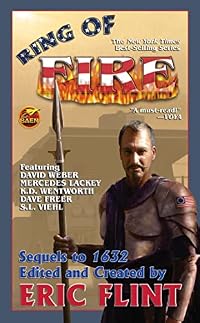
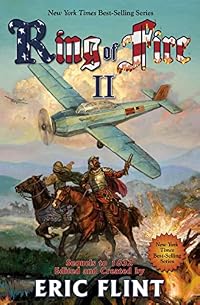
Return to the Alternate Universe of 1632 and 1633 as the Top Writers of Alternate History and Military SF Join Forces in the Shared-Universe Volume of the Year The battle between democracy and tyranny is joined, and the American Revolution has begun over a century ahead of schedule. A cosmic accident has shifted a modern West Virginia town back through time and space to land it and its twentieth century technology in Germany in the middle of the Thirty Years War. History must take a new show more course as American freedom and democracy battle against the squabbling despots of seventeenth-century Europe. Continuing the story begun in the hit novels 1632 and 1633, the New York Times best-selling creator of Honor Harrington, David Weber, the best-selling fantasy star Mercedes Lackey, space adventure author K. D. Wentworth, Dave Freer, co-author of the hit novels Rats, Bats & Vats and Pyramid Scheme (both Baen), and Eric Flint himself combine their considerable talents in a shared-universe volume that will be a must-have for every reader of 1632 and 1633. show lessTags
Recommendations








Member Reviews
I am not a short story person, so I don't know what I was thinking reading this book. I even seem to be planning to read the Grantville Gazette, which after this reminder I find utterly baffling. The problem is, there's not enough room to get anywhere in a short story. Half these shorts feel like the prelude chapter to a novel: lots of setup, then they end. The other half I didn't read.
That being said, I was going to give this three stars (technically competent, but unimpressive), but the novella at the end (The Wallenstein Gambit) is just long enough to actually get somewhere, and it's a good ride the whole way through.
That being said, I was going to give this three stars (technically competent, but unimpressive), but the novella at the end (The Wallenstein Gambit) is just long enough to actually get somewhere, and it's a good ride the whole way through.
Some good stories, some eh stories. None really bad, but also very few that really stand out. I like To Dye For, and several others - but some have interesting characters but not much story, some have strong stories and somewhat sketchy characters. Eric explicitly states in his foreword that the point of the anthology is to prevent the normal flow of an alternate history story, where the author's main characters seem to do everything and cause all the changes. I think it succeeds with that - Tom Stone certainly becomes an important character; Simpson's switch from cardboard villain to someone with depth is in here; for that matter, several stories explore how various people were dealing with being stranded back in time in the early show more days, which 1632 skims over quite lightly (nothing much from Gretchen's wedding until the next spring). And so on. It adds a lot of depth, but it also displays the problem with the whole series for me - by the time I was halfway through the book, I was bored with going over old ground from new viewpoints. Each individual story is at least interesting, but in the aggregate they're too much. I've never managed to read all the 1634 books or even look at 1635, for the same reason - too much and too scattered. And you really have to know all the stories to understand the later ones - every event has repercussions, every character affects the entire story. Very realistic and just too much. And far too many of the stories are just 'my character gets to meet an interesting historical character' - the Fredrich von Spee one is definitely that; the witch aspect was better dealt with in the nurses one, the great point was von Spee reading about himself in the encyclopedia, and it was a clumsy scene in a clumsy story. Tom Simpson can't shoot worth a darn, anyway - certainly not a headshot with a handgun. And so on. I'm slogging through it - don't want to quit in the middle - but from now on I'll read just the few memorable ones, not the whole book. show less
A Solid Anthology: "Ring of Fire" is a collection of short stories set in the universe created by Eric Flint in his 2000 novel "1632." In "1632," the town of Grantville is ripped from modern day West Virginia and dropped in the middle of Germany, in the middle of the Thirty Years' War, by a cosmic accident (commonly considered an Act of God) which is eventually dubbed the 'Ring of Fire.'
The fifteen stories in this anthology seem to have been written after the publication of "1632," but before that of its sequel "1633." They take place concurrently with the action in those two novels: "Power to the People" by Loren K. Jones goes all the way back to the Ring of Fire that kicked off 1632, while Eric Flint's "The Wallenstein Gambit" is set show more in the middle of the year 1633. As with all anthologies, the styles and qualities of the stories varied from author to author, from the 16-page "To Dye For" by Mercedes Lackey to Flint's 120-page novella. However, although I enjoyed some stories in "Ring of Fire" more than others, I can honestly say there were none I actively disliked, which is pretty much as good as it gets for anthologies.
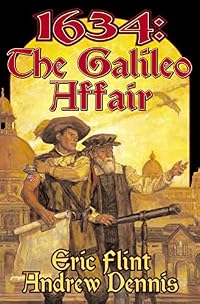
What makes "Ring of Fire" so interesting is the fact that it is not your typical anthology. Most 'spin-off' anthologies like this one feature stories peripheral to the main plot of the series, involve minor characters and don't play a significant role in the grand scheme of things. Some stories such as "Power to the People" and "When the Chips Are Down" by Jonathan Cresswell and Scott Washburn seem to follow that model. However, most of them actually play important roles shaping both the plots and the characters of the later books in the series. For example, David Weber (who coauthored "1633") writes a story about the founding of the new American navy that plays a prominent role in "1633" and Andrew Dennis's story sets up "1634: The Galileo Affair" (which he coauthored) and develops some of its main characters. Meanwhile, "The Wallenstein Gambit" incorporates other stories in "Ring of Fire," redraws the map of Europe, and lays the basis for forthcoming "1634: ..." novels.
The point is that this anthology plays an important role in the series, and needs to be read by anyone who wants to enjoy future 163x books. This is a part of Eric Flint's interesting approach to the whole series, which tries to make the '1632 universe' a full-bodied and realistically complex place. To do this Flint writes the main books of the series with a number of different coauthors (David Weber, Andrew Dennis, Mike Spehar, Virginia DeMarce), while at the same time allowing all of the authors who contributed to "Ring of Fire" to make their own mark on the developing series. Flint has even begun publishing fan fiction in an online magazine (the "Grantville Gazette") and incorporating it into 163x novels. It is (to my knowledge) a unique approach, and so far seems to be producing excellent results.
So not only is "Ring of Fire" a solid anthology in its own right, it is required reading for those who intend to follow Flint et al.'s 163x series. Although "1633" builds off of several stories in "Ring of Fire," it can be understood and enjoyed without reading the anthology. The same is less true of the "1634: ..." books that are currently being written and published. If you enjoyed "1632" enough to want to read more books in the series, "Ring of Fire" should be a sure bet.
To conclude, and to emphasize one last time the important role played by "Ring of Fire" in the development of the 163x series, I will sketch out the current shape of the series and indicate which stories in "Ring of Fire" are incorporated into each of the planned books. Of the fifteen stories in the anthology, only three do not seem to play a role in the larger series, though they may yet be incorporated into one of the volumes currently being planned or written.
"1633" with David Weber
---"In the Navy" by David Weber
---"A Matter of Consultation" by S.L. Viehl
---"Skeletons" by Greg Donahue
"1634: The Galileo Affair" with Andrew Dennis
---"American Past Time" by Deann Allen and Mike Turner
---"To Dye For" by Mercedes Lackey
---"A Witch to Live" by Walt Boyes
---"Between the Armies" by Andrew Dennis
"1634: The Baltic War" with David Weber
"1634: Escape from the Tower" (Eric Flint solo)
"1634: The Austrian Princess" with Virginia DeMarce
---"Biting Time" by Virginia DeMarce
"1634: Bohemia" (tentative title) with Mike Spehar
---"A Lineman for the Country" by Dave Freer
---"The Three Rs" by Jody Dorsett
---"Here Comes Santa Claus" by K.D. Wentworth
---"The Wallenstein Gambit" by Eric Flint
"1635" with Virginia DeMarce
Stories that don't (yet) play a role in the series:
---"Power to the People" by Loren K. Jones
---"Family Faith" by Anette M. Pedersen
---"When the Chips are Down" by Jonathan Cresswell and Scott Washburn show less
The fifteen stories in this anthology seem to have been written after the publication of "1632," but before that of its sequel "1633." They take place concurrently with the action in those two novels: "Power to the People" by Loren K. Jones goes all the way back to the Ring of Fire that kicked off 1632, while Eric Flint's "The Wallenstein Gambit" is set show more in the middle of the year 1633. As with all anthologies, the styles and qualities of the stories varied from author to author, from the 16-page "To Dye For" by Mercedes Lackey to Flint's 120-page novella. However, although I enjoyed some stories in "Ring of Fire" more than others, I can honestly say there were none I actively disliked, which is pretty much as good as it gets for anthologies.
What makes "Ring of Fire" so interesting is the fact that it is not your typical anthology. Most 'spin-off' anthologies like this one feature stories peripheral to the main plot of the series, involve minor characters and don't play a significant role in the grand scheme of things. Some stories such as "Power to the People" and "When the Chips Are Down" by Jonathan Cresswell and Scott Washburn seem to follow that model. However, most of them actually play important roles shaping both the plots and the characters of the later books in the series. For example, David Weber (who coauthored "1633") writes a story about the founding of the new American navy that plays a prominent role in "1633" and Andrew Dennis's story sets up "1634: The Galileo Affair" (which he coauthored) and develops some of its main characters. Meanwhile, "The Wallenstein Gambit" incorporates other stories in "Ring of Fire," redraws the map of Europe, and lays the basis for forthcoming "1634: ..." novels.
The point is that this anthology plays an important role in the series, and needs to be read by anyone who wants to enjoy future 163x books. This is a part of Eric Flint's interesting approach to the whole series, which tries to make the '1632 universe' a full-bodied and realistically complex place. To do this Flint writes the main books of the series with a number of different coauthors (David Weber, Andrew Dennis, Mike Spehar, Virginia DeMarce), while at the same time allowing all of the authors who contributed to "Ring of Fire" to make their own mark on the developing series. Flint has even begun publishing fan fiction in an online magazine (the "Grantville Gazette") and incorporating it into 163x novels. It is (to my knowledge) a unique approach, and so far seems to be producing excellent results.
So not only is "Ring of Fire" a solid anthology in its own right, it is required reading for those who intend to follow Flint et al.'s 163x series. Although "1633" builds off of several stories in "Ring of Fire," it can be understood and enjoyed without reading the anthology. The same is less true of the "1634: ..." books that are currently being written and published. If you enjoyed "1632" enough to want to read more books in the series, "Ring of Fire" should be a sure bet.
To conclude, and to emphasize one last time the important role played by "Ring of Fire" in the development of the 163x series, I will sketch out the current shape of the series and indicate which stories in "Ring of Fire" are incorporated into each of the planned books. Of the fifteen stories in the anthology, only three do not seem to play a role in the larger series, though they may yet be incorporated into one of the volumes currently being planned or written.
"1633" with David Weber
---"In the Navy" by David Weber
---"A Matter of Consultation" by S.L. Viehl
---"Skeletons" by Greg Donahue
"1634: The Galileo Affair" with Andrew Dennis
---"American Past Time" by Deann Allen and Mike Turner
---"To Dye For" by Mercedes Lackey
---"A Witch to Live" by Walt Boyes
---"Between the Armies" by Andrew Dennis
"1634: The Baltic War" with David Weber
"1634: Escape from the Tower" (Eric Flint solo)
"1634: The Austrian Princess" with Virginia DeMarce
---"Biting Time" by Virginia DeMarce
"1634: Bohemia" (tentative title) with Mike Spehar
---"A Lineman for the Country" by Dave Freer
---"The Three Rs" by Jody Dorsett
---"Here Comes Santa Claus" by K.D. Wentworth
---"The Wallenstein Gambit" by Eric Flint
"1635" with Virginia DeMarce
Stories that don't (yet) play a role in the series:
---"Power to the People" by Loren K. Jones
---"Family Faith" by Anette M. Pedersen
---"When the Chips are Down" by Jonathan Cresswell and Scott Washburn show less
(Alistair) Well, much the same as 1632 and 1633, really, for world-thoughts and suchlike, it being effectively a sequel to the former and taking place before, after, and in the middle of the latter.
Of course, being a book of short stories by varied authors, not all of whom have written in this universe before, or whom for that matter are terribly established - several very unfamiliar names, and my library is huge - the quality is somewhat variable, but on the whole, it holds up its end well.
Which is a good thing, considering that this anthology both fills in some of the backstory for 1633 and holds the points at which the various 1634 books, of which there are several, split off their own threads.
Thus, recommended for those following show more the series. Those not, well, read at least 1632 first.
( http://weblog.siliconcerebrate.com/cerebrate/2009/02/ring_of_fire_ed_eric_flint.... )
(Amy) I first read 1632 and 1633 years ago, when I was engaged in reading online e-books during down time at work. It strikes me as remarkably unlikely that I would ever have picked them up in other circumstances - I'd passed them over with an eyeroll many times in bookstores - because the whole "Connecticut Yankee" plot has long struck me as overplayed. Nonetheless, this particular instance of technoyanks-in-the-past actually seems to work, and indeed proves quite compelling despite some less-than-fully-convincing characterizations at times, not to mention infodump speeches worthy of Heinlein at his wordiest.
Compelling, did I say? And compelling it indeed must be, for how else might one explain the 17 authors (of whom, OK, one is the editor/original author, and another the co-author of 1633, but that still leaves plenty of new blood) who were willing to submit stories to this fairly recently-established shared universe, not to mention all the Grantville Gazettes and the subsequent anthology, as well as co-authors for later books. I think it's fairly safe to say that the concept caught the attention of quite a few people.
Alternate history, if done carefully, is always interesting. The game of "if" is really what speculative fiction is all about, and alternate history plays with the gloves off. The Grantville universe plays with its eyes open, as well, giving frank - and often excessively detailed, in fairness - compare-and-contrast between the original timeline and the one the Ring of Fire created. It also has some of the fun aspects of post-apocalyptic fiction, in the "how to rebuild without everything coming crashing down on our heads" sense, though obviously the setting for same is not post-apocalyptic in the traditional sense. (A case could probably be made, though, that Germany in the middle of this time period looked pretty damned apocalyptic.)
In short, it pushes some buttons to which the speculative fiction community is predisposed to respond, and I confess I'm no different. It's fun to watch things unfold along this new timeline, one step at a time from the point of divergence, in all directions at once. Recommended, but don't start here. Start here, instead.
( http://weblog.siliconcerebrate.com/zenos-library/2009/04/ring_of_fire_ed_by_eric... ) show less
Of course, being a book of short stories by varied authors, not all of whom have written in this universe before, or whom for that matter are terribly established - several very unfamiliar names, and my library is huge - the quality is somewhat variable, but on the whole, it holds up its end well.
Which is a good thing, considering that this anthology both fills in some of the backstory for 1633 and holds the points at which the various 1634 books, of which there are several, split off their own threads.
Thus, recommended for those following show more the series. Those not, well, read at least 1632 first.
( http://weblog.siliconcerebrate.com/cerebrate/2009/02/ring_of_fire_ed_eric_flint.... )
(Amy) I first read 1632 and 1633 years ago, when I was engaged in reading online e-books during down time at work. It strikes me as remarkably unlikely that I would ever have picked them up in other circumstances - I'd passed them over with an eyeroll many times in bookstores - because the whole "Connecticut Yankee" plot has long struck me as overplayed. Nonetheless, this particular instance of technoyanks-in-the-past actually seems to work, and indeed proves quite compelling despite some less-than-fully-convincing characterizations at times, not to mention infodump speeches worthy of Heinlein at his wordiest.
Compelling, did I say? And compelling it indeed must be, for how else might one explain the 17 authors (of whom, OK, one is the editor/original author, and another the co-author of 1633, but that still leaves plenty of new blood) who were willing to submit stories to this fairly recently-established shared universe, not to mention all the Grantville Gazettes and the subsequent anthology, as well as co-authors for later books. I think it's fairly safe to say that the concept caught the attention of quite a few people.
Alternate history, if done carefully, is always interesting. The game of "if" is really what speculative fiction is all about, and alternate history plays with the gloves off. The Grantville universe plays with its eyes open, as well, giving frank - and often excessively detailed, in fairness - compare-and-contrast between the original timeline and the one the Ring of Fire created. It also has some of the fun aspects of post-apocalyptic fiction, in the "how to rebuild without everything coming crashing down on our heads" sense, though obviously the setting for same is not post-apocalyptic in the traditional sense. (A case could probably be made, though, that Germany in the middle of this time period looked pretty damned apocalyptic.)
In short, it pushes some buttons to which the speculative fiction community is predisposed to respond, and I confess I'm no different. It's fun to watch things unfold along this new timeline, one step at a time from the point of divergence, in all directions at once. Recommended, but don't start here. Start here, instead.
( http://weblog.siliconcerebrate.com/zenos-library/2009/04/ring_of_fire_ed_by_eric... ) show less
This is a collection of several different stories about the Ring of Fire world started with the book 1632. Eric Flint invited several authors to write their own stories using the characters and setting he created. I was surprised by this, especially because he says he plans to incorporate their ideas into the rest of the series. History is something that happens to a LOT of people, he says, and he didn't just want to know what happened to the few characters he created, but to lots and lots of people. I thought it was a fun idea, and I enjoyed this collection. Some of the stories that dealt with religion were a little too boring for me, but I enjoyed most of them.
If it wasn't for some of the boring stories such as the ones focusing on religion I could have given this 4 stars. Most of the stories though help expand the 1632 universe and add more depth to the story-lines.
A collection of stories of varying lengths focusing on people that are mostly side characters in the first couple of books in the 1632 series, but may well, I don't know, become important characters of their own eventually.
Flint recommends reading this book right after 1632, but says that it also works reading it afterwards. As a compromise I read both at the same time and that also works.
Despite being a collection of short stories by different authors, the style is not that different. I don't know if the stories are edited, but it feels like the authors are coming together and complementing each other.
If you enjoy the series and the story, well worth a read.
Flint recommends reading this book right after 1632, but says that it also works reading it afterwards. As a compromise I read both at the same time and that also works.
Despite being a collection of short stories by different authors, the style is not that different. I don't know if the stories are edited, but it feels like the authors are coming together and complementing each other.
If you enjoy the series and the story, well worth a read.
Members
- Recently Added By
Lists

Books Read in 2013
1,630 works; 51 members
Author Information

207+ Works 28,949 Members
Eric Flint was born in southern California in 1947. He received a bachelor's degree from UCLA in 1968 and did some work toward a Ph.D. in history, with a specialization in history of southern Africa in the 18th and early 19th centuries, also at UCLA. After leaving the doctoral program over political issues, he supported himself from that time show more until age 50 as a laborer, machinist and labor organizer. In 1993, his short story entitled Entropy and the Strangler won first place in the Winter 1992 Writers of the Future contest. His first novel, Mother of Demons, was published in 1997 and was picked by the Science Fiction Chronicle as a best novel of the year. He became a full-time writer in 1999. He writes science fiction and fantasy works including The Philosophical Strangler and the Belisarius series. (Bowker Author Biography) show less
All Editions
Some Editions
Series


Work Relationships
Common Knowledge
- Canonical title
- Ring of Fire I
- Original title
- Ring of Fire
- Original publication date
- 2004
- People/Characters
- William Harvey; Cardinal Mazarin; Friedrich von Spee; Albrecht von Wallenstein
- Important events
- Thirty Years' War
- First words
- "I'm telling you, Mike, we can do this!"
- Last words
- (Click to show. Warning: May contain spoilers.)"Always."
- Original language
- English
- Disambiguation notice
- This work has nothing to do whatsoever with the Movie by the same name. Do not combine it with the movie!
Also, be very careful when combining anthologies within the Ring of Fire/1632 Universe; note everyone lists the ... (show all)volume number in the title, check to see what the ISBN refers to.
Classifications
Statistics
- Members
- 754
- Popularity
- 37,106
- Reviews
- 13
- Rating
- (3.55)
- Languages
- English
- Media
- Paper, Audiobook, Ebook
- ISBNs
- 5
- ASINs
- 3