
K. D. Wentworth (1951–2012)
Author of The Course of Empire
About the Author
Image credit: K.D. Wentworth in 2006 [credit: Catriona Sparks]
Series
Works by K. D. Wentworth
Kaleidoscope 2 copies
Special Needs 2 copies
Exit Strategy 2 copies
The Gender Plague 2 copies
The Orangery 2 copies
The Ronnie 2 copies
Tall One 2 copies
Blessed Assurance 1 copy
Alien Land 1 copy
The Embians 1 copy
The Battle for Cassville 1 copy
The Rose War {short story} 1 copy
Midnight at the Quantum Cafe 1 copy
Blade Runner [short story] 1 copy
Here Comes Santa Claus 1 copy
Burning Bright 1 copy
'Tis the Season 1 copy
As You Sow 1 copy
Drinking Problem 1 copy
Associated Works
The Magazine of Fantasy and Science Fiction January/February 2012, Vol. 122, No. 1 & 2 (2012) — Contributor — 21 copies
The Magazine of Fantasy and Science Fiction October/November 1993, Vol. 85, No. 4 & 5 (1993) — Author — 17 copies
Tagged
Common Knowledge
- Legal name
- Wentworth, Kathy Diane
- Birthdate
- 1951-01-27
- Date of death
- 2012-04-18
- Gender
- female
- Education
- University of Tulsa
- Occupations
- elementary school teacher
science fiction author
editor
conrunner - Organizations
- Science Fiction and Fantasy Writers of America (SFWA)
Oklahoma Science Fiction Writers
Writers of the Future
Conestoga, Inc. - Awards and honors
- Field Publications Teachers as Writers Award
Writers of the Future (1989) - Agent
- McCarthy Agency, The
- Cause of death
- pneumonia
cancer (cervical) - Nationality
- USA
- Birthplace
- Tulsa, Oklahoma, USA
- Places of residence
- Tulsa, Oklahoma, USA
- Place of death
- Tulsa, Oklahoma, USA
- Associated Place (for map)
- Tulsa, Oklahoma, USA
Members
Reviews

So yeah, it turns out I'm not a big fan of L. Ron Hubbard. But that didn't stop me from requesting a copy of L. Ron Hubbard Presents: Writers of the Future, Volume XXVII from LibraryThing's Early Reviewers program. I always enjoy a good sci-fi/fantasy anthology, and I was at least subliminally aware of the Writers of the Future program, and figured this'd be a good bet for some high-quality SF/F short fiction (SFFSF?).
I love it when I'm right.
The Writers of the Future contest seems a fairly show more reputable program, with contest entries judged by such esteemed SFF writers as Orson Scott Card, Anne McCaffrey, Larry Niven, and Frederik Pohl, among others. And past contest winners include such notable names as Stephen Baxter, Patrick Rothfuss, and Dave Wolverton. So right off the bat, this book showed the promise of some good stuff inside.
And on the whole, it delivers. There are some weaker stories, but they're merely decent, not bad. But beyond that, there are a few truly phenomenal entries. Here's a (very) brief review for each story:
Also included are three essays on advice for writers and artists; I'll be honest: I skimmed 'em. I was just there for the stories. On the whole, it's decent collection, elevated by the presence of 4-5 particularly strong stories. If I had to rank the top five, I'd have to go with "Maddy Dune", then "The Sundial", with "How Like a God" and "The Dualist" tying for third, and "Medic!" bringing up the rear. It's worth checking out just for those stories. And I'm going to have to keep an eye out for previous collections, as well. [4 out of 5 stars] show less
I love it when I'm right.
The Writers of the Future contest seems a fairly show more reputable program, with contest entries judged by such esteemed SFF writers as Orson Scott Card, Anne McCaffrey, Larry Niven, and Frederik Pohl, among others. And past contest winners include such notable names as Stephen Baxter, Patrick Rothfuss, and Dave Wolverton. So right off the bat, this book showed the promise of some good stuff inside.
And on the whole, it delivers. There are some weaker stories, but they're merely decent, not bad. But beyond that, there are a few truly phenomenal entries. Here's a (very) brief review for each story:
- "The Unreachable Voices of Ghosts" by Jeffrey Lyman — Almost every story in this collection is a science-fiction piece; this is no exception. A lonely man goes on what is essentially a suicide run to the edge of the solar system, fishing for a miniature black hole, and finds something else besides. There's a nice atmosphere to the piece, and if the twist at the end isn't entirely unanticipated, well, it's still a solid and oddly-moving start to the anthology.
- "Maddy Dune's First and Only Spelling Bee" by Patrick O'Sullivan — Maybe this fantasy story should have been held until the end of the collection, because it sets the bar impossibly high for everything that follows. I'm not going to spoil anything by going into any detail, but this is hands-down the best entry here; it's worth buying the book just for this one. I would love to see someone pay O'Sullivan to turn this into a series.
- "The Truth, From a Lie of Convenience" by Brennan Harvey — A reporter on the Moon discovers that a Crazy Conspiracy Theory just might be true! Shocking! Nothing really new here, though it is still mostly enjoyable, even if the ending is kind of weak.
- "In Apprehension, How Like a God" by R. P. L. Johnson — Another strong story, this time a sci-fi murder mystery. I guessed the killer early on, but I never guessed the killer's actual identity. Color me impressed.
- "An Acolyte of Black Spires" by Ryan Harvey — Fantasy or sci-fi? I couldn't tell, but it doesn't really matter. This one felt fairly cliché and dry throughout, though the mild twist at the end made me appreciate it more.
- "The Dualist" by Aaron Hughes — At this point, the trend seems to be that the even-numbered stories are my favorites. It wasn't until the last couple of pages that I figured out where this story was going, and it wasn't until the final paragraphs that I understood, and was thusly blown away. A surprisingly moving tale.
- "Bonehouse" by Keffy R. M. Kehrli — An intriguing premise: hunting down people who've run away and fully immersed themselves in the internet. But it didn't really do much with it. Enjoyable, if entirely forgettable.
- "This Peaceful State of War" by Patty Jansen — A decent "first contact" story, and if the fact that mysterious alien biology is the culprit is fairly predictable, the truth of that biology is stunning.
- "Sailing the Sky Sea" by Geir Lanesskog — A fairly-entertaining tale about survival in a gas giant's atmosphere. I loved how they pulled off the rescue, though I wish it had been foreshadowed earlier, instead of just coming out of the blue as it did.
- "Unfamiliar Territory" by Ben Mann — This might be my least favorite story here. It felt pretty clichéd, and didn't really have a whole lot of plot, though it managed to tease at a larger story to be told later.
- "Medic!" by Adam Perin — This story saves the collection from a comparatively-weak second half. We get the story of a crotchety battlefield medic as he attempts to save his 1,000th life and earn his transfer out of the service. The main character is entertaining, and the ending is nicely emotional.
- "Vector Victoria" by D. A. D'Amico — Another weak entry, based on the otherwise-intriguing premise of a government-engineered virus and the protesters (terrorists?) that try to counter it. Unfortunately, the story is a ho-hum rehash of old government-is-good/government-is-bad arguments, with no real resolution. And I found titular protagonist to be incredibly naive (as intended, I'm sure) and irritating (likely not).
- "The Sundial" by John Arkwright — This might be the second-best story here. If you pressed a gun to my head, I'd probably classify it as "fantasy"; it almost feels like it doesn't belong in the same book as the rest of these stories. I won't spoil anything, though; you have to pick up this book to read "Maddy Dune", anyway.
Also included are three essays on advice for writers and artists; I'll be honest: I skimmed 'em. I was just there for the stories. On the whole, it's decent collection, elevated by the presence of 4-5 particularly strong stories. If I had to rank the top five, I'd have to go with "Maddy Dune", then "The Sundial", with "How Like a God" and "The Dualist" tying for third, and "Medic!" bringing up the rear. It's worth checking out just for those stories. And I'm going to have to keep an eye out for previous collections, as well. [4 out of 5 stars] show less
 This review was written for LibraryThing Early Reviewers.
Disclosure: I received this book as part of the LibraryThing Early Reviewers program. Some people think this may bias a reviewer so I am making sure to put this information up front. I don't think it biases my reviews, but I'll let others be the judge of that.
The twenty-eighth installment of the L. Ron Hubbard Presents Writers of the Future anthology continues the tradition of showcasing the best science fiction authors whose work has previously not been professionally published. As usual, show more the stories in this collection are all pretty good, and some reveal authors who one could very easily see writing great stories in the future. The only thing that is a little disturbing about this selection of works is that although some of the writers included are young up and comers, there seem to be far too many older authors represented in their ranks. While the contest rules are clear, and the only requirement an author has to meet is that they do not have any previous professional sales, it seems to defeat the purpose of a contest titled "Writers of the Future" when middle-aged authors who have turned to fiction writing as a second career are featured.
One element that runs through the stories in the volume is that many feel like they should be longer stories, feeling oddly truncated or somehow incomplete. The first story in the book, Of Woven Wood by Marie Croke, displays this characteristic, told from the perspective of a magical construct named Lan made from wood full of internal containers used by the apothecary Haigh to store his supplies. But Haigh is dead, killed by a fire that destroyed most of his laboratory, and Lan is taking refuge with the apothecary's neighbor Jaddi. As the story opens, Lan's head aches, a condition which he attributes to the fact that his head container is empty. But none of his other containers ever hurt when they are empty, which confuses Lan. The story is complicated when visitors from the royal court arrive claiming that Haigh stole something valuable from the queen, although for most of the story they won't say what it is that they are looking for. The queen's emissaries leave for a bit, Lan cleans up Haigh's house, goes through his notes, and begins filling in for Haigh as an apothecary, and the story meanders along for a bit until the queen herself shows up and everything ties up in a little bow in the last few pages. The problem I have with the story is that the transition from the mystery of Lan's confusion to the resolution of the story feels incredibly abrupt, as if there were chunks of plot development left out of the middle. The premise and characters are interesting, and the world that the story takes place in seems interesting, but the plot just doesn't seem to be fully fleshed out. I enjoyed the story, but it needed to be developed more.
The Rings of Mars by William Ledbetter is another story that seems like there should have been more story, or at least there should be a sequel. A somewhat eccentric explorer on Mars named Jack has discovered a pattern of anomalies that lead him to believe that intelligent life left a message for travelers from Earth to find. For reasons that aren't ever really explained, Jack is being prematurely shipped home by the company sponsoring the expedition, and blames his friend Malcom at least partially for this turn of events. After a perfunctory tiff between the two, Jack and Malcolm patch up their differences to thumb their nose at the evil corporation that paid a fortune to transport them to Mars and explore the anomalies themselves. Helped be a cooperative sandstorm, the pair have just enough time to do some destructive archaeology and uncover the secret message left behind by the mysterious alien benefactors. Still intent on foiling the corporation that pays them and makes their explorations even possible, the story ends with Malcolm and Jack splitting up so that they can upload the message publicly to everyone. The story is a fairly standard alien archaeology story, albeit one that is told fairly well. But it seems like the middle of a larger, more complete story. The set-up, explaining why Jack is being ejected from Mars, and exactly why the corporation is supposed to be nefarious, seems to be missing, and the story just seems to end abruptly when things started to get really interesting.
Sometimes a story has an interesting idea, is well-written, has sympathetic characters and a coherent plot, and yet it still adds up to an unsatisfying read. The Paradise Aperture by David Carani is one of those stories. Jon is a photographer with an unusual talent: when he takes pictures of certain doors, those pictures then become doorways to other worlds. He has become rich off of this talent, but it also caused him to lose his wife when she retreated behind such a door picture to escape their burning house. Five years later, Jon searches the world with his daughter Irene looking for just the right door that will lead him into the pocket universe where his wife is trapped. The story meanders along, giving hints that there is a religious backlash against his ability, which eventually results in a government ban on him using his talent. For no apparent reason Jon decides to set up a pair of doors facing one another, and somehow this proves to be the secret to finding his wife, and results in the multiverse of hidden universes behind the door pictures shattering. Every piece of the story works, but somehow it adds up to less than the individual pieces suggest it should. The reason for Jon's power is never explained, nor is how his power works. He just "knows" which doors to photograph. The multiverse of pocket dimensions behind the doors is never explained or described in any way, and as a result when Jon does his "two doors facing one another" trick, it seems to come out of left field, because the reader has no reason to believe it would work, and no clue as to why it works. The story ends up being an example of a man's dedication to keep going in the hope of finding his lost love, but without any real indication as to how she got lost or how he found her again, the search feels almost pointless, and the resolution seems contrived.
The singularity, the concept that at a certain point artificial intelligence will become as capable as human intelligence, and will then rapidly surpass us as succeeding and increasingly sophisticated generations of new artificial intelligences are built, has become a fairly common science fiction trope in recent years. Fast Draw by Roy Hardin draws upon this well, and couples it with a story of love gone wrong as Jack, a relatively old AI that is still far superior to normal humans, is threatened by his human ex-girlfriend Gloria in a bar. Most of the story takes place in the time it takes for Gloria to draw her gun and fire, which is an eternity for the accelerated thought processes of an AI of Jack's capabilities. The story alternates between Jack's flirtation with a pretty bar patron as Gloria draws her weapon, and digressions explaining the development of powerful AIs and the resulting stratified society driven by the fact that AIs separated by more than a handful of generations have such disparate capabilities that they find it hard to interact directly. The story moves along until there is a fairly predictable twist involving the pretty AI that Jack is talking with at the bar, and then another more or less unexpected twist that comes out of left field. The story is decently written and readable but most of it is simply explaining how the singularity would work, and as a result it isn't particularly memorable.
Since the release of the Matrix movies, there seems to have been a modest trend towards Matrix -like science fiction in print. The idea of humans sleeping away their lives while controlled by some outside entity isn't new - I first encountered it when I was a teenager reading Dean Koontz' Wake Up to Thunder - but it does make for some good science fiction. And The Siren by M.O. Muriel, follows this tradition, and the resulting story is pretty good science fiction. Janie is a troubled teenager who wakes up one day in a strange coffin-like bed in a honeycomb of countless sleeping people. Through the course of the story it is revealed that this is the collective human unconscious, and everyone on Earth has essentially had their minds shut off so that an alien race of invaders can occupy our bodies. Janie's mind is "fractured" as a result of her schizophrenia, and as a result, she can dissociate enough to "wake up" in the collective unconscious and move about. She meets several other people with similar abilities, most of whom have various mental illnesses that fracture their minds. What was a disability in the "normal" world becomes a valuable attribute in the collective human unconsciousness that allows humanity to fight back against the alien interlopers. The Siren is told out of order, as one might expect from the somewhat jumbled mind of a schizophrenic teenager, and was yet another story that left me feeling like it was a truncated excerpt drawn from a larger one, leaving me wondering, for example, what happened to the aliens who were lured by Janie and disposed of. Even so, it is an interesting and well-written story, and one of the best in the volume.
Most alien contact stories place humans either as the technologically superior race interacting with a nation of supposedly primitive aliens, or as comparative barbarians faced with advanced and inscrutable denizens from afar. Contact Authority by William Mitchell manages to place humans in both positions at once, sandwiching his characters between the awesome might of the Alliance, and the almost incomprehensible Caronoi. Humanity is the most freshly minted member of the somewhat misnamed "Alliance", a vast interstellar community that evaluates every race when it achieves gravity control technology and either admits them as a member or annihilates them. The Alliance has handed humans the task of investigating the Caronoi, a new race that seems to be on the verge of discovering gravity control technology, but is a strange race that lives what seem to be pre-agricultural lives punctuated by massive singing sessions in which they hatch technologically advanced ideas and then execute them, such as building and sending out robot probes to explore their solar system. The story focuses on Jared, a special agent sent by the human Office of Alliance Liaison to investigate what appear to be premature contacts between the human observers and the Caronoi. His covert sleuthing is exposed and becomes an official inquiry, leading him to Rory Temple, the grandson of the man who had established humanity's contact with the Alliance and supposedly saved us from destruction. Jared discards Rory as suspect, and then comes back to him, and then learns what the Alliance really wants to know about both the Caronoi and us, and everything ends up turning on a couple of mathematical models that economists use to evaluate behavior. The story is an interesting twist on the traditional alien contact story that reminded me a little bit of that found in David Brin's Uplift setting. In the end, I wanted to read more about the Alliance and the aliens that comprised it, which seems to me to be an indication that the story was successful.
As I said earlier, several of the stories in this volume seem like they are actually novel length stories that have been squashed until they fit into a short fiction format. The Command for Love by Nick T. Chan definitely feels like a novel length story that has been compressed into a shorter work. The story centers on Ligish, an ancient war golem now serving the mostly senile Master Grey as a house servant. Ligish is concerned, because the homunculus that directs his subconscious has been giving him commands to love his master's daughter Anna. The plot is driven by an unwelcome marriage contract arranged by General Maul for Anna's hand, who it is implied took advantage of Master Grey's mental infirmity to force the contract into existence. Because the law in this world only recognizes men as self-aware beings, and thus all women, golems, and homunculi are required to obey them. Ligish sets out to prove Anna is self-aware, and ends up on a quest across the strange golem-shaped landscape to talk to God. The story is so densely packed that the reader is left wanting to know more about the elements that make it up. The story offers only tantalizing glimpses of the strange clockwork golem world,and its strange clockwork golem God, and the strange regimented society that inhabits it. The various characters are interesting, but the story has to rush by them so fast in order to get through the vast scope of the plot that they are given a short shrift. We are told that Master Grey is a beloved but doddering man, but we don't ever get to see him as such. We are told that Anna is a brilliant young woman, but we have only a limited amount of characterization in the story to establish this. The priest Ligish consults seems like an interesting character, but he's never developed. Maul is very villainous, but there really seems to be almost nothing to him other than sneering arrogance. In the middle of the story, Gabriel, the King of the Golems, drops in without any warning, or really even any indication that such a character existed prior to his intrusion into Ligish's story. If The Command for Love were a novel length story, all of these elements could have been explored, and when I was reading the story, I found myself wishing they were. The story as presented gives the framework for the achingly tragic love story that it intends to be, but everything about it felt truncated and incomplete. I liked the short story presented here, but I wanted to read the novel it yearns to be.
Some stories remind you of other stories you read previously, and make you think about those sotires again. My Name Is Angela by Harry Lang is one of those stories, because when I was reading it, I found myself comparing it to the Robot stories of Isaac Asimov. In this story Angela is an elementary school teacher, but she doesn't recognize her students and seems emotionally detached. She goes home to her companion Bruno who watches wrestling on television and doesn't seem to be able to recognize any of the participants. She cooks their food, irons their clothes, grades tests, and has sex with Bruno. And she hits him with an iron when she's mad at him. But even though she's human, she's product and so is her partner, manufactured to serve as a permanent underclass to handle menial tasks. And when one realizes this, one's mind recoils at the idea of creating people in this way for this purpose. Which is where the Robot stories come in. In Asimov's books, robots are given positronic brains that function as well as human brains with built in limitations, and are intended to serve as servants to handle menial and dangerous jobs so humans don't have to. But the moral question that confronts the reader in My Name Is Angela simply doesn't work into the Robot stories at all. Creating a race of self-aware slaves seems perfectly fine if they are made of metal and wires, but morally abhorrent if they are mentally limited constructs of flesh and blood. One wonders why this is. Is it because Angela cooks oatmeal for Bruno? Because she irons clothes and has sex? But this is the central horror of the story: What if a corporation did create human constructs to live among us. Angela isn't a person, but is rather property, and is treated as such. But Angela is human, with human desires and human aspirations, which collides with her manufacturer's goals. My Name is Angela is a sad, terrifying, and ultimately very human tale, and is quite good and truly frightening at the same time.
Featuring children left to fend for themselves after all the adults in the world have been overcome by an alien plague that encases them in hardened amber called "the crud", Lost Pine by Jacob A. Boyd seems to be somewhat reminiscent of a science fiction version of Lord of the Flies, with enigmatic aliens thrown in for good measure. The story features a pair of teens named Gage and Adah living at the Lost Pine Inn, having taken over when they found it abandoned after the encasement of its former owners. The pair are hiding from the mobs of lawless gangs that have taken control of the cities following the collapse of civilization. They are visited by another refugee, a kid using the pseudonym Monk, which raises Gage's suspicions, because he reasons that anyone who uses a pseudonym has something to hide. The three children work out an accommodation that they all can live with, and the story proceeds to unload some exposition on the reader, outlining where the crud came from, how Gage and Adah figured out how to fend for themselves, and Gage's obsession with opening a locked gun safe in the basement of the Lost Pine. After some twists and turns, the aliens themselves show up and the kids figure out their plan, which turns out to be potentially benevolent, but which seems almost insanely cruel by human standards. The story is decent, but with so much left unexplained, it seems like the first act of a story rather than a complete story in itself.
One of the oddest things about Shutdown by Corry L. Lee is that I enjoyed everything about the story except the actual story. The world that Lee imagines is interesting, with humanity threatened by a strange alien invasion of mechanical flora and fauna that the characters aren't even sure is actually an invasion. The character at the center of the story - an aspiring ballet dancer named Adanna who joins the military because she needs prosthetic fingers to realize her dream of being a professional dancer - is unusual, interesting, and fairly well-characterized. And the situation Adanna finds herself in where she is called upon to voluntarily shut her entire body down in order to avoid alien detection, is also interesting. But once Adanna succeeds in penetrating the alien habitat, causes some trouble, and then makes her escape, the what little there is to the plot more or less peters out. The nature of the aliens is never expanded upon. The importance of Adanna's actions is never elucidated. And Adanna, having accomplished enough to realize her dream of being in a professional ballet company decides to throw that dream aside for no particularly apparent reason. This is another story that felt like it should have been part of a larger story, probably serving as the expository prologue for whatever story that it was part of. And while what was delivered was interesting, what was delivered is ultimately a disappointment due to the unfinished feeling provided by the plot.
One recurring theme that crops up in science fiction is the use of high technology to emulate a more primitive time, usually to extol the virtues or wisdom of some particular culture. In While Ireland Holds These Graves by Tom Doyle, nanotechnology and advanced artificial intelligence has been used to transform Ireland into a sort of Irish Disneyland, with quaint pubs, twisty country roads, and the reconstructed personalities of Irish literary giants. Except that the reconstructed version of Ireland seems to have sparked a spate of Irish nationalism in the face of an apparently homogenized world society, to the point where non-Irish individuals want to come to Ireland and pretend to be Irish, and in response, the Irish government gets ready to close itself off from the rest of the world so that anyone who wants to stay in Ireland must commit to staying for an entire year. Dev, one of the architects of the literary AIs, arrives to try to persuade his lost love to give up Ireland, who happens to have been the other architect of the literary AIs. He meets up with James Joyce, wanders about and finds a couple incarnations of Yeats, and is eventually dragged to the girl he is looking for. After some perfunctory back and forth, Dev accomplishes his hitherto unrevealed objective and promptly kills himself, resulting in a boy seeks girl, boy finds girl, boy loses girl and commits suicide story that has a bit of a twist at the end that makes most of what went before seem kind of pointless. Though the idea of reviving literary figures as AIs seems somewhat interesting, the story that results is not particularly interesting, and it doesn't really go anywhere.
Another story that has an interesting premise, but a plot that is oddly unconnected with the background is The Poly Islands by Gerald Warfield. The story takes place on the "Poly Islands", large accretions of plastics floating in the Pacific Ocean than have been drawn together with signaling buoys. But the story itself only tangentially deals with this scenery, involving a young Chinese woman named Liyang fleeing the Hong Kong tongs after making off with large amounts of their money and a pile of advanced computer chips. Once she reaches the Poly Islands, Liyang finds a quirky multi-ethnic community of outcasts apparently led by an Indian guru called Crab. Some of the inhabitants are Chinese, and have organized into a pair of small Chinese tongs which both try to recruit Liyang to their ranks. Liyang sides with neither of the tongs, but more or less on a whim instead aligns herself with a man named Adam who turns out to be a researcher studying the structure of the Poly Islands. The story proceeds along two tracks: one path that is basically an extended piece of exposition in which Liyang learns about the structure of the islands, how they came to be, who Adam and Crab really are, and why her chips are important to their work, and a second, mostly irrelevant path in which the tongs vie with each other and with Crab for authority over the islands. The entire tong plot seems to be included mostly to break up the expository sequences, and turns out to be almost entirely irrelevant to the actual main plot. The resulting story is disjointed, with the reader left feeling like they read a good short story that had been padded out with a mostly pointless conflict to lengthen it.
The final story in the book is Insect Sculptor by Scott T. Barnes, an odd story involving the use of mind-sharing technology to use groups of insects to make sculptures. The technology posited in the story is interesting, essentially allowing a human to mentally direct, and if the humans is skilled enough possibly enter the mind of insects under their control, but the use the technology is put to in the story seems to be about the least interesting use one could come up with. Making termites gather together in a big mass to form the shape of an elephant or a miniature Taj Mahal is cute, but less interesting than all of the industrial or military uses that such technology could be put to. In this story, a man named Adam travels to Abidjan offer himself as an apprentice to the greatest insect sculptor in the world, the Gajah-mada. He is met by the Gajah-mada's assistant Isabella, who tests him and finds his skills wanting. But Adam is persistent and he eventually becomes part of the Gajah-mada's retinue of performers working at his cabaret style show. Adam, of course, has a problem he has to overcome, and he does so with Isabella's help, eventually learning her secret and becoming Gajah-mada's chosen heir. The story is serviceable, but has an interesting almost off-handed remark about how Adam and the Gajah-mada may have created an almost immortal intelligence, and frustratingly, like so much else in the story, the implications of this technology are simply skipped over. Insect Sculptor has so many interesting ideas contained in it that it is disappointing that the story Barnes produced using them was so pedestrian. This could have been a brilliant story, but unfortunately it is merely average.
There is something of a tradition in the Writers of the Future volumes of dusting off an old essay written by L.Ron Hubbard and inserting it into the book. I am not sure if this is a misguided attempt to honor Hubbard, or an easy way to make fun of him, because the essays are almost always hilariously awful. The Hubbard essay in this volume is Story Vitality, in which he pontificates on the importance of doing research for a story to make it have more impact. The story he chooses to highlight is a piece of nautical adventure about the commander of a Coast Guard cutter named The Phantom Patrol. Hubbard talks about how terrible the story was until he went and talked to some actual Coast Guard members, and then tries to illustrate how doing this legwork improved his story. The trouble is, the writing in the essay, and the selected passages from The Phantom Patrol are so poorly written that it is hard to imagine how bad they were before Hubbard "improved" them with his research.
Fortunately, the other two essays included in the volume are far less unintentionally hilarious, and are instead insightful and interesting. The Importance of Short Fiction by Kristine Kathryn Rusch discusses, naturally enough, short fiction in speculative fiction writing, coming out in favor of it as a starting point for new authors. Not because it is easy - Rusch makes clear that she thinks that writing good short fiction is much harder than novel-length fiction, but rather because it is short, and as a result an author can complete projects, get them on the market, and get feedback on a regular basis. There's not much more to Rusch's essay, but advice from one of the most business-savvy authors working today is always useful. The other essay in the volume is Shaun Tan's Advice for a New Illustrator, offering, naturally enough, career advice to young artists. Tan starts off by saying that no two careers are comparable, and so he can't offer any universal advice, but then proceeds to offer some universal advice that more or less boils down to keep improving your skills and finish projects that you get. Tan doesn't offer particularly revelatory advice, but it does seem to be sound, albeit fairly mundane advice.
As one might expect, the stories in this installment of Writers of the Future are all at least serviceable, with a few stand-outs here and there. All of the stories are by writers who clearly have some talent, but are all still clearly honing their craft. All of the stories show flashes of the superior writer each of the authors featured in this volume could become, with interesting ideas, character, and plots cropping up in several of the stories. In almost every case, however, all of the pieces for making the leap from a good story to a great story are not yet all together. Every writer in this volume could have an excellent career ahead of them, and almost all of them could crash and burn as well, or simply fade away. The only things that one can be certain of following reading this book are that Hubbard has a hilariously inflated opinion of the quality of his own writing, and both Rusch and Tan are capable professionals who are willing to offer clear advice to newcomers to the industry. This collection is, in the end, a very readable look into the creative minds of a collection of promising new speculative fiction authors,
This review has also been posted to my blog Dreaming About Other Worlds. show less
The twenty-eighth installment of the L. Ron Hubbard Presents Writers of the Future anthology continues the tradition of showcasing the best science fiction authors whose work has previously not been professionally published. As usual, show more the stories in this collection are all pretty good, and some reveal authors who one could very easily see writing great stories in the future. The only thing that is a little disturbing about this selection of works is that although some of the writers included are young up and comers, there seem to be far too many older authors represented in their ranks. While the contest rules are clear, and the only requirement an author has to meet is that they do not have any previous professional sales, it seems to defeat the purpose of a contest titled "Writers of the Future" when middle-aged authors who have turned to fiction writing as a second career are featured.
One element that runs through the stories in the volume is that many feel like they should be longer stories, feeling oddly truncated or somehow incomplete. The first story in the book, Of Woven Wood by Marie Croke, displays this characteristic, told from the perspective of a magical construct named Lan made from wood full of internal containers used by the apothecary Haigh to store his supplies. But Haigh is dead, killed by a fire that destroyed most of his laboratory, and Lan is taking refuge with the apothecary's neighbor Jaddi. As the story opens, Lan's head aches, a condition which he attributes to the fact that his head container is empty. But none of his other containers ever hurt when they are empty, which confuses Lan. The story is complicated when visitors from the royal court arrive claiming that Haigh stole something valuable from the queen, although for most of the story they won't say what it is that they are looking for. The queen's emissaries leave for a bit, Lan cleans up Haigh's house, goes through his notes, and begins filling in for Haigh as an apothecary, and the story meanders along for a bit until the queen herself shows up and everything ties up in a little bow in the last few pages. The problem I have with the story is that the transition from the mystery of Lan's confusion to the resolution of the story feels incredibly abrupt, as if there were chunks of plot development left out of the middle. The premise and characters are interesting, and the world that the story takes place in seems interesting, but the plot just doesn't seem to be fully fleshed out. I enjoyed the story, but it needed to be developed more.
The Rings of Mars by William Ledbetter is another story that seems like there should have been more story, or at least there should be a sequel. A somewhat eccentric explorer on Mars named Jack has discovered a pattern of anomalies that lead him to believe that intelligent life left a message for travelers from Earth to find. For reasons that aren't ever really explained, Jack is being prematurely shipped home by the company sponsoring the expedition, and blames his friend Malcom at least partially for this turn of events. After a perfunctory tiff between the two, Jack and Malcolm patch up their differences to thumb their nose at the evil corporation that paid a fortune to transport them to Mars and explore the anomalies themselves. Helped be a cooperative sandstorm, the pair have just enough time to do some destructive archaeology and uncover the secret message left behind by the mysterious alien benefactors. Still intent on foiling the corporation that pays them and makes their explorations even possible, the story ends with Malcolm and Jack splitting up so that they can upload the message publicly to everyone. The story is a fairly standard alien archaeology story, albeit one that is told fairly well. But it seems like the middle of a larger, more complete story. The set-up, explaining why Jack is being ejected from Mars, and exactly why the corporation is supposed to be nefarious, seems to be missing, and the story just seems to end abruptly when things started to get really interesting.
Sometimes a story has an interesting idea, is well-written, has sympathetic characters and a coherent plot, and yet it still adds up to an unsatisfying read. The Paradise Aperture by David Carani is one of those stories. Jon is a photographer with an unusual talent: when he takes pictures of certain doors, those pictures then become doorways to other worlds. He has become rich off of this talent, but it also caused him to lose his wife when she retreated behind such a door picture to escape their burning house. Five years later, Jon searches the world with his daughter Irene looking for just the right door that will lead him into the pocket universe where his wife is trapped. The story meanders along, giving hints that there is a religious backlash against his ability, which eventually results in a government ban on him using his talent. For no apparent reason Jon decides to set up a pair of doors facing one another, and somehow this proves to be the secret to finding his wife, and results in the multiverse of hidden universes behind the door pictures shattering. Every piece of the story works, but somehow it adds up to less than the individual pieces suggest it should. The reason for Jon's power is never explained, nor is how his power works. He just "knows" which doors to photograph. The multiverse of pocket dimensions behind the doors is never explained or described in any way, and as a result when Jon does his "two doors facing one another" trick, it seems to come out of left field, because the reader has no reason to believe it would work, and no clue as to why it works. The story ends up being an example of a man's dedication to keep going in the hope of finding his lost love, but without any real indication as to how she got lost or how he found her again, the search feels almost pointless, and the resolution seems contrived.
The singularity, the concept that at a certain point artificial intelligence will become as capable as human intelligence, and will then rapidly surpass us as succeeding and increasingly sophisticated generations of new artificial intelligences are built, has become a fairly common science fiction trope in recent years. Fast Draw by Roy Hardin draws upon this well, and couples it with a story of love gone wrong as Jack, a relatively old AI that is still far superior to normal humans, is threatened by his human ex-girlfriend Gloria in a bar. Most of the story takes place in the time it takes for Gloria to draw her gun and fire, which is an eternity for the accelerated thought processes of an AI of Jack's capabilities. The story alternates between Jack's flirtation with a pretty bar patron as Gloria draws her weapon, and digressions explaining the development of powerful AIs and the resulting stratified society driven by the fact that AIs separated by more than a handful of generations have such disparate capabilities that they find it hard to interact directly. The story moves along until there is a fairly predictable twist involving the pretty AI that Jack is talking with at the bar, and then another more or less unexpected twist that comes out of left field. The story is decently written and readable but most of it is simply explaining how the singularity would work, and as a result it isn't particularly memorable.
Since the release of the Matrix movies, there seems to have been a modest trend towards Matrix -like science fiction in print. The idea of humans sleeping away their lives while controlled by some outside entity isn't new - I first encountered it when I was a teenager reading Dean Koontz' Wake Up to Thunder - but it does make for some good science fiction. And The Siren by M.O. Muriel, follows this tradition, and the resulting story is pretty good science fiction. Janie is a troubled teenager who wakes up one day in a strange coffin-like bed in a honeycomb of countless sleeping people. Through the course of the story it is revealed that this is the collective human unconscious, and everyone on Earth has essentially had their minds shut off so that an alien race of invaders can occupy our bodies. Janie's mind is "fractured" as a result of her schizophrenia, and as a result, she can dissociate enough to "wake up" in the collective unconscious and move about. She meets several other people with similar abilities, most of whom have various mental illnesses that fracture their minds. What was a disability in the "normal" world becomes a valuable attribute in the collective human unconsciousness that allows humanity to fight back against the alien interlopers. The Siren is told out of order, as one might expect from the somewhat jumbled mind of a schizophrenic teenager, and was yet another story that left me feeling like it was a truncated excerpt drawn from a larger one, leaving me wondering, for example, what happened to the aliens who were lured by Janie and disposed of. Even so, it is an interesting and well-written story, and one of the best in the volume.
Most alien contact stories place humans either as the technologically superior race interacting with a nation of supposedly primitive aliens, or as comparative barbarians faced with advanced and inscrutable denizens from afar. Contact Authority by William Mitchell manages to place humans in both positions at once, sandwiching his characters between the awesome might of the Alliance, and the almost incomprehensible Caronoi. Humanity is the most freshly minted member of the somewhat misnamed "Alliance", a vast interstellar community that evaluates every race when it achieves gravity control technology and either admits them as a member or annihilates them. The Alliance has handed humans the task of investigating the Caronoi, a new race that seems to be on the verge of discovering gravity control technology, but is a strange race that lives what seem to be pre-agricultural lives punctuated by massive singing sessions in which they hatch technologically advanced ideas and then execute them, such as building and sending out robot probes to explore their solar system. The story focuses on Jared, a special agent sent by the human Office of Alliance Liaison to investigate what appear to be premature contacts between the human observers and the Caronoi. His covert sleuthing is exposed and becomes an official inquiry, leading him to Rory Temple, the grandson of the man who had established humanity's contact with the Alliance and supposedly saved us from destruction. Jared discards Rory as suspect, and then comes back to him, and then learns what the Alliance really wants to know about both the Caronoi and us, and everything ends up turning on a couple of mathematical models that economists use to evaluate behavior. The story is an interesting twist on the traditional alien contact story that reminded me a little bit of that found in David Brin's Uplift setting. In the end, I wanted to read more about the Alliance and the aliens that comprised it, which seems to me to be an indication that the story was successful.
As I said earlier, several of the stories in this volume seem like they are actually novel length stories that have been squashed until they fit into a short fiction format. The Command for Love by Nick T. Chan definitely feels like a novel length story that has been compressed into a shorter work. The story centers on Ligish, an ancient war golem now serving the mostly senile Master Grey as a house servant. Ligish is concerned, because the homunculus that directs his subconscious has been giving him commands to love his master's daughter Anna. The plot is driven by an unwelcome marriage contract arranged by General Maul for Anna's hand, who it is implied took advantage of Master Grey's mental infirmity to force the contract into existence. Because the law in this world only recognizes men as self-aware beings, and thus all women, golems, and homunculi are required to obey them. Ligish sets out to prove Anna is self-aware, and ends up on a quest across the strange golem-shaped landscape to talk to God. The story is so densely packed that the reader is left wanting to know more about the elements that make it up. The story offers only tantalizing glimpses of the strange clockwork golem world,and its strange clockwork golem God, and the strange regimented society that inhabits it. The various characters are interesting, but the story has to rush by them so fast in order to get through the vast scope of the plot that they are given a short shrift. We are told that Master Grey is a beloved but doddering man, but we don't ever get to see him as such. We are told that Anna is a brilliant young woman, but we have only a limited amount of characterization in the story to establish this. The priest Ligish consults seems like an interesting character, but he's never developed. Maul is very villainous, but there really seems to be almost nothing to him other than sneering arrogance. In the middle of the story, Gabriel, the King of the Golems, drops in without any warning, or really even any indication that such a character existed prior to his intrusion into Ligish's story. If The Command for Love were a novel length story, all of these elements could have been explored, and when I was reading the story, I found myself wishing they were. The story as presented gives the framework for the achingly tragic love story that it intends to be, but everything about it felt truncated and incomplete. I liked the short story presented here, but I wanted to read the novel it yearns to be.
Some stories remind you of other stories you read previously, and make you think about those sotires again. My Name Is Angela by Harry Lang is one of those stories, because when I was reading it, I found myself comparing it to the Robot stories of Isaac Asimov. In this story Angela is an elementary school teacher, but she doesn't recognize her students and seems emotionally detached. She goes home to her companion Bruno who watches wrestling on television and doesn't seem to be able to recognize any of the participants. She cooks their food, irons their clothes, grades tests, and has sex with Bruno. And she hits him with an iron when she's mad at him. But even though she's human, she's product and so is her partner, manufactured to serve as a permanent underclass to handle menial tasks. And when one realizes this, one's mind recoils at the idea of creating people in this way for this purpose. Which is where the Robot stories come in. In Asimov's books, robots are given positronic brains that function as well as human brains with built in limitations, and are intended to serve as servants to handle menial and dangerous jobs so humans don't have to. But the moral question that confronts the reader in My Name Is Angela simply doesn't work into the Robot stories at all. Creating a race of self-aware slaves seems perfectly fine if they are made of metal and wires, but morally abhorrent if they are mentally limited constructs of flesh and blood. One wonders why this is. Is it because Angela cooks oatmeal for Bruno? Because she irons clothes and has sex? But this is the central horror of the story: What if a corporation did create human constructs to live among us. Angela isn't a person, but is rather property, and is treated as such. But Angela is human, with human desires and human aspirations, which collides with her manufacturer's goals. My Name is Angela is a sad, terrifying, and ultimately very human tale, and is quite good and truly frightening at the same time.
Featuring children left to fend for themselves after all the adults in the world have been overcome by an alien plague that encases them in hardened amber called "the crud", Lost Pine by Jacob A. Boyd seems to be somewhat reminiscent of a science fiction version of Lord of the Flies, with enigmatic aliens thrown in for good measure. The story features a pair of teens named Gage and Adah living at the Lost Pine Inn, having taken over when they found it abandoned after the encasement of its former owners. The pair are hiding from the mobs of lawless gangs that have taken control of the cities following the collapse of civilization. They are visited by another refugee, a kid using the pseudonym Monk, which raises Gage's suspicions, because he reasons that anyone who uses a pseudonym has something to hide. The three children work out an accommodation that they all can live with, and the story proceeds to unload some exposition on the reader, outlining where the crud came from, how Gage and Adah figured out how to fend for themselves, and Gage's obsession with opening a locked gun safe in the basement of the Lost Pine. After some twists and turns, the aliens themselves show up and the kids figure out their plan, which turns out to be potentially benevolent, but which seems almost insanely cruel by human standards. The story is decent, but with so much left unexplained, it seems like the first act of a story rather than a complete story in itself.
One of the oddest things about Shutdown by Corry L. Lee is that I enjoyed everything about the story except the actual story. The world that Lee imagines is interesting, with humanity threatened by a strange alien invasion of mechanical flora and fauna that the characters aren't even sure is actually an invasion. The character at the center of the story - an aspiring ballet dancer named Adanna who joins the military because she needs prosthetic fingers to realize her dream of being a professional dancer - is unusual, interesting, and fairly well-characterized. And the situation Adanna finds herself in where she is called upon to voluntarily shut her entire body down in order to avoid alien detection, is also interesting. But once Adanna succeeds in penetrating the alien habitat, causes some trouble, and then makes her escape, the what little there is to the plot more or less peters out. The nature of the aliens is never expanded upon. The importance of Adanna's actions is never elucidated. And Adanna, having accomplished enough to realize her dream of being in a professional ballet company decides to throw that dream aside for no particularly apparent reason. This is another story that felt like it should have been part of a larger story, probably serving as the expository prologue for whatever story that it was part of. And while what was delivered was interesting, what was delivered is ultimately a disappointment due to the unfinished feeling provided by the plot.
One recurring theme that crops up in science fiction is the use of high technology to emulate a more primitive time, usually to extol the virtues or wisdom of some particular culture. In While Ireland Holds These Graves by Tom Doyle, nanotechnology and advanced artificial intelligence has been used to transform Ireland into a sort of Irish Disneyland, with quaint pubs, twisty country roads, and the reconstructed personalities of Irish literary giants. Except that the reconstructed version of Ireland seems to have sparked a spate of Irish nationalism in the face of an apparently homogenized world society, to the point where non-Irish individuals want to come to Ireland and pretend to be Irish, and in response, the Irish government gets ready to close itself off from the rest of the world so that anyone who wants to stay in Ireland must commit to staying for an entire year. Dev, one of the architects of the literary AIs, arrives to try to persuade his lost love to give up Ireland, who happens to have been the other architect of the literary AIs. He meets up with James Joyce, wanders about and finds a couple incarnations of Yeats, and is eventually dragged to the girl he is looking for. After some perfunctory back and forth, Dev accomplishes his hitherto unrevealed objective and promptly kills himself, resulting in a boy seeks girl, boy finds girl, boy loses girl and commits suicide story that has a bit of a twist at the end that makes most of what went before seem kind of pointless. Though the idea of reviving literary figures as AIs seems somewhat interesting, the story that results is not particularly interesting, and it doesn't really go anywhere.
Another story that has an interesting premise, but a plot that is oddly unconnected with the background is The Poly Islands by Gerald Warfield. The story takes place on the "Poly Islands", large accretions of plastics floating in the Pacific Ocean than have been drawn together with signaling buoys. But the story itself only tangentially deals with this scenery, involving a young Chinese woman named Liyang fleeing the Hong Kong tongs after making off with large amounts of their money and a pile of advanced computer chips. Once she reaches the Poly Islands, Liyang finds a quirky multi-ethnic community of outcasts apparently led by an Indian guru called Crab. Some of the inhabitants are Chinese, and have organized into a pair of small Chinese tongs which both try to recruit Liyang to their ranks. Liyang sides with neither of the tongs, but more or less on a whim instead aligns herself with a man named Adam who turns out to be a researcher studying the structure of the Poly Islands. The story proceeds along two tracks: one path that is basically an extended piece of exposition in which Liyang learns about the structure of the islands, how they came to be, who Adam and Crab really are, and why her chips are important to their work, and a second, mostly irrelevant path in which the tongs vie with each other and with Crab for authority over the islands. The entire tong plot seems to be included mostly to break up the expository sequences, and turns out to be almost entirely irrelevant to the actual main plot. The resulting story is disjointed, with the reader left feeling like they read a good short story that had been padded out with a mostly pointless conflict to lengthen it.
The final story in the book is Insect Sculptor by Scott T. Barnes, an odd story involving the use of mind-sharing technology to use groups of insects to make sculptures. The technology posited in the story is interesting, essentially allowing a human to mentally direct, and if the humans is skilled enough possibly enter the mind of insects under their control, but the use the technology is put to in the story seems to be about the least interesting use one could come up with. Making termites gather together in a big mass to form the shape of an elephant or a miniature Taj Mahal is cute, but less interesting than all of the industrial or military uses that such technology could be put to. In this story, a man named Adam travels to Abidjan offer himself as an apprentice to the greatest insect sculptor in the world, the Gajah-mada. He is met by the Gajah-mada's assistant Isabella, who tests him and finds his skills wanting. But Adam is persistent and he eventually becomes part of the Gajah-mada's retinue of performers working at his cabaret style show. Adam, of course, has a problem he has to overcome, and he does so with Isabella's help, eventually learning her secret and becoming Gajah-mada's chosen heir. The story is serviceable, but has an interesting almost off-handed remark about how Adam and the Gajah-mada may have created an almost immortal intelligence, and frustratingly, like so much else in the story, the implications of this technology are simply skipped over. Insect Sculptor has so many interesting ideas contained in it that it is disappointing that the story Barnes produced using them was so pedestrian. This could have been a brilliant story, but unfortunately it is merely average.
There is something of a tradition in the Writers of the Future volumes of dusting off an old essay written by L.Ron Hubbard and inserting it into the book. I am not sure if this is a misguided attempt to honor Hubbard, or an easy way to make fun of him, because the essays are almost always hilariously awful. The Hubbard essay in this volume is Story Vitality, in which he pontificates on the importance of doing research for a story to make it have more impact. The story he chooses to highlight is a piece of nautical adventure about the commander of a Coast Guard cutter named The Phantom Patrol. Hubbard talks about how terrible the story was until he went and talked to some actual Coast Guard members, and then tries to illustrate how doing this legwork improved his story. The trouble is, the writing in the essay, and the selected passages from The Phantom Patrol are so poorly written that it is hard to imagine how bad they were before Hubbard "improved" them with his research.
Fortunately, the other two essays included in the volume are far less unintentionally hilarious, and are instead insightful and interesting. The Importance of Short Fiction by Kristine Kathryn Rusch discusses, naturally enough, short fiction in speculative fiction writing, coming out in favor of it as a starting point for new authors. Not because it is easy - Rusch makes clear that she thinks that writing good short fiction is much harder than novel-length fiction, but rather because it is short, and as a result an author can complete projects, get them on the market, and get feedback on a regular basis. There's not much more to Rusch's essay, but advice from one of the most business-savvy authors working today is always useful. The other essay in the volume is Shaun Tan's Advice for a New Illustrator, offering, naturally enough, career advice to young artists. Tan starts off by saying that no two careers are comparable, and so he can't offer any universal advice, but then proceeds to offer some universal advice that more or less boils down to keep improving your skills and finish projects that you get. Tan doesn't offer particularly revelatory advice, but it does seem to be sound, albeit fairly mundane advice.
As one might expect, the stories in this installment of Writers of the Future are all at least serviceable, with a few stand-outs here and there. All of the stories are by writers who clearly have some talent, but are all still clearly honing their craft. All of the stories show flashes of the superior writer each of the authors featured in this volume could become, with interesting ideas, character, and plots cropping up in several of the stories. In almost every case, however, all of the pieces for making the leap from a good story to a great story are not yet all together. Every writer in this volume could have an excellent career ahead of them, and almost all of them could crash and burn as well, or simply fade away. The only things that one can be certain of following reading this book are that Hubbard has a hilariously inflated opinion of the quality of his own writing, and both Rusch and Tan are capable professionals who are willing to offer clear advice to newcomers to the industry. This collection is, in the end, a very readable look into the creative minds of a collection of promising new speculative fiction authors,
This review has also been posted to my blog Dreaming About Other Worlds. show less
This review was written for LibraryThing Early Reviewers.
Ignoring the misleading cover blurb of “The Best New Science Fiction and Fantasy of the Year” (which it most obviously isn’t, and isn’t intended to be), this is an entertaining collection of stories from mostly unknown writers, many of whom show enough promise to continue selling to professional markets. The stories range from near misses marred by uneven writing or predictable stories and characters to a few that feature accomplished, intriguing, better-than-average storytelling and show more characterization. The best of the bunch were Patrick O’Sullivan’s “Maddy Dune’s First and Only Spelling Bee,” turning what could have been a predictable premise into a tale that made me genuinely care about the pair of, respectively, barely alien and very alien main characters; Van Aaron Hughes’s “The Dualist,” in which a provocatively complicated diplomatic relationship between human and alien had me curiously wondering what would happen next; “Sailing the Sky Sea” by Geir Lanesskog, featuring a well-drawn cast of characters playing out a convincing mystery in a very brief amount of time; and “An Acolyte of Black Spires” by Ryan Harvey, with a well-imagined alien society that successfully drew me into the story and ultimately provided a satisfying resolution. The common denominator of the best stories in the collection seemed to be unique, believable, and very “alien” alien characters. show less
This review was written for LibraryThing Early Reviewers.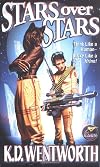
This book is a sequel to Black on Black, one of the few books I’ve rated with five stars. I think I liked this sequel even more than its predecessor. This book, Stars over Stars, built logically from the events and character growth of the previous book. However, it told an entirely new story on a new planet. There were a few familiar characters, and a lot of new ones. We also meet and learn about a new alien species. Each book stands well on its own, but I wouldn’t recommend reading this show more book first if you have any intention of reading both of them. It would spoil too much about what happened in the previous book.
As with the previous book, we’re usually reading from the perspective of various alien characters. The new alien species was very different from the now-familiar hrinn, and they were interesting to read about. I really like the way this author writes alien characters. They aren’t just human-like aliens with a few special abilities or physical characteristics to make them “alien”. They have their own unique cultures and belief systems and mannerisms and thought processes, and they’re written consistently. But we don’t learn about the aliens through info dumps. We learn about them by being inside their heads and by seeing how they react to events going on in the story.
Mitsu is also back in this book. Those who were disappointed by her lower level of involvement in the first book may be happy to see her play a larger and more important role in this book, although she still takes plenty of abuse! As do many of the other characters.
One thing that I suddenly realized as I was finishing up this book was that there really wasn’t any sort of a romance subplot anywhere in the series. There were a couple things that could possibly be interpreted as a potential for romance, but it was very subtle if it was even there at all. I actually find that refreshing. Don’t get me wrong, I enjoy the occasional romance thread if it’s done well and if it doesn’t detract from the real story. But it seems like authors think nearly every book has to have romance in it. I’ve read too many books where a good story was brought down because there was a romance subplot forced into it and it wasn’t written well. In that case, I’d rather it be left out altogether. A book can be great without romance, and this book absolutely proves that in my eyes. I’m sorry that there weren’t any more books in this series – I definitely would have read them. show less
As with the previous book, we’re usually reading from the perspective of various alien characters. The new alien species was very different from the now-familiar hrinn, and they were interesting to read about. I really like the way this author writes alien characters. They aren’t just human-like aliens with a few special abilities or physical characteristics to make them “alien”. They have their own unique cultures and belief systems and mannerisms and thought processes, and they’re written consistently. But we don’t learn about the aliens through info dumps. We learn about them by being inside their heads and by seeing how they react to events going on in the story.
Mitsu is also back in this book. Those who were disappointed by her lower level of involvement in the first book may be happy to see her play a larger and more important role in this book, although she still takes plenty of abuse! As do many of the other characters.
One thing that I suddenly realized as I was finishing up this book was that there really wasn’t any sort of a romance subplot anywhere in the series. There were a couple things that could possibly be interpreted as a potential for romance, but it was very subtle if it was even there at all. I actually find that refreshing. Don’t get me wrong, I enjoy the occasional romance thread if it’s done well and if it doesn’t detract from the real story. But it seems like authors think nearly every book has to have romance in it. I’ve read too many books where a good story was brought down because there was a romance subplot forced into it and it wasn’t written well. In that case, I’d rather it be left out altogether. A book can be great without romance, and this book absolutely proves that in my eyes. I’m sorry that there weren’t any more books in this series – I definitely would have read them. show less
Lists
Awards


You May Also Like


Associated Authors
Statistics
- Works
- 36
- Also by
- 31
- Members
- 1,565
- Popularity
- #16,484
- Rating
- 3.6
- Reviews
- 52
- ISBNs
- 33

