My Place
by Nadia Wheatley
On This Page
Description
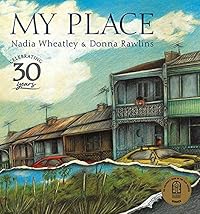
"My Place, the classic Australian picture book, is a 'time machine' which takes the reader back into the past. It depicts the history of one particular piece of land in Sydney from 1788 to 1988 through the stories of the various children who have lived there. It aims to teach the reader about the history of Australia, about families, settlers, multiculturalism, and the traditional owners of the land. Each child's story covers a decade in time, showing their particular dress, customs and show more family life. The book also features maps that the successive generations of children have 'drawn' which demonstrate the things that have changed - as well as the things that have remained constant. 'My Place' ultimately aims to show 'that everyone is part of History' and that 'every place has a story as old as the earth'."--Provided by publisher. show lessTags
Recommendations


Member Reviews
Author Nadia Wheatley and illustrator Donna Rawlins take the reader on a voyage through time in this classic Australian children's book, which opens in an urban neighborhood in (then present day) 1988, and offers a snapshot of the same location every ten years, stretching back to 1788. Each two-page spread features a different young narrator, discussing the make-up of their family, their activities, and the world around them. "My Place" is different in each time period being depicted, and nothing emphasizes that more than the maps, ostensibly drawn by each child narrator, that are included, thus allowing changes - in population level, building density, and types of industry/activity present - to be tracked visually, as well as show more textually.
An engaging and informative book, My Place draws a fascinating portrait of the changes effected by two hundred years of immigration to Australia, opening and closing, appropriately enough, with an Aboriginal narrator. The copy I read, which was sent by a kindly goodreads pal down under - thanks again, Kim! - is a 20th Anniversary Edition, which speaks to its lasting appeal. A textually advanced picture-book - I'd say the level was more middle-grade, than early reader - with incredibly detailed artwork that rewards close scrutiny, this is the kind of book to be slowly savored, and then read again and again. Some of the details that struck me on this first reading - the way that the children's companion animals varied, from generation to generation, but the need for them did not; the fact that the Millers were once the Müllers, something that quietly changed (with no overt commentary in the text) from 1908 to 1918; the ubiquity of hard work, in every generation profiled; the matter-of-fact acceptance of convict labor, in many of the earlier periods, and the appalling fact that some convicts were young children (like Sam), who were convicted of minor crimes like stealing a coat, in order to keep warm, and shipped off to lives of hard labor on the other side of the world - could give way, or better yet, be augmented by new impressions and details, on a second or third approach to the book.
There is so much to take in here, that it's difficult to know where to begin! A rich, rich book, one that will give young readers an appreciation for the grand sweep of Australian history, while also filling in some of the human stories and details that make up that larger narrative, My Place is a work (I believe) of fiction, but would make an excellent selection for a young person's history class. Just outstanding! show less
An engaging and informative book, My Place draws a fascinating portrait of the changes effected by two hundred years of immigration to Australia, opening and closing, appropriately enough, with an Aboriginal narrator. The copy I read, which was sent by a kindly goodreads pal down under - thanks again, Kim! - is a 20th Anniversary Edition, which speaks to its lasting appeal. A textually advanced picture-book - I'd say the level was more middle-grade, than early reader - with incredibly detailed artwork that rewards close scrutiny, this is the kind of book to be slowly savored, and then read again and again. Some of the details that struck me on this first reading - the way that the children's companion animals varied, from generation to generation, but the need for them did not; the fact that the Millers were once the Müllers, something that quietly changed (with no overt commentary in the text) from 1908 to 1918; the ubiquity of hard work, in every generation profiled; the matter-of-fact acceptance of convict labor, in many of the earlier periods, and the appalling fact that some convicts were young children (like Sam), who were convicted of minor crimes like stealing a coat, in order to keep warm, and shipped off to lives of hard labor on the other side of the world - could give way, or better yet, be augmented by new impressions and details, on a second or third approach to the book.
There is so much to take in here, that it's difficult to know where to begin! A rich, rich book, one that will give young readers an appreciation for the grand sweep of Australian history, while also filling in some of the human stories and details that make up that larger narrative, My Place is a work (I believe) of fiction, but would make an excellent selection for a young person's history class. Just outstanding! show less
My Place tells the story of girl's house. It starts with the girl living there in the present time. Then it works backward in time to other children who lived in that same place. It goes by decades all the way back to 1788. The book really gives a feel for what life was like for children in each time period. I found myself wondering about the history of my own place as I read it.
This picture book shows how a particular neighbourhood in Sydney has changed from an urban street to the first white settlement and before to the time when the Aborigines lived there. The story takes us backwards in decades from 1988 to 1788. We see the changes through the eyes of the various children who lived in the area. There is a connection felt between the inhabitants of the time, the changing landscape and the relationships of family and community as time passes.
Review by: Fiona
Review by: Fiona
Oy. Working backwards was confusing. If I really cared, I'd work forwards on a reread next week. But really, my only question now is, What kind of tree is a Big Tree that lives for so very long like that? An 'early' picture shows mangroves.... And where is this, actually? There's a reference to Sydney Town and a mention of being close enough to see the ocean....
Summary: This books talk about different children in Australia for over 200 years. It starts in 1788 and goes to 1988. It talks about all the different houses and has a map on how the houses were placed and how it has changed through the years.
My reaction: I thought this was a cool book because it made me think about how my life, house, and town has changed just within the past few years. It made me wonder how everything has changed in the past decades.
Classroom:
1. I could have them write about how their life has changed in just the past few years.
2. We could look on the computer and see just how much the town has changed in the past 10, 50, and 100 years and then talk about what is the same and what is different.
My reaction: I thought this was a cool book because it made me think about how my life, house, and town has changed just within the past few years. It made me wonder how everything has changed in the past decades.
Classroom:
1. I could have them write about how their life has changed in just the past few years.
2. We could look on the computer and see just how much the town has changed in the past 10, 50, and 100 years and then talk about what is the same and what is different.
Summary
This story is about the changes that can occur in a specific location like Australia due to immigration and the change in times. The artists takes pictures of the same location for a span of 200 years to indicate the drastic changes that take place. The opening and closing of new business, the filth that storm the street and than are clean again. Graffiti on walls and than disappear again. This book goes from present day back every ten years for a span of 200 until the colonial ages to see just how far we have come.
Personal Opinion
This is a wonderful picture book to help the students understand that past generations didn’t have the same things we have; they acted and experienced completely different aspects of life even show more though they were in the same location. It’s a good interpretation of change for the better and worse.
Classroom Extension
1. You could allow the students to change the setting of the classroom, have a dress up theme where they wear outfits that may fit a past time. Than you could have a small party time activity where you would try and create a dish or two that went with this time period to help them truly see how things change.
2. You could do a family tree for each individual student; it could be a homework activity that followed a lesson on ancestry. Where you came from and see how far back the parents can go and than place them around a giant world map to indicate where each family originated. show less
This story is about the changes that can occur in a specific location like Australia due to immigration and the change in times. The artists takes pictures of the same location for a span of 200 years to indicate the drastic changes that take place. The opening and closing of new business, the filth that storm the street and than are clean again. Graffiti on walls and than disappear again. This book goes from present day back every ten years for a span of 200 until the colonial ages to see just how far we have come.
Personal Opinion
This is a wonderful picture book to help the students understand that past generations didn’t have the same things we have; they acted and experienced completely different aspects of life even show more though they were in the same location. It’s a good interpretation of change for the better and worse.
Classroom Extension
1. You could allow the students to change the setting of the classroom, have a dress up theme where they wear outfits that may fit a past time. Than you could have a small party time activity where you would try and create a dish or two that went with this time period to help them truly see how things change.
2. You could do a family tree for each individual student; it could be a homework activity that followed a lesson on ancestry. Where you came from and see how far back the parents can go and than place them around a giant world map to indicate where each family originated. show less
Very unique book about a generation and their experiences living in the town. Each page goes to a previous generation and so on. The pictures are cute and the drawing of the neighborhoods are neat to look at. The last page really ties together the whole book.
Members
- Recently Added By
Lists

A Child's Book Tour of Australia
61 works; 5 members

Read in 2022
31 works; 1 member
Author Information

28+ Works 1,165 Members
Nadia Wheatley is an Australian writer, born on April 30, 1949 in Sydney, New South Wales, Australia. She began writing full-time in 1976 and has written numerous award-winning picture books, novels, and works of history for children and adults. She has twice received the New South Wales Premier's Children's Book Prize. Her biography of Charmian show more Clift won the New South Wales Premier's Award for Australian History (2002). Her other work includes My Place (illustrated by Donna Rawlins), The House that was Eureka, The Papunya School Book of Country and History (in collaboration with Aboriginal students and staff at Papunya School - Northern Territory) and Going Bush which received an Australian Award for Excellence in Educational Publishing (2007). In 2016, her book, Flight (illustrated by Armin Greder), won the 2016 Children's Book Council of Australia (CBCA) Book of the Year Award, Picture Book of the Year. (Bowker Author Biography) show less
Some Editions
Awards and Honors
Awards
Common Knowledge
- Original publication date
- 1987
- Important places
- Australia; New South Wales, Australia; Sydney, New South Wales, Australia
Classifications
Statistics
- Members
- 411
- Popularity
- 75,106
- Reviews
- 9
- Rating
- (4.21)
- Languages
- English, Norwegian
- Media
- Paper
- ISBNs
- 14