How German Is It
by Walter Abish
On This Page
Description
Ulrich Hargenau testifies against fellow members of a German terrorist group in order to save himself and his wife, Paula, and contemplates the nature of his German heritage.Tags
Recommendations






























Member Reviews
When should victims and their descents stop being victims and when do the crimes of our ancestors stop being our fault? This is territory of How German Is It = Wie Deutsch Ist Es by Walter Abish published in 1981 but set in the 70’s when the post war generation were having to come to terms with their futures and the pasts it was built on. Abish is an American but whose family had fled Europe during the Hitler years.
The central character is Ulrich a writer who is the son of a former high ranking German military officer executed for his role in the 1944 plot to assassinate Hitler. He and his brother a modernist architect are from the aristocratic elite who supported Hitler’s anti-communist stance as a political necessity. We first show more meet Ulrich having returned to the new post war town and discover that he had been caught up with a terrorist cell who were imprisoned based on his evidence so he and his wife are free. This has serious consequences as it clear that his wife who leaves him believes in the terrorist cause as may one of his girl friends. His brother, Helmuth is helping to build the new Germany and is in cahoots with the Mayor and has a chaotic sex life causing his marriage to fall about. This again ripples through the novel and helps to shape the climax of the story.
A servant who saved the family in the fall of Nazi Germany lives in the new town and serves in the best restaurant and is known and loved by the two brothers. But it’s clear in the web of relationships that build up that not all is as it seems. As the character’s relationships build up a picture of who Ulrich is and why he must react in the final count in the way he does, we also start to discover that the new town is built on the ruins of a concentration camp and a willingness to try and ignore the past. To the point that we begin to see that the terrorists may well be the moralists except they are as much a failure as the bright new town.
It is a political thriller and more as Abish is an experimentalist writer who uses German stereotypes and a central character, Ulrich, who is initially a cipher to builds up the story by switches in narrator, by the author questioning the action or intention of the character or situation etc. As the story unfolds the interaction with the other characters builds in to real psychological studies. The climax and its consequences for Ulrich seek to answer the question of the novel’s title.
The novel is highly recommended and for all it being experimental is not a difficult read. It won the American book award(PEN/Faulkner) in 1981 and deserves a wider readership. show less
The central character is Ulrich a writer who is the son of a former high ranking German military officer executed for his role in the 1944 plot to assassinate Hitler. He and his brother a modernist architect are from the aristocratic elite who supported Hitler’s anti-communist stance as a political necessity. We first show more meet Ulrich having returned to the new post war town and discover that he had been caught up with a terrorist cell who were imprisoned based on his evidence so he and his wife are free. This has serious consequences as it clear that his wife who leaves him believes in the terrorist cause as may one of his girl friends. His brother, Helmuth is helping to build the new Germany and is in cahoots with the Mayor and has a chaotic sex life causing his marriage to fall about. This again ripples through the novel and helps to shape the climax of the story.
A servant who saved the family in the fall of Nazi Germany lives in the new town and serves in the best restaurant and is known and loved by the two brothers. But it’s clear in the web of relationships that build up that not all is as it seems. As the character’s relationships build up a picture of who Ulrich is and why he must react in the final count in the way he does, we also start to discover that the new town is built on the ruins of a concentration camp and a willingness to try and ignore the past. To the point that we begin to see that the terrorists may well be the moralists except they are as much a failure as the bright new town.
It is a political thriller and more as Abish is an experimentalist writer who uses German stereotypes and a central character, Ulrich, who is initially a cipher to builds up the story by switches in narrator, by the author questioning the action or intention of the character or situation etc. As the story unfolds the interaction with the other characters builds in to real psychological studies. The climax and its consequences for Ulrich seek to answer the question of the novel’s title.
The novel is highly recommended and for all it being experimental is not a difficult read. It won the American book award(PEN/Faulkner) in 1981 and deserves a wider readership. show less
How German Is It was a welcome surprise. It addresses the German culture and identity in the post WWII era, a subject about which I have been curious and have tried to learn, especially during a vacation to Germany in the fall of 2018. Published in 1980, this novel can only address these questions as of that point in time, and as I found out 38 years later the German people are still working out the answers to these questions, and still working on who they are. But 38 years after publication, How German Is It doesn't feel dated. The language is fresh, crisp. The issues brought to the front by the novel do not feel resolved, in fact they feel very relevant.
Where I struggled with the novel and wasn't completely satisfied was with the show more characters and the plot. Many of the characters are left partially developed. Perhaps this is intentional. Perhaps this is how some of the German citizens today feel. The plot never really happened. It went off in several different directions, all of which were interesting, but none of which was really seen through to the end, except one that felt too minimally developed. This was almost an incredible reading experience, but it was a very enjoyable one and very enlightening as well; it helped me look at the issues in new and different ways. show less
Where I struggled with the novel and wasn't completely satisfied was with the show more characters and the plot. Many of the characters are left partially developed. Perhaps this is intentional. Perhaps this is how some of the German citizens today feel. The plot never really happened. It went off in several different directions, all of which were interesting, but none of which was really seen through to the end, except one that felt too minimally developed. This was almost an incredible reading experience, but it was a very enjoyable one and very enlightening as well; it helped me look at the issues in new and different ways. show less
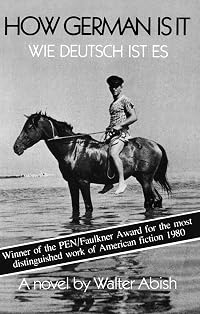
Could the cover cite an old picture of Arnold Genthe on horseback in the Pacific Ocean or not?
A question so crucial that it exists as a kind of shorthand.
Tan Alemanes es una novela peculiar, original y bien ejecutada. Trata del amor, pero de un amor sentenciado, de guerra, pero de una guerra terminada, de una nueva Alemania, pero con ecos del pasado. Todo con una sutil y controlada ironia.
Jan 29, 2009Spanish
Ratings
Members
- Recently Added By
Lists

Authors from Austria
4 works; 1 member

Pen/Faulkner Winners and Finalists
178 works; 9 members

Harold Bloom - The Western Canon: D. The Chaotic Age
833 works; 24 members

Canon de la narrativa universal del s. XX (cicutadry)
499 works; 3 members
Author Information

11+ Works 1,106 Members
Walter Abish was born in Vienna, Austria. Much of his childhood was spent in China. He became an American citizen in 1960. Abish's fascination with human communication led him to write works focused on the use of language. His first novel, Alphabetical Africa (1974), was an experiment in alliteration, moving forward and backward through the show more alphabet while telling the story. Throughout the 1970s, he wrote short stories that demonstrated a variety of unique writing formats. His second novel, How German Is It (1980), a more conventionally written book, received the 1981 PEN/Faulkner award, an honor bestowed by his peers. In Eclipse Fever (1993), Abish continues to play with language, this time within the context of a suspense story about Mexico's social and intellectual elite. Abish lives in New York where he is a lecturer in English and Comparative Literature at Columbia University. (Bowker Author Biography) show less
Some Editions
Awards and Honors
Series
Belongs to Publisher Series
Common Knowledge
- Canonical title
- How German Is It
- Original title
- Wie Deutsch ist es
- Original publication date
- 1982
- Original language
- German
Classifications
Statistics
- Members
- 478
- Popularity
- 63,735
- Reviews
- 5
- Rating
- (3.81)
- Languages
- 8 — Dutch, English, French, German, Italian, Norwegian (Bokmål), Spanish, Swedish
- Media
- Paper, Ebook
- ISBNs
- 14
- ASINs
- 2