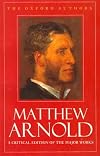
Matthew Arnold / edited by Miriam Allott and Robert H. Super
by Matthew Arnold
The Oxford authors (Arnold)
On This Page
Description
Considered the bridge between romanticism and modernism, Matthew Arnold wrote verse that is simple, unadorned and straightforward. From the hypnotic and beautiful lines of Dover Beach, to the pastoral narrative of The Scholar Gipsy, Arnold cast a gaze at the main intellectual issues of the nineteenth century while giving a timeless insight into man and nature. This collection covers his major poetic works, including the narrative poems, sonnets and elegiac poems, illuminating the lyricism show more and serenity of Arnold's best poetry. - Delivered with verve and passion, Jonathan Keeble's reading is suffused with an energy found in Arnold's most moving poetry. - Other poems include Desire, Longing, A Summer Night, Consolation, Philomela, A Dream, East London, West London, Thyrsis, Immortality, Growing Old, A Wish, Bacchanalia; Or, The New Age, A Modern Sappho, The Hayswater Boat, The River, Human Life, The Buried Life, Austerity of Poetry, A Farewell, Requiescat. show lessTags
Recommendations













Members
- Recently Added By
Author Information

223+ Works 3,793 Members
Matthew Arnold, a noted poet, critic, and philosopher, was born in England on December 24, 1822 and educated at Oxford University. In 1851, he was appointed inspector of schools, a position he held until 1880. Arnold also served as a professor of poetry at Oxford, during which time he delivered many lectures that ultimately became essays. Arnold show more is considered a quintessential proponent of Victorian ideals. He argued for higher standards in literature and education and extolled classic virtues of manners, impersonality and unanimity. After writing several works of poetry, Arnold turned to criticism, authoring such works as On Translating Homer, Culture and Anarchy, and Essays in Criticism. In these and other works, he criticized the populace, especially the middle class, whom he branded as "philistines" for their degrading values. He greatly influenced both British and American criticism. In later life, he turned to religion. In works such as Literature and Dogma and God and the Bible, he explains his conservative philosophy and attempts to interpret the Bible as literature. Arnold died from heart failure on April 15, 1888 in Liverpool, England. (Bowker Author Biography) show less
All Editions
Series

Common Knowledge
- Canonical title
- Matthew Arnold / edited by Miriam Allott and Robert H. Super
Classifications
- Genres
- Fiction and Literature, Poetry, Literature Studies and Criticism
- DDC/MDS
- 828.809 — Literature & rhetoric English & Old English literatures English miscellaneous writings 1837-1899 Individual authors
- LCC
- PR4021 .A46 — Language and Literature English English Literature 19th century , 1770/1800-1890/1900
- BISAC
Statistics
- Members
- 40
- Popularity
- 728,232
- Languages
- English
- Media
- Paper, Ebook
- ISBNs
- 4
- ASINs
- 1