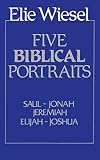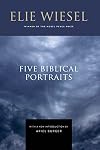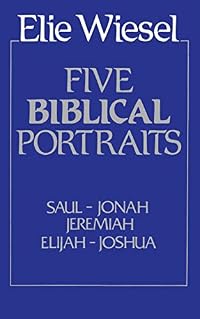
Five Biblical Portraits
by Elie Wiesel
On This Page
Description
Nobel Peace Prize-winner Elie Wiesel brings ancient religious leaders to literary life, framing his commentary with pressing and enduring questions as a survivor and witness to the Holocaust.Five Biblical Portraits represents an old-new approach to Jewish textual commentary. This sequel to Elie Wiesel's Messengers of God continues the work done in that volume of bringing religious figures to life and studying their place both in the text and in our lives. Wiesel reflects on his own life as show more well as the tragedy of the Holocaust as he discusses each figure and adds personal framing and insight into the religious study. Through sensitive readings of the scriptures as well as the Talmudic and Hasidic sources, Wiesel illuminates Joshua, Elijah, Saul, Jeremiah, and Jonah. He seeks not simple answers but fully complex responses to the crucial questions of human suffering as he examines each religious figure in turn.Originally published in 1981, this new edition of Five Biblical Portraits includes a new text design, cover, and an introduction by Ariel Burger, which examines how Wiesel's post-Holocaust Midrash teaches us not only how to read the Bible but also how to read the world. show lessTags
Recommendations















Member Reviews
NO OF PAGES: 157 SUB CAT I: Bible Stories SUB CAT II: SUB CAT III: DESCRIPTION: This collection of biographies of prophets does a masterful job humanizing these figures. Elie Wiesel asks today's questions in the context of the past.NOTES: SUBTITLE: Saul, Jonah, Jeremiah, Elijah, Joshua
Gethsemani trip, 4-2013
Members
- Recently Added By
Author Information

Eliezer "Elie" Wiesel was born in Sighet, Romania on September 30, 1928. In 1944, he and his family were deported along with other Jews to the Nazi death camp Auschwitz. His mother and his younger sister died there. He loaded stones onto railway cars in a labor camp called Buna before being sent to Buchenwald, where his father died. He was show more liberated by the United States Third Army on April 11, 1945. After the war ended, he learned that his two older sisters had also survived. He was placed on a train of 400 orphans that was headed to France, where he was assigned to a home in Normandy under the care of a Jewish organization. He was educated at the Sorbonne and supported himself as a tutor, a Hebrew teacher and a translator. He started writing for the French newspaper L'Arche. In 1948, L'Arche sent him to Israel to report on that newly founded state. He also became the Paris correspondent for the daily Yediot Ahronot. In this capacity, he interviewed the novelist Francois Mauriac, who urged him to write about his war experiences. The result was La Nuit (Night). After the publication of Night, Wiesel became a writer, literary critic, and journalist. His other books include Dawn, The Accident, The Gates of the Forest, The Jews of Silence: A Personal Report on Soviet Jewry, and Twilight. He received a numerous awards and honors for his literary work including the William and Janice Epstein Fiction Award in 1965, the Jewish Heritage Award in 1966, the Prix Medicis in 1969, and the Prix Livre-International in 1980. He received the Nobel Peace Prize in 1986 for his work in combating human cruelty and in advocating justice. He had a leading role in the creation of the United States Holocaust Memorial Museum in Washington, D. C. He died on July 2, 2016 at the age of 87. (Bowker Author Biography) show less
Some Editions
Series
Belongs to Publisher Series
Common Knowledge
- People/Characters
- Saul, King of Israel; Jonah; Jeremiah, prophet; Elijah the Prophet; Joshua
- Dedication
- For Andre Neher in Jerusalem
and
Robert McAfee Brown in California - First words
- Vayehi aharei mot Moshe eved adoshem. "And it came to pass that when God's servant Moses died," voyomer adoshem el Yeoshoua ben Nun mesharet Moshe leemor, "God told Moses' aid Joshua, son of Nun, as follows: 'Moses has passe... (show all)d away and you are now his successor, you are now your nation's leader; go and cross the river Jordan; go and occupy the land wich I have chosen for the children of Israel."
- Last words
- (Click to show. Warning: May contain spoilers.)How many other sacred and eternal, inspired and inspiring books are there in which the last sentence is neither affirmation nor injunction, nor even a statement, but, quite simply, a question?
Classifications
- Genres
- Religion & Spirituality, Nonfiction, Biography & Memoir, History
- DDC/MDS
- 221.9 — Religion The Bible Old Testament (Tanakh) Geography, history, chronology, persons of Old Testament lands in Old Testament times
- LCC
- BS571 .W547 — Philosophy, Psychology and Religion The Bible The Bible Works about the Bible Men, women, and children of the Bible
- BISAC
Statistics
- Members
- 165
- Popularity
- 197,784
- Reviews
- 2
- Languages
- 5 — Dutch, English, German, Italian, Norwegian (Bokmål)
- Media
- Paper, Ebook
- ISBNs
- 9
- ASINs
- 2