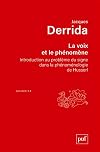
La voix et le phénomène
by Jacques Derrida
On This Page
Description
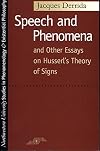
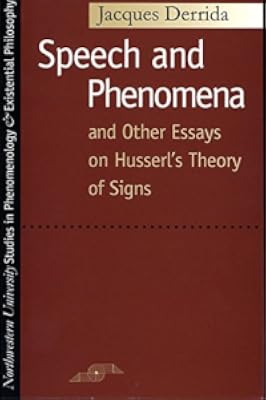
"In Speech and Phenomena, Jacques Derrida situates the philosophy of language in relation to logic and rhetoric, which have often been seen as irreconcilable criteria for the use and interpretations of signs. His critique of Husserl attacks the position that language is founded on logic rather than on rhetoric; instead, he claims, meaningful language is limited to expression because expression alone conveys sense. Derrida's larger project is to confront phenomenology with the tradition it show more has so often renounced--the tradition of Western metaphysics." -- Publisher's description show lessTags
Recommendations















Member Reviews
Big influence on me at the time I read it.
Lång introduktion av översättarna. Läst delvis. Husserl gör det svårt. Men här finns central derrida kunskap att hämta.
May 18, 2014Swedish
Ratings
Members
- Recently Added By
Author Information

399+ Works 19,701 Members
Jacques Derrida was born in El-Biar, Algeria on July 15, 1930. He graduated from the École Normal Supérieure in 1956. He taught philosophy and logic at both the University of Paris and the École Normal Supérieure for around 30 years. His works of philosophy and linguistics form the basis of the school of criticism known as deconstruction. This show more theory states that language is an inadequate method to give an unambiguous definition of a work, as the meaning of text can differ depending on reader, time, and context. During his lifetime, he wrote more than 40 books on various aspects of deconstruction including Of Grammatology, Glas, The Postcard: From Socrates to Freud and Beyond, and Ulysses Gramophone: Hear Say Yes in Joyce. He died of pancreatic cancer on October 9, 2004 at the age of 74. (Bowker Author Biography) show less
Some Editions
Series
Belongs to Publisher Series
Common Knowledge
- Canonical title
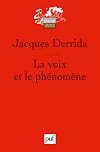
- La voix et le phénomène
- Original title
- La voix et le phénomène: introduction au problème du signe dans la phénoménologie de Husserl
- Alternate titles
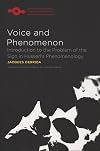
- Voice and Phenomenon: Introduction to the Problem of the Sign in Husserl's Phenomenology
- Original publication date
- 1967 [original French]; 2011 [English: Lawlor]; 1968 [Italian: Jaca Book]
- First words
- Published in 1967, when Derrida was thirty-seven years old, Voice and Phenomenon appeared at the same moment as Of Grammatology and Writing and Difference. All three books announced the new philosophical ... (show all)project called “deconstruction.” Although Derrida would later regret the fate of the term “deconstruction,” he would use it throughout his career to define his own thinking. While Writing and Difference collects essays written over a ten-year period on diverse figures and topics, and while Of Grammatology aims its deconstruction at “the age of Rousseau,” Voice and Phenomenon shows deconstruction engaged with the most important philosophical movement of the last hundred years: phenomenology. Only in relation to phenomenology is it possible to measure the importance of deconstruction. Only in relation to Husserl's philosophy is it possible to understand the novelty of Derrida's thinking. Voice and Phenomenon therefore may be the best introduction to Derrida's thought in general. It is possible to say of it what Derrida says of Husserl's Logical Investigations. Voice and Phenomenon contains “the germinal structure” of Derrida's entire thought (3).
[From Lawlor's "Translator's Introduction: The Germinal Structure of Derrida's Thought" (2011) to his translation of Derrida's "Introduction" to Voice and Phenomenon (1967)]
The Logical Investigations (1900–1901) opened a path down which, as is well known, all of phenomenology has been pushed. Until the fourth edition (1928), there was no fundamental shift; nothing was put back into ques... (show all)tion in a decisive way. Some things were of course rearranged, and there was a powerful work of explanation. Ideas I and Formal and Transcendental Logic unfold, without a break, the concepts of intentional or noematic sense, the difference between the two strata of analytics in the broad sense (pure morphology of judgments and consequence-logic), and they remove the deductivist or nomological restriction that has until now affected the concept of science in general.
[From Lawlor's translation (2011) of Derrida's "Introduction" to Voice and Phenomenon (1967)]
Husserl begins by pointing out a confusion. Within the word “sign” (Zeichen), always in ordinary language and at times in philosophical language, are hidden to heterogeneous concepts: that of expression<... (show all)/i> (Ausdruck), which we often mistakenly hold as being the synonym of the sign in general, and that of indication (Anzeichen). Now, according to Husserl, there are some signs that express nothing because these signs carry—we must still say this in German—nothing that we can call Bedeutung or Sinn. That is what indication is. Certainly, indication is a sign, like expression. But it is different from expression because it is, insofar as it is an indication, deprived of Bedeutung or Sinn: bedeutunglos, sinnlos. Nevertheless, it is not a sign without signification. Essentially, there cannot be a sign without signification, a signifier without a signified.
[From chapter 1 of Lawlor's translation (2011) of Derrida's Voice and Phenomenon (1967/2011)] - Last words
- (Click to show. Warning: May contain spoilers.)Contrary to the assurance that Husserl gives us about it a little later, “the look” cannot “remain.”
[From chapter 7 of Lawlor's translation (2011) of Derrida's Voice and Phenomenon (1967/2011)] - Original language
- French
Classifications
- Genres
- Philosophy, Nonfiction, Literature Studies and Criticism
- DDC/MDS
- 142.7 — Philosophy & psychology Philosophical schools of thought Critical philosophy Existentialism And Phenomenology
- LCC
- B3279 .H94 .D382 — Philosophy, Psychology and Religion Philosophy (General) By period Modern By region or country
- BISAC
Statistics
- Members
- 438
- Popularity
- 69,954
- Reviews
- 2
- Rating
- (3.83)
- Languages
- 12 — Danish, Dutch, English, French, German, Hungarian, Italian, Japanese, Polish, Portuguese (Portugal), Spanish, Swedish
- Media
- Paper
- ISBNs
- 23
- ASINs
- 2